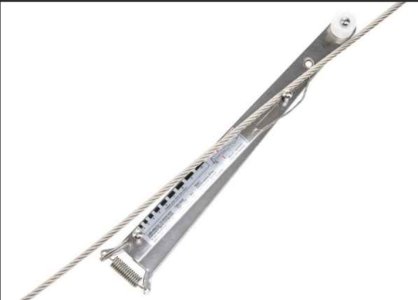
Rig Tension Gauges.

[70521]

Well-Known Member
Joined
31 Aug 2011
Messages
22,412
Visit site
A certain sponsor, Father Christmas Inc., has deposited a small sum of cash in my bank account with the instructions that this year it is not to be spent on case of Highland Park, but something for the boat!

As a result of these 'restricted funds' I am looking at rig tension gauges.

There is a PBO article from 2016, which, as usual, is as useful as a chocolate tea pot.

I'd be interested hearing about some practical experience from users. I have excluded the Spinlock RigSense Tension Gauge 5-8mm. At £261 it is well overpriced for the use it would get - unless I rented it our at £20 per hour with a £400 deposit.
 
I've often thought a division of the forum might be given over to some way of sharing the cost for items and equipment that are too specific in purpose and infrequent in use, to warrant each and every member buying their own.

Group members could jointly own a tube of Duralac paste, too. I bought one at least ten years ago and have used less than 1% of its contents. :sneaky:
 
I tensioned the rig of a previous boat some years back, using the instructions published on the website of some well known spar or sail manufacturer, based on measuring the stretch of the wire compared to UTS. When the boat was next lifted out the hand at the boatyard said he'd never seen rigging set up so taught, and clearly thought they were excessively so.

Which of he, the instructions, or my following of them (though I did take great care) were in error I don't know. They were certainly tighter than they'd previously been on that boat (and others I've been on) but then they'd only been how they were when I bought the bought and then my subsequent occasional setting up of them up by feel, sight and a bit of chin stroking.

The rig hadn't fallen down during years of use in each of those conditions.
 
I’ve used a Loos gauge for the past five years and think they’re fine …. they’re not precision instruments but if you make repeated measurements of opposite shrouds you’ll be able to set them pretty accurately and be able to tweak the forestay tension and mast rake. Depending on the boat it can make a meaningful difference.
 
I rig and then tension based on the 'twang' theory .... first make sure by using main halyard that mast is truly upright. Then I tension till I get a dull low 'note' from the wire when knocked. I check I get same from its opposite partner.

When sailing I watch for slack on the lee side ... I do not tighten then as that causes inbalance of stays tension. I wait till back at base and then give each side same number of turns .. watch when next sailing ...
For me a barely detectable slack is ok on lee side..

My latest sailboat acquisition has a rigging gauge ... very simple affair of two bars pivoted at end end ... with strong spring and pins to lock it onto the stay.

https://www.svb24.com/en/rig-tension-meter.html

rig gauge.jpg


It actually works very well ... took a minute or so to figure out how to put on the stay .. but once worked out - it is fine ... and it does not need to be exactly same height on the stay ...
I knew I had a slackish stay on the 38 and this identified it ...
 
Using UTS can have a over tension effect if the rig is over size like mine.

Another way is to sail the boat on a beam reach and tension the slack rigging to just tight then sail the boat on the other side and do the same thing.

Never done it that way and anyone have any comment on this method
 
Using UTS can have a over tension effect if the rig is over size like mine.

Another way is to sail the boat on a beam reach and tension the slack rigging to just tight then sail the boat on the other side and do the same thing.

Never done it that way and anyone have any comment on this method
I was taught by Rigging guy - that you should never take out more than 50% of slack in that way each side ... if you do - you will end up with either overstressed tensioned rig or mast out of vertical / balance.

He recc'd noting slack and tensioning equal amounts each side when boat was moored and no sails up loading the rig ... then sail her again ....
 
I was taught by Rigging guy - that you should never take out more than 50% of slack in that way each side ... if you do - you will end up with either overstressed tensioned rig or mast out of vertical / balance.

He recc'd noting slack and tensioning equal amounts each side when boat was moored and no sails up loading the rig ... then sail her again ....

OK I can see those thanks for the comment

I tend to do mine the way you suggest but as I said my rigging is deficiently over size wire
 
I have a Loos gauge (well three in fact, one of each size, as I have had boats with different shroud diameters). I find it's a useful way to be confident of having the same tension as usual, since here in Finland it's normal to take off the mast when you lift out the boat each autumn. I regularly lend out my gauges to other club members.

I did notice that while our boat has 7mm diameter shrouds, its original manual says it has 6mm diameter shrouds. So I tension my shrouds to the recommended percentage (from Seldén mast guide) of the breaking strain of 6mm diameter wire, so as not to overstress the boat. This works fine for me.
 
I’ve got the Loos gauge for up to 7mm wire. Handy thing to have as I replaced my standing rigging with boat afloat and mast up, one shroud at a time. A boat neighbour was a rigger - he reckoned the vast majority of boats have under-tensioned rigging, though he could of been touting for work of course!
 
I had a Loos gauge for my last boat and it worked well. Unfortunately, the new boat has much thicker rigging, so I need a new one. Santa hasn't obliged, so I'm waiting for one to turn up in the For Sale section. In the meantime, I've got a rough idea how a properly tensioned rig should feel, so I go by.

A boat neighbour was a rigger - he reckoned the vast majority of boats have under-tensioned rigging

Jerry the Rigger told me much the same. He reckoned that getting the rig as tight as you can using hand tools, without going mad, would get it about right.
 
I had a Loos gauge for my last boat and it worked well. Unfortunately, the new boat has much thicker rigging, so I need a new one. Santa hasn't obliged, so I'm waiting for one to turn up in the For Sale section. In the meantime, I've got a rough idea how a properly tensioned rig should feel, so I go by.

A boat neighbour was a rigger - he reckoned the vast majority of boats have under-tensioned rigging

Jerry the Rigger told me much the same. He reckoned that getting the rig as tight as you can using hand tools, without going mad, would get it about right.

Rig tension ... I have a brilliant indicator of rig tension on my 25ft Motor sailer ... if the bog door can still just open / close without scraping the mast baking plate - its correct. If the bog door scrapes the backing plate - its too much tension.
If I was to rig as : "getting the rig as tight as you can using hand tools" then bog door would be a problem and coachroof seriously compressed ...

I have had rig on that boat and others done by riggers in UK and here when I was not around ---- rig has been basically as I would have done .... tight enough to not have undue slack on lee side when boat heeled and pressed.

Now that I have the SureCheck Rig tension meter - I shall be using on both the 25 and 38 at start of 2025 season.

With regard to having meter for wire sizes ... yes of course ideal world is to have meters to match ... but that does not stop a meter for a different size from given a reading ... OK - the reading will not be usuable in the tension table .. but the number is good indicator of getting other stay to match etc.
 
I have an 11/12 fractional rig & spent some time getting the rig tension & mast rake right. The forestay was- until I recently changed to a Profurl furler with adjustable forestay- was fixed length. So in 14 years I changed the forestay 5 times until I got the rake right. Most Hanse have an aft rake on the mast. I found dead upright better. I spent a lot of time getting the 3 sets of stays to the optimum tension. The uppers being 24% according to my loos gauge.
It actually made a worthwhile difference to windward performance, in that I had slight increase in speed but also pointing ability. I certainly would never have anything like near slack rigging up wind, as the chance of a mast inversion could be catastrophic.
 
The mast diamonds are the only bit we use a gauge on. We have the use of a Spinlock for that. The rest of the rig is tensioned by the backstays each time you sail. It’s a case of one grunt or 2 on the winch handle, depending on wind strength. Our shrouds have the backstays attached to them about 2.5m above deck. 4:1 purchase, back to a 28ST winch. If they’re not tight enough, you can see the excess deflection in the forestay, and pointing is affected. That presumably is what happens with conventionally rigged boats if not tensioned enough. Which explains the number of cruisers who seriously underperform to windward.

Our diamonds are highly tensioned, 2 sets of triangular spreaders, with very obvious pre bend in the mast when it’s all set up.
 
For the yacht I bought myself a Loos professional rig tension gauge. I used it to check the tension in the rig after it had been set up by a rigger and now use it to tweak as necessary.
 
I too bought a Loos rig tension gauge. Yes I know you can set the tension other ways but I find you can't beat a rig gauge for quickly setting and checking the tension. They are a lot less faff that tape measures or other methods.
 
How to set up your rig: tension your shrouds on masthead or fractional - Practical Boat Owner

According to this PBO article you can set the tension using the UTS of the wire and setting the tension to a percentage of the strength or strain using a tape measure over a certain distance.

No tension gauge needed

The full description of how to do this is explained clearly in Selden'a Hints and Advice document which you can download free from their website. It actually describes the whole process of setting up your rig from scratch using their folding rule method which is based on the Youngs Modulus of the wire to achieve a fixed percentage of UTS, regardless of diameter. They call it the folding rule method, because that's what they use rather than a tae measure and it's actually more accurate than most gauges. You do need a vernier gauge to measure the extension you achieve as well as the folding rule. I actually find a metre long dowel easier for the job than the folding rule, simply because it doesn't fold at inconvenient times.

Link to the Selden document:

https://www.google.com/url?sa=t&rct...usg=AOvVaw1QvcnmY8kOsqoByMsQNFx5&opi=89978449

Peter.
 
Top