Restricting charge to LiFePo batteries.

fredrussell

Well-Known Member
Joined
24 Mar 2015
Messages
4,321
Visit site
One of the very few downsides to LiFePo batteries is that they don’t appreciate being left at full charge for long periods. This is no issue to the live-aboards, who cycle their batteries daily, but my boat is sat in a marina for days or, on rare occasions, a week or so unused. Is there a device that can switch off the shore power charger and/or solar at a user defined percentage of capacity?

Boat has Victron IP22 charger and Smart Solar 75/15 MPPT. I’m wondering if a smart shunt would be able to ‘talk’ to these devices to stop them charging?
 
One of the very few downsides to LiFePo batteries is that they don’t appreciate being left at full charge for long periods. This is no issue to the live-aboards, who cycle their batteries daily, but my boat is sat in a marina for days or, on rare occasions, a week or so unused. Is there a device that can switch off the shore power charger and/or solar at a user defined percentage of capacity?
Yes, it's the charger settings. Set the bulk/absorption to fully charge the battery and the float to maintain it at something less, 60%, 70%, 80% etc. Might want to set the repeat absorption too, or if it's a Victron charger remember to set the storage voltage too.

If it's long term storage set bulk/absorption to less than 100% SOC voltage. If it's only for a few months and nothing is on, turn the chargers off.

Not though that leaving the boat for short periods (week or two) does not constitute long term storage at full charge. Also not, keeping the batteries at low SOC while you're not there kind of defeats the point of having LFP. It's a compromise between having all of the storage capacity of LFP and making them last forever.

It would be useful to know the make/model of your mains charger and solar controller.
 
Last edited:
One of the very few downsides to LiFePo batteries is that they don’t appreciate being left at full charge for long periods. This is no issue to the live-aboards, who cycle their batteries daily, but my boat is sat in a marina for days or, on rare occasions, a week or so unused. Is there a device that can switch off the shore power charger and/or solar at a user defined percentage of capacity?

Boat has Victron IP22 charger and Smart Solar 75/15 MPPT. I’m wondering if a smart shunt would be able to ‘talk’ to these devices to stop them charging?
No, a Smartshunt is a monitor, it cannot control other devices.

You need to change the charger settings, what are are they both now ?
 
No, a Smartshunt is a monitor, it cannot control other devices.
I'm sure you're quite right that a SmartShunt doesn't help here, but they can in fact talk to Multiplus and SmartSolar chargers to inform them of the battery's actual voltage, so that the charger can account for voltage drop in the cables.

This can be done by Bluetooth (I think Victron calls "Smart Networking"?) or via a Victorian Cerbo GX or a RaspberryPi running the Venus software.

I'm sure you know all this, but I just wanted t to get my well akshually points in.

The Victron Venus GX seems remarkably affordable right now, BTW. So cheap it seem almost (but not quite) not worth messing around with a Pi.
 
Last edited:
No, a Smartshunt is a monitor, it cannot control other devices.

You need to change the charger settings, what are are they both now ?
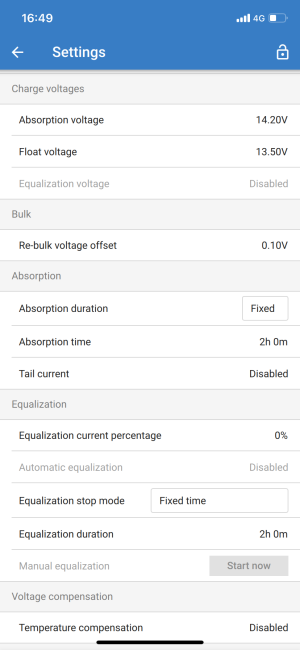
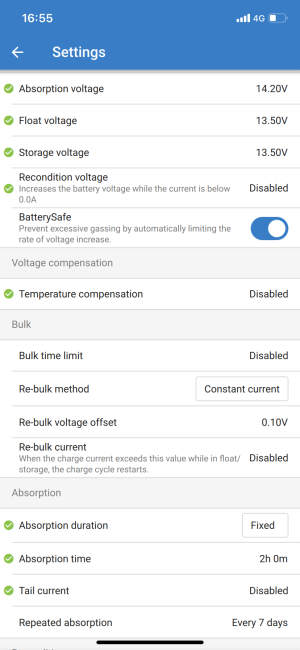
I’ll need to check but I’m pretty sure they’re both on factory settings for my battery - so “lithium” for the IP22, and “LiFePo” for the SmartSolar. I haven’t gone into expert/advanced settings on either device.
 
I'm sure you're quite right that a SmartShunt doesn't help here, but they can in fact talk to Multiplus and SmartSolar chargers to inform them of the battery's actual voltage, so that the charger can account for voltage drop in the cables.
Yes, whilst the SmartShunt cannot control other devices it can share voltage and current with some.
This can be done by Bluetooth (I think Victron calls "Smart Networking"?) or vi a Victorian Cerbo GX or a RaspberryPi running the Venus software.

I'm sure you know all this, but I just wanted t to get my well akshually points in.
I did know, but nonetheless, worth sharing.

akshually it's called VE.Smart networking. ;)
 
Post back what they are, Victron default settings are not the best.
Smart Solar float is 13.5v
IP22 ‘storage’ (no float in Lithium mode) is also 13.5v

Am I right to say I need to see what the voltage of my battery is at, say, 70% capacity and set both devices to float at that voltage?
 
One of the very few downsides to LiFePo batteries is that they don’t appreciate being left at full charge for long periods.
This is a massively overblown issue. LiFePo4 batteries are incredibly resilient and as long as you don't overcharge them they will be absolutely fine. Ours are years old now and have mostly been at 100% charge with no appreciable drop in capacity. Set the recommended settings and then forget about it, use them as you need. The one change I did make was to turn off the charger if leaving the boat for any length of time since they don't need to be kept topped up like lead.
 
I know some will hold their hands up in horror .... but there are many ways to control charge to items ... KEMO do a range of controllers. Basically designed for campers / caravans etc ... they sense the battery voltage and cut off charge at user set value ... when battery discharges and drops to another user set value - the charger is reconnected

I am considering using such to maintain LiFePo4 batterys for my e-outboard .. basically they are too small to use as domestic on the boat - so better to leave the Lead Acids in place and then take feed from them via the KEMO device to my LiFePo4. Making it a simple addition and no need to change existing setup on the boat.
User settings mean you can decide whether to max at 100% or float them at slightly lower to increase their life ..
 
Smart Solar float is 13.5v
IP22 ‘storage’ (no float in Lithium mode) is also 13.5v

Am I right to say I need to see what the voltage of my battery is at, say, 70% capacity and set both devices to float at that voltage?
Not much to go on there, considering how many settings there actually are.
 
This is a massively overblown issue. LiFePo4 batteries are incredibly resilient and as long as you don't overcharge them they will be absolutely fine. Ours are years old now
Years old ?
and have mostly been at 100% charge with no appreciable drop in capacity.
When did you last do a proper capacity test ?
Set the recommended settings and then forget about it, use them as you need.
Who's recommended settings ? Everyone and his dog has "recommended settings", many of them are nonsense.
The one change I did make was to turn off the charger if leaving the boat for any length of time since they don't need to be kept topped up like lead.
Considering paragraph 1, why bother ?
 
I know some will hold their hands up in horror .... but there are many ways to control charge to items ... KEMO do a range of controllers. Basically designed for campers / caravans etc ... they sense the battery voltage and cut off charge at user set value ... when battery discharges and drops to another user set value - the charger is reconnected

I am considering using such to maintain LiFePo4 batterys for my e-outboard .. basically they are too small to use as domestic on the boat - so better to leave the Lead Acids in place and then take feed from them via the KEMO device to my LiFePo4. Making it a simple addition and no need to change existing setup on the boat.
User settings mean you can decide whether to max at 100% or float them at slightly lower to increase their life ..
But the OPs chargers are well suited to maintaining the correct charging to his LFP battery.
 
Years old ?

When did you last do a proper capacity test ?

Who's recommended settings ? Everyone and his dog has "recommended settings", many of them are nonsense.

Considering paragraph 1, why bother ?
Have you seen significantly degraded LiFePo4 systems? Everyone I know of, and everything I've read suggests almost nobody has seen real world capacity loss, and those that have were down to hardware failure.
We do "capacity testing" all the time as we live on board and when away anchoring often get down very low. Everything is recorded to the VRM cloud in real time over Starlink so I can see the history going back years.

Degradation just isn't a sensible thing to be concerned about. I do think setting the charge system up properly is important, and your advice is good. I was simply pointing out that degradation has not been something lithium users have complained about or seemingly experienced. With battery prices dropping faster and faster it's just not an issue.
 
Last edited:
That's better (y)

Set absorption to 14.4V, it'll charge a little faster.

13.5V float will keep the batteries at about 95%, unless you're leaving the boat for months on end i'd leave it there. If you do leave it for months, turn the charger off or set absorption and float to 13.2V, that'll keep the batteries at about 70%

Set Max absorption time to 5m

Check the low temp cutoff is above 0c
 
Top