Replacing Anti-slip deck paint - Options

mhember

Member
Joined
12 Feb 2018
Messages
33
Visit site
We are the happy owner of a 1968 Sea Dog 30 Ketch. As built, she had moulded non-slip deck and then (I think in about 1989) this was overlaid with a very good non-slip painted finish.

As all things do, it has now come to the end of it's natural life and is failing in a number of areas. We want to replace it, which will involve a lot of grinding back and hard work. There is a 2014 PBO article which tests paint options.

So - questions:

1 - What would be a good product to use to 'build up' from the moulded deck to form a base layer on which to paint.
2 - Any views as to whether the conclusions PBO reached in 2014 have changed? Any good new products / ideas out there (we want a 'sandy' finish).

Any tips from anyone who has done a similar job would be welcome.

Thanks!

Marcus & Hazel
Black Dog
 
I did my deck with Kiwi Grip last summer which went over previous non slip paint without too much preparation. There are previous threads with lots of detailed advice and tips.
 
For as far as I can remember I have always used masonry paint that has very fine sand. It can be tinted to whatever colour you fancy and it costs a fraction of the 'marine' products. My boat is afloat all the year round and usually lasts over three years exposed to sun and rain... as does my house (Malta). This is what I use:

Mc5ruSU.jpg


Note the price on the label and includes the tinting. That is for 5 Litres!
 
Sandtex worked really well and still fine 3 years on - scrubbable and super cheap to redo if we ever have to. I would not use it on a racing boat where people have to shuffle along the side deck on their bottoms as it is not kind to waterproofs but perfect for bare feet, shoes and boots.
 
I did my deck with Kiwi Grip last summer which went over previous non slip paint without too much preparation. There are previous threads with lots of detailed advice and tips.
Same here, I used 'Sand' colour which was a bad choice as any bird droppings etc stains are hard to clean off. When I next overcoat I will use a darker colour.
 
For as far as I can remember I have always used masonry paint that has very fine sand. It can be tinted to whatever colour you fancy and it costs a fraction of the 'marine' products. My boat is afloat all the year round and usually lasts over three years exposed to sun and rain... as does my house (Malta). This is what I use:

Mc5ruSU.jpg


Note the price on the label and includes the tinting. That is for 5 Litres!

Here in the cold frozen North that stuff attracts dirt & grime, i use International deck paint, sparingly
 
Took mine back to the moulding ( more or less ) with Peelaway paint stripper, then used Kiwigrip, tinted with a dye to make my preferred colour

Very pleased with the result
 
Kiwi grip is good in that you can pretty much heap it on like Artex ;) although some people prefer the general commercial textured deck paint over a 2 part epoxy primer.

Hi We used kiwi grip , on a 42 ft took all the tread master off with some swearing !! and kiwi gripped over no issues and go's on great and looks good . only downside is it is expensive to the alternatives
 
So the old non-slip paint came up remarkably easily with a heat gun and scraper - about a day with two of us to clear the whole deck. This revealed the old moulded non-slip finish and the old paint appeared to have been applied with a 'filler' layer to make a smooth finish between the moulded areas and the plain fibreglass / flat areas.

Because it has all been painted / stained we are going to need to repeat that trick - any thoughts as to a thick 'bonding / filling' layer to put over the mouldings and provide enough thickness to fill and provide a smooth surface to paint?

The photograph shows the deck as it is - the green seems to be some sort of an undercoat or primer (or perhaps just the first effort at painting!) which was under a thicker layer of darker 'filler' with the light-grey (and very good, but worn out) non-slip on top.
JMQlPxD.jpg


Anyone done anything similar?

Thanks

Marcus
 
To follow up after some time - we used Kiwi grip and, 18 months later, absolutely delighted with it. Easy to apply, good instructions, and the tips about masking etc really worked well. Cannot recommend it highly enough.

20190317_131940.jpg
 
Nice job. Looks really good. Kiwigrip is good stuff but expensive.
Two years ago I had a similar task on our 10m sailing cruiser. I used Kiwigrip in the cockpit as its grippy but kind to bare skin and oilskins. I had to knock down a few spiky peaks though.
To save money I used Sandtex on the deck after sanding down the old moulded in non slip.
Both have done well. The Sandtex still has great non slip but has gathered a bit of an ingrained dirty look. That said, we are at anchor for most of the six month sailing season and don't wash the deck vey often, so no surprise. It will last a few more years.
The Kiwigrip is much more worn and scruffy looking and needs recoating. But, being in the cockpit and as we are liveaboards, it gets far more traffic.
One tip for other readers of this revived thread: light coloured deckpaint might show the dirt a bit more readily but it reflects heat to a remarkable degree. We did the deckpainting in June 2018 in 25 to 30 degree air temperature. The temperature difference between cream coloured painted deck and dark grey unpainted deck was 10 degrees. Down here in the Med that is a huge blessing. Up in the far north I guess that every bit of solar heat absorbtion would be welcome.
 
I've used masonry paint on the floorboards of my old GP14 but on my floating cottage I used Premier non-slip.
Had to buy a tin of grey and a tin of white to get the right shade but it did a good job, bottle tops came in handy for masking the radius corners, I did take off the deck fittings which I was resealing anywaydeck.jpg
 
I have been a supporter of Masonry paint for years having watched my father and others use it as a child. Later sailing on ships - of course there was International and Jotun deck paint - but watched many shipping companys change from dedicated deck paints to conventional two pack with added 'sand' ...... even sailed with one company that returned to using chlorinated rubber paint.

The worst but best non-slip paint I have ever been with - was a test case - where International paid for the decks of two shell VLCC's (300,000 ton) to be painted - claiming literally a life time use. It was a ceramic based paint that literally was concrete ! Only one colour though and that was its problem .... off-white. We couldn't understand why we all suffered headaches on the bridge - till someone suggested it may be the sun beating down on it and reflected up ... we then took standard Brunswick Green paint for the pipelines and painted over the 50m ahead of the accommodation ... instant cure. But as a non-slip it was best I've ever seen ... and never cracked or wore.

Ok - yachts ... back to masonry paint .. I buy in 10litre bins - mixed to colour I want at local DIY shop ... about 40euros a bin ...

Quick scrub and air dry of deck ..... slap it on - my boat is less than a day to do all ... leave it for 2 days (1 day is dry but still soft) second day you can walk on it. I usually only do one coat at beginning of season and it lasts all year. When I used to do 2 or 3 coats - it lasted 2 or 3 seasons ....

SA 31 May 2019 cleaned.jpg

That was May last year and still similar today ... but in spring will get another wash off and new coat.

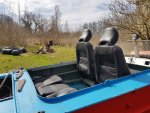
My Soviet speedboat has it as well ... and its years since it was applied ... still looks good ... just needs a little touch up round some edges ... (note the old seats from my Volvo !! )

Volvo seats Progress Apr 2018.jpg

Please do not misunderstand me ... I do not say it replaces or is better than 'proper' Deck Paint ... but for my 1970's boat and my wallet - it suits !!
Something I like about it as well .... you can kneel on it .. walk on it with bare feet and it is not rough. Some deck paints are ok at first - but after a few minutes can feel like your skin has been grazed by sandpaper.
 
I used masonry paint for many many years. It does work well but has a tendency to go green over winter.
After multiple coats it starts to crack and pieces flake off and more coats start to look very tatty. Getting it all off is something else.
I wandered around the marina and looked at a lot of boats with painted decks.
Nearly all had chipping/flaking so decided I didn't want to go down that road again.
Treadmaster works out quite pricey and have seen how difficult the epoxy adhesive is to remove further along.
I went for a Treadmaster lookalike made from epdm rubber and glued with 2 pack contact adhesive. Less than half the price and after 5 years is doing extremely well.1581588827983-1790473638.jpg1581589078408924204927.jpg
 
Hi Rappey ... I have to admit that I looked at doing similar - you can get non slip surfacing that is very thin but durable for stairs etc. But in the end - it was the preparation that put me off .... trying to remove all those years of paint !

But nice.
 
Top