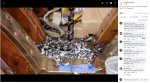
Rebuilding 1929 Fastnet winner Tally Ho

As Tally Ho was originally built in the UK, long before the concept of VAT was invented by a sadistic tax man, how would she be regarded now for VAT status?
I know that if a British built and registered boat is sold overseas and then returns to Britain, they will have to pay VAT to ''import' the boat.
But if the boat is 100 years old, does this still apply?
And because Tally Ho is being 're-built' rather than starting off as a new boat being built from scratch, how does this affect things? If there are still a few bits of the original structure on the boat, will she be regarded as an 'old' boat or a 'new' boat?
And if they do decide to charge VAT on her (assuming that Leo wants to 'import' her properly), what would they use as a basis for determining the current value of her when she arrives in Britain?
Could Leo register her in the USA (as she was re-built there), perhaps in Delaware (many non USA folk seem to have boats registered in Delaware) and then she would just be a 'visitor' to Britain?
I wonder if the VAT man will consider Tally Ho as a 100 year old boat or a brand new boat. For a 100 year old boat you would expect the majority of the boat to be, err, 100 years old.

Ink
 
I wonder if the VAT man will consider Tally Ho as a 100 year old boat or a brand new boat. For a 100 year old boat you would expect the majority of the boat to be, err, 100 years old.

Ink
Interesting question. On situations such as this HMRC often take a surprisingly practical approach not rules based. I expect they would take the view that the yacht is overwhelmingly new and therefore not pre existing and therefore liable to VAT on import.

I don't imagine that VAT will be an issue for Leo, he'll just keep it out of VAT jurisdiction for the requisite number of days and be careful of his UK days. I doubt the yacht will linger on the Hamble for weeks on end whilst Leo commutes from Slough to the City every day.....

I hear so often that such and such a yacht is "owned by a company and therefore no tax paid " but generally that's just not true. "Never let the tax tail wag the dog" Having one's yacht trapped in a corporate structure and having to duck and dive to stay just tax compliant is a stressful nightmare. Best to be above board, suffer some tax pain maybe, and not have to worry about it. It is very much a first world problem. A tax Partner that I once worked with always had his first piece of tax advice as "first get yourself a tax problem" - how true is that.
 
Studying the laying of the deck, it occurred t me that he is using much thicker stock. I went back to one of the v. early videos when the deck was removed and we can see the deck was only 1.5" possibly compared today. I guess it was teak originally(?) so cu.in v cu in of cedar would be lighter but still I think it might be significantly heavier.
 
Studying the laying of the deck, it occurred t me that he is using much thicker stock. I went back to one of the v. early videos when the deck was removed and we can see the deck was only 1.5" possibly compared today. I guess it was teak originally(?) so cu.in v cu in of cedar would be lighter but still I think it might be significantly heavier.
Yes, I thought it was thicker than necessary, not that I know anything about wooden boats. Will this have a detrimental effect on the CoG?
 
Being aware Jamie is thinking through everything, presumably he has takne that into account. He altered the keel weight so perhaps it is all thought through.
 
I remember sailing on a big ketch and the wooden decks caulking was very untidy. It looked like it had been spread all over the gaps about 1/2 inch either side. I mentioned this to the skipper and he said it was left like this on purpose to aid grip when wet.
 
Top