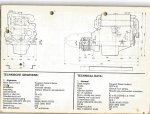
Re engine ,shaft drive 50hp

I would decide what you need/want.

it will save you money if you go for something where the plumbing is similar. Otherwise your changing water locks strainers and all sorts.

Beta are good for customer service but they are priced competitively and that’s reflects in the product.

I would go yanmar and I would certainly consider one of their new common rail engines. Less soot, quieter more economical but also more electronics - all be it these days I would say as reliable as mechanical diesels and generally easier to fix. Engineers are starting to loose the old diesel skills now.

Mountbatten boathouse had some good pricing on yanmars and a few in stock. If your in the plymouth area.

if your after volvo SMS in salcombe are spot on
 
Thanks, I tried Yanmar with another boat, Crickey they know how to charge for spares. Not off the list though.

yeah to be fair they are all the same.

never buy impellers from the Oem, and I tend to go for MANN filters, just takes a bit off effort to parts match things up.

when it comes to major engine components it’s much for muchness.

whatever you go for make sure it has a large alternator on it. 120s are pretty standard now. Surpentine poly v belts are so much better Than the old B belt profiles. No dust!

most heat exchangers use an aluminium extrusion with welded ends and they aren’t all that thick and if the caps aren’t greased annually your going to need a new one quite shortly circa 800 quid for the part.

the yanmars heat exchanger are cast abs the tubes are heavy and made of cupro nick bronze. They last. But equally they are also expensive when they eventually do need replacement.

The other thing about yanmar is the parts support. - they carry parts for engines produced in the 1970’s and you can’t really criticise that when some aren’t carrying parts for engines 10 years old!
 
+1 for our Beta 50. So simple you could easily fit one yourself with a little (cranage) help from the yard.

Can’t really go wrong with Kubota block. Japanese engineering from - I think I read somewhere - the world’s biggest manufacturer of diesel engines by volume.

Someone would need to explain to me why common rail is required in a marine/industrial application like this. I doubt you’d benefit from the fuel efficiency gains (unless you did 10s of thousands of hours) and plus the parts cost, as suggested, could wipe out any economic gains. Otherwise the quietness and smoothness seems more applicable to your hatchback that your boat.

A no brainer IMO.
 
Someone would need to explain to me why common rail is required in a marine/industrial application like this. I doubt you’d benefit from the fuel efficiency gains (unless you did 10s of thousands of hours) and plus the parts cost, as suggested, could wipe out any economic gains. Otherwise the quietness and smoothness seems more applicable to your hatchback that your boat.
A no brainer IMO.

+1

I don't think common rail diesels with electronic control have any place in a damp marine environment. No limp home mode and no AA or RAC to get you going again.
 
Beta, whether the old pipes line up, or not. New engine feet, hoses and cocks are a trivial expense compared to the new engine and labour, and probably need replacement anyway. Common rail would be insane on a yacht, it causes endless expensive problems, even on basic delivery vans.
I re-engined with a Beta recently, lots of options and you can speak to a person to discuss things.
 
Apart from being smoother and quieter more economical and producing less in emissions.

The main advantage of a common rail diesel is the ease of bleeding. In that you only have to purge fuel to the fist filter. No messing with the nut on the pump or having to crack injectors.

onto the marine environment bit, if your engineroom isn’t clean and dry it isn’t a appropriate place for any engine and needs something doing to keep it dry!

electrics wise ok, not much you can do about a knackered ecu, however this is very rare. Otherwise most of the important connections are actually within the engine, under the rocker, and the ecu plugs are all waterproof. These have been in use on motor yachts for the last decade. Other than the ecu the electrics are exactly the same.

if the injection pump fails on a mechanical diesel, you will likely have to take it to a specialist shop, this is the same for a common rail, except the pump which charges the rail is actually mechanical and far simpler in design and therefore long lasting.

nozzels on a mechanical diesel are set manually and should be regularly adjusted (ideally annually but no one ever does it) for maximum engine efficiency. Common rails do this automatically within limits and therefore prevent visits to the workshop. Engine internals and oil remain cleaner contributing further to engine life.

I have to say I am a kubota fan, the engines are well engineered. Especially the v1505. If you dive onto their global website they are starting to release common rail engines.

trouble is the marinisation parts, which give you 90%. Of the trouble just aren’t all that good on any of the kubota options, they are all a bit budget. Cummins onan might be the exception to that, but they are generators.

one other niggle I don’t find the paint particularly good on the betas (seems a little on the thin side occasionally)

may work I have a 5 year old beta fire pump/aux engine sat next to 30 year old yanmar and considering they get the same maintenance the yanmars looking considerably better! Also yanmars on its original everything except the raw water pump and exhaust elbow.
Betas on new water pump, new raw water pump, heat exchanger, exhaust elbow, wiring loom, control panel, several relays, engine feet, alternator. And that’s in 1600 hrs. Yanmars on 10k (it’s a generator) both these engines being equivalent to a yacht auxiliary at 50 hp max output.

whether you go mechanical or common rail, that’s up to you to weigh up the pros and cons, I would Say that the most important thing is a clean professional installation as it’s usually the things around the engine, fuel electrics plumbing that cause issues and rarely the engine itself.

I favour the racor type fuel filters, small spin ins are good for your type of install and it even comes with a little pump in the housing to assist with priming. Good filtration helps with pump and injector life on any engine.
Hope that helps.
 
The main advantage of a common rail diesel is the ease of bleeding. In that you only have to purge fuel to the fist filter. No messing with the nut on the pump or having to crack injectors.

Any standard "old tech" engine will self bleed after changing filters just by replacing the mechanical pump with an electric one costing a few quid, as mine has. A large percentage of boat owners are quite capable of servicing their engines, even rebuilding when necessary. Very little can be done on a common rail without having the ecu reprogrammed. Even the far simpler black boxes on Volvo engines have been causing problems with engines frequently failing to start due to damp and failure of circuit boards and they're supposedly designed for marine environment.
 
Any standard "old tech" engine will self bleed after changing filters just by replacing the mechanical pump with an electric one costing a few quid, as mine has. A large percentage of boat owners are quite capable of servicing their engines, even rebuilding when necessary. Very little can be done on a common rail without having the ecu reprogrammed. Even the far simpler black boxes on Volvo engines have been causing problems with engines frequently failing to start due to damp and failure of circuit boards and they're supposedly designed for marine environment.
Indeed. My 1990s Nissan import van (with the QD32 ‘eti’ motor that is legendary in 4WD circles) self bleeds due to its electric injection pump.

But even with the standard setup on our Beta I reckon I can have it bled in 5 minutes. You’d need to if a jerrycan fuel source became required in anger.

I do agree with the other advantages of the Yanmar (build/marinisation quality). My old
man’s Hylas 44 had one that was bullet proof and responded to mechanics in far flung places pulling it apart as a result his rather neglectful attitude towards the lump!

But that’s precisely where/why I’d feel that commonrail - specifically - just isn’t a feature that would sway me, personally.
 
Any standard "old tech" engine will self bleed after changing filters just by replacing the mechanical pump with an electric one costing a few quid, as mine has. A large percentage of boat owners are quite capable of servicing their engines, even rebuilding when necessary. Very little can be done on a common rail without having the ecu reprogrammed. Even the far simpler black boxes on Volvo engines have been causing problems with engines frequently failing to start due to damp and failure of circuit boards and they're supposedly designed for marine environment.

The Volvo black boxes and the control panel that goes with them are not a shining example of good electrical engineering that’s for sure. Can’t disagree with that.

I think on the bleeding front a lot depends on how hands on a type you are as to how quickly you can get the thing bled.

Have to say it’s likely the price that would put you off the common rails as they are probobly quite a bit more expensive...I haven’t checked though.

I was taking a look at the yanmar website and did note the 4JH57 comes with a dual alternator option which is nice to have. (beta have been supplying this option and others for quite some time)
 
Have to say broadly speaking any of the mentioned engines will perform very well as long as they have been installed well.

my top tip. If they will give you a price for installation without looking in your existing engine room then question it!
 
One point well worth considering whatever the make, will they modify mounts to fit existing beds and holes? When I changed engines, I gave Thornycroft the hole centres for the existing mounts and when I installed the new one, the bolts lined up perfectly. Only changes were a different length of exhaust hose to the water trap, the instrument panel and loom and fuel lines.
 
The other great thing about the Beta (aside from cost) is that it is a completely mechanical engine (no electronics) and does not have a timing belt or chain. The cam is gear driven from the crank and the injection pump is driven off the cam, as is the water pump. It is overhead valve too, and made of iron. Pretty-much bullet-proof.
 
Apart from being smoother and quieter more economical and producing less in emissions.

The main advantage of a common rail diesel is the ease of bleeding. In that you only have to purge fuel to the fist filter. No messing with the nut on the pump or having to crack injectors.

onto the marine environment bit, if your engineroom isn’t clean and dry it isn’t a appropriate place for any engine and needs something doing to keep it dry!

electrics wise ok, not much you can do about a knackered ecu, however this is very rare. Otherwise most of the important connections are actually within the engine, under the rocker, and the ecu plugs are all waterproof. These have been in use on motor yachts for the last decade. Other than the ecu the electrics are exactly the same.

if the injection pump fails on a mechanical diesel, you will likely have to take it to a specialist shop, this is the same for a common rail, except the pump which charges the rail is actually mechanical and far simpler in design and therefore long lasting.

nozzels on a mechanical diesel are set manually and should be regularly adjusted (ideally annually but no one ever does it) for maximum engine efficiency. Common rails do this automatically within limits and therefore prevent visits to the workshop. Engine internals and oil remain cleaner contributing further to engine life.

I have to say I am a kubota fan, the engines are well engineered. Especially the v1505. If you dive onto their global website they are starting to release common rail engines.

trouble is the marinisation parts, which give you 90%. Of the trouble just aren’t all that good on any of the kubota options, they are all a bit budget. Cummins onan might be the exception to that, but they are generators.

one other niggle I don’t find the paint particularly good on the betas (seems a little on the thin side occasionally)

may work I have a 5 year old beta fire pump/aux engine sat next to 30 year old yanmar and considering they get the same maintenance the yanmars looking considerably better! Also yanmars on its original everything except the raw water pump and exhaust elbow.
Betas on new water pump, new raw water pump, heat exchanger, exhaust elbow, wiring loom, control panel, several relays, engine feet, alternator. And that’s in 1600 hrs. Yanmars on 10k (it’s a generator) both these engines being equivalent to a yacht auxiliary at 50 hp max output.

whether you go mechanical or common rail, that’s up to you to weigh up the pros and cons, I would Say that the most important thing is a clean professional installation as it’s usually the things around the engine, fuel electrics plumbing that cause issues and rarely the engine itself.

I favour the racor type fuel filters, small spin ins are good for your type of install and it even comes with a little pump in the housing to assist with priming. Good filtration helps with pump and injector life on any engine.
Hope that helps.
All very plausable but as soon as you said "(ideally annually but no one ever does it)" your plausability went out of the window!
 
In my (so-far quite limited) experience Beta are just such a nice company to deal with. Really efficient on the parts and helpful tech support, as everyone on here says. And for specific 'marine' stuff, not insultingly expensive: I should be receiving our new 'high rise crossover' exhaust today and for something that I'm assuming they'll have TIGed-up themselves in Gloucs, it wasn't bad at £200-odd + VAT.

When I ordered they asked if I wanted it heat wrapped and I was about to scoff at the prospect of my paying for someone to do that - but when I curtly asked how much, they replied £1.10 a metre (or some such)! ?
 
Some common rails are good for 500,000 miles, can produce 202hp from a 2.1 litre.
Weak link seems to be the electronic injectors.
About £200 supply for a bosch injector.
Would hate to think how much yanmar would charge with their add a nought on the end pricing.
For a boat I would chose a purely mechanical affair
 
Top