Raising anchor if electric windlass fails

Chainstoppers are brilliant

Agreed.

They have a one-way clutch (like a rope clutch) that, when engaged, will automatically grip the chain if it tries to pull out while allowing for normal retrieval.

They are of great help when trying to break out the anchor. Modern anchors have so much grip that they take some persuasion to break out. They also make retrieval much easier in the rare emergency when the anchor winch fails so are relevant to this thread.

If you have room and a strong enough deck (or can reinforce it), a Chainstopper is worth fitting.

Below is a photo of chainstopper and devil’s claw on our boat:
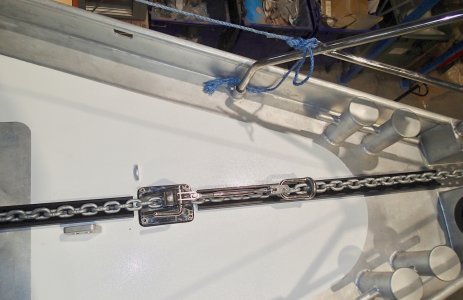
IMG_8896.jpeg
 
This is what you need - for all your tools

s-l960.jpg

Not cheap, but it does work, and keeps on working, unlike WD40
My spare hack saw blades were in their sealed cellophane wrapper and they still went rusty and so did the bottom of my can of spray grease.
 
This happened to me this year when my Quick windlass failed with 30m of 10mm stainless steel chain down and a 27kg anchor. We were in about 6m of water.

We did the following to get the anchor up ....

Tools used:

Long screwdriver from the toolbox where the shaft passed through the chain links and was long enough to lock the chain in the anchor roller guide and prevent it re-deploying.

A 10mm chain claw which was part of our anchor snubber, attached to 15m of 10mm rope.

Electric genoa winch. (Manual would also be possible).

Process.

We attached the claw to the chain just behind the bow roller assembly and ran the rope down the side-deck to the genoa winch.

Once the rope was secure on the winch and taking the strain, we pulled about 6-7 metres of chain out of the locker because when you start pulling, the chain is doubled up as it moves down the side deck, so you need an equal length from the locker to get the first 7m up.

Once the claw was pulled about 7 metres down the side deck by the electric winch, we fixed the chain at the roller end with the screwdriver, repositioned the claw and rope ready for the next pull.

Then Remove the screwdriver and pull up the next 7m.

Repeat the above until the anchor is raised. We were pulling up about 6-7 metres at a time and the chain ended up laid out along the side deck.

Eventually the anchor came up and was made fast in the bow roller, and the chain on the side decks was then fed back into the anchor locker.

The windlass is now replaced, and if I had to do it again we would use the same process as it worked pretty well. I did consider using the spinnaker halyard which could have pulled more up in one go, but I felt the chain retrieval would be a bit uncontrollable if it was dangling 3/4 of the way up the mast.

Note of caution: Be careful with the chain on the side-deck, even if a few links go over the side it will start a chain reaction (lol) which will result in all the retrieved chain going over the side. Yes, it happened to us, and the free-running chain almost tripped up the rear admiral and took her for a swim - and it smarted a bit when it hit her ankle.
 
This happened to me this year when my Quick windlass failed with 30m of 10mm stainless steel chain down and a 27kg anchor. We were in about 6m of water.

We did the following to get the anchor up ....

Tools used:

Long screwdriver from the toolbox where the shaft passed through the chain links and was long enough to lock the chain in the anchor roller guide and prevent it re-deploying.

A 10mm chain claw which was part of our anchor snubber, attached to 15m of 10mm rope.

Electric genoa winch. (Manual would also be possible).

Process.

We attached the claw to the chain just behind the bow roller assembly and ran the rope down the side-deck to the genoa winch.

Once the rope was secure on the winch and taking the strain, we pulled about 6-7 metres of chain out of the locker because when you start pulling, the chain is doubled up as it moves down the side deck, so you need an equal length from the locker to get the first 7m up.

Once the claw was pulled about 7 metres down the side deck by the electric winch, we fixed the chain at the roller end with the screwdriver, repositioned the claw and rope ready for the next pull.

Then Remove the screwdriver and pull up the next 7m.

Repeat the above until the anchor is raised. We were pulling up about 6-7 metres at a time and the chain ended up laid out along the side deck.

Eventually the anchor came up and was made fast in the bow roller, and the chain on the side decks was then fed back into the anchor locker.

The windlass is now replaced, and if I had to do it again we would use the same process as it worked pretty well. I did consider using the spinnaker halyard which could have pulled more up in one go, but I felt the chain retrieval would be a bit uncontrollable if it was dangling 3/4 of the way up the mast.

Note of caution: Be careful with the chain on the side-deck, even if a few links go over the side it will start a chain reaction (lol) which will result in all the retrieved chain going over the side. Yes, it happened to us, and the free-running chain almost tripped up the rear admiral and took her for a swim - and it smarted a bit when it hit her ankle.
Out of curiosity, did you try simply lifting by hand?
10mm chain is about 2.3kg/m so in 6m of water that's just shy of 14kg.
Obviously it gets much heavier once you get to the anchor.

Just asking because I, a scrawny 9 stone weakling, went without a functioning electric windlass for years, and found lifting by hand in <10m to be easier and faster than using the manual option on the windlass.
 
Out of curiosity, did you try simply lifting by hand?
10mm chain is about 2.3kg/m so in 6m of water that's just shy of 14kg.
Obviously it gets much heavier once you get to the anchor.

Just asking because I, a scrawny 9 stone weakling, went without a functioning electric windlass for years, and found lifting by hand in <10m to be easier and faster than using the manual option on the windlass.
When it all fell over the side I lifted it out by hand, it was pretty easy, but initially pulling the chain in I was fighting the wind as well as the weight of the chain ... the boat is 44ft with high topsides, as well as bimini, sprayhood, solar arch, dinghy on davits etc... basically a typical high-sided AWB at around 13,000 kg in cruising trim. I didn't want to exhaust myself fighting the windage, knowing that when I got the chain in, I would have to break the anchor out of the mud. The bottom in this particular anchorage is thick gooey mud, and it requires a permanent, relatively high force, to break the anchor out - I wasn't sure I could achieve the same force manually. The water is also silty so I couldn't see the bottom to be able to motor over the anchor to break it out. I normally run the windlass until it slows and the chain tightens, then wait for the anchor to slowly break out of the mud.

It would have been very slow progress - and I happen to have pretty powerful electric sheet winches - so why not? ;) It came up pretty quickly once we had established the routine.
 
When it all fell over the side I lifted it out by hand, it was pretty easy, but initially pulling the chain in I was fighting the wind as well as the weight of the chain ... the boat is 44ft with high topsides, as well as bimini, sprayhood, solar arch, dinghy on davits etc... basically a typical high-sided AWB at around 13,000 kg in cruising trim. I didn't want to exhaust myself fighting the windage, knowing that when I got the chain in, I would have to break the anchor out of the mud. The bottom in this particular anchorage is thick gooey mud, and it requires a permanent, relatively high force, to break the anchor out - I wasn't sure I could achieve the same force manually. The water is also silty so I couldn't see the bottom to be able to motor over the anchor to break it out. I normally run the windlass until it slows and the chain tightens, then wait for the anchor to slowly break out of the mud.

It would have been very slow progress - and I happen to have pretty powerful electric sheet winches - so why not? ;) It came up pretty quickly once we had established the routine.
Makes sense. I only lift by hand when the chain is vertical. It's SWMBO's job to get the boat in position using the engine. Can be a challenge in stronger winds!
 
Pulling the anchor up on a boat without such luxuries as electric windlasses, breaking it out is the tough bit, especially if it's really dug in after a blow or something. Oh drives, I pull. At the point where the chain, or rode if it’s deep, goes vertical, I take a tirn round the mooring cleat, and do the ‘throttle up’ hand gesture. That pops it out every time. Then she backs off and all is easy again. 12kg Spade and about 12 metres of 8mm stainless chain. Breakout is the only bit we might like a windlass for. But it would make the whole operation cockpit based. I must admit I’m jealous of you guys when it’s blowing 25kn and raining.
 
My electric wimdlass failed as my anchor was nearly up so was able to pull It up by hand. The next anchorage on Sky I made sure I anchored in shallow water but was unable to raise anchor so chain hook and hand billy back to cockpit winch with ten foot at a time.
When I got it up it had a section of verry large chain hooked on I think it had been a fishermans mooring for lobster creels.
 
My windlass is from the mid 70’s, a Francis 400, and it is similar, so not a new problem for electric winches. I also have 10mm chain and used to have a 60 lb CQR. To manually weigh anchor I have sat on the foredeck and hauled in hand over hand, this method allows the chain to drop down the hawse to the anchor locker. I have also used the chain hook on my snubber lead back to the sheet winch, with the gypsy used to hold the chain when transferring the chain hook back to the bow. This leaves a pile of chain along the deck to be stored later.

With a bit of thought it is easy enough to do, albeit slower than the windlass.
Been there, done that with a 75lb CQR - using a sheet winch, bit by bit.

Not possible by hand in 15M depth with that length of oversized chain plus the anchor weight to haul up.
 
Why do you need a devil’s claw as well as your chain stopper?
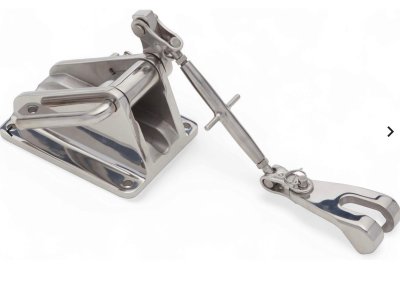
The Devils claw is for tightening the anchor when it is on the bow roller without keeping a load on the windless.

It locks the anchor into the bow roller and stops the anchor and chain bouncing around and making a noise in rough seas. It is a nice addition if you anchor frequently.

Muir (and probably other companies) sell chainstoppers with a devils claw in various sizes (see the photo below), but the devils claw attachment is easy to DIY. It is just a turnbuckle and chain hook. Ours was added by our boatbuilder.

IMG_8906.jpeg
 
Last edited:
The Devils claw is for tightening the anchor when it is on the bow roller without keeping a load on the windless.

It locks the anchor into the bow roller and stops the anchor and chain bouncing around and making a noise in rough seas. It is nice addition if you anchor frequently.

Muir (and probably other companies) sell chainstoppers with a devils claw in various sizes (see the photo below), but the devils claw attachment is easy to DIY. It is just a turnbuckle and chain hook. Ours was added by our boatbuilder.

View attachment 200887

I used a chain hook (much more substantial than the one in the photo) to attach a snubber line part way down the chain for bumpy conditions.
It bent in a storm. But the CQR held.
 
I used a chain hook (much more substantial than the one in the photo) to attach a snubber line part way down the chain for bumpy conditions.
It bent in a storm. But the CQR held.
I am also not a fan of chain hook to connect the snubber to the chain. However, the connection for the devils claw is different from a chain/snubber connection. I don't use the devils claw when at anchor.

There is much debate about the ideal chain/snubber connection. Personally, I prefer a soft shackle. It cannot fall off or bend and jam. It does not abrade the galvanising or weaken the chain with a point contact. However, there are many options.

Unfortunately, a soft shackle does not work for the devils claw attachment as tightening the turnbuckle induces a twist in the soft shackle. A rigid connection is needed.

I agree the devils claw on the commercial Muir product does look a little weak to my eyes. Muir must have done their sums; nevertheless, our boatbuilder used a much beefier chain hook for this purpose as shown in post #21. This has never bent or jammed despite some sporty sailing conditions.
 
Last edited:
The Devils claw is for tightening the anchor when it is on the bow roller without keeping a load on the windless.

It locks the anchor into the bow roller and stops the anchor and chain bouncing around and making a noise in rough seas. It is nice addition if you anchor frequently.

Muir (and probably other companies) sell chainstoppers with a devils claw in various sizes (see the photo below), but the devils claw attachment is easy to DIY. It is just a turnbuckle and chain hook. Ours was added by our boatbuilder.

View attachment 200887
Great, now I want one!
 
The Devils claw is for tightening the anchor when it is on the bow roller without keeping a load on the windless.

It locks the anchor into the bow roller and stops the anchor and chain bouncing around and making a noise in rough seas. It is nice addition if you anchor frequently.

Muir (and probably other companies) sell chainstoppers with a devils claw in various sizes (see the photo below), but the devils claw attachment is easy to DIY. It is just a turnbuckle and chain hook. Ours was added by our boatbuilder.

View attachment 200887
Do you use a snubber or is the chain stopper adequate for your boat?

At what point is a snubber not needed - noting that heavy ships don’t use snubbers?
 
Do you use a snubber or is the chain stopper adequate for your boat?

At what point is a snubber not needed - noting that heavy ships don’t use snubbers?
At anchor we always rig a stretchy snubber. Ours attaches at the stern, runs along the deck, and is attached to a chain with a soft shackle.

The snubber is not needed and probably does little for security in most conditions, but who wants to get up in the middle of the night if the wind picks up unexpectedly? It also helps reduce chain rumble in some substrates. Importantly, the snubber has few drawbacks, providing you have a system to deploy and recover the snubber easily.

The chain stopper serves a different purpose to the snubber. The snubber adds stretch, the chain stopper prevents load on the windlass. The main advantage of the chain stopper is when breaking out the anchor, where it removes load on the windlass, automatically locking it in place as the chain is slowly recovered. There are other uses, such as when the anchor windlass fails.

We anchor over 300 days a year, so we have naturally installed all the bells and whistles to help us and improve the performance when it comes to anchoring.

Many boats manage perfectly successfully with less anchoring equipment, but devices such as chain stoppers and devils claws are not ridiculously expensive in boat terms (especially the DIY alternatives), so they are worth considering if you anchor frequently.
 
At anchor we always rig a stretchy snubber. Ours attaches at the stern, runs along the deck, and is attached to a chain with a soft shackle.

The snubber is not needed and probably does little for security in most conditions, but who wants to get up in the middle of the night if the wind picks up unexpectedly? It also helps reduce chain rumble in some substrates. Importantly, the snubber has few drawbacks, providing you have a system to deploy and recover the snubber easily.

The chain stopper serves a different purpose to the snubber. The snubber adds stretch, the chain stopper prevents load on the windlass. The main advantage of the chain stopper is when breaking out the anchor, where it removes load on the windlass, automatically locking it in place as the chain is slowly recovered. There are other uses, such as when the anchor windlass fails.

We anchor over 300 days a year, so we have naturally installed all the bells and whistles to help us and improve the performance when it comes to anchoring.

Many boats manage perfectly successfully with less anchoring equipment, but devices such as chain stoppers and devils claws are not ridiculously expensive in boat terms (especially the DIY alternatives), so they are worth considering if you anchor frequently.
Thanks.

Why might you want to get up in the night if you didn’t have a snubber and only a chain stopper? I hope I understood you correctly.

As I understand it, the yacht inertia, the chain stretch and catenary provides adequate snubbing for larger boats. Large yachts don’t use snubbers. I’m curious where the cut-off lies.
 
The snubber reduces noise and reduces snatching.

Reducing snatching improves holding. Snatching can occur in gusty conditions and/or bumpy conditions.
The noise reduction is very appreciable to get a good nights sleep in less than perfect conditions.

My boat is 20m length from tip of the bow sprint to stern rail and about 34 tons with half a tank of water and diesel and a few beers in the fridge.

In very strong gusty winds the catenary can effectively get used up in the gusts and the rode momentarily pulled bar tight. The snubber ( I use about 10m of 24mm nylon rope) is effective in those conditions as the boat can be moving backwards fairly fast in the gusts.

I don't know where the cut off is, but I am well below the cut off point as to where a snubber is no longer useful.
 
Last edited:
Thanks.

Why might you want to get up in the night if you didn’t have a snubber and only a chain stopper? I hope I understood you correctly.
If conditions were benign and you didn't bother putting on a snubber, then you'll regret it when conditions change. Been there, many times.
If the chain is made off fast on deck (e.g. a chain stopper, or in my case the 'lunch stop' position, a short rope strop going back to the cleat on top of the windlass) then the chain can bang about and grumble in the bow roller, a noise which transmit through the whole boat. You also get no benefit of meaningful shock absorption, nor anything to help stop the boat veering from side to side.

As I understand it, the yacht inertia, the chain stretch and catenary provides adequate snubbing for larger boats. Large yachts don’t use snubbers. I’m curious where the cut-off lies.
Inertia isn't your friend. A heavier yacht is just building up more energy and when the rode pulls tight, you'll feel it.
Chain doesn't stretch to any measurable degree that is useful in this scenario. If it does, you need heavier chain!!
Catenary is a useful damping mechanism in light conditions, but the chain becomes essentially straight in stronger winds, especially with lighter chains. By about F6 catenary no longer provides enough damping in most circumstances.

My usual setup is a length of three strand, attached with a large carabineer on to the chain, and with about 4-5m let out so that when at rest, it is a little under the surface of the water. In stronger conditions I will let out the full length. In gusty, switchy conditions, I'll rig a second snubber to create a bridle, with one on either side. This seems to help reduce the boat sailing around, although it's not a magic bullet. It's also a useful form of backup.

I'm not sure about larger yachts not using snubbers. Perhaps it becomes impractical beyond a certain point? I imagine that you're talking the kind of boat that has a permanent on-watch crew who can turn on the engines and respond to conditions. Any privately owned boat that I've seen uses a snubber.
 
I like my beauty sleep :). With a good-quality large anchor and effective snubber, there is little need to visit the foredeck even if conditions deteriorate in an unexpected way, such as a local thunderstorm in the middle of the night.

The stretch of a snubber reduces the peak load (the average load stays roughly the same) on an anchor. This is especially true in moderate/high wind speeds where the chain catenary is lost.

If you have sensible ground tackle, the anchor should have plenty of reserve capacity in most conditions to withstand these peak loads, but you never know the composition of the substrate or the actual conditions that will be experienced. Therefore, deploying a snubber as a routine is sensible in my view. If you have an easy-to-deploy snubber, it takes very little effort.

Large vessels ( such as superyachts and cargo vessels ) do not use snubbers. I am not sure if this is because they are impractical, offer little benefit, or perhaps a combination of these factors (anyone who has crewed on these vessels care to enlighten the forum? ), but I have witnessed many such vessels drag in conditions while we were quite secure, so perhaps they are not the best examples to follow.
 
Last edited:
Top