Radar – is it worth it on a 40 year old 30 footer?

JohnDL

Well-Known Member
Joined
1 Oct 2017
Messages
97
Visit site
I have spent a small fortune and many man weeks upgrading my Achilles 9M and the previous owner did the same. Now apart from the hull & deck, mast and boom and the engine (1997 and in good nick) everything of importance is less than c 2 years old. I have a new plotter, AIS Receiver etc.

The only thing left is Radar. The question is, is it worth c £3k? For various reasons, including power requirements, I think it has to be broadband on a pole rather than a cheaper traditional pulse radar up the mast, and most of the cost would be lost when I finally give up sailing when the body will not cope any more in 5 – 10 years time.

I don't feel the need for radar to help with Navigation having a pencil, compass, echo sounder, charts etc. plus 3 independent marine GPS systems (Plotter, iPad & PC) plus the phone when I am away from base for any length of time.

Most sailing is in and around the Solent with hopefully 3 to 5 weeks a year, perhaps a bit more, cruising in the channel and perhaps up to the Scottish Isles and up the east coast to visit old haunts at some time, all single handed. I don’t intend to sleep when at sea but could get caught out.

When outside of the Solent, AIS should give warning of merchant shipping - I am not impressed with AIS in the Solent as everything is delayed too long and there is at least one large sightseeing boat that should have a cat A AIS that on 2 occasions in the last couple of months has had nothing showing when she has past me close by going into Portsmouth.

My worry is hitting a buoy, small fishing boat or similar. Yes I know you should keep a look out but s&&t happens and I have had one cat A airprox (the worst) @ c 50 foot spacing @100 knts, driving a light aircraft and I could have done nothing about it without technology in both aircraft - the powered glider came from below me and I could not have seen it without going almost inverted, god knows where he was looking! So I am rather sensitive to the issue!

So how good is modern radar for collision avoidance vs small targets? Discuss please.
 
Radar is excellent these days but how often are you going to be sailing in fog?
My 30 years of Solent sailing tells me that the answer is very rarely indeed. If it does happen there are numerous shallow places to anchor and hide until it clears.
I would not bother buying radar for Solent area sailing on a 30 foot yacht.
If you are going to cross the Channel I would buy radar as the fog can be quite persistent and you may be exposed to poor vis for a considerable time with nowhere to hide.
 
I fitted the radar over 11 years ago and I have used it only a few times. The last time I used it was a couple of years ago when approaching the Needles from south east in thick fog. Radars are very useful in poor visibility especially when small craft are around.
 
Depends on the target.

Most decent nav buoys / beacons with reflectors will show up but small fishing type buoys will be invisible. As for small fishing boats - professional trawlers etc should be no issue but i wouldn't rely on it to pick up small open fishing boats in anything other than ideal conditions.

That said - if single handed and going outside waters such as the solent, i would be very keen indeed to fit Radar.

It gives another position fixing tool, can run alarms to help keep a lookout and should pick up most dangerous targets.
 
Is it worth 3G ? No
I have a simple RADAR. I allmost never use. My boat is 35 ft I don't go out in conditions when I need RADAR.
But it is nice to have.
Look first at a basic RADAR and ask yourself is it worth it to you for the peace of mind you will get from fitting it.
If you answer yes.
Ask yourself if the extra expense of a broadband RADAR is worth it.

My RADAR can detect a shit hawk floating on a flat calm. No problem on a nice day.
Small boats and kayaks
I don't need it on a nice flat calm day.
Heavy Rain pretty much blinds it so does the sea state from a strong wind..
The "clutter" can easily be set to high and eliminate big boats.
Fortunately fog heave rain and strong winds is a rare combination of events.

Ultimately only you can answer your question re value
 
Maybe a different take

We have 3G Broadband and previously had a Raymarine traditional. The instant on of Broadband is a boon, when you want it you want it NOW, not when it has warmed up. If you are entering an anchorage it will define vessels who do not have anchor lights and it will define vessels in fog (who do have anchor lights and AIS is off). Its great for tracking thunderstorm cells - you can see the gaps between cells, you can see which way they are moving. At close quarters it is great to allow you to determine how far you are from shore (more accurate than a chart plotter) or other boats. It picks up our dinghy hanging off our transom and it picks up our bowsprit (indication of how good it is at close quarters, we are 38' loa). Our installation is about 3-4m up the mast. Broadband is not much use for navigation - low shore is not picked up as well, say 7-10nm, as traditional radar. It will pick up large commercial vessels at 40nm (even if it does not pick up low shoreline).

We do not have AIS, there is very little commercial shipping (compared to where you are) and most commercial vessels are lit up like Xmas trees (and we really don't have much fog). We do have smaller vessels, who are not required to carry, or use, AIS. It will miss little runabouts in big seas - most little runabouts are not out in big sees - but will pick them up (and sound an alarm) before you hit them! You will need to wire in a piezo electric alarm, they are cheap (the inbuilt alarm is pretty innocuous).

We sail as a couple, and I do single handed passages - I/we would not be without it. Its not as good as a second crew - but I know the limitations of the radar, I do not know the limitations (concentration) of crew.

From what you post I suspect the costs include a new chart plotter, when we bought we bought the chart plotter - because the Ray marine unit had failed and we specifically wanted Broadband. If you already have a compatible chart plotter - the price you quote seems high.

When you come to instal - if you decide to buy - the cabling has the flexibility of a game fishing rod, Do not skimp on the length of the cable (for the scanner) - you will need more than you think, just to go round corners. Other than this issue it is easy to instal - its instal, plug and play. Feeding the cables is something you could teach a monkey - it just needs patience. So - do it yourself. WiFi is great, you can make breakfast and see the radar (and 'drive' the radar) from your iPad at the galley.

But anything that helps you is worth Stg3,000 - especially in your congested waters - unless you are actually 23 years old (and then you will be invincible!)

Jonathan
 
We have just upgraded to a Raymarine Quantum Wireless radar from a set over 20 years old. the difference is amazing. it is much more clear, picks up the tiniest of objects, uses very little power. i can even get the radar display on my mobile phone.

As for usefulness when we need it we are VERY glad we have it. When we were in the solent we only used the radar in very thick fog and only when we had to go somewhere. so probably twice a year. Crossing the channel we used it to plot ships, these days we use AIS for that. In poor visibility, rain, fog it is invaluable. ocen sailing we use the radar to track rain squals/thunderstorms so we can try to avoid them..
 
What sort of weather do you usually sail in?

Have you crewed on a boat with radar, if so did you use it.
 
I have spent a small fortune and many man weeks upgrading my Achilles 9M and the previous owner did the same. Now apart from the hull & deck, mast and boom and the engine (1997 and in good nick) everything of importance is less than c 2 years old. I have a new plotter, AIS Receiver etc.
[ ....]
When outside of the Solent, AIS should give warning of merchant shipping - I am not impressed with AIS in the Solent as everything is delayed too long and there is at least one large sightseeing boat that should have a cat A AIS that on 2 occasions in the last couple of months has had nothing showing when she has past me close by going into Portsmouth.
I do not understand what you mean by "everything is delayed too long" in reference to AIS targets. Surely you do not refer to web-based sites, which can delay displaying ships, with so much in the way of displaying your AIS receiver output "(Plotter, iPad & PC)".

I sail single-handed in the Adriatic and my AIS receiver data feeds a netbook running OpenCPN on the navigation table (my older Garmin plotter cannot display AIS targets and I prefer the larger screen). It is invaluable in reporting (and alarming) commercial shipping, especially the many fast ferries that ply the Croatian coastline. There is nothing that is "delayed", all targets are displayed on the screen long before I get to notice them visually.
 
Thanks for the replies, as I suspected quite a wide range of views. I'll try and address most questions but apologies if your post is not referenced.
 
"Surely you do not refer to web-based sites, which can delay displaying ships, with so much in the way of displaying your AIS receiver output "(Plotter, iPad & PC)".

...... There is nothing that is "delayed", all targets are displayed on the screen long before I get to notice them visually.

The AIS Rx is directly linked to an almost new plotter. In the Solent on a quite weekday or at 6:30 in the morning it works well. At lunch time on a nice Sunday things start to go wrong with huge numbers of boats transmitting (dozens of which are alongside on the Hamble and elsewhere) and the system starts to get overloaded. I understand that the authorities are considering allocating more channels to AIS but that is clearly a long term measure.

Since installing the new toy I have watched it quite closely and, on a busy day, it is not unusual to have a warning about a relatively slow moving target that is already well past. Checking the individual transmissions I have found on more than one occasion a time stamp 20 minutes old and 10 minutes is very common as are flags for "poor GPS accuracy". So in confined and busy waters it is not that useful - although I have it on with alarms disabled. In the channel it is a different matter.
 
One point not mentioned. If you sail single handed & the radar display is in the cabin ( which it may well be on a 30 ft yacht) then it will be difficult to use in the fog, when you need to be on deck. If you have a crew then the one using the radar needs to be able to use it, so if that is you then you will not be helming (or if under autopilot you will still not be on deck). In over 250 channel crossings ( 30% SH) I have never felt the need for radar; but, now I have AIS, I do sometimes appreciate that overlaid on my plotter which sits behind my tiller, close to hand.
 
What sort of weather do you usually sail in?

Have you crewed on a boat with radar, if so did you use it.

No recent experience and none with marine broadband, hence the question.

I no longer feel the need to prove myself in bad weather and being retired I am less susceptible to "get home-itis" than many so I do not set off on a leg when extreme weather is forecast or in fog but settle down to a good book (or the never ending boat maintenance). But as we all know things do not always go to plan and a bright clear day at base can be rather different just down the river, especially when some advection fog rolls in or a thunderstorm reduces visibility to not very much.
 
Last edited:
Our installation is about 3-4m up the mast. Broadband is not much use for navigation - low shore is not picked up as well, say 7-10nm, as traditional radar.

Not a problem for me with loads of GPS

It will miss little runabouts in big seas - most little runabouts are not out in big sees - but will pick them up (and sound an alarm) before you hit them! You will need to wire in a piezo electric alarm, they are cheap (the inbuilt alarm is pretty innocuous).

I am not worried about super tankers as the AIS should pick them up it is the smaller stuff, Buoys etc. I am worried about. The plotter has a good loud alarm you are not going to ignore!

We sail as a couple, and I do single handed passages - I/we would not be without it. Its not as good as a second crew - but I know the limitations of the radar, I do not know the limitations (concentration) of crew.

:)

From what you post I suspect the costs include a new chart plotter, when we bought we bought the chart plotter - because the Ray marine unit had failed and we specifically wanted Broadband. If you already have a compatible chart plotter - the price you quote seems high.

Yes a few months old Garmin GPSMAP and compatible with broad band radar. The price is on the high side - I rounded up. The advertised price for a Garmin Fantom is c £1.8k and up, a Strut is about £750 - I don't want more clutter on the mast, maybe £100 for another 100AHr of battery (I just added one additional with DSVR etc. so I am most of the way there for that but had not knocked the cost off in my mind). Plus odds and ends. I can do the installation myself.

- unless you are actually 23 years old (and then you will be invincible!)

I have that tee shirt but am now an oap :(.
 
Last edited:
One point not mentioned. If you sail single handed & the radar display is in the cabin ( which it may well be on a 30 ft yacht) then it will be difficult to use in the fog, when you need to be on deck. If you have a crew then the one using the radar needs to be able to use it, so if that is you then you will not be helming (or if under autopilot you will still not be on deck). In over 250 channel crossings ( 30% SH) I have never felt the need for radar; but, now I have AIS, I do sometimes appreciate that overlaid on my plotter which sits behind my tiller, close to hand.

The plotter is topside but is a bit small and off centre, however the iPad in a water resistance case can be used as a back up using the Garmin Helm App which replicates the plotters display and controls.
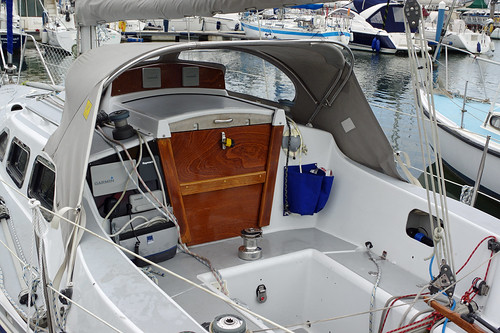
cockpit now by https://www.flickr.com/photos/155795245@N04/, on Flickr
 
Last edited:
Depends on the target.

That said - if single handed and going outside waters such as the solent, i would be very keen indeed to fit Radar.

I am coming to that view. I do have the feeling it would be an expensive decoration for 99.9% of the time, but for the other 0.1% it could be pretty darn important.
 
Ah! Now I understand the costs. I had noted you had at last achieved maturity - the 23 years - it was my slight attempt at humour.

Daydream's point is valid - you really need all this stuff at the helm, not down below. It really develops from my comment about radar - when you need it you want it NOW not when its gone through a warm up stage - same goes for displays down below (they are better up). Use the tablet down below and the master screen up. Or get a good waterproof case for the tablet. Think through having chart, radar display and AIS on one screen, or split screens etc. I installed our screen and have excess cable at the screen end - we can have the screen in the cabin (on the supplied bracket) or up at the helm on a bracket I made - but for us this just means the cable comes out of a hatch and is not inconvenient (just looks ugly). Its almost definitely not going to be so easy to arrange in a monohull.

Jonathan

Apologies, our posts crossed.
 
I am coming to that view. I do have the feeling it would be an expensive decoration for 99.9% of the time, but for the other 0.1% it could be pretty darn important.

:encouragement:

Solo I consider it pretty much vital onboard for offshore passages so you can get some sleep, but the rest of the time easily counted on the fingers of one hand has it been really used in anger in the past decade. Those times the 1100 quid was not begrudged at all!

Offshore passages in warmer climes it's great for spotting squalls heading your way as well so you have time to get ready with the shampoo :cool:
 
I don't see what the age or size of boat has to do with it. I installed radar on our cheap and ancient Centaur after being caught out in thick fog approaching Calf Sound one time. As Alant says, it has other uses as well, such as assisting pilotage at night and collision avoidance in daylight. Needs to be seen and operated from the helm, pointless having it down below on a short handed boat.
 
Top