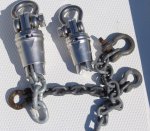
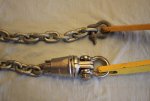
Putting floats on anchor chain

I am familiar with the testing re. pivoting fluke anchors. They bury much more deeply than general purpose anchors, and thus as far as that difference goes, obey different rules.

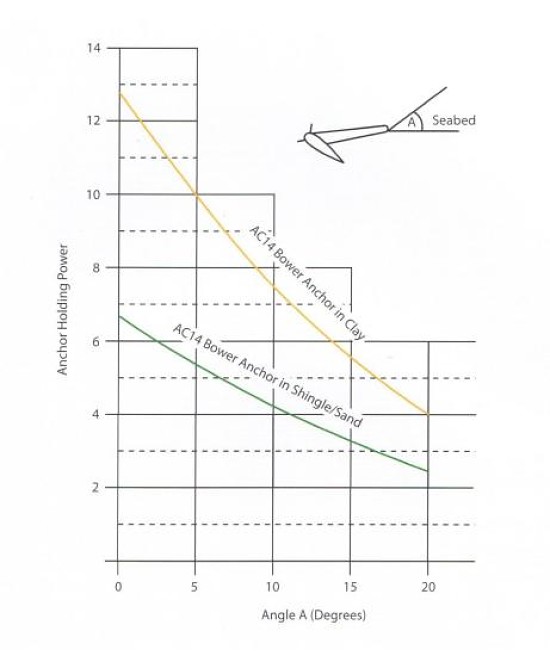
For example, during Panope's tests, the shackle is seldom more than a few inches below the sand. During Taylor's tests, the anchor was generarll more than 5 feet under ground, and ins some cases much more. Just look at the graph.

I do not believe Taylor's tests should be extrapolated to general purpose anchors.

Does anyone have holding capacity vs. scope data on general purpose anchors, such as Mantus, Spade, or Rocna? Until we see that data, I'm not sure what we are talking about. Anecdotal tales are interesting, but the rode tension was probably no more than 20% of the proven holding capacity of the anchor, so we don't know what was lost, only that there was still enough remaining. I've published some test results, with rope instead of chain to eliminate the effect of catenary, and the results were not perfect. They were "good," maybe even impressive, but holding was reduced. The other thing I noticed, is the effect is greater in flowing sand or soft mud, with the holding below 3:1 scope (about 20degrees) to unpredictable to plot, which is why the graps stop there.

I plotted my data against this data (below), and the curves were very close, depending on the design. HOWEVER, the Fortress had very different (better) short scope characteristics, sufficient that I don't not consider them directly comparable. It was a clear outlier in the plot. It also burried a lot deeper.

So let's look at data for the anchors we actually use. Rocna. Spade. Mantus. Excel.

[BTW, I once asked SPADE this question. They said it maintained 100% hold at 7:1 scope. They then explained that is because they rate holding capacity at 7:1 scope. Hysterical.]


Anchor-holding-power-relation-with-scope.jpg

image-asset.png

Stick to CQR or Bruce, preferably genuine ones if you don't like rust. The CQR needs at least 4:1, but is one great storm anchor as it heads for the centre of the earth if pulled hard enough. The Bruce only needs 3:1 and is probably the most popular anchor these days, (It used to be the CQR on yachts or Danforth on power boats).
Genuine Fisherman's anchor with reverse slider for wrecks, rocks or Gawd forgive us, coral.
 
Here is an interesting video by a young girl who is sailing around the world on a 26' Grinde - in this episodes she talks about freeing her anchor chain from the coral heads, and using floats on it.
She stresses that the coral where she is anchored is dead, so no corals were killed in the filming.

Be careful about sharks in the Pacific in particular!
 
Thank you, this was enlightening and thought-provoking.

I was not sceptical but intrigued by Bob Taylor's analysis. If the US Navy, other navies, the oil rig companies have developed a programme to calculate shackle angles and have taken the trouble to verify the data produced by actually testing the results then I for one am not going to contradict the background. Their investment is focussed at maximising performance and though improvement for us might be small they are additive and do no harm. The commercial industry accept the value of small incremental changes - if it works for them it cannot so us any harm.

I beach our cat fairly regularly - we have a convenient nearby location, it allows us to keep the hull and props clean and the tide is very sympathetic and goes in and out on a regular and predictable basis :)

IMG_4753.jpeg

We can stay for 2 whole days and to stop us floating away in the middle of the night we set the bow and two stern anchors. I've taken to setting them as deeply as possible and then during low tide - digging them out, carefully. I have a series of photos now showing the angles of the shackles and rode. Bob's analysis is in soupy mud (and I'm not actually sure how he defines the seabed/sea interface for soupy mud) but we anchor generally on sand and the anchors are set in sand from our cat (set underwater). I don't find the angles that Bob calculates but I do find the effect, that the shackle angle is not related to scope and is always higher than scope - but modern anchors engage and set - almost no matter what the angle. I think if you set at 2:1 (maybe next time I'll try it) then even a modern anchor would struggle to set and engage - but there is really no issue at 3:1. Short rode engaging and setting ability is one of the big advantages of MOST modern anchor designs). The very high hold of modern anchors is so high and with such a large safety margin a reduction in holding capacity is not going to be significant (as Vyv described in his post, see above).

The major characteristic influencing shackle angle is seabed, its shear strength, and the size of the rode close to the anchor, shackle, swivel, chain. None of this should be a surprise but normally, your and our, focus is on scope (the ratio) with no thought for the impact of the rode on anchor performance. If you look at Vulcan - Peter Smith has machined the shank like a meat cleaver - he knew reducing the profile of the shank would enhance performance - no wonder CQRs struggled in harder seabeds. Indirectly its also a reason Fortress and Viking perform well - the fluke plate is very thin and is able to penetrate the seabed (more easily than a big chunky fluke).

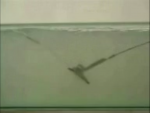
Bruce, the oil rig anchor company, sent me a video of one of their anchors being tested in an artificial, transparent, seabed. in an acrylic or glass tank The test was to show how a shear pin when actioned can be used to release the angle of the shank (so ignore the anchor its almost ready to be retrieved backwards. Its an old video and I'm sure more recent ones would look more pretty but I took a screen shot to illustrate the effect seabed resistance has on the rode. Note that the rode has a reverse catenary and the angle of the rode at the shank is, slightly, higher than the angle close to the (artificial) seabed surface.

IMG_8686.PNG

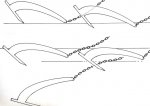
I've made a schematic sketch which also illustrates a similar pattern

IMG_5184.jpeg

In the above sketch I also illustrate another characteristic - as the anchor dives shear strength of the seabed increases and the anchor under tension finds it increasingly difficult to overcome the force acting in opposition to it diving further particularly as with depth more and more chain needs to be buried. The reverse catenary (a term used by the oil rig industry) increases and the angle the fluke makes with the seasbed (in our case commonly 30 degrees) slowly reduces and when it gets to about 10 degrees - it starts to drag. If your anchor has a low seabed angle and/or you have a chunky rode then it will achieve that 10 degrees more quickly.

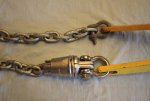
For a chunky rode - which rode do you think might resist penetration more than the other?
IMG_0390.jpeg

Its also another reason to consider chain size. The 2 chains, below, have a similar strength (I've measured them), our original chain was 8mm and we have down sized to 6mm. The major driver is that the 6mm chain is lighter but there are other advantages, smaller windlass, less power needed, the rode takes up less space - and it is less resistant to burial. Anecdotally - Danforth used to sell their anchor with a wire strop - maybe for the reasons outlined.

IMG_9881.jpeg

All these little details, Peter Smiths machined shank and smaller chain are individually difficult to measure in terms of improving anchor performance (given the variability of a seabed) but add them together and you can make a real impact.

It merits comment - the phenomena is accounted for in testing as commonly chain and a shackle are used, the scope is, say 5:1 (so recognisable) thus the ultimate hold incorporates the shackle tension angle. Omitting to mention the scope ratio, or using different rodes will impact results and make comparison between tests less useful.

An argument against taking any notice of the impact of the rode on setting is that the chain will not be buried much (or at all).

This is a 8kg aluminium A80 Spade. Its the same physical size as a 15kg steel Spade. Its off our cat, 38' 7t - similar windage to a 45' AWB and we have been sitting at anchor for a few hours, light wind. The depth is 5m, the scope 5:1. This was prior to our use of 6mm chain but its 8mm chain with a 3/8th" G209a Crosby shackle and a Boomerang.

Spot the chain
phonto.jpeg

Clue - the green rope is attached to the chain.

The sand is soft - but as Bob Taylor indicated soft seabeds still impact anchor performance by resisting rode burial.

This, I think, is one of Vyv's pictures, which I lifted from an earlier thread (but don't recall which). The chain has been thrashing the seabed under strong winds - but the anchor has dived further, set more deeply and the chain is still buried. A smaller rode would have offered less resistance to burial (allowing the anchor to dive more deeply and develop more hold. Rocna anchor.

Rocna-Paros.jpg

It needs a degree of religious fervour to maintain the focus :)

There does seem to me to be a contradiction when people look to ways to improve the efficiency of their cruising: new sails, better running rigging, new MFD, using LFRs ...... and then carry 100m of 10mm chain when they could be using 8mm chain and a smaller shackle.....??? (saves 85kg in the bow, smaller (cheaper) windlass, less power - and a deeper diving anchor!)

Take care, stay safe

Jonathan

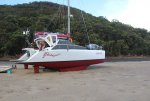
As an aside - the location in the first photograph is the bay in which the Petrovs were hidden when requesting political asylum in Australia. There is a Government house, off picture to the left, hidden in the trees. The bay is only accessible by water and was easy to secure. You would need to be in your 70's to recall the diplomatic brouhaha.

Google 'Petrov Affair'.
 

Attachments

  • phonto.jpeg
    phonto.jpeg
    44.6 KB · Views: 0
Last edited:
UMM, Errr! Far Eastern stainless is no good due to poor fatigue life. The real McCoy stainless does not shine, it's dark grey and is made in Coventry or Frankfurt. An old 4 times circumnavigator, (I've only done one trip round), told me not to use stainless for anything serious many moons ago, but I ignored his wise words and have now had 3 big failures as a result:
7mm Norseman terminal fatigue cracks after 6 months, New 8mm Dyform rigging wire stranded after 3 months, and worst of all a 12mm bolt snapped in shear when I tried to tighten it by hand.
That's why I never use stainless swivels to connect an anchor, just biggest possible hot dipped galvanised mild steel chain joiners and shackles with Sabatack 750XL as a thread locker, (Anchor thieves carry cutters for wire).
 

Attachments

  • IMG_0390.jpeg
    IMG_0390.jpeg
    76.5 KB · Views: 3
Last edited:
Never, ever use stainless steel swivels unless you can buy them directly from a factory in Germany or Coventry. The reason is that the mostly far Eastern stainless has a very short fatigue life as they do not anneal it often enough and often use recycled stainless. Real certified top quality stainless has a better fatigue life and does not shine, it's dark grey and expensive. Hot dipped galvanised mild steel is the only safe way to go.
Very few Chandleries stock the real McCoy stainless, and I've had 2 serious failures from the shiny stuff. One was a genuine Norseman Dyform 7mm terminal that split open after only 6 months, and the other was a 12mm bolt that failed in a classic angled crack when tightened up by hand. That bolt was nice and shiny with all the right markings for 316S, but had a pre existing stamping flaw.

I don't endorse swivels at all

If you need a swivel I suggest a Boomerang, that you can make yourself at home or buy.

Boomerang Your Anchor

And/or use the YBW search function with the key word 'Boomerang' and you will find full instructions on how to make your own - some here have done so.

Viking Anchor sell them mail order or you can buy from Anchor Right via Jimmy Green.

And to make it clear - I do not generate any money from the sale of product based on the concept.

Jonathan
 
I don't endorse swivels at all

If you need a swivel I suggest a Boomerang, that you can make yourself at home or buy.

Boomerang Your Anchor

And/or use the YBW search function with the key word 'Boomerang' and you will find full instructions on how to make your own - some here have done so.

Viking Anchor sell them mail order or you can buy from Anchor Right via Jimmy Green.

And to make it clear - I do not generate any money from the sale of product based on the concept.

Jonathan

Thanks, very interesting and I've not seen that gear before.

In terms of breaking out an anchor, it is possible to weld a bar, or fit a large galvanised D ring between the 2 ends of the anchor to attach the chain or heaven forbid, rope rode. That way you simply overrun the anchor and the D ring slides along the rod or shank, (Easy to fit a D ring to a Fisherman's anchor), and it pulls out the stuck anchor just like a tripping line float rig when some twerp thinks it's a free mooring buoy.
The snubber rig looks cool, but alas I've just ordered 2 stainless chain hooks, ahhhh! Don't panic as the chain will still be locked around the windlass gypsy!
 
Thanks, very interesting and I've not seen that gear before.

In terms of breaking out an anchor, it is possible to weld a bar, or fit a large galvanised D ring between the 2 ends of the anchor to attach the chain or heaven forbid, rope rode. That way you simply overrun the anchor and the D ring slides along the rod or shank, (Easy to fit a D ring to a Fisherman's anchor), and it pulls out the stuck anchor just like a tripping line float rig when some twerp thinks it's a free mooring buoy.
The snubber rig looks cool, but alas I've just ordered 2 stainless chain hooks, ahhhh! Don't panic as the chain will still be locked around the windlass gypsy!

If you check the Anchor Right SARCA or the Manson Supreme anchor - I think they pre-date you :) for a slot in the shank

Ah!!! Stainless steel hooks..... :(

You have not read my article on chain hooks?

Testing the Effects of Chain Hooks - Practical Sailor

nor this one - real life

Safety at Sea: Surviving a Powerful Storm in the Med

and an asnwer

https://www.practical-sailor.com/sails-rigging-deckgear/a-snubber-hook-for-all-occasion

but even better

search out the July 2021 issue of Yachting Monthly - they have an excellent anchor :) focussed at mono hulls

Take care, stay safe

Jonathan
 
If you check the Anchor Right SARCA or the Manson Supreme anchor - I think they pre-date you :) for a slot in the shank

Ah!!! Stainless steel hooks..... :(

You have not read my article on chain hooks?

Testing the Effects of Chain Hooks - Practical Sailor

nor this one - real life

Safety at Sea: Surviving a Powerful Storm in the Med

and an asnwer

https://www.practical-sailor.com/sails-rigging-deckgear/a-snubber-hook-for-all-occasion

but even better

search out the July 2021 issue of Yachting Monthly - they have an excellent anchor :) focussed at mono hulls

Take care, stay safe

Jonathan

Just what I needed, another order to send back to Fleabay.

Practical boat sailor is one great magazine, BUT I forgot to Google anchor hooks before I hit the buy now tab.

I've got some scrap stainless plate for the bridle and Cobalt drill bits, BUT ahhhhh! another recycling bin job!
 
Just what I needed, another order to send back to Fleabay.

Practical boat sailor is one great magazine, BUT I forgot to Google anchor hooks before I hit the buy now tab.

I've got some scrap stainless plate for the bridle and Cobalt drill bits, BUT ahhhhh! another recycling bin job!

Sorry

But if you want a stainless hook - you cannot really walk past the Cromox range. I think Jimmy Green is a distributor, or Petersen in (UK's) Newcastle.

Only:

I made all my bridle plates from 800 MPa Q&T steels but these then need to be galvanised. I then had some custom made in 7075 aluminium alloy and anodised - but the answer, I think (along with my Boomerang) is to go Duplex stainless. If you go the Duplex route you will never worry about the integrity of the item (assuming you don't try to cut corners and make it thinner than suggested) and you will not need to look for a galvaniser willing to galvanise HT steels. Your problem, if you are in the UK - is finding a source of duplex stainless. Having been working 'in the area', geographic and industry, I have sources for most of the metals HT steels, aluminium and I've found people who will galvanise ( - in the UK try Body Cote (I think Bristol) or Google Greencote, or, less preferred as its a different process, Highland Galvanising.

If you can find the steels you can make a bridle plate, a chain hook (modify the bridle plate design) and a Boomerang on a kitchen table in an evening - you need an angle grinder, decent bench drill, some means to abrade (angle grinder again) a good vacuum cleaner and a supportive wife - not necessarily in that order :)

Jonathan

Jonathan
 
Sorry

But if you want a stainless hook - you cannot really walk past the Cromox range. I think Jimmy Green is a distributor, or Petersen in (UK's) Newcastle.

Only:

I made all my bridle plates from 800 MPa Q&T steels but these then need to be galvanised. I then had some custom made in 7075 aluminium alloy and anodised - but the answer, I think (along with my Boomerang) is to go Duplex stainless. If you go the Duplex route you will never worry about the integrity of the item (assuming you don't try to cut corners and make it thinner than suggested) and you will not need to look for a galvaniser willing to galvanise HT steels. Your problem, if you are in the UK - is finding a source of duplex stainless. Having been working 'in the area', geographic and industry, I have sources for most of the metals HT steels, aluminium and I've found people who will galvanise ( - in the UK try Body Cote (I think Bristol) or Google Greencote, or, less preferred as its a different process, Highland Galvanising.

If you can find the steels you can make a bridle plate, a chain hook (modify the bridle plate design) and a Boomerang on a kitchen table in an evening - you need an angle grinder, decent bench drill, some means to abrade (angle grinder again) a good vacuum cleaner and a supportive wife - not necessarily in that order :)

Jonathan

Jonathan

Used to fabricate all sorts of metal parts for smallish boats, but I try to avoid having to send parts away for hot dip galvanising, as it's cheaper to buy steel plates that are already galvanized, or heaven forbid in fatigue live terms, stainless plate. Sheffield might be where they smelt iron ore for stainless steel, but Coventry seems to be the best place for metal parts, including made to measure items. The nearest hot dip galvanizing company is in Cardiff, if you ship through Wessex Steel Ltd who have a pick up point just west of Bournemouth.
 
Last edited:
The only time we went the floating-chain route was in the Tuamotus in French Poly where in certain areas there are coral bommies everywhere, you looked for the biggest area of clear sand you could find, dropped the anchor as close to its centre as you could manage with hopefully 10+m of chain and then buoyed the next 20-30m depending upon depth. We only rarely did it even there (it's a PIA to get right) and never when stronger or changeable winds were predicted.
 
Top