
Protection product test

Yes sorry about that! Feel free to try your samples on my fading gelcoat in the South of France any time you like ... I've got plenty of spare bedrooms and an indoor swimming pool that might benefit from a polish as well!


Hmm, working holiday, I might take you up on that.. :)


Just a quick update, apologies it is taking a while.

Most product samples are in, there are a few more in the pipeline but hopefully I will have everything ready for a January 16 start.

The gel coated panels are mostly done, I've gone for 10" x 8" separate panels, this way there will be no cross contamination and product panels can be easily photographed and compared throughout the months.

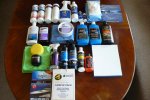
Product samples are in from:

3M Marine

Dulon International

Meguiar's

Bullet

AGlaze

Collinite

CeNano

Some are offering more than one product, wax and a sealant for example, also the preparation products and follow on products to maintain.

A few others to come in the mail and more manufacturers in communications, so more confirmed will be added.

Tony
P1120302.jpg
 
Last edited:
Excellent, thanks for keeping us all updated, I for one am watching with great interest.
Time to see once and for all how they compare.

No AutoGlym super resin polish + Top Gloss protection yet?
 
Thanks guys, really appreciate the interest and support. :)

Contacted Autoglym to see what they would be willing to put forward if anything.

As you say, either a combination of super resin polish followed by extra gloss protection, or possibly they might want their HD paste wax to go up against the offerings from 3M, Collinite and Bullet, but we'll see.
I'm not sure myself which of their products would be better on gelcoat long term, both the sealants and the wax have a good reputation.

As I said to David earlier in the thread, Autoglym are really targeting the automotive sector, but they do make sales to boat owners and many are happy with the results, so would be good to see them included in the line up.

I'm sure they are thinking it over at the moment.

Still waiting to hear back from Farecla, they have a far more 'marine' specific range out these days so hoping they will be coming on board also.

Tony
 
Comparison%20line%20up_zpsoffrmjm1.jpg


That's the last of the products in and huddled together for a group photo.

We will be describing each product in detail including the application process, also the products used to prepare the surface and the wash down products for ongoing safe maintenance.


Before I put product to panel - I would like to offer my deepest thanks and warmest gratitude to the following ladies and gents for helping us in this comparison.

Carol Branson - Ship Shape Norfolk (Collinite)

Amy Chappell - GTECHNIQ

Kees den Haan - Dulon International

Mike Friedrich - CeNano

Mark Docherty - Autoglym

Martyn Bridge - International Paint Ltd (Akzonoble)

James Oakey - Bullet Polish Europe Ltd

Dale Masterman - Meguiar's

Brian Robinson - 3M Marine

Michael Bollom &
Clive Hancock - A Glaze Marine Products

Steve Simpson - Farecla
 
Last edited:
Interesting to see how these compare and I assume you are including a control untreated panel (embarrassing if it doesn't deteriorate in the time available, unlikely though). How are you assessing the results? I'm not familiar with Glossmeters but remember how difficult it was to get reproducible results when using instruments to measure dyes & pigments many years ago. Only one aspect and I expect you are using more than one method.

Sorry if this was covered already and I didn't spot it.
 
Interesting to see how these compare and I assume you are including a control untreated panel (embarrassing if it doesn't deteriorate in the time available, unlikely though). How are you assessing the results? I'm not familiar with Glossmeters but remember how difficult it was to get reproducible results when using instruments to measure dyes & pigments many years ago. Only one aspect and I expect you are using more than one method.

Sorry if this was covered already and I didn't spot it.


Yes, one panel will be completely naked for comparison, the embarrassing aspect would surely be if any of the treated panels deteriorated faster than the naked one!
I don't however foresee that happening with our line-up, but anything is possible.

Gel coats have evolved and improved in-line with other marine cosmetics, with UV inhibitors etc already incorporated in some, there is as you say the slight possibility that we won't see any deterioration in the untreated panel in our first year. We are using some of the best gel coat available.
We kind of discussed this in another thread, where a real test of these products would be in med like conditions, where UV, heat etc were greater than here in the UK.

Some manufacturers have gone to great lengths and expense through test facilities to simulate thousands of hours of accelerated exposure and various conditions to see how their products fare. These facilities also have the ability to measure gloss / pigment loss etc.

This is a real world exposure test here in the UK under UK conditions. If we have to be patient for differences to show themselves, then that is what will happen. My tools are going to be eyes and experience. I have a Bodelin Proscope, Sun gun, jewellers loupe, variable degree gloss meter etc, all are out-performed by the eye.

We have the ingredients needed for deterioration, UV, oxygen, salt water, acidic rain and other fall out.

Assessing the performance of each application is going to be a tricky one, indeed as you hint the difficulty in measuring accurately the degrading, or how well that product is continuing to provide a barrier to oxygen is going to be no easy task, but possible.

I guess first we need to establish what qualities we are looking for.

A decent final finish protection application has a few tasks it needs to take care of, primarily these are:

Slowing down the degrading due to UV.
Eliminating the degrading due to oxygen.
The ability to shield the surface from fall out including acidic rain, dirt and water including both salt and pontoon.
The ability to repel / reject, or be 'hydrophobic'.
The duration it can maintain performing the above.

Now it's easy for us to see when gel coat has deteriorated looking at two boats side by side, one might be glossy the other dull and chalky. Even on one boat there will be many areas that may have deteriorated faster than the surrounding areas.
What we don't know all of the time by simply looking is what caused that condition, poor gel coat, UV, oxygen exposure, wash down chemical choice, poor wash technique, or a combination of all of these things.

What we tend to instantly label it as though is 'oxidised' where that isn't the case, it's just what we term it once obviously failed. But, it doesn't tell the story or show the time line of how it got there.
Oxygen is the final nail in the coffin, once a product fails to provide a barrier to oxygen it's a rapid decline. Take a bite out of an apple to see how fast oxygen works at exchanging free radicals on a surface.
This is more relevant to 'surface condition' though, where a marred surface will degrade much faster, likewise an apple hasn't the same surface qualities as gel coat, there's a part of me that would like to go deeper into that but I'd be making the explanation even more complicated than I am currently.

It's clear to see in some cases why a certain area has degraded faster than others, such as a surface that is facing the Sun more ( a radar arch for example) will have a higher UV and heat exposure that will put more pressure on its ability to perform, in many cases making the protection venerable and then allowing oxygen to step onto the field.

Peel away the names or logos on a two year old boat and unless you are a dedicated maintenance guru, the likelihood would be, is that you would notice a difference in the gel coat surface underneath. The vinyl would have shielded the named section from UV and oxygen. Just as many would notice a difference or line where a cover sits.

Each panel is separated by a strip of vinyl tape, we won't notice the full impact until the end, but when we remove the tape we will have a time shot of what the gel coat was like at the start.

Of the products above, some are geared more towards UV protection, some might be able to maintain protection against acidic rain etc and some will have a better interaction with dirt and water.
Of course what I am looking for is one that encompasses all. We are are all different though and some might just be after a decent UV blocker and not be interested in hydrophobic qualities and so on.

When we apply a product (let's say a wax for an example) the surface is beading water, if when washing the boat down a month later you noticed that the surface isn't beading the same as it was when you applied it, you'd probably know it was time to re-apply.
In the same way, we will be washing each panel down on a regular basis and noting the height of the bead or the 'contact angle' of the water bead to establish its performance relative to how it was at point of application.

But this will only give us one side of the story, as above, the product may stop beading after a week, but continue to protect against oxygen and UV for many more months. We may have to wait a while before seeing any early signs of the onset of UV / oxygen degrading.
There's going to be other qualities of course such as ease of application, if it smells like caramel or the inside of an engine, but this will be during the application / description of each.

I'm going to divide them into categories, so that a wax is up against another wax, a hydrophobic sealant against another and so on. This way we will be comparing products that claim a certain performance in each sector.


Tony
 
Tony,

The only point I can question in your thinking relates to the fact you're using top quality gel coat, which may already have uv protection built in and is likely to degrade more slowly than more inferior products.

Surely in a test of the protection coating on top of the gel coat, it's better to use a more inferior grade of gel coat that is susceptible to general deterioration, so it shows up how well it is or isn't being protected by the wax, polish or sealant on top. It will also show up differences and results more quickly?
 
Last edited:
Tony,

The only point I can question in your thinking reates to the fact you're using top quality gel coat, which may already have uv protection built in and is likely to degrade more slowly than more inferior products.

Surely in a test of the protection coating on top of the gel coat, it's better to use a more inferior grade of gel coat that is susceptible to general deterioration, so it shows up how well it is or isn't being protected by the wax, polish or sealant on top. It will also show up differences and results more quickly?


I did think along exactly the same lines and you've highlighted something that was a long ponder.

It boiled down to either having fast results and run the risk that inferior gel coat could be blamed for a products poor performance.

Or, ensure that the gel coat was first class and that nothing other than the product was to blame, or to take the credit.

It's also safe to say that a gel coat that has the ability to completely stop UV degrading isn't around as yet and that the Scott Bader (gel coat being used) is used on Fairline, Princess and many more.
So not really going for super UV protecting gel coat any more than a new owner of such would be enjoying and looking to protect.

It's good, but certainly not unfair and any advantage it gives the product in terms of durability is offered to all the products.

It's important that they are on a level playing field (which they are) I wish I could press the fast forward button, but given the choice of speed of results or accuracy, I'm certain you'd opt for accuracy.

I was always having my wrist slapped whilst attempting to sample a cake before it was set, my daughter is no different, she pleads that the proof of the pudding is in the eating with a cheeky grin, I reply with "if you're judging, I want it perfect and you'll have to wait".

That said, an inferior gel coat might better highlight the ability of a product as this would put more pressure on the application, agreed, but there's the ponder.

I've always stood behind the fact that on occasions a decent product fails due to many reasons other than the product itself.
Applying to a surface that is not ready to receive it, such as being heavily swirl marked, greasy, oxidised, water scaled or washed with products of a high PH that would strip the application once applied.

Perhaps we could run another comparison that would encompass these types of variables in the future, if it would be of interest?

I plan on running a surface correction system comparison also, but for now I've only room in the oven for this one.


Tony
 
Last edited:
Fair enough, at least it was a very considered decision.

My angle is that not all of us have the latest Fairline, Princess etc models and trying to keep older boats looking good is (IMO) a tougher call in that respect.

I'm looking forward to the trial and its results with great interest.
 
Very true!

But you do / should have a couple of advantages also.

The first thing is that older boats 'usually' have more gel coat thickness to them, providing you with far more correctional ability. On occasion this is out-weighed if the surface over the years has been corrected more than it has been protected.

The second is gel coat continues to cure throughout its lifetime, so all things level, the older the gel, the harder it will be.

For many this proves to be a major hurdle and learning curve, I'm not stating that this is a concern of yours, just for many.

Success comes in the form of having the surface ready, regardless of the choice of protection, due to how hard and resilient the gel coat is, this is the biggest stumbling block.

What works (correction wise) for most won't work for all, so where a heavy compound could be disastrous for one gel coat, on another (older gel coat) it may just tickle the surface and you never really get it to a point where it has a decent reflection with good clarity and so - 'ready'.

A product can't create a shine for long, that comes from the surface itself. The concept has sold a million products, but ruined millions of gel coats.

99 times out of a 100 this is the hurdle that needs to be jumped. Once jumped and the surface is fully corrected, it will perform just as good as the more modern gel coats, in most cases better and so in turn the protection products work as they should.

It's not always what works the best, more often than not it's what works the best for you, so appreciate it's not fully tailored for everyone, that's just more variables that make this a tricky thing to get to grips with.
 
How about using a cheap non marine product such as Turtle Wax?
What parameters are you going to record?

I liked Turtle wax back in the day and still have a few bottles of the old school in the garage (along with many more) I guess we could keep adding to the list but we have 15 protection products up for evaluation now, time to get on with things.
Will be monitoring how the products slow down the ageing process compared to an un-treated panel, looking for early signs of oxidation, UV degrading, also how well the surface repellency is throughout the year.
 
Here's the layout, we have three panels, divided into 15 sections and this is the final list up for comparison.

There will be a blank panel left un-treated.

I hope to review one or two each evening (starting this evening) so we should be ready to place them outside very soon.

Panel%20layout%20_zpsjv9r2rvj.jpg


1) 3M Ultra performance paste wax
2) Bullet Glacier Glaze
3) Collinite Fleetwax
4) International marine wax
5) Autoglym High definition wax

6) 3M Scotchgard liquid wax
7) Meguiar's Flagship premium marine wax
8) Bullet Hi-shine sealant
9) Farecla Profile UV wax
10) International UV sealer

11) AGlaze GRP sealant
12) Dulon International 1 & 2
13) Autoglym Extra gloss protection
14) Gtechniq C1+EXO
15) Nanotol from CeNano


Tony
 
Last edited:
Okay, first up on panel number 1 we have
3M Marine’s Ultra performance paste wax.

What it says on the tin
Easy-on, easy-off formula
Long lasting UV protection
Exceptional durability
High gloss, wet-look finish

3M’s part no 09030

Available at
3mdirect.co.uk

Price
£20.12

Quantity
269 g

Cleaning / correctional qualities

None, a stand alone protection product.

Preparing the panel
Finesse-it finishing material would be the product most would use prior to using the wax. Some opt to further wipe the surface with IPA (Isopropyl alcohol) prior to applying the wax as an additional step to ensure the best bond between surface and wax.
P1120392_zpsrecbf36f.jpg


On opening
A sturdy metal tin with a tight seal lid.

Contents
The wax itself is an ivory colour and has a unique but pleasant waxy caramel smell.

Application
Wipe an applicator pad to load up some product and spread evenly on the surface.
P1120393_zpsjtdwg7n2.jpg


Removing excess
You can wipe off the product almost straight away, there’s no long waiting for the product to haze.
P1120395_zps7tefiys3.jpg


Repellency
Water is beading very well on the surface. I would score the beading at 6 out of 10.
P1120397_zpsaq6qfqog.jpg

Comments
Certainly an easy on, easy off product, the beading / repellency is high for a wax in this price bracket.

Will review / edit this at the end of January.
 
Next up on panel number 2 we have Bullet’s Glacier Glaze.

What it says on the tin
No bold claims, simply application instructions, which is refreshing.

Available at
Bulletpolish.co.uk

Price
£25.50 with applicator and microfiber

Quantity
120ml

Cleaning / correctional qualities
None, a stand alone protection product.

Preparing the panel
Ensure surface is squeaky clean prior to application.
Bullet recommend their Marine Eco wash concentrate.
P1120400_zpsfyfvllyd.jpg


On opening
A smooth plastic tub with a twist lid.

Contents
The wax is yellow, smells ok nothing unpleasant, new car type of smell, certainly can smell the Carnauba.

Application
Comes with an applicator sponge, so load the sponge with the product and spread evenly over the surface.
P1120407_zpsktx4vuua.jpg


Removing excess
Wait 15 minutes for product to dry, then wipe off with the included microfiber.
P1120403_zpsavhdsseh.jpg


Testing repellency
Water is beading very well on the surface, I would score the beading at 6 out of 10.
P1120404_zpsgllw0vtm.jpg

Comments

The beading surprised me, also it went on smooth and off smooth.
Bullet’s website recommend waiting 15 minutes before removing excess, but I’m certain this wait could be reduced to about a minute without adverse effects in its performance or durability. In the same time frame you could apply 2 coats.
 
Tony
I am not sure if you are also going to include ease of use as a parameter, though I am not sure how to assess that. Round the boatyard one sees people working by hand through to pros with the latest tools and polishing heads. Peoples' needs will also vary here, I think. Someone with his £££ new boat may be very happy to pay for weeks or dedicated work for that ultimate finish, but maybe a day is as much as I am willing to spend.
 
Tony,

One thing I've always been curious about is whether products can be applied in several coats to build up more protection, or does each one remove the previous thereby only ever having the same effect as one coat? How does one tell?
Again I don't want to (even further) complicate your already comprehensive test but if you could give us a pointer from your experience I'd be very grateful.
 
Tony
I am not sure if you are also going to include ease of use as a parameter, though I am not sure how to assess that. Round the boatyard one sees people working by hand through to pros with the latest tools and polishing heads. Peoples' needs will also vary here, I think. Someone with his £££ new boat may be very happy to pay for weeks or dedicated work for that ultimate finish, but maybe a day is as much as I am willing to spend.

Gavin, as you say it's a tricky one to assess, certainly as we're applying to new gel coat. 'Ease of use' or how easily the product goes on is really down to the surface condition.

Having tried all of the products I can state that none of them are difficult to apply, in fact all are easy, but again this is due to the surface they are going on rather than the product itself. There are going to be differences between each product, but this would be minimal compared with the surface condition.


As an example, a friend of one one my clients the other day asked if I would wash and wax her car for her, as she is thinking of selling. It's only 4 years old and 'looks' in very good condition.

After I had given the car a good pre-wash and clean, I asked her to come and take a look and feel of the surface.

If you place your hand inside a plastic 'freezer type' zip bag and feel the surface, it will make your fingertips super sensitive.

Her jaw dropped as she felt lumps of tar, brake dust particles and other fall out.
Next, I passed her a microfibre and asked her to glide it along the paintwork, of course it kept sticking on each and every 'above surface' contaminate.

I explained and demonstrated that before I could wax the car, additional steps should be taken to remove these contaminates. After all they will eventually embed themselves into the layers of paint causing further problems.
Also, by removing them it will make the surface far smoother and easier to keep clean. The first thing a potential buyer might do is run their palm over the surface, I don't know why fully, but it seems we all do it.

I had simply run a clay bar over one section of the roof and asked her to feel the difference with the bag and the microfibre. "it's all gone" she said, with a surprised expression and the microfibre glided over the surface with 'ease'.

On gel coat and in a marina environment, we get above surface contaminates, not as much, but we also have below surface (highs and lows), certainly when the early stages of oxidation turn up. Either will make the application process difficult. A hard to glide microfibre is a sure sign that the surface isn't ready for protection by a long shot. If you apply at this stage things will get worse and not better for many reasons I won't get into now.

If one is only willing to spend a day on it, then spend 90% of it preparing.

Work it hard and it becomes easy.
Work it easy and it becomes hard.
 
Top