Propagation distance of AIS.

As said above, theoretically VHF line of sight between antennas. However, on a number of occasions in the western approaches I could see foreign fishing vessels visually and on radar when about five to ten miles away but they only showed on AIS when within one or two miles.
And where is your AIS aerial mounted. I've been thinking of putting mine on the push pit but if the range is that limited I might have to rethink it.
 
And where is your AIS aerial mounted. I've been thinking of putting mine on the push pit but if the range is that limited I might have to rethink it.

A major - well worth considering - advantage of mounting your AIS antenna on the rail/bimini/stern-goalposts is that while you may lose a bit in transmission distance, you will still have a working AIS and equally/more importantly VHF antenna if you were to lose the mast.
 
A major - well worth considering - advantage of mounting your AIS antenna on the rail/bimini/stern-goalposts is that while you may lose a bit in transmission distance, you will still have a working AIS and equally/more importantly VHF antenna if you were to lose the mast.
Unless like us you have two masts. VHF antenna on one and VHF and AIS on the other
 
And where is your AIS aerial mounted. I've been thinking of putting mine on the push pit but if the range is that limited I might have to rethink it.
Mine is on the radar/solar arch over the stern so mounted about 3.5 metres above static sea level.
Should have made previous post clearer, my normal (class B) AIS detection ranges are around 10 miles. I suspect those fishing vessels were deliberately reducing their AIS signal strength.

My thinking is the same as BobnLesley #22. Both my antenna leads are at the chart table and can be exchanged between AIS and VHF

As noted by others, transmission is 'line of sight' and even in big seas, there are times when you're sat at the top of the swell, I suspect that once you've been 'picked-up' the receiving station perhaps holds on to your position for those periods when you're down in the trough?

Class B transmissions are not continuous. The frequency of TX depends on the speed of the vessel and the data load in the area. Update intervals generally vary between 5 seconds and 3 minutes. A friend's boat had separate transmit and receive units so own vessel's AIS on their chart plotter would appear over the boat's position, then stay in that location as the boat continued on its track for two or three minutes before being updated again.
 
I think this was the view on the plotter whilst moored in Southsea Marina many years ago.. There was no option to reduce clutter and it was having to display everything within the Solent as well as multiple ships across the shipping lanes. The cursor point is at 60 miles distance.

View attachment 136118

Wish I could find the screenshot showing vessels near Boulogne and one in the Thames estuary.
That's a B&G plotter, but what cartography are you using, please? It's really nice.
 
Mine is on the radar/solar arch over the stern so mounted about 3.5 metres above static sea level.
Should have made previous post clearer, my normal (class B) AIS detection ranges are around 10 miles. I suspect those fishing vessels were deliberately reducing their AIS signal strength.

That's good to know, I dont have an arch so the best I can probably do is a pole to raise by 1.5m above deck level.
 
Class B transmissions are not continuous. The frequency of TX depends on the speed of the vessel and the data load in the area. Update intervals generally vary between 5 seconds and 3 minutes. A friend's boat had separate transmit and receive units so own vessel's AIS on their chart plotter would appear over the boat's position, then stay in that location as the boat continued on its track for two or three minutes before being updated again.

Class B+ is the one that alters with boat speed .... Class B is a steady long interval between data sets.
 
The radio horizon is slightly further than the visible horizon, but how much further depends on the weather.

The other factor not yet mentioned is how sensitive your receiver is. You get what you pay for.
 
That's a B&G plotter, but what cartography are you using, please? It's really nice.
That screenshot is from the B&G Link app with C-Map cartography on the plotter.

I have both Navionics and C-Map on board. The C-Map is pleasant on the eye but after getting used to Navionics, that's what's used on the main plotter.
 
Cluttered screen ... its why I swap from AIS on Chart screen to AIS own screen at times depending on where I am and also the range setting I'm using.

Its similar to when I did my early Radar courses for my Licences ....

In busy areas - choose short range display to get rid of the distance targets .. then work the close ones as they come ... (at intervals swapping to longer range as a check of what more is on its way !)

Even zooming in to de-clutter the view, the MFD is still receiving all the AIS messages, decoding them, storing/updating them in a list of stations and calculating dangerous ones from the list. The older plotters did appear to run slower once AIS turned on.
 
That screenshot is from the B&G Link app with C-Map cartography on the plotter.

I have both Navionics and C-Map on board. The C-Map is pleasant on the eye but after getting used to Navionics, that's what's used on the main plotter.
Thanks. I have both, covering different areas with some overlap, but don't recall finding that setting for C-Map.
 
The green triangle is my last AIS transmitted position, my actual position is the red symbol.
Needless to say all other vessels receivers would show myself in the green spot.
There were several tens of class A transponders nearby.

ais%2Bshadow%2B8_zps1tsblnab.jpg
. A friend's boat had separate transmit and receive units so own vessel's AIS on their chart plotter would appear over the boat's position, then stay in that location as the boat continued on its track for two or three minutes before being updated again.
 
  • Like
Reactions: srm
Shore stations - sprinkled.

I was disappointed that I was only tracked a few miles from the coast. Doesn't matter in terms of safety I know.
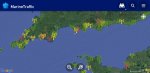
Ais class b is captured nicely by shore stations across Lyme Bay as well...

Screenshot_20190527-182141_MarineTraffic.jpg

What area are you in? Perhaps not many shore receiving stations in the area.

In MarineTraffic, you can filter to show where the receiving stations are, then find their details.

Screenshot_20220531-195741_MarineTraffic.jpg
 
Even picked up one showing it was going the other way and one showing it was going 90 Deg to its actual direction! ......................... Whether the poor range on some installations is lack of hieght or poor transmission power or both can't really be determined but it makes the AIS pretty useless in some circumstances
I am glad that you mentioned that, because it is the first time someone else has agreed with me that there can be anomolies. I was sailing from Guernsey past La Roche Douvres to Treguier & a boat was 3 miles of the stbd bow. According to my AIS, there was one 3 miles off the port quarter. It was excellent visibility, but I could not see it. As I sailed on, the target "sailed"right through the lighthouse on the rocks.
It later transpired that the target was being transmitted from the boat 3 miles in front.
My AIS was working OK. I was picking up other targets before & after the event correctly. A later check with another vessel, confirmed that my signal was being transmitted Ok.
 
Standard class b through a Raymarine active splitter and antenna about 16m above sea level.

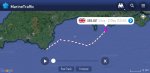
We're picked up by MarineTraffic all the way across the channel..

View attachment 136114
That is one hell of a cross track error. Was it due to tide, wind, or too much beer on board?
I was hoping to do the trip soon & that does seem to be a big detour just for tide.
Is that normal? #10 looks more like one might expect.
 
I am glad that you mentioned that, because it is the first time someone else has agreed with me that there can be anomolies. I was sailing from Guernsey past La Roche Douvres to Treguier & a boat was 3 miles of the stbd bow. According to my AIS, there was one 3 miles off the port quarter. It was excellent visibility, but I could not see it. As I sailed on, the target "sailed"right through the lighthouse on the rocks.
It later transpired that the target was being transmitted from the boat 3 miles in front.
My AIS was working OK. I was picking up other targets before & after the event correctly. A later check with another vessel, confirmed that my signal was being transmitted Ok.

Don't forget that AIS data set is dependent on GPS positional data ..... if the GPS you are using is an old set feeding the AIS unit - the AIS Tx does not correct it - it takes the info as 'gospel'. Old sets can wander a lot ... OK - it shouldn't be as much as you quote in your post ... but not impossible.
 
Top