Problems with Volvo shaft seal

eddystone

Well-Known Member
Joined
18 Aug 2013
Messages
1,936
Location
North West Devon
Visit site
In March 2014 I had a new prop shaft, new [cutluss/cutlass/cutless] bearing, new Volvo seal and the prop itself refurbished. Cutlass bearing needed replacement this year ( mismatch between prop and bearing or damage from calcium deposits were alternative explanations). Now the Volvo seal is spraying drips around so, as i understand there should be zero drips, will also need replacing.

2 questions - a) how quickly do they deteriorate? - I planned to use the boat a bit before lifting out in the spring, when it will be replaced.
b) is it common to need replacing after 18 months? Usual replacement interval is 5/7 years i thought.
I suppose the lips could have been damaged when the [cutluss/cutless/cutlass] bearing was replaced.

any ideas welcomed. (Boat is Sadler 32 and engine mounts were replaced relatively recently)
 
No, it should not fail. Common reason for leak is serious misalignment or more likely in your case the lip seals have been damaged on re assembly.
 
I agree with Tranona, it should last years, and it is easy to damage the lips when removing and refitting, especially if the plastic lip protector they are supplied with is not used. It is unlikely to fail catastrophically in a few months light use, I had one which sprayed as you describe for a season, after I refitted it in a hurry. It was subsequently replaced with a new one, very carefully fitted on a spotlessly clean prop shaft with the plastic protector in place, and the leak stopped.

Amongst your many options when you lift out are:
Fit a new Volvo (or Radice, which are similar lip seal glands, but with a balance line so they don't need burping). I'm assuming your prop shaft is still in good condition.
Fit a PSS seal, which doesn't rely on lips sealing on the shaft.

Vyv Cox gives loads of info on stern glands on his excellent web site:

http://coxengineering.sharepoint.com/pages/sternglands.aspx

Oh, and it would be worth checking engine alignment for peace of mind........
 
Last edited:
Those Volvo seals need "burping" when the boat is put back in the water and before the shaft is turned as they rely on water cooling and can otherwise be damaged. I also find it advisable to pack the three lips with grease before inserting the removable protective sleeve and mounting the seal. They need re-greasing every year too. I use a piece of drinking straw to slip the grease under the lip seals.
 
Yes I do burp it but i did wonder if I caused damage by squeezing too much grease in - probably not and agree most likely cause was re-assembly when cutl...ss bearing replaced (what is the right spelling!)
 
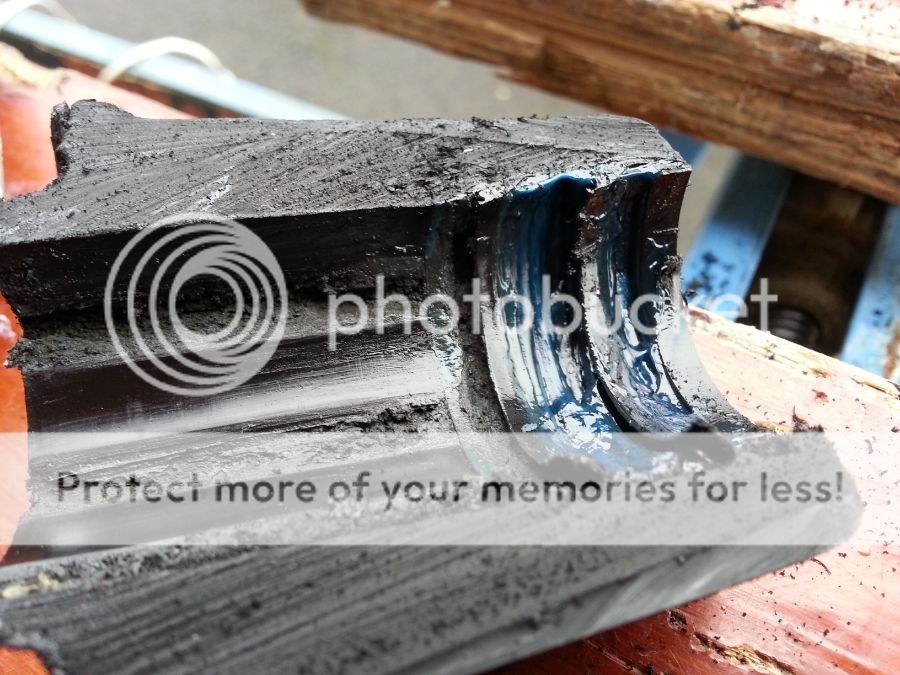
I have just had our Volvo Shaft Seal replaced which was 12 years old. It had to started to drip very slightly when the motor was running but still completely dry when the boat wasn't in use. The engineer gave us the old seal back and I cut it open to have a look how worn it was, surprisingly it didn't look that bad.

I grease it a couple of times per year using a drinking straw which seems pretty important, I could imagine the lip seals would get damaged pretty quickly if run dry. It also appears to be essential to use the orange sleeve to protect the lip seals when moving the seal or shaft.
 
I have just had our Volvo Shaft Seal replaced which was 12 years old. It had to started to drip very slightly when the motor was running but still completely dry when the boat wasn't in use. The engineer gave us the old seal back and I cut it open to have a look how worn it was, surprisingly it didn't look that bad.

I grease it a couple of times per year using a drinking straw which seems pretty important, I could imagine the lip seals would get damaged pretty quickly if run dry. It also appears to be essential to use the orange sleeve to protect the lip seals when moving the seal or shaft.

It is not the lip seals that need the cooling, but the fluted rubber bearing that makes up most of the length of the seal (but does not seal!). If you do run dry the noise that makes will wake you up.
 
Here are a couple of images that might help.
You can see the cylindrical section which locates on the shaft and the two lip seals.
This section has grooves in it which seperate it into 6 sections.

Grease should be applies between them , 1cc I remember. On my size (25mm) The void between the seals is about 15mm from the end.

As others have said you should get no drips at all from it and it is likely damage happened on fitting using or not using the seal protector.

One further possibility is that the seal was fitted fine but there was some damage to the surface of the propshaft , unlikely if it has been renewed.

20150314_095627_zpsxr9f6pdc.jpg


20150314_095605_zps4tbpfjtl.jpg
 
Here are a couple of images that might help.
You can see the cylindrical section which locates on the shaft and the two lip seals.
This section has grooves in it which seperate it into 6 sections.

Grease should be applies between them , 1cc I remember. On my size (25mm) The void between the seals is about 15mm from the end.

As others have said you should get no drips at all from it and it is likely damage happened on fitting using or not using the seal protector.

One further possibility is that the seal was fitted fine but there was some damage to the surface of the propshaft , unlikely if it has been renewed.

20150314_095627_zpsxr9f6pdc.jpg


20150314_095605_zps4tbpfjtl.jpg

Tks for pics!
Cheers/ Len
 
In March 2014 I had a new prop shaft, new [cutluss/cutlass/cutless] bearing, new Volvo seal and the prop itself refurbished. Cutlass bearing needed replacement this year ( mismatch between prop and bearing or damage from calcium deposits were alternative explanations). Now the Volvo seal is spraying drips around so, as i understand there should be zero drips, will also need replacing.

2 questions - a) how quickly do they deteriorate? - I planned to use the boat a bit before lifting out in the spring, when it will be replaced.
b) is it common to need replacing after 18 months? Usual replacement interval is 5/7 years i thought.
I suppose the lips could have been damaged when the [cutluss/cutless/cutlass] bearing was replaced.

any ideas welcomed. (Boat is Sadler 32 and engine mounts were replaced relatively recently)

My Volvo seal is 16 years old and not leaking so you really need to investigate the reason for the short life before fitting a new one.

Www.solocoastalsailing.co.uk
 
Yes I do burp it but i did wonder if I caused damage by squeezing too much grease in - probably not and agree most likely cause was re-assembly when cutl...ss bearing replaced (what is the right spelling!)

I doubt you would damage it with too much grease but too much grease is a known cause of the seal weeping. If the boat is ashore remove the seal, and wash out with paraffin.

Is the seal the right size?
 
Replace with a Radice seal, cheaper and has a 'nipple' to easily grease, and a vent tube. My original Volvo seal lasted 9yrs and started leaking last year eaven though I had greased and burped every year. When I examined the old seal BOTH internal seals had inverted, but had been leak free up until then. Obviously I had fitted it incorrectly - from memory there was not a fitting sleeve with it(I got it cheap from an internet auction site), so the life I got out of it I was pleased with. I replaced with a Radice seal.
 
Still think most likely reason is damage when cutless bearing replaced; should they have put protective sleeve back before doing that? - not that I've got one.
Doesn't Radice seal need feed from the cooling system?
 
Still think most likely reason is damage when cutless bearing replaced; should they have put protective sleeve back before doing that? - not that I've got one.
Doesn't Radice seal need feed from the cooling system?

Yes, you're probably right. The protective sleeve tends to get mislaid. You can use a thin sheet of rigid plastic instead.

The Radice seal doesn't need a water feed for sailboat speeds. The pipe connection however allows for a vent tube (going well above waterline) so that burping isn't required.
 
I've never quite understood why currently available seals are moulded as one piece. Many older lip seal designs have a bronze carrier on the end of a tube with two opposed seals pressed in and a feed tube between the seals. My own has a reservoir of oil attached (smells like ATF and is red). So far as I can see, to refurbish it simply requires a new hose and two new seals (with stainless springs) pressed and and hey presto - good as new. Perhaps that is the real reason for the single moulded construction - built in obsolescence. It strikes me that anyone skilled at lathe turning can produce such a seal.

Rob.
 
I've never quite understood why currently available seals are moulded as one piece. Many older lip seal designs have a bronze carrier on the end of a tube with two opposed seals pressed in and a feed tube between the seals. My own has a reservoir of oil attached (smells like ATF and is red). So far as I can see, to refurbish it simply requires a new hose and two new seals (with stainless springs) pressed and and hey presto - good as new. Perhaps that is the real reason for the single moulded construction - built in obsolescence. It strikes me that anyone skilled at lathe turning can produce such a seal.

Rob.
the new ones are cheaper to make..
 
Found this interesting since I have just replaced the prop shaft, cutless bearing in P bracket, and Volvo seal. Hope this lot lasts bit longer than yours did.
Your experience of Volvo seal needing replacement after about one year is highly untypical, Volvo say replace after 5 years but they usually seem to go on longer than this. Likewise cutless bearings and shafts.

Interested that limescale deposits were mentioned as a possible cause of short life, if I have left the boat afloat for a few weeks, there is a bit of a graunching noise as I put it into gear, and I ascribe this to limescale deposits (or barnacles which amounts to much the same thing) in the cutless bearing; I suspect that this reduces the life of the bearing (and prop shaft) somewhat but I can't think of a way of avoiding this. Even so, you should get a few years service before wear becomes substantial enough to require replacements.

As others have noted, something seems to be wrong (unless you spent a lot of time under engine, but generally only charter and schools boats do that sort of engine hours) and you need to find out what it is. Apart from alignment and/or engine movement due to engine mounts needing attention, both of which have already been mentioned, I can't think of any cause.
 
the new ones are cheaper to make..

Perhaps so, but much dearer to own as they have a life expectancy of 5-7 years and then incurr full replacement cost rather than a piece of hose (relatively expensive for the correct grade) and two seals (cheap). Judging by the pricing, most of any cost saving has contributed to the profit margin. I'm always amazed that the Volve seal, in particular, has caught on as they require burping and greasing whereas all you need is a feed of oil between the seals. It's pretty much on a par with Volvo prop anodes which don't last a season. When visiting a colleague in Sweden, he said he found it embarassing that Volvo are a Swedish firm as they charge an arm and a leg and supply unfit for purpose carp.

Rob.
 
Top