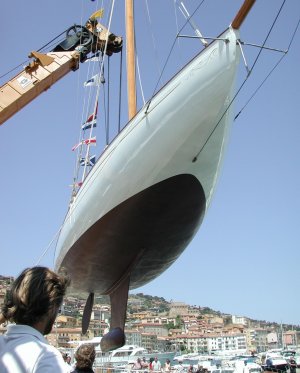
Probably a silly question - headsail sheets

See my post 5 above. And 17. Yes I started with manila - lightly tarred. Yacht Grade for racers and Number One for hoi polloi like me. It came in "inch and quarter" or "inch and a half" and you bought it by weight.
Four strand tarred hemp for shroud lanyards and buoy ropes ( you picked up the buoy and took in on board and hauled in the rope to find the chain, which you made fast round the Samson post with a lighterman's hitch

Then we went to whilte Polyester three strand. Plastic buoys came in about this time.

The Youth of Today fret about marinas - what was a Marina? ;)

You must be very, very old.

Questions

What's this Samson Post thing?

Surely everyone was malnourished then, except for the Hoi Poloi, so everyone was a 'lighterman'. Presumably the young ladies would hanker after being 'lighter girls'

Rope sold by weight - quite sensible, even today - strength and elasticity are a function of weight, not 'size' as size is a function of construction.

The first synthetic climbing ropes, of which I was aware, made by Bridon, were No 1, 2, 3 and 4 were 3 strand nylon. But we used a length of thin hemp round the waist, 4 or 5 wraps, to which the No 4 was attached using a Tarbuck knot.

Jonathan
 
I adhere to the rule that headsail sheets should be blue. But having replaced one sheet due to chafe I now should replace the other. It has been quite handy not having the port and starboard sheets identical, but it looks odd.

I can replace the other sheet (14mm Dyneema with a braid coat) with the twin of the first one, or choose a slightly different form of blue, What would you advise?
Tell me about the dyneema jib sheets please. I find even the braided dyneema is too hard on my delicate hands. Perhaps you have found something a bit softer.

I can see the logic of standardised rope colours on racing boats. Crews do chop and change boats. Particularly if the owner/skipper turns out to be rubbish.

The only thing I colour code is the colour stickers on on each side of the boom. I use the sticky circles used to attach tell tales. Not the complete answer to colregs but often seems to help a bit when tired.
 
🤣
So. Just wondering if dyneema halyards etc on racing boats have now done away with rope spliced wire ?
Almost entirely, I would think. When I came to replacing my wire main halyard this year I was faced with the choice of wire or Dyneema. The trouble with the more desirable Dyneema was that it would have meant changing the old sheaves to suit the new line and avoid possible damage from what the wire might have done to the old one. In the end I opted for wire again, which was slightly cheaper anyway.
 
When I started sailing you could have any colour you wanted for halyards and sheets, as long as it was brown, you bought it by weight. you turned each line end for end at the end of a yard and replaced the lot at the end of the second year!
I think that is the source of an old adage.
When chandlers sold old stock they were getting "money for old rope"
Manilla and cotton rope was for posh yachts, sisal for the budget option.
 
Almost entirely, I would think. When I came to replacing my wire main halyard this year I was faced with the choice of wire or Dyneema. The trouble with the more desirable Dyneema was that it would have meant changing the old sheaves to suit the new line and avoid possible damage from what the wire might have done to the old one. In the end I opted for wire again, which was slightly cheaper anyway.
We replaced a rope to wire halyard with dyneema without needing to change the sheave. Stripping the cover on the live end and choosing a size down from the original polyester part helps. Only the stripped core passes over the sheave, just like the wire one. Unless yours was wire the whole length!
 
Almost entirely, I would think. When I came to replacing my wire main halyard this year I was faced with the choice of wire or Dyneema. The trouble with the more desirable Dyneema was that it would have meant changing the old sheaves to suit the new line and avoid possible damage from what the wire might have done to the old one. In the end I opted for wire again, which was slightly cheaper anyway.
I can understand that. I think I would do the same.

A few boats back, I replaced wire for dyneema on a lifting keel. I had the blocks changed to acetol which were custom made but not too expensive. At least access was easy and no worry about UV.
 
Tell me about the dyneema jib sheets please. I find even the braided dyneema is too hard on my delicate hands. Perhaps you have found something a bit softer.

I can see the logic of standardised rope colours on racing boats. Crews do chop and change boats. Particularly if the owner/skipper turns out to be rubbish.

The only thing I colour code is the colour stickers on on each side of the boom. I use the sticky circles used to attach tell tales. Not the complete answer to colregs but often seems to help a bit when tired.
We use this Liros Dynamic Plus for our jib sheets (white with blue fleck) Liros 12mm Dynamic Plus Dyneema - Sheets, Halyards, Control Lines

Very happy with it. Do a lot of short tacking, and never wear gloves.
 
Our dyneema sheets and control lines aren’t a dyneema related worry. We wear gloves routinely as the loads are very high, not because the ropes are hard to handle. There is no polyester on our boat apart from mooring lines and lazyjacks.
 
Almost every thing goes through clutches so I concentrate on labelling them clearly (and have learnt to only use the term on the label as there are so often different ways to describe the same thing.)

We do have the same coloured headsail sheets so they are the rope on the big starboard or port winch. Teaching port and starboard is about the one thing I like crew to learn instinctively.
 
You must be very, very old.

Questions

What's this Samson Post thing?

Surely everyone was malnourished then, except for the Hoi Poloi, so everyone was a 'lighterman'. Presumably the young ladies would hanker after being 'lighter girls'

Rope sold by weight - quite sensible, even today - strength and elasticity are a function of weight, not 'size' as size is a function of construction.

The first synthetic climbing ropes, of which I was aware, made by Bridon, were No 1, 2, 3 and 4 were 3 strand nylon. But we used a length of thin hemp round the waist, 4 or 5 wraps, to which the No 4 was attached using a Tarbuck knot.

Jonathan
Just for you, Johnathan:

lighterman's hitch - Bing video

You used this with the mooring riser chain round your Samson post on the foredeck because you can tie it in chain and it will not jam.

A Samson Post is what you had on the foredeck if you didn't have a proper running bowsprit with a pair of bitts to make the mooring fast to. If you have a proper bowsprit you have a pair of bitts.

See “bitter end”.

For a good description of what you did before plastic inflatable mooring buoys (and fenders) see Arthur Ransome, "We Didn't Mean To Go To Sea", chapter one.

Started sailing when I was three and bought my first boat in 1969.
 
Last edited:
Can I answer by saying that I initially though about green stbd .. red port sheets ..then bought a full reel of Kingfisher braid (same as Marlow) and replaced all ...

Its not hard to distinguish a port and stbd genny sheet !!
 
Our dyneema sheets and control lines aren’t a dyneema related worry. We wear gloves routinely as the loads are very high, not because the ropes are hard to handle. There is no polyester on our boat apart from mooring lines and lazyjacks.
No polyester covers?

I was taught - no dyneema for spinnakers halyards, too unforgiving if a gust hits. Having said that I've never heard of an accident where dyneema cause an issue with a gust.

Jonathan
 
Just for you, Johnathan:

lighterman's hitch - Bing video

You used this with the mooring riser chain round your Samson post on the foredeck because you can tie it in chain and it will not jam.

A Samson Post is what you had on the foredeck if you didn't have a proper running bowsprit with a pair of bitts to make the mooring fast to. If you have a proper bowsprit you have a pair of bitts.

See “bitter end”.

For a good description, see Arthur Ransome, "We Didn't Mean To Go To Sea", chapter one.

Started sailing when I was three and bought my first boat in 1969.

I was being flippant - the loss of the Samson post is a big loss. The video was news to me - thanks.

I do feel a bit inadequate in the company of those who were brought up to sailing, there is so much old that you know that is often introduced as being new, like soft shackles. I suspect some novel practices are actually ancient. There is certainly a different language, or vocabulary, I (and suspect others) never learnt.

But like soft shackles ( and square topped mains?) I do wonder what other lore is hidden away that might enjoy a re-birth if modern materials were used.

Jonathan
 
Last edited:
🤣
So. Just wondering if dyneema halyards etc on racing boats have now done away with rope spliced wire ?

When we replaced, around 1990, the running rigging for Dyneema on JoXephine of Hong Kong part of the reason was to remove the main halyard which was rope spliced to wire. I was quite used to removing the mast (and the boat yard had got the removal down to a fine art) and I drilled out the old sheave and replaced with a bigger, wider, one. When I last looked I still had the old sheave, which I kept - just in case. It never occurred to me that I could remove the cover..... :). Now..... I would not think twice.

The other motivation to changing to Dyneema was simple - the headsail halyard no longer needed constant adjustment, just occasional adjustment. :). We had 2mm or 3mm, don't recall actual size, lightweight Kevlar spinnaker sheets - which eventually rotted in the UV.

The lessons learnt were then applied to Josepheline and we specified that all the running rigging was to be Dyneema.

Jonathan
 
Last edited:
I was being flippant - the loss of the Samson post is a big loss. The video was news to me - thanks.

I do feel a bit inadequate in the company of those who were brought up to sailing, there is so much old that you know that is often introduced as being new, like soft shackles. I suspect some novel practices are actually ancient. There is certainly a different language, or vocabulary, I (and suspect others) never learnt.

But like soft shackles ( and square topped mains?) I do wonder
I was very lucky; my father loved sailing and messing about in boats generally and shared his enthusiasm. He would come up with things from the Twenties and Thirties (being a penniless postgraduate and then a penniless lecturer he crewed mainly for RCC members).

what other lore is hidden away that might enjoy a re-birth if modern materials were used.

Jonathan
My favourite example is probably the “bulb fin raters” of the 1890s and 1900s…

IMG_1777.jpeg
They were stopped by changes to the rating rules - the International Rule in Europe and the Universal Rule in the USA - because they were too expensive. The materials were not up to the job and the boats destroyed themselves. But I wish people would not talk of “modern hull forms”!
 
Last edited:
Our spinnaker halyard is dyneema. It’s for a code 0 too.
Oddly whilst I was advised to keep a non-dyneema halyard for a spinnaker our screecher had a dyneema halyard and the first had a 'torqued' 'non twist' single luff cord (not sure what the correct term is) and the second had 2 dyneema luff cords, separated by about 50mm and both furled round their own luff. The halyard had a polyester cover that the clutch slowly chewed and destroyed. I think we wore through 3 halyards for the screecher.

I crewed on a larger cat, 44', on a delivery, crew of 4, and some one took the screecher halyard off the mast winch and the clutch chewed through the polyester cover and the halyard slipped - big time. It was impossible to tighten the halyard (because the broken cover jammed in the mast slot) and similarly we could not drop nor furl it. We had to cut the halyard - all the time the screecher was effectively full. Fortunately we were in open water. Its not a lesson you forget (always keep a highly tensioned halyard on the winch - do not rely on the clutch). But maybe clutches and rope construction has improved.

Jonathan
 
I was very lucky; my father loved sailing and messing about in boats generally and shared his enthusiasm. He would come up with things from the Twenties and Thirties (being a penniless postgraduate and then a penniless lecturer he crewed mainly for RCC members).


My favourite example is probably the “bulb fin raters” of the 1890s and 1900s…

View attachment 169382
They were stopped by changes to the rating rules - the International Rule in Europe and the Universal Rule in the USA - because they were too expensive. The materials were not up to the job and the boats destroyed themselves. But I wish people would not talk of “modern hull forms”!

Cannot resist it - they must have been a devil to anchor - all those 'stays'.

Looks to be in the Med? and looks to be 'recent' - maybe 'invented' by an Oz to win the AC :).

Those of us who are 'Johny come lately's' don't have your depth of exposure to 'yachting' have never heard of 'bulb fin raters' - we have had to cram your many decades into a very few (decades) and either forget or missed so much.

I'm trying to make up lost ground. :)

Jonathan
 
This concept must be new, or 'relatively' new. Sheets and all cordage used to be brown, or maybe straw coloured (and now if you have a 'traditional' yacht you will buy synthetics in the same sorts of colours to match your, genuine, CQR (with the real anchor concealed in a bow locker).

I'm too young, and hence impocuneous, to know but surely the next move was to all white polyester, unless you were flush, thus from south of the border, and it had a coloured fleck in the cover.

Changes then moved rapidly and we had flecks, commonplace and then solid colours - but surely solid colours were 60s or 70s hardly enough time in 'yachting' for it to be a rule (unless you came from the Home Counties - in which case everything had to be blue). Presumably Scots yachts from Glasgow had a different rule and everything was red, not blue. I could imagine Mt Heath would have been keen that 'working' sheets should be blue.

When Dyneema became more common place we bought reels of solid coloured rope and what we did not use, which was a lot, went to other X-99s.

Odd how 'rules' might develop.

Jonathan
There was a period when the colour of a single yarn in a rope indicated the manufacturer.
 
Top