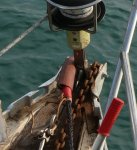
Preventing chafe

Pirx

Well-Known Member
Joined
14 Apr 2018
Messages
144
Visit site
The marina at Stranraer is turning out to be a bit bouncy and I am worrying about chafing mooring lines.

Two suggestions have been larger diameter mooring lines and polythene pipes, or both.

Any thoughts ?
 
The marina at Stranraer is turning out to be a bit bouncy and I am worrying about chafing mooring lines.

Two suggestions have been larger diameter mooring lines and polythene pipes, or both.

Any thoughts ?
Double the lines, add chafe protection. Tie a line from bow through bottom eye of fenders then to stern. Stops fenders bouncing out
 
For the chain strop to my swinging mooring, I made a sleeve from industrial tarpaulin - the stuff lorry sides are made from - just cut a rectangle, fold it over and run it through the sewing machine. This seems to cut out any wear in the rope tail.
 
My mooring strops have flexible plastic pipes for their whole length (don't know it they are polythene) up to the splice at each end and I can recommend this - however, even the polythene need to be protected from sharp edges e.g. the end of a toe rail.
 
if you take the sting out of the movement with rubber compensators or steel springs, then the rope doesn't move as much and the peak load (which I believe causes most of the chafe) is reduced.

Also, and at risk of teaching you to suck eggs, if you wind your OXO very firmly onto the cleat at every turn, there's less opportunity for it to move around.
 
If you have a lot of stretch, this works well: the rope is tied to the inner red hose, the outer brown hose does not move: as the rope stretches, it brings the inner red hose with itself, friction exists only between the two hoses.
Jeanjeanade.JPG
 
In 'A Manual of Seamanship' extra master Graham Danton has a towrope protected with sheet copper and canvas. Course, you all carry sheet copper....

I like the hose within a hose.
 
You don't define in any detail what causes the chafe - what is the mooring line rubbing on that causes the damage. If the damage is side to side - dyneema will also wear, its abrasion resistant along the length of the fibres - not across the fibres.

You need stretchy mooring lines so you need to accept the lines will move. Dyneema offers some protection but it would be better if the dyneema remains stationary and the mooring line moves freely inside the dyneema sleeve - then the dyneema is unlikely to abrade the mooring line. Most attempts at removing chafe are short term - as the chafe protection is left to move - and it will eventually wear out or through - though Dyneema if used correctly is excellent.

If the movement is back and forth - then a simple stationary flexible piece of hose pipe with the mooring line threaded through will minimise chafe - and its cheap.

The trick is making the dyneema sleeve, or hose pipe, stationary at the point (or area) where the line abrades and allowing the mooring line to move freely inside the 'tube'.


You could spend the next few evenings making yourself some hybrid ropes - splice dyneema to your choice of mooring line. The mooring line will provide the stretch and the dyneema you will judiciously position to accept the place of wear - noting the wear needs to be along the fibres for dyneema (not across the fibres).

You mentioned one suggesting is bigger mooring warps - they will have reduced stretch and may result in a different sort of damage from increased snatch loads. Adding springs or rubber compensators, see RJJ's post, would be the solution to the new problem.

Jonathan
 
Last edited:
You mentioned one suggesting is bigger mooring warps - they will have reduced stretch and may result in a different sort of damage from increased snatch loads.

Jonathan
Yep! Had 4in dia braided in one of the notorious Porthleven storms. Took the hatch coaming out of the deck, and another time a ring out of the quay. Excessive weather though.
 
Top