Power to an onboard Rasberry PI (as used for nav)

bluerm166

Well-Known Member
Joined
29 Sep 2009
Messages
1,119
Visit site
If you use a Rasberry Pi for onboard navigation ,say with OPEN CPN,how do you power the Pi ? The official power supply for a 4B is rated at 5.1V / 3 amps.
Do you use an adapter with a high rating in a typical 12v 'cigar' outlet ,an ordinary adapter e.g. 2.1 amp or some other method.(other than use of an inverter available on board) ?

Seems that PI sellers who have had stock are now lowering their prices in anticipation of the forthcoming refreshed stock.
 
Last edited:
I've used things like this and found them to be reliable although that particular one is over the top in terms of power if only driving a Pi. A 4A version should be ok. It's just a simple buck DC-DC convertor but they seem to handle any transients very well so the power to the Pi is stable.
For more protection then some sort of UPS for the Pi is worth investigating to go between the Pi and the supply. I'd try to have it on its own switch/fuse/breaker at the power panel.
 
Last edited:
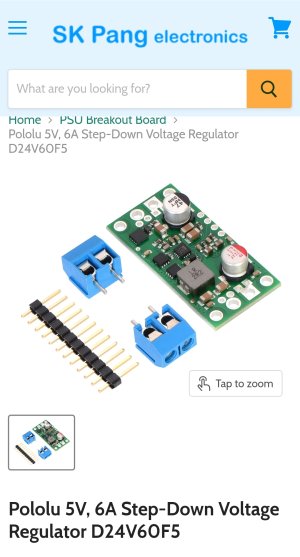
I'd use one of the SJPang step-up step-down power converters wired direct to a breaker on the main switch panel... No connection to the company but its where I've bought a lot of Pi stuff including their Pican-M which is great for NMEA2000 connectivity.


PSU Breakout Board

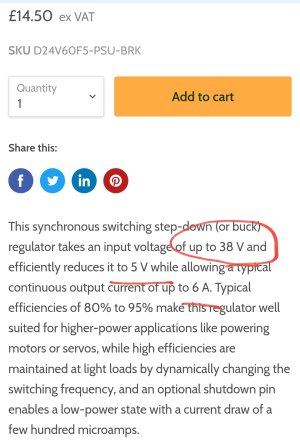
How about their 'up to 38v input step down to 5v 6A'


Screenshot_20230701-144137_Samsung Internet.jpg
Screenshot_20230701-144212_Samsung Internet.jpg
 
I use a dedicated, Blue Sea Systems USB socket. It's rated 4.8A constant voltage. Bought for Pi3 but seems to work for well over 24 hours at a time for us. Expensive but all I knew at the time.
 
I'd use one of the SJPang step-up step-down power converters wired direct to a breaker on the main switch panel... No connection to the company but its where I've bought a lot of Pi stuff including their Pican-M which is great for NMEA2000 connectivity.


PSU Breakout Board
That would certainly do the trick but you'd want to consider protection of some sort like a box or encapsulation. Clearly very easy to do however.
 
You could yes but these are switching regulators and consequently can generate quite a lot of noise. Consequently I prefer to keep mine quite separate from the Pi. Furthermore the newer Pis run quite hot as might the power supply so if they're in a box together you'll need to remove that heat. Again an easy problem to solve but it should be considered.
 
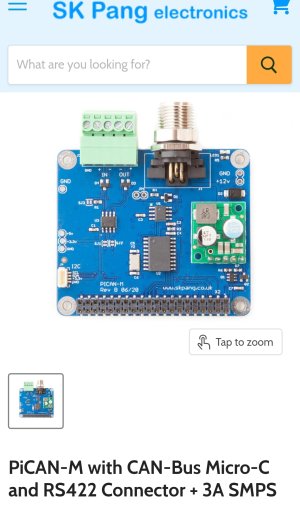
If you're going to end up connecting the Pi to NMEA2000, SKPang even provide a board that will take the power for the Pi from the NMEA2000..

Screenshot_20230701-145937_Samsung Internet.jpg

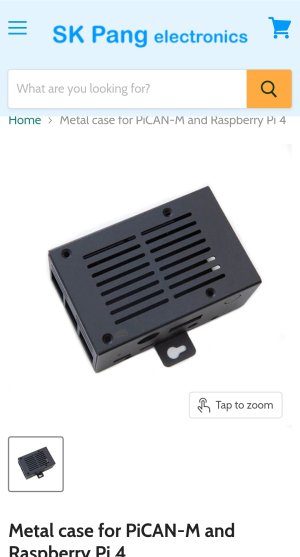
Screenshot_20230701-150012_Samsung Internet.jpg
 
I've used things like this and found them to be reliable although that particular one is over the top in terms of power if only driving a Pi. A 4A version should be ok. It's just a simple buck DC-DC convertor but they seem to handle any transients very well so the power to the Pi is stable.
For more protection then some sort of UPS for the Pi is worth investigating to go between the Pi and the supply. I'd try to have it on its own switch/fuse/breaker at the power panel.
The second one is exactly what i have used for three years with no problems for my Ocpn using a Rpi4b. My pi is in a small drawer with an extract fan which keeps the temp down nicely.

Cheap as chips so buy a spare.
 
I use a Pi4 running Navionics on Android 11. The display ( which replaced a Raymarine C120) is a Beetronics 10" touchscreen which runs on 12vDC and has a USB output which powers the Pi.

NMEA0183 and AIS data feeds to the Pi via onboard wifi.
 
lots of useful info on this thread. But what doi you all use to generate wind, boat speed and depth inputs?

for that matter how do you get radar and ais overlay?
 
There is a very simple way to do this ....

A SBEC ..... a simple small unit that reduces voltage to 5V and can be bought at various max amp ratings.

They are reliable - we use such to drop our LiPo / LiFe batterys in models down to the 5V needed for our Receivers. If we can trust such to work in models that cost from 10's to 1000's of euros .... then a Pi is no problem at all.

Here's example :

https://www.amazon.com/fosa1-Regulator-Switching-Stabilizer-Replacement/dp/B08K4GGP6C

More ....

Amazon.com : ubec dc/dc step-down buck converter - 5v 3a output

Nothing fancy needed .... just supply 12v or if you have 24v .. to the input and let the diddy little SBEC do its job ..... many have 3 wire output - ignore the yellow / white signal wire - its not needed.
You can get these in dual output as well - I have dual output that handles up to 20A for my gasoline models ...
 
Many thanks to all responders for this array of useful suggestions from those with first hand experience .Its a learning curve on a detailed project but plainly rewarding.
Seems that fixed step transformers are straightforward but would require soldering which I am not good at in the desired quality.
It is noticeable that Open CPN runs beautifully on UBUNTU where I am testing it on PC compared with a Windows 10 installation or Android tablets .
 
any comments on how you get an onboard data feed of boat speed, depth, ais, radar? are all these multiplexed in some way and then fed into the open cpn software?
 
any comments on how you get an onboard data feed of boat speed, depth, ais, radar? are all these multiplexed in some way and then fed into the open cpn software?

I use NavMonPC to combine up to 4 NMEA inputs to feed the combined data to OpenCPN.

This is on a Windows PC don't know if NavMonPC runs on rasberry pi
 
OpenPlotter3 on the Rpi4 has a neat Serial App which sets up the connections between the Signal K server, Ocpn & the Usb inputs. Op3 makes it easy as everything you need is in the image.

In my case i use a Quark gps receiver which feeds direct to th Pi using a single usb port. Ais could be received over this but i have not had much sucess with the Quark ais & anyway i moved to a transponder.

I also have two usb to Rs422 adapters plugged into the Pi. One is for AIS from my DigitalYacht transponder at 38.4kb, the other feeds information to my Simrad autopilot. The Simrad also has a feed of my nmea 0183 stuff (speed, depth, wind etc from my St60 instruments). I don't need this on Ocpn but it would be trivial to arrange.

Can't speak for radar as i have a dedicated Furuno box.

Plenty of control over what happens, for instance i filter what is sent to the autopilot from ocpn.

Takes some time to get your head round but once sorted its very stable. I'm always once release behind on ocpn to be sure its well debugged 🤫
 
The hard bit is to deal with power being switched off accidentally.

Does anyone have a small UPS which can communicate the requirement to run 'shutdown -h now' to the Pi?
 
Top