Plumb bow stupidity

I just watched a Beneteau 41.1 charter boat lifting it anchor. The anchor came up upside down so the girl on the bow let it down again and is smacked into the hull. She powered the windlass up and it came up upside down again. She lowered it again and banged the hull hard for a second time. Who thought it was a good idea to have plumb bows? If you have an extended bow roller to place the anchor further forward the offerings from the production boat manufacturers are often pretty flimsy affairs.
We have a traditional raked bow with a massive bowroller. We often bring up the anchor and it's full of mud or sticky sand. We dangle the anchor at the surface and motor along at low revs to clean the anchor. How do you do this with a plumb bow?
Actually, Plumb Bows are not new, they have just come back into fashion! I don't have a problem with the anchor on my Heard Falmouth Working Boat with its Plumb Stem. In my opinion, they are not stupid.

www.solocoastalsailing.co.uk
 
Last edited:
Besides the anchoring aspect – a boat with a plumb bow has a clear disadvantage in this type of mooring, very common in the archipelagic regions of Scandinavia.
IMG_5555.jpeg
 
I always feel that the raked bow, apart from looking more graceful, probably gives a “variable rate” kind of cushioning when ploughing into waves. …akin to the suspension on some vehicles.
Not necessarily. It is not a subject I have explored myself, but when a raked bow meets a wave, it will be pushed upwards and induce a pitching movement to the boat. A plumb bow can cut through a wave, especially since the entry will be finer. This is obviously a complex problem but I would guess that a modern bow is inherently faster and more comfortable, though the current wide sterns may act to counter this, and the shallow forefoot can be a problem in some seas. I was impressed by the performance of a pair of modern First 30s that I saw beating to windward while I was struggling against short seas off Zeebrugge. Of course, a heavy boat with a full bow, such as a Nic 32 will give a comfortable ride, but very slow compared to any design of the last thirty years.
 
Not necessarily. It is not a subject I have explored myself, but when a raked bow meets a wave, it will be pushed upwards and induce a pitching movement to the boat. A plumb bow can cut through a wave, especially since the entry will be finer. This is obviously a complex problem but I would guess that a modern bow is inherently faster and more comfortable, though the current wide sterns may act to counter this, and the shallow forefoot can be a problem in some seas. I was impressed by the performance of a pair of modern First 30s that I saw beating to windward while I was struggling against short seas off Zeebrugge. Of course, a heavy boat with a full bow, such as a Nic 32 will give a comfortable ride, but very slow compared to any design of the last thirty years.
from the brief research i di, it appears that plumb bow boats dont actually have a fine entry. they have fuller bows due to their reduced reserved bouyancy
 
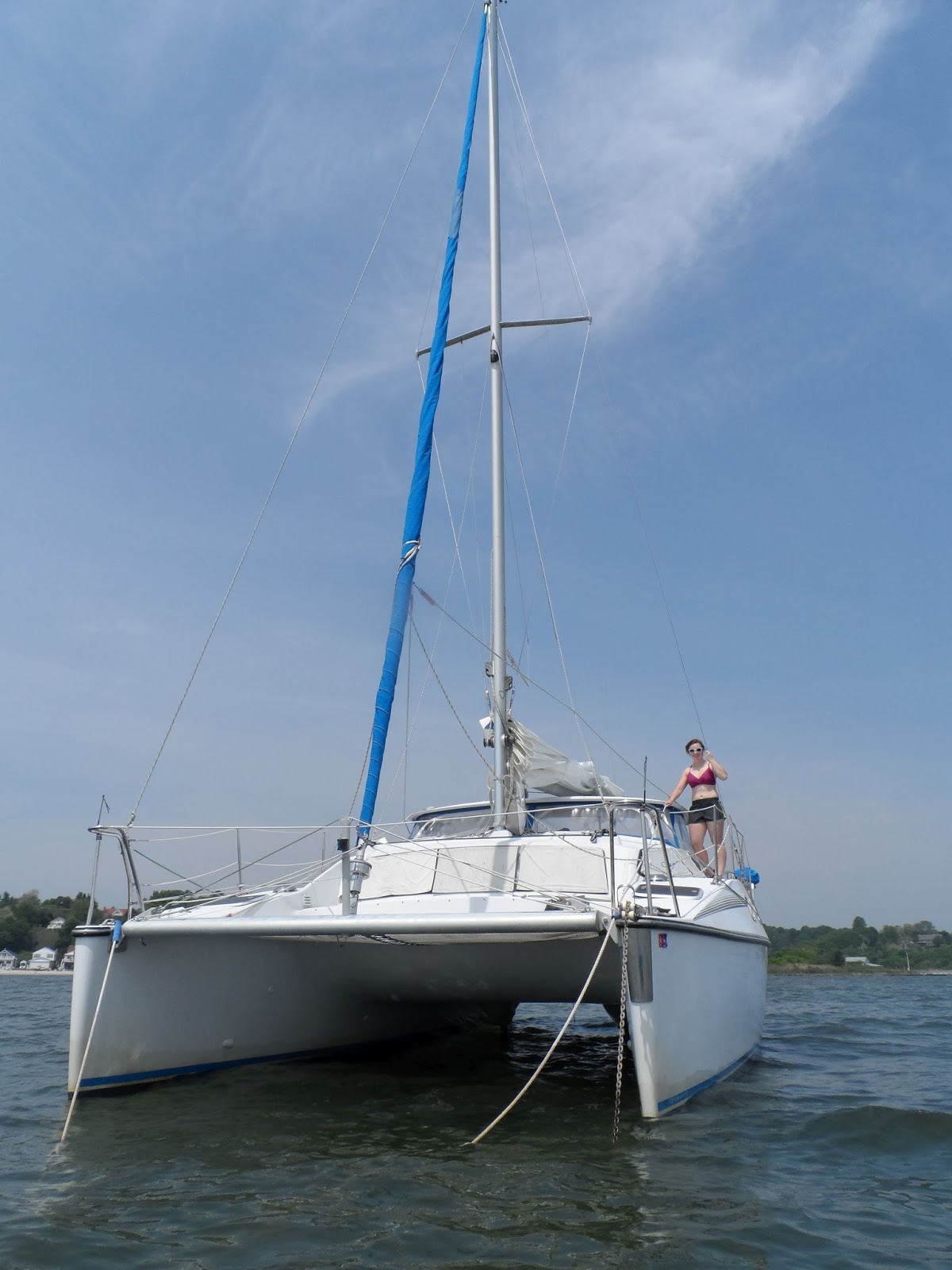
You have a cat. Presumably the windlass is in the middle away from the bows?
No. The windlass is just behind the bow and the chain locker is in the bow, some distance back. Some have an anchor on each bow.

The boat is >20 years old, no dings.


The roller does protrude just a little. Of course, since you use a roller, the rode is not under tension on the roller except during break-out. That is a 35# anchor, so appropriate for a 34' cat.
Manson+Supreme+Low+Res.jpg
 
My understanding (and please add 'in my understanding', 'in my opinion', 'from what I've read' etc throughout...) is that plumb bows are faster simply because they maximise waterline length, which reduces wave-making drag at any speed when it's significant, as well as increasing the potential maximum speed.
Once you fix on a plumb bow, if you carry the shape at the deck down to the waterline you get a very thick entry and, in a shallow hull, a fairly hard chine towards the bow, which causes lots of drag. So designers go for a flared bow with a fine entry.
If you compare this to a hull of the same length with a.bow overhang, there's potentially more buoyancy there because you've got the chin of the bow in the water as well as the wider part up towards the deck. The overhanging bow only has more buoyancy if it's carried forwards to make a longer boat.
The designer Phil Bolger pointed out that reducing wetted area is great but it often tends to degrade the performance of the boat in other ways, by reducing lateral resistance or stability, so it's not worth pursuing too much for its own sake.
 
No. The windlass is just behind the bow and the chain locker is in the bow, some distance back. Some have an anchor on each bow.

The boat is >20 years old, no dings.


The roller does protrude just a little. Of course, since you use a roller, the rode is not under tension on the roller except during break-out. That is a 35# anchor, so appropriate for a 34' cat.
Manson+Supreme+Low+Res.jpg
A quick look round the marina would suggest that your bow roller does extend considerably more. than most. Regardless of how plumb the bows are. Although, I admit, it seems that 20% of those in #64 do have an extended roller
 
Last edited:
Besides the anchoring aspect – a boat with a plumb bow has a clear disadvantage in this type of mooring, very common in the archipelagic regions of Scandinavia.
IMG_5555.jpeg
I am not sure that I would feel happy making that final "leap" on to those slippery looking rocks. But in its favour, the boat with the plumb bow has got his ladder close, second only to the MOBO :( :rolleyes: :eek:
 
But in its favour, the boat with the plumb bow has got his ladder close, second only to the MOBO
Looking closely, you will notice that the HR in front has its ladder folded back. Extracted to full length it will make stepping ashore or aboard quite convenient.
Of course, the photo was just to illustrate this type of mooring, which many here are not familiar with.
 
Our bow isn’t plumb, but it’s steep. In our case it is very fine, the amas even more so. If you were foolish enough to be disporting yourself on the front half of the boat whilst going to windward/reaching, in a brisk breeze, you are going to get wet. Swimming trunks would be more appropriate than waterproofs, just give up early, don’t fight it😄 the cockpit, it’s rare to be splashed at all. Anchor wise, the roller is on the starboard front beam. We don’t carry an anchor there, they live in the front locker like any other boat, but that’s where we deploy and recover from. If it’s muddy, we can park it there if we want to, and bearing in mind the previous remark, it's usually clean after 5 minutes. I daresay the boat isn’t much wetter than that rather handsome craft above. And if it’s bowsprit top trumps, they have us beaten!
 
from the brief research i di, it appears that plumb bow boats dont actually have a fine entry. they have fuller bows due to their reduced reserved bouyancy
I’m not sure that I follow that. It looks to me that for a given overall length and with the same beam, the boat with the longer waterline length will have the finer entry, regardless of the shape of the topsides.
 
I’m not sure that I follow that. It looks to me that for a given overall length and with the same beam, the boat with the longer waterline length will have the finer entry, regardless of the shape of the topsides.
Some boats do have fuller underwater sections, carrying their buoyancy further forwards. Avoids that rather odd posture that old 1/4 tonners used to have when heeled.
 
Looking closely, you will notice that the HR in front has its ladder folded back. Extracted to full length it will make stepping ashore or aboard quite convenient.
Of course, the photo was just to illustrate this type of mooring, which many here are not familiar with.

Love the Archipelago .. will be back in Stockholm Archipelago later this year .... maybe meet somewhere ?
 
I’m not sure that I follow that. It looks to me that for a given overall length and with the same beam, the boat with the longer waterline length will have the finer entry, regardless of the shape of the topsides.
The new shaped plumb bow Ben Oceanis 38.1 anchored next to us has a very blunt bow. At the waterline its not so blunt but as you rise up the bow it get progressively wider to the point at deck level where it is considerably wider than the bow roller fitting. You need reserve bouyancy somewhere. If it's not in an overhanging bow then it needs to be in the wider section above the waterline. Overhanging bows don't need to do this and can have a fine entry and carry the shape all the way up to deck level. If you Google some of the yacht design pages online it is well documented
 
Top