Plastic Sea Cocks

That's a long-winded way of saying "plastic" :)

Pete

No. It's not.
Your hull is likely a composite matial called FRP or GRP. If the seacocks in question were only... "plastic" they would be brittle and unsuitable. Without the matrix of glasss fibre, so would your boat's hull. Altho you can call it anything you wish...
:rolleyes:

Note B: the original RC Marine line of Marelon fittings and valves from Australia were purchased by Forespar in the 80's. At first there were just some label changes, and later more differently-engineered products were produced, and then in the 90's a new style of seacock was introduced that's much stronger than the original ones.
(Yes indeed the old style handles will break IF you do not keep the ball valve lubed up and worked regularly. It appears that the ball material is very slightly hydroscopic -- gets tighter over the years. Friction increases.)

I have the newer ones, installed in '02, and still working just fine. They are often referred to in the trade as the "OEM" model valves, as they are not usually marketed directly to end users, but rather sold and installed thru boat yards and thru boat constructors. They also use a different thread than the other/older valve models ( "buttress thread").

I have installed bronze thru hulls and like them fine, but slightly prefer the Marelon version to save weight and avoid electrolysis worries.

LB
 
No. It's not.
Your hull is likely a composite matial called FRP or GRP. If the seacocks in question were only... "plastic" they would be brittle and unsuitable. Without the matrix of glasss fibre, so would your boat's hull.

And what do you think the "P" in GRP and FRP stands for? :) And yep, my boat is made of it, hence known to some as a "plastic gaffer".

I'm not for a moment saying there's anything wrong with Marelon seacocks, and I'm sure there are more precise engineering terms to describe their material, but as a day-to-day phrase I don't think "plastic" is inaccurate.

Pete
 
Thanks for the URL's, some thoughts.

The first picture in the first URL is a Forespar Marelon through hull the second picture isn't, as far as I can tell, although he claims it is. The third picture indicates brute force has been used.

The second URL looks like an old version where the screw holding the handle on was too small ( he said, I don't know if that's true) and the handle came off.

The third one used too much force and the handle came off.

The fourth says 'Last summer I had a Marelon handle and part of the square drive break off in my Head's sink drain when I went to open it.' I assume it may be for the reason above but he doesn't say what he did.

Only one admits to using brute force but I suspect they all did for one reason. All throughulls including Marelon should be opened and closed every month. I suspect they hadn't done that, hence the force.

I think one of the comments says it all: 'I have several Marlon valves that are tight to stuck. 'The boat sat on the hard for over two years before we bought her and got her in the water'. So he didn't open and close them.
 
. All throughulls including Marelon should be opened and closed every month.
.

Whaaat? I should give up sailing now then. Nice if you live near the boat or do lots over the Winter but if any seacocks I use needed that I'd chuck them now.

If you can't rely on an eased and if necessary lubricated seacock opening by hand only after 6 months non-use then it's a rubbish seacock in my view.
 
>Whaaat? I should give up sailing now then. Nice if you live near the boat or do lots over the Winter but if any seacocks I use needed that I'd chuck them now.
If you can't rely on an eased and if necessary lubricated seacock opening by hand only after 6 months non-use then it's a rubbish seacock in my view.

I'm only passing the manfacturers' recommendation on. If you want to ignore it or don't want to spend the time going to the boat then you might have a problem. Our travel time to the boat every month is one and a half hours each way.
 
If you can't rely on an eased and if necessary lubricated seacock opening by hand only after 6 months non-use then it's a rubbish seacock in my view.

Stopcocks for domestic water supply and gas supply of adequate quality for the duty lie untouched for years but remain functional.

Seawater on the other hand has a high salt content which becomes problematic when the water evaporates leaving solids or corrodes metal. If seawater doesn't provide a sufficient problem on its own nature lends a hand with a variety of marine growths.

This means that valves must be periodically exercised, cleaned and lubricated if they are to remain functional. Plastic construction can only eliminate the corrosion problem.

133070794.jpg


Metal construction doesn't prevent mechanical failure, only make it less likely.
 
The one downside I heard about the Marelon valves is that the handles can break off, and from what I heard, the handle is not a renewable item.
But thats just heresay from another forum, but may be worth while investigating

http://c34.org/bbs/index.php/topic,2729.0.html

Marelon is not "plastic" here in the USA, since there are many "plastic" ball valves available in hardware stores that many times get incorrectly used.
 
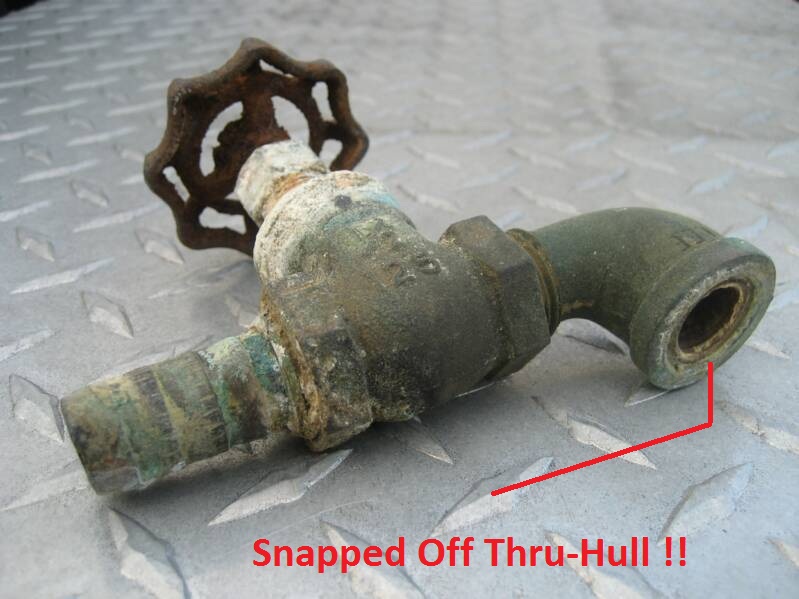
That looks suspiciously like a gate valve which has NO place on a boat anyway.

Stopcocks for domestic water supply and gas supply of adequate quality for the duty lie untouched for years but remain functional.

Seawater on the other hand has a high salt content which becomes problematic when the water evaporates leaving solids or corrodes metal. If seawater doesn't provide a sufficient problem on its own nature lends a hand with a variety of marine growths.

This means that valves must be periodically exercised, cleaned and lubricated if they are to remain functional. Plastic construction can only eliminate the corrosion problem.

133070794.jpg


Metal construction doesn't prevent mechanical failure, only make it less likely.
 
Plastic seacocks are not accepted in the engine space by the MCA for coding purposes - read into that what you will.

Plastic seacocks come ino their own in metal (steel and aluminium) hulls. In GRP hulls they have no advantage for corrosion reasons over DZR.

So they don't accept plastic hoses either?
 
I will be replacing all of the skin fittings and ball valves at our next haul out with these TruDesign ones.
PT.

I have just fitted these for the heads inlet and outlet. seem like a very good product, less bulky than the Forespar range and more versatile as you can purchase 45 degree elbose as well as straight or right angled hose connectors which can help with installation.

With any "plastic" (glass fiber composite) seacock, just make sure you get the required bore / through flow you need. As these fittings get their strength from thier thickness of consturction, you will most likely need to make the hole in your hull larger to accommodate a plastic seacock giving the same bore as the equivalent metal one you are replacing.

Rob
 
......With any "plastic" (glass fiber composite) seacock, just make sure you get the required bore / through flow you need. As these fittings get their strength from thier thickness of consturction, you will most likely need to make the hole in your hull larger to accommodate a plastic seacock giving the same bore as the equivalent metal one you are replacing.

Rob

Thanks for the heads up Rob. This is something I was completely unaware of. Will have to look into things a lot more closely then.

Cheers, PT.
 
Like many people i may store "things" near seacocks, when things get rough, things fly about, i'd rather they hit good quality bronze fitting than a plastic one. I don't know off hand the melting points of marleon vs bronze , i guess the metal will be higher.
 
Like many people i may store "things" near seacocks, when things get rough, things fly about, i'd rather they hit good quality bronze fitting than a plastic one.

For all you know, the "plastic" fitting may be stronger. Certainly it's a more robust shape, compared to the usual arrangement of a ball valve perched on top of a threaded skin fitting. If glass filled plastic is automatically weaker, aren't you worried about those same "things" punching a hole through your hull?

Pete
 
For all you know, the "plastic" fitting may be stronger. Certainly it's a more robust shape, compared to the usual arrangement of a ball valve perched on top of a threaded skin fitting. If glass filled plastic is automatically weaker, aren't you worried about those same "things" punching a hole through your hull?

+1

...and I assume Stevensuf also has the inconvenience of keeping all his seacocks closed to ensure that when all the loose "things" in his bilges shear the much more vulnerable hoses (likely plastic) connected to them off he doesn't get a boat load of seawater.
 
Wow, I am quite impressed by those. Particularly the part where they put an oxy-acetylene torch on one for a minute or so and set it on fire, then it goes out straight away and is still usable. I may have to re-evaluate my plans to replace all mine.. :confused:
 
Top