Silvercloud
Well-Known Member
And a change of underwear perhaps 



Silvercloud will know the sequence for deploying the chute better than me but I personally would stall the plane first then deploy the chute to reduce the speed and stress on everything. I think they have fitted it (parachute) to the new Cirrus jet too. Nice to have.out of idle curiosity, is there any video or simulation of how the thing works? I mean assuming you are doing some speed (dunno but guess over 100kph or 100mph??) and something turns sour, engine dies say.
You are still doing some reasonable speed (what say 70?) and you pull the chute. Thing goes off to the back, cutting speed, balancing the whole plane and slowly bring it down to a 4G hit (that's going to hurt a bit..)
Assuming you land on a field or something flattish, do you actually save the plane or is it a write-off?
sorry many Qs...
V.


The parachute is deployed by a rocket and the whole thing is stored in a small compartment behind the rear seats.
There is a roll cage built into the aircraft and the seats are specially designed to absorb the impact.

. . . and there's a packet of Hamlet cigars supplied in the glove compartment.

I would maybe slow down ( if there is a speed requirement ) but a stall. No! That would simply increase your rate of decent and the chute is there to do the opposite !Silvercloud will know the sequence for deploying the chute better than me but I personally would stall the plane first then deploy the chute to reduce the speed and stress on everything. I think they have fitted it (parachute) to the new Cirrus jet too. Nice to have.
From memory I think the max deployment speed is between 130-140 kts.
I used to own and fly a Cirrus SR22 G2 N222SW and they are a great aircraft.
I kept mine a Rochester in Kent and could be in the sout of France in 3 hours.
The ballastic chute is a "last resort" option when there is no where to go after mechanical failure.
Many lives have been saved this way.
Yes that right The stated speed is 130-140 kts but as you say there have been deployments at much higher speeds with no problems.
I guess its a case of pull the handle at any speed if all else fails.
I meant to slow it down just before it stalled, as it starts to flutter, and pull the chute not when it had stalled fully that the wing is going over lol.I would maybe slow down ( if there is a speed requirement ) but a stall. No! That would simply increase your rate of decent and the chute is there to do the opposite !


Three weeks before I did my parachute training course in 1975 a parachute got wrapped round the tail of a Cessna 182 at Ashbourne in Derbyshire on what I am led to believe was the last day of operation of the club which was being shut down because of noise objections. Nobody could get to the suspended parachutist and the aircraft was struggling for stability towing him around...then the suspended parachutist's reserve canopy popped and upended the aircraft. There were three in the aircraft, and the outside parachutist above the now descending aircraft.
When it impacted (nose down and semi inverted) the three in the aircraft suffered quite serious injury, but survived and made full recoveries. The student whose reserve they all came down on was relatively unhurt. Remember this is all suspended from a 24ft diameter small reserve canopy. The student went on to have a career in the RAF as a navigator/WO.
There is a somewhat grainy photo somewhere of the incident but I couldn't find a copy on line. Only the pilot qualified for a golden caterpillar badge as he had no parachute, and was the only occupant of the aircraft with no intention of jumping...but his life was saved by a parachute.
I think the cause was deemed to be excessive air speed at the point of exit from the aircraft (You stood on a step on the wheel and held the wing strut before release). When the apex of the canopy deployed from the static line deployment bag it whipped back and got wrapped round the tailplane.
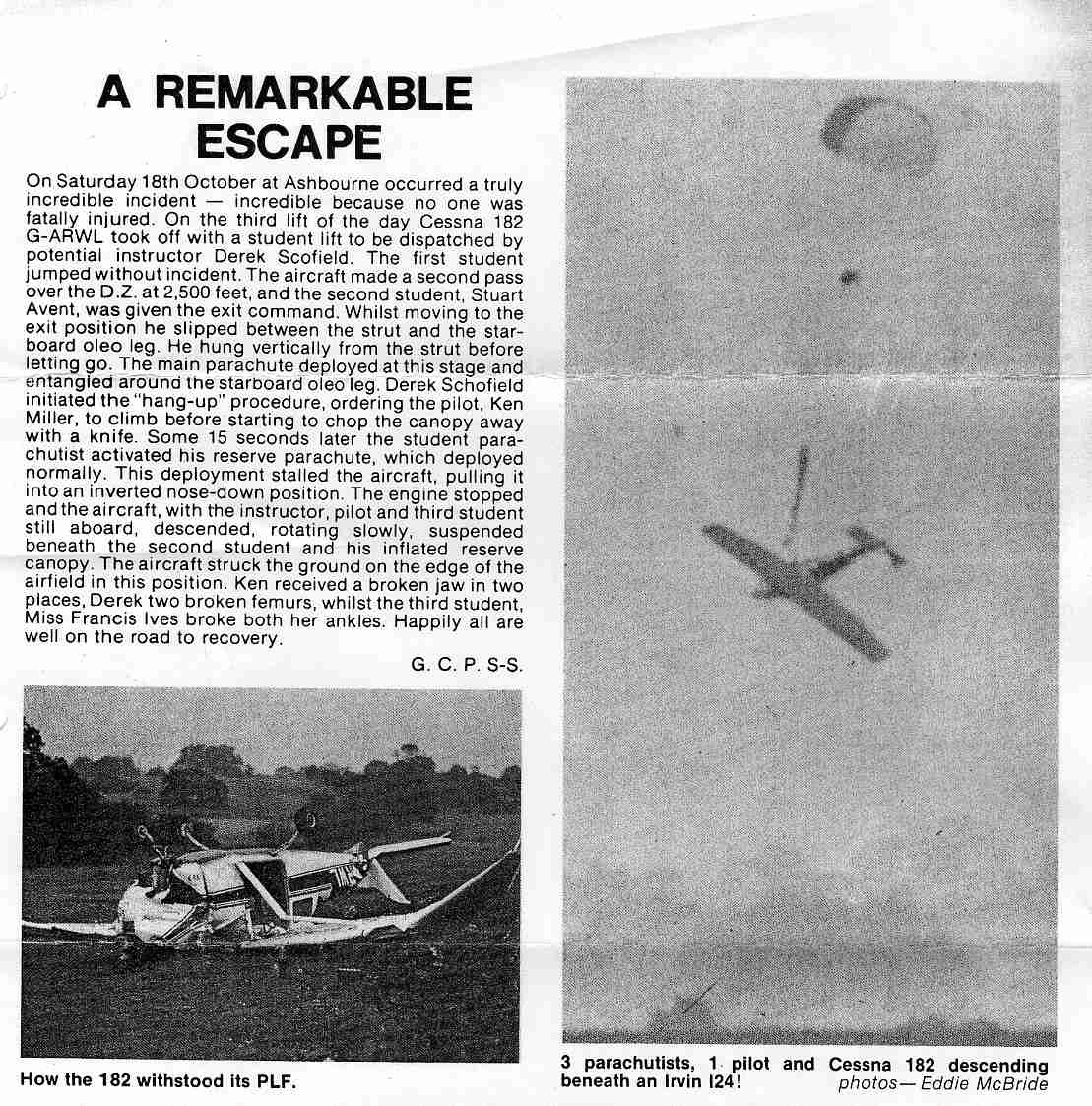
Article written by Charles Shea -Simmonds who was an old boy of my school and he did a display into our rugby field maybe around 1969-70..before square parrot shooting began.


