Pile Mooring -- Single Handed

There was a poll recently on YBW on member's yacht size.

178 owners voted and only 5 owners had a yacht larger than 15m. 54' is 16.4 metres.

To most people 54' is quite a large yacht and a monster to some (if not many)

Jonathan
Yacht size can generally be equated to the depth of pockets of the owners and the type of sailing they do and have experience of.
 
Yacht size can generally be equated to the depth of pockets of the owners and the type of sailing they do and have experience of.

I’ll offer you my friend, came sailing with me a few times from zero experience in anything that floats, he decided he wanted his own boat, straight to a powerfully rigged 45ft as his first boat after literally 6 trips with me. I tried to talk him into something more sensible but he wasn’t having any of it.

I delivered it home with a friend with him as crew and then let him get on with it, we all thought it was a disaster waiting to happen particularly as he hadn’t done any nav courses either and wouldn’t be told anything. A lot of iPhone nav and trust in electronics.

However he quickly got the measure of it, nothing bad happened and he upgraded a couple of years later to 55ft, again with a massive rig, 3m keel etc.

The last I heard he was considering one of those huge carbon cats you see in the back of the YW super yacht supplement that cost as much as all the boats in your marina added together. I’d be surprised if now he’s set his mind to it, it doesn’t happen.

Obviously he’s an unusual case but they are out there standing behind the wheel of some very big boats!
 
Yacht size can generally be equated to the depth of pockets of the owners and the type of sailing they do and have experience of.
The fantasy yacht thread says more on that subject. Not many of us would opt for anything truly enormous if there were no constraints. Our fantasy yacht is 2ft longer than our current one.
On topic, I’ve been 1st mate on a 57 footer coming to a pile mooring in the hamble, with the best parking skipper I have ever met on the helm. He had a line rigged between the 2. And a second looser line tied to the fore and aft lines. The boat came to a half kind of resting on the bigger tighter line, the looser line was boat hooked, fore and aft lines dropped over cleats, the kettle went on. If there was any more to it than that, it wasn’t readily apparent.
 
There was a poll recently on YBW on member's yacht size.

178 owners voted and only 5 owners had a yacht larger than 15m. 54' is 16.4 metres.

To most people 54' is quite a large yacht and a monster to some (if not many)

Jonathan
It's only a monster if you haven't experienced it. Which is why I mention that it's not nearly so difficult to handle as people think, who haven't tried it. In most situations, it's easier.

When I bought this boat, 17 years ago, I was actually looking for something a little smaller, as I myself at that time had no experience with anything larger than 46'. But a contract fell through and there were so many good things about this boat (built 2001 and hardly used) I held my nose and did it. Never regretted it and never found myself wishing for something smaller. As I said, I sail long distances and usually with large crews and need the stowage, tankage, stability at sea, etc.

Actually I am not happy with the stowage on this boat at all. For my kind of sailing, I need a lot more deck stowage, a proper sail locker, storage for large quantities of tools and spare parts, good technical space, workshop, etc. I was actually working with a Dutch architect on a design for a custom built aluminium boat which would have better suited my use case, and with an ice-rated hull for the Arctic. But business setbacks from wars and invasions unfortunately deprived me of the means to realize that project, and now it will probably never happen.
 
I’ll offer you my friend, came sailing with me a few times from zero experience in anything that floats, he decided he wanted his own boat, straight to a powerfully rigged 45ft as his first boat after literally 6 trips with me. I tried to talk him into something more sensible but he wasn’t having any of it.

I delivered it home with a friend with him as crew and then let him get on with it, we all thought it was a disaster waiting to happen particularly as he hadn’t done any nav courses either and wouldn’t be told anything. A lot of iPhone nav and trust in electronics.

However he quickly got the measure of it, nothing bad happened and he upgraded a couple of years later to 55ft, again with a massive rig, 3m keel etc.

The last I heard he was considering one of those huge carbon cats you see in the back of the YW super yacht supplement that cost as much as all the boats in your marina added together. I’d be surprised if now he’s set his mind to it, it doesn’t happen.

Obviously he’s an unusual case but they are out there standing behind the wheel of some very big boats!
Huge carbon cat makes me think, instinctively, disaster waiting to happen, but this may again be a case of prejudice, from someone like me who hasn't experienced it! :D

Great story (y)
 
The fantasy yacht thread says more on that subject. Not many of us would opt for anything truly enormous if there were no constraints. Our fantasy yacht is 2ft longer than our current one.
On topic, I’ve been 1st mate on a 57 footer coming to a pile mooring in the hamble, with the best parking skipper I have ever met on the helm. He had a line rigged between the 2. And a second looser line tied to the fore and aft lines. The boat came to a half kind of resting on the bigger tighter line, the looser line was boat hooked, fore and aft lines dropped over cleats, the kettle went on. If there was any more to it than that, it wasn’t readily apparent.
Very interesting! I think I understand the arrangement you are describing; please confirm:

1. A stouter line (buoyed? floating?) rigged between the piles, fairly taught. On the rings, right?

2. A looser line attached to either end of the regular mooring strops, right? Is this line buoyed?

3. You as crew hooked the second line, and walked it forward to drop on a bow cleat, rinse and repeated with stern cleat?

Something like that?
 
Book the local sailing school to give you a days ‘own boat tuition’ and when the instructor arrives mug him with it.
…..
This is the one situation where I very much doubt that a local sailing school instructor would be very useful (though there may be exceptions).

The OP has had the boat for 17 years so I assume is very familiar with handling the boat in general, and with piles when fully crewed.
The issue here is handling when solo with piles.

I am a great fan of the RYA courses and instructors. BUT the system has one huge hole - solo and short handed sailing. Probably due to the economics of running courses, they are all done with a large crew. And hence all the techniques and practices are done in fully crewed mode.
Coming into pontoons there is an always somebody jumping onto pontoons and multiple handling ropes. They don’t teach solo docking - without stepping off.
And many instructors have minimal experience of solo sailing (where they do this will be from their own sailing, just like others on here).
 
I don't much like the comparison with "monster 4x4's". 54' is not a "monster yacht", and I can and do sail -- and moor -- her single handed, and have been doing so for 17 years without ever so much as scratching another boat (touch wood).

Like you, I prefer sailing in company. We were 7 crossing the Atlantic (on a different boat, a 67-footer; I was the skipper), and will be 4 or 5 this summer going to the Faroe Islands on this boat. We were 5 for the whole summer in the Arctic. This boat is the right size for long distance sailing, with crews like that. Especially when you sail in places were you have to be fully autonomous for a month or two at a time, and need tankage and stowage for that. I single hand not so much for fun, but because I spend 4 or 5 months a year on board, and don't always have company.

Pile moorings are the one type of mooring I don't have much experience with, and I'm grateful to everyone who has chimed in with helpful tips and useful criticism (as opposed to snarking). It helps me a lot to think this through. Keep 'em coming!
Absolutely the boat makes sense for your long range / high latitudes cruising. Just a challenge for the Hamble piles.

I assume you have a bow thruster for a boat that size (and possibly could fit a stern thruster if doing more solo harbour hopping).
Do you have a wireless remote for the thruster? This is a game changer for pontoon berthing solo - able to control bow when walking up and down side decks.
Generally should very much avoid use of bow thruster for moorings as can suck pick up ropes into blades and convert a minor issue into an RNLI call-out (real events). But IF VERY SURE there are no ropes nearby and used carefully, this could rescue a situation where nearly got the bow attached and the weight of the boat is getting away from you?
 
I would always try to arrive/leave at a time when you are heading into a current. Maybe a couple of knots or more.

That way you can adjust your engine speed to allow you to easily :
- maintain your position relative to the piles, eg come to a stop alongside while you attach a line;
- creep forward or drop back; or
- ferry-glide sideways.
 
Very interesting! I think I understand the arrangement you are describing; please confirm:

1. A stouter line (buoyed? floating?) rigged between the piles, fairly taught. On the rings, right?

2. A looser line attached to either end of the regular mooring strops, right? Is this line buoyed?

3. You as crew hooked the second line, and walked it forward to drop on a bow cleat, rinse and repeated with stern cleat?

Something like that?
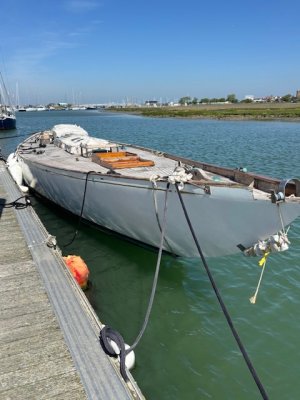
Exactly like that. Buoyed, yes. The boat is this one, please excuse her lack of mast, it came to a sticky end….
IMG_2435.jpegLong keel, pretty heavy gaff cutter, 57ft plus bowsprit. It was a total doddle, just stopped between the piles, in fact left idling ahead as it was spring flood.
 
This is the one situation where I very much doubt that a local sailing school instructor would be very useful (though there may be exceptions).

The OP has had the boat for 17 years so I assume is very familiar with handling the boat in general, and with piles when fully crewed.
The issue here is handling when solo with piles.
Similarly the OP is not going to find many people on YBW with the background to help him.

Out of 178 owners (who contributed to the poll) only 5 had a yacht of a similar size to the OP's. How many people sail a yacht of that size single handed? How many of those single handed owners are likely to use pile moorings?

I noted the OP's 2 comments about needing to be nimble and that its a long way from helm to bow (and back again). Unless he is significantly younger than I think those 2 issues are certainly not going to disappear - they might also become more important. I'd seriously think of a plan B, (and maybe buy a small car or an electric bike) in parallel with the piles. I might also look at how the rest of the piles, and the yachts using the piles, have resolved the issues (and speak to the owners). There will surely be some overlap between the advice given here and practice in the chosen location (and other locations using piles).

Jonathan
 
Never regretted it and never found myself wishing for something smaller.
Well up until now! Now you face the practical difficulties of manoeuvring the boat shorthanded AND the cost implications of a big boat!

Rather than call it a monster truck I’d say it’s a bit like having a Winnebago and trying to park it at your local Tesco! Possible if you pick the right times, easier if you have someone clued up to help you and probably not as scary as it looks after the first half dozen times. Certainly more comfortable for journeys and sleeping a bunch of people than an old Fiesta and a tent, of even a VW Camper but if you needed to to park it somewhere awkward every day it would soon wear thin, maybe to the extent you use if less.
 
What he says is very true though. Driving it to yhe correct spot is a skill, but a one man skill. I couldn’t do this solo on my tri, its too flighty but a 54ft boat will sit where you put it for much longer.
 
What he says is very true though. Driving it to yhe correct spot is a skill, but a one man skill. I couldn’t do this solo on my tri, its too flighty but a 54ft boat will sit where you put it for much longer.
BUT when you nearly but dont quite get something hooked on and you are holding a rope by hand and it JUST doesn't quite reach the cleat on the foredeck, things can quickly get serious when 20 tons starts to drift out.
With a 30 footer easy to pull the rope and get the boat in by hand. 40 foot and any breeze becomes very tricky. 50 foot need to be very careful not to have hand trapped or pulled OB. Could all go very pear shaped quickly, just being 6 inches short to loop over.
 
Last edited:
I'm on a riverside fore and aft mooring which I think is pretty much the same.
I have a buoyed line with snap shackles on both ends and spliced in rings to clip the shackles back on to to make the ends into loops.
My mooring lines end in eye splices, when I leave the mooring I connect the fore and aft mooring lines together using the buoyed line and drop it overboard.
On return I hook the buoyed line and pull it up and over a cleat, hand over hand the line along the side deck and again hook it over a cleat. Then oxo the mooring lines to the bow and stern cleats.
To make hooking the buoyed line over the boat cleats easier, I have made three short lines with eye splices at both ends, one end is cow hitched to the buoyed line, they distributed along the buoyed line to line up with deck cleats.
The advantage you will have over me is that you can leave or arrive with the line at the most convenient side of the boat depending on wind direction, I can only leave or arrive on the river side.
It's easier to do than describe as I've been doing it for 26 years now!
I had the same set up on the Tamar, in a place where any wind with west in it whistled round the headland and blew straight across my mooring. Add to that a strong tidal current and I got to the stage that I’d only try to moor at slack water, leaving only the wind to fight against. I only lasted one season.
 
BUT when you nearly but dont quite get something hooked on and you are holding a rope by hand and it JUST doesn't quite reach the cleat on the foredeck, things can quickly get serious when 20 tons starts to drift out.
+1
Spent only a few weeks on a big boat (a friend s 61' Swan, those from the 80s, IIRC 35 tons?), bring the boat to the exact spot at the right moment and it allows you some more seconds to maneuver ropes and the like, get it even slightly wrong and one has to do it all again, which might be easy but also not easy/impossible, once it has gathered any momentum the human force is irrelevant. Delivered her from the US to Gibraltar via Horta, had only three occasions to moor but it was immediately self-explanatory :)
 
It is not exactly easy but again it’s not impossible, granted a strong cross wind would make life complicated but it should be possible to quickly get a line around the static pile line onto a mid ships cleat. The alternative is to fit a stern thruster to complement the probable bow thruster that can then be set to hold the boat against the taught pile line using proportional thrust. There are many ways to skin a feline.
 
Appreciating the difficulties of berthing single handed, might it be worth paying a couple of locals to assist? Depending on how often the OP berths, it might work out considerably less expensive than the alternative, which appears to be a marina berth. Departure seems less problematic than arrival...
Are there "boatmen" on the Hamble?
 
Absolutely the boat makes sense for your long range / high latitudes cruising. Just a challenge for the Hamble piles.

I assume you have a bow thruster for a boat that size (and possibly could fit a stern thruster if doing more solo harbour hopping).
Do you have a wireless remote for the thruster? This is a game changer for pontoon berthing solo - able to control bow when walking up and down side decks.
Generally should very much avoid use of bow thruster for moorings as can suck pick up ropes into blades and convert a minor issue into an RNLI call-out (real events). But IF VERY SURE there are no ropes nearby and used carefully, this could rescue a situation where nearly got the bow attached and the weight of the boat is getting away from you?
Yes, I have a Sleipner 10hp bow thruster which is incredibly useful. Yes, it's absolutely fantastic for adjusting the bow a metre or two to get ropes on. I don't have a wireless remote and had never thought of that. Interesting idea. Yes, I know all about ropes in bow thrusters, and don't ask me how I know! 🫣

Losing thruster would not be an RNLI callout in any situation I can think of, but I shouldn't say that, or that very unthinkable situation will probably happen! I spring off (and on) whenever it's reasonable instead of using the thruster, and the dinghy makes a great tugboat, if you've got crew to man it.
 
Appreciating the difficulties of berthing single handed, might it be worth paying a couple of locals to assist? Depending on how often the OP berths, it might work out considerably less expensive than the alternative, which appears to be a marina berth. Departure seems less problematic than arrival...
Are there "boatmen" on the Hamble?
You're not the first person to suggest this, and I hadn't thought of it.

We'll see how it goes -- first trial on Saturday! -- and if it seems dodgy, I'll consider this.


I have a secret weapon for this process -- I have a very powerful electric sheet winch right next to the helm position, which I can operate with one hand on the wheel. I'm really thinking that pulling the bow line on board from the cockpit using a leader line on the winch, could be really effective, and enable me to get the bow well secured without every going up to the bow. I use this winch for different berthing maneuvers (besides the jib sheets!); it's really effective.

If I've got hold of a line stretched between the piles, I could loop that over a centre cleat to stabilize the boat laterally. Then if I've got access to the stern line via the loose line, then it should not be that hard to get the stern tied up. I'm starting to imagine this better -- and thanks to all of you for helping me think this through -- and I'm starting to feel a bit better about it.
 
Top