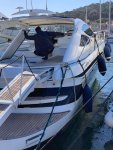
Pershing

I went with Keith Willis from the yachting Expert for the survey, couldn’t recommend him highly enough, kept me updated on the survey day via WhatsApp and produced a defects sheet 6am the next morning.

 
Keith Willis did our survey also and I found him excellent.

As you know we are in Beaulieu-sur-Mer so if you want any local tips do let me know.

For local work I use Didier Lacoche, who is based in St Jean. He is very good, can sort just about anything out, speaks excellent English if your French is average.

I can PM you his email and mobile number.
 
Keith Willis did our survey also and I found him excellent.

As you know we are in Beaulieu-sur-Mer so if you want any local tips do let me know.

For local work I use Didier Lacoche, who is based in St Jean. He is very good, can sort just about anything out, speaks excellent English if your French is average.

I can PM you his email and mobile number.
Thanks, I’m in touch with Didier, he is brokering the boat.
 
Or Google Pershing 53 cap Feret

Pershing 52 Used Boat for Sale 2001 | TheYachtMarket

looks a nice one leagues ahead of anything U.K. PLC has at that L node .

Are you prepared to share the snag list ?

We factored in the bow cushions and soft top when we made our offer, everything else is being made good by the owner.


Remarks
1The fixed firefighting system in the engine room was last inspected in 2018
2The fire flap on the engine room ventilation on starboard cannot close because there are cables from the passerelle blocking the fire flap
3The flares seen on board expired in 2013


TABLE 2 (Operational or service items)

ItemRemarks
1The vertical alignment of the passerelle needs verifying, the passerelle sits low in the passerelle box
2The VHF speaker did not function when tested and the handset cable insulation is in poor condition
3One of the gas struts on the wetbar lid is leaking oil
4The lock for the companionway door is missing
5The cockpit cushions and foredeck cushions are in poor condition
6The material on the sliding roof is in poor condition
7The speed log fitting has broken off and will need replacing
8The surface of the antifouling is very uneven, and this will have a detrimental effect on the hull efficiency
9There is evidence of a minor oil leak on the portside main engine raw water pump
10There is evidence of a water leak on the face plate gasket of the starboard main engine raw water pump
11The aircon unit in the engine room would benefit from a service, the tray needs cleaning, the surface corrosion on the compressor needs attention. The insulation on the treated water pipework needs replacing in places to prevent excess condensation
12The WC in the forward cabin flushed but the water did not drain from the bowl
13The top of the fuel tank in the engine room needs cleaning
14One of the deckhead in the saloon panels is loose, the velcro pad has detached from the back of the panel
15There is some deterioration of the sealant around the windscreens
16The saloon TV did not switch on when tested
17The sealant in the forward cabin shower cubicle needs replacing
18The lense of the starboard nav light is cracked
19There is evidence of a minor leak on the portside main engine exhaust box drain
20The portside gearbox oil pressure sensor was giving incorrect readings, showing max oil pressure even when the engine had stopped


TABLE 3 (Non-essential and cosmetic items)

ItemRemarks
1The teak on the platform was replaced but one step above the platform was omitted
2The teak on the engine room hatch is worn down to the base of the caulking seam
3There is a dent in the stainless-steel rubbing strake on the portside
4There are cosmetic gelcoat cracks around the aft surface of the platform
5There are cosmetic gelcoat cracks in the corners of the roof opening
6There is some cosmetic corrosion on the helm position switch panels
7There is some surface corrosion on the main engine mounts
8There is a small amount of water in the bilge under the aft saloon seat unit
9The lacquer throughout the interior is ‘milky white’ in appearance
10The galley flooring is stained
11The body of the anchor winch motor is surface corroded
 
Thx .(y)
Looks normal for the age.
They say ( and I am believer ) that 1/2 the pleasure of ownership of a largish boat is the DIY fixing / never ending maintenance list .

Legally the Fr get a bit jumpy on flare dates and other std safety kit .If you haven’t already researched this he local “ bloc “ book in the Capitanerie or one of the two chandlers in Cap F will have the flare pack .

The rest is at the sellers as you say or your convenience.
 
Surveyors' reports always look scary but they get paid to find faults. If those are the worst faults your surveyor has identified then it seems like a nice boat, especially if the seller has agreed to rectify them. It certainly looks like a well cared for boat in the photos. Have you sea trialled it?

I must say I really like Pershings around this size. Veritable dogs danglies
 
Chris, first of all congratulations and all the very best for a lot of happy cruising with her!

If the boat is indeed the one in PF link, you are welcome as the second forum member to join you the club of MAN V8/800 owners, after myself!
Well, as far as I know, anyway... :unsure:
Not that it's a rare engine, mind. Back in its days, it was extensively adopted by almost all the major builders.
And as the very last of fully mechanical MANs, even if it does have its quirks, it's widely recognized as well tried and tested.
Anyway, I'm looking forward to hearing about your experience with those puppies!

Time being, I have just one comment, and also one favour to ask you, if I may.
Starting with the latter, I am attaching below a photo picked from the ad linked by PF, where I circled in red a small tube connected to a pneumatic valve.
Whenever you will be back in your e/r, could you please check where it ends, and possibly take a pic?
It should be attached somewhere along the aftercooler (the square-ish box sitting above the engine, behind the lifting ring).
I'm only interested for a cross-check about possible alternatives I heard about, depending on engine installation choices.

The other thing you might be interested to know is that in the same pic there is one large part missing.
All the belts and pulleys should in fact be fully covered by a protection carter.
Unfortunately, I can't find a pic showing the whole carter, but in the second pic below you get an idea of how it looks like.
BTW, forget the long ratchet with the red handle: it's only there because the pic was meant to show to a mate of mine how to spin the engines manually.

My guess is that some mechanic didn't re-install the carter after a belts replacement, to waste less time upon the next check.
But since the front side of your engines looks easily accessible, leaving the belts exposed is a serious risk for anyone entering the e/r with the engines running, even if just at idle.
In fact, also accepting that nobody in his right mind would voluntarily put a hand in there, it's always possible to slip, in tight places.
Or a loose bit of garment could be accidentally grabbed by a pulley, with possibly nasty consequences.
Oh, and just in case you might wonder, I don't think that Pershing originally installed the engines without those carters, not only for obvious potential producer liabilities, but also because any MAN dealer in charge of signing the commissioning papers could not have accepted that.

Feel free to ask if you are curious about anything else engine-related.
Far from pretending to know as much as a MAN professional should, but by now I learned quite a bit about those chunks of iron! :)

i1desCrI_o.jpg


5qSD3Ftj_o.jpg
 
I thought those pulleys should have has some sort of cover, I’ll ask the question.
That looks like a waste gate for over boost that you’ve circled, I’ll have a look and take some pics, hopefully all the bits & pieces will be finished by the end of next week and we can go down and have a play.
 
That looks like a waste gate for over boost that you’ve circled, I’ll have a look and take some pics
Thanks a lot, I appreciate!
Anyway, nope, it isn't a waste gate. The function of that valve is somewhat complicated to describe properly, but I'll try just in case you are interested (though essentially what PF already said is correct).
My question wasn't related to its function though, but just to check if by chance in your engines (which are a few years older than mine, albeit exactly the same model) they are connected differently, since I was told that they were, in earlier versions.

Now, the premise is that the aftercooler of these engines is split into two sections.
In one of them circulates the closed cooling liquid, with no restrictions of any kind.
In the other one circulates the sea water, and THAT section is opened/closed by that valve, depending on boost pressure.
The rationale is that if you are running the engines at very low rpm, with no boost pressure, raw water could cool down the intake air too much, and it's actually better to warm it up a bit, otherwise the engine could run too cold, when kept at or just above idle for some time.
But as soon as the turbos begin spooling, the intake air goes up in temperature radically, well above 200° C.
So, that valve is meant to open as soon as the boost pressure builds up, allowing sea water to circulate in its own section of the aftercooler, for better cooling of intake air.
Interestingly, the closed circuit cooling liquid continues to circulate in its own section also at high rpm, but its function is not anymore to warm up the intake air (as it does at very low rpm), but it contributes to cooling it instead, because at high rpm the after-turbo air temperature becomes so high that by flowing through an aftercooler section whose temperature is around 85° C, it actually cools down.

All that said, this design was mostly meant for usage in very cold waters, and as PF said, several MAN engineers in the Med suggest to lock the valve permanently open, also because it was known to get stuck closed, hence feeding the engines with very hot air - something which is better to avoid!
 
Without Iirc they are in ASD boat as well ,Magnum or Baia ?


Mines the inline 6 and has not got the sea water regular .But being 2003 have the MMDS , so I can see “ inlet air temp “ along with “ sea water pump pressure “ and “EGT “

The air is just plane cooled , all the time .

Theres one or two provisos in the hand book .....stuff like don’t idle for longer than 5 mins switch off .
Which is as one can imagine totally impractical approaching new anchorages or leaving marinas etc .
Its noticeable when off the plane the jacket temp drops from its normal 84/85 to 79 or lower in winter .

Book also says warm up above 60 jacket temp before opening up ie getting on the plane .
which I do anyhow from a good house keeping pov .You just push a bow wave when out of the marina for a few mins .Thats moving just above D speed for me N of 10 knots ......soon warms them up to 60 .

Your new skill ( with cold engines ) and ASD ,s is gonna have to be learning to play around with the throttles , find the bow wave speed and synchronise your prop aeration.

Too deep , too soon before proper warm up , too rapid acceleration when cold too fouled stern gear , too much fuel ie weight on board and you risk unseen damage and shortening the life as the engines cant meet the prop demand and the EGT s soar .

Interesting to know what speed it pops up on the plane .

When you go out for the first “a play “ if you have not arranged already might be worth taking an experienced ASD guy ( person ) out to demo the best way of getting it up


It’s just I heard from others with ASDs mid season ( fouling ) + full tanks they can only go at 10/12 knots until they have burnt off say 20 % of the weight ......won’t get up !

Not being a party pooper but that’s why they do 1050 Hp variant.

Dont know where you are re dive bottles and regulators etc but I highly recommend getting the kit + knowledge to dive in and clean your own gear . Saves 100,s or 1000 ,s over the season and the Fr are not particularly reliable .....you could turn up and find the diver has not done it for example.You don’t do it in the marina , you just tootle out side say to Paloma beach and do it there @ anchor .

Interested to hear how the first “ play “ goes (y)
 
Some more local people you can rely on for some of your snags are:

Tofani at Beaulieu for the bow cushions and probably the roof. Muriel is in the show room at the port and they do great work. They made now sun loungers for us and they are excellent.
Dante extinguishers at Cap D’Ail will sort out your fire system. Run by a Dutch guy.

Send a PM to DAW about MAN engines. One of hiS Sunseeker Port 53s has MANs. I get Didier to service my Volvos.

The chandelier at St Jean is run by Aquamarine at Beaulieu. Once they know you, you can expect a discount on stuff.
 
Thanks chaps, great information, my daughter has padi so I’ll send her down to do the mid season cleaning and I’m told Didier is good with ASD, the first few times out we’ll definitely have a captain of some sorts with us.
I’m also told Sunseeker have a good mechanic.
 
Thanks chaps, great information, my daughter has padi so I’ll send her down to do the mid season cleaning and I’m told Didier is good with ASD, the first few times out we’ll definitely have a captain of some sorts with us.
I’m also told Sunseeker have a good mechanic.
Firstly happy to see another Pershing owner (y)
Also you may not need the dive gear, I can trim up and reach the full gear from surface as the props are at full extent of the swim platform on the Pershing 50, not sure where they sit on the P52, but worth a look.
 
Chris H
That boat looks very nice
As said the survey/ snag list points are to be understood given the age
2001?
Doesn’t, seem long ago ( to me anyway) then one realises it is!
agree with Porto and Mapis
Good engines
And yeh, Fiddling/Fettling etc
All good stuff hope you have many happy hours
?
K
 
Top