PBO #561: Diver down flag

It appears in the IMO International Code of Signals so I don't understand your point, Kev. Can you explain please?

Not in mine, though I did notice that you mentioned the US edition of signals. Maybe the yanks have different ones?
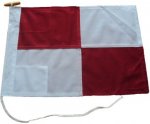
My "U" is a red/white quartered check.
 
It appears in the IMO International Code of Signals so I don't understand your point, Kev. Can you explain please?

What I mean is that this is flag uniform

Uniform.jpg

And that this

dive_flag.jpg

is not.

In fact I don't see it appearing anywhere in the ICS as shown below but if you know better then that's cool :cool:

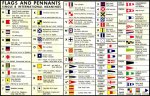
SIGNAL_FLAG_FULL.jpg
 
The point of my original post is that boaters need to be aware of this flag.

It's a point worth raising for those travelling to different countries, as is the reversing of the bouyage system in some countries.

If any one did the PADI course around 1999-2000 the Go Dive manual which you get as part of the course material states both flags and shows both flags, so even all the Americans should be aware of the A flag if they were paying attention. I had a US instructor in Grenada teaching both flags.

I quote from Padi Go dive manual for scuba and open water diver....
"The appropriate flag (they show both A and red/white) depends on where and under what conditions you dive. In some instances you may be required to fly both flags particularly when boat diving."

Red is visible as a colour at a greater distance but, it is still a flag of the same or similar size. Most problems in identifying a dive boat are the size/location of the flag not, not being able to see the colour. Any small slow/stationary vessel displaying a fixed prominent flag should (I would think) serve as a warning to keep clear. If I see a flag I don't know the meaning of I would keep clear and maybe grab an almanac to check.
 
Last edited:
Not in mine, though I did notice that you mentioned the US edition of signals. Maybe the yanks have different ones?
My "U" is a red/white quartered check.

Hi Rigger Mortice.

Info in the Reeds Almanac, section 5 (Communications); 5.1 (The International Code of Signals).

I mentioned the USA version as well since I found it on the web....
 
Nigel makes an important point. Some divers use the red flag with white stripe to mean diver down. Others use A.

Boaters should be aware that either could mean diver down.

Correct usage or not, that is the reality.

In the same way that, in reality, most boats that motor-sail don't show a cone.
 
Nigel makes an important point. Some divers use the red flag with white stripe to mean diver down. Others use A.

Boaters should be aware that either could mean diver down.

Correct usage or not, that is the reality.

In the same way that, in reality, most boats that motor-sail don't show a cone.

I genuinely don't have a problem with that and I'll dive under any combination of flags (as long as Alpha is one of em :rolleyes: ) ... anything that adds to safety is a good thing IMHO. My comments relate to the clear assertion by the OP that the Red flag is the one that is and should be used by all divers and that is just not true... again IMHO.
 
It was a bloke called Dockery that started it all!
"Inventing a flag is one thing. Getting it used and recognized is another. Perhaps more important than his role in creating the dive flag was Dockery's evangelism for it. With the persistent tenacity of a good entrepreneur 2 Dockery began selling flags and promoting their use."
 
It seems hard to believe that anyone thinks it is appropriate to use a procedure that is specifically American and not recognised here in preference to the official international one- just amazing! How the @*%$ is anyone in UK supposed to know what American procedures are, or to recognise them, let alone to be expecting anyone to use them? This is directly equivalent to driving on the right in Hamble and excusing it because "that's what they do in the US" or arbitarily deciding to leave red and green bouys on the wrong side for the same reason and smugly claiming "But I thought everyone knew this" which is an utterly specious, utter irrational and frankly utterly irresponsible argument.

Navigation is a serious business and is not conducted by arbitarily applied jungle rules like some raucous game of uckers, if you can't stick to the rules just don't bloodywell do it and mess up/hazard everything up for the rest of us law-abiding users!

Grow up! This behaviour is just plain childish.
 
MASH - you are missing the point. Your examples are not applicable.

Think of this like motoring without a cone. A lot of people do it, so you'd better recognise that fact and act accordingly.

Some people use the red/white flag to indicate diver down. That IS a fact (as demonstrated by the OP). How many do so in the UK is obviously a subject of debate, but it is clear that SOME do.

So we can debate endlessly whether that is right or wrong. Actually it is a pretty short debate because it is technically wrong to do so: it isn't the correct flag. But the fact remains the people DO use that flag to indicate diver down.

It can only be a good thing that boaters are educated as to the (technically incorrect) usage of that flag, so that when they see it in the future they know what it means.

It would also be a good thing to educate divers that it is the wrong flag, but that is a separate issue.
 
It is of no practical use for any flag to be recognised by divers worldwide, it is the power boat going past close by that needs to know! Use the correct flag!

Actually, on a red RIB the legal A flag would show up better...

Rob.
 
I think there is a difference between it being 'recognised' for what it physically is, a flag of american origin often used to denote divers down and promoted as such by the PADI org and others, and being 'recognised' as the international symbol that is supposed to be flown to indicate 'divers down, keep clear at slow speed' to all mariners/boat owners.

I recognise it in the first sense, I do not do so in the latter. Of course I know what it is and I would respond to it just the same as an A flag but that doesn't make it any more significant than that. Use it if you choose, I choose to use, and advocate the use of, the correct one but that's just me I s'pose. :rolleyes:
 
Nigel, if this thread proves anything it is that this flag is NOT recognised by divers worldwide.

+1

(Actually I suspect many (not all) divers do recognise it, as you do see it on various diving paraphernalia, as a logo rather than a flag. What I have an issue with is Nigel's repeated mulish assertions that all divers here use it.)

Pete
 
This is going to be a long post – but it gives me an opportunity to get it off my chest!

As background, I learned to sail at age 12, first in dinghies then yachts etc – going right through to teaching at national sailing centres as well as many others, at the same time (well starting about age 17) I also learned diving, again I progressed in that and taught diving as well (initially with BSAC, but also with PADI, TDI and SAA) – so when I wasn’t teaching sailing I was usually teaching diving----- Until I realised one couldn’t make a real living out of either, or both; and got a proper job!

My main problem with diving, is that there are two “methods” in use:

The first or traditional method is used by BSAC (British sub-aqua club) SocSac (Scottish sub-aqua club) SAA (Sub-aqua association) VDST (Verband Deutscher Sporttaucher e. V.) etc etc

In which the expectation is that you are learning diving to a good level, and each stage in the learning process is a step towards the future goals. So for example when learning about gases, you learn (numerically) about pressure/volume changes (Boyles law), Pressure/temperature changes (Gay-Lussac's law), volume/temperature changes (Charles law), partial pressures (Dalton’s law) and so on – not that any of these are used at a basic diver level; however when you move on to more advanced diving and you need to calculate your gas usage – you already have the information.

The second or new method is used by the purely commercial operations, so PADI (Professional association of diving instructors aka Pay and Dive Inc), SSI (Scuba Schools International), NAUI (National Association of Underwater Instructors) etc

- use the principle of “Teach/learn the minimum needed”. So since a basic diver only needs to be aware the basic idea of volume goes down as pressure increases, that is all they get – some instructors may go on to mention that it’s Boyles law, or maybe when the pressure doubles the volume halves, but actually that is beyond the syllabus!

Although I hate this idea, it is actually brilliant as it recognises that people don’t want to learn to dive very safely and be knowledgeable - they actually just want to get a certificate that enables them to do very simple (instructor/leader) led dives, whilst only losing a few days out of their holiday to obtain the certificate!:confused:

As a result their syllabus is trimmed down to the most basic level – and the basic level out of the US is the one very local flag used in local rules – but now taught to inexperienced divers throughout the world!

A good illustration of this is the introduction by the international association of diving - CMAS (Confédération Mondiale des Activités Subaquatiques) of a single “Star” system which they awarded to all regional bodies such as BSAC, PADI, SAA etc ;

so although PADI’s “Master diver” sounds very impressive – and clearly a high level – it is actually only a two star CMAS qualification – the equivalent of a “club diver” or “sports diver” – actually a low level of qualification (although a worthwhile achievement in its own right)

In fact PADI can only award up to two stars (PADI Dive master being towards the top end of CMAS**), whereas BSAC/SOCSAC/SAA all go right up to CMAS****

So quite simply people go on a cheap – learn to dive quickly (AKA obtain the lowest level certificate whilst losing the minimum number of days during your holiday) qualification – the result being the only flag they know is not international, but a local US unofficial one.

By the way, flag A as a diver down flag has been in existence a long time before the ‘60s as it was around when the code of flags was around in the early 1900’s – although whilst underway it meant a RN vessel was undergoing speed trials – in harbour it meant underwater work (even before SCUBA).

So when Dockery introduced the modified DI flag of the navies (i.e. the diagonal white stripe starts from the top at the hoist rather than at the top at the fly) the international signal was already established

DI can mean Division or Dissent depending on the associated signals, so to turn a whole division, the Corpen, Division, (associated division name), Turn, direction (such as port), and Preparatory would need to be flown, after confirmation of all ships being ready, the prep would be struck, and all ships in that division would turn!

In reality this is a very big error by divers, they assume that since they have been taught this one flag, it must be right - and international, in fact outside of the US it is neither!

In reality every seafarer is taught the IRPCAS which clearly defines Flag Alpha as being compliant for any nation, myself I know what the Inverted Division flag means, I can also recognise a DSMB or SMB (Delayed / surface marker buoy) along with a myriad of other clues as to when divers are in the water - but when diving I wouldn't expect others to!

BB
 
Last edited:
I think there is a difference between it being 'recognised' for what it physically is, a flag of american origin often used to denote divers down and promoted as such by the PADI org and others, and being 'recognised' as the international symbol that is supposed to be flown to indicate 'divers down, keep clear at slow speed' to all mariners/boat owners.

As I found in my PADI manual they promote and advise the use of both flags equally
 
Top