dgadee
Well-Known Member
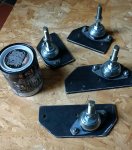
New engine is slightly narrower than old one so I have made up plates to fit new bearers onto. Advised to use Galvafroid on the bare metal. What for the top coat (red - it's a Beta)? Just exterior gloss?


 Im sure it was once painted..
New engine is slightly narrower than old one so I have made up plates to fit new bearers onto. Advised to use Galvafroid on the bare metal. What for the top coat (red - it's a Beta)? Just exterior gloss?


Hi, replaced mine a couple of years ago, only a small engine but I bought stainless plate think it was 100cm x 7.5cm wide by 6mm thick, think it was about 60 quid, needed to have holes drilled and nuts welded on but think the hole job came to inc. purchase of stainless 316 plate was about 13o quid but looks great and no need to paint or deal with corrosion, only other thing may be to get them galvanised.
Hope that helps... good luck with it all

The keel plate on my Hunter 490 was done in Zinga at the recommendation of the chap who blasted it. It has lasted and protected very well but seems to chip off very easily. The leading and trailing edges, which run pass rollers - have both lost most of their paint. On that basis I'd recommend Zinga for anything unlikely to be abraded.I've used Zinga, from MG Duff (the anodes people). It's similar to Galvafroid but seems to have advantages in that it continues to protect even when deeply scratched.

Hot dip galvanising is by far the better option in the long run, even if you have to recut any threads after galvanising. I have a local metal fabrication business that sends batches for HDG and are happy to add extra items in the batch. I've just had an outboard bracket for an inflatable done which cost me £5.New engine is slightly narrower than old one so I have made up plates to fit new bearers onto. Advised to use Galvafroid on the bare metal. What for the top coat (red - it's a Beta)? Just exterior gloss?
Hot dip galvanising is by far the better option in the long run, even if you have to recut any threads after galvanising. I have a local metal fabrication business that sends batches for HDG and are happy to add extra items in the batch. I've just had an outboard bracket for an inflatable done which cost me £5.
Www.solocoastalsailing.co.uk
I have a feeling we've discussed this before, and I'd agree. It is softish and does need a tough overcoating, the Physics of which it wouldn't cut it in all applications. Perfect for an engine bearer though.The keel plate on my Hunter 490 was done in Zinga at the recommendation of the chap who blasted it. It has lasted and protected very well but seems to chip off very easily. The leading and trailing edges, which run pass rollers - have both lost most of their paint. On that basis I'd recommend Zinga for anything unlikely to be abraded.

Good day to you. I have just come across this debate on the use of Zinga on boats, and I can confirm that Zinga has been used on over 80 steel vessels in the UK, including tug-boats, fishing trawlers, work barges, house-boats, two Mediterranean Cruisers and also on two British nuclear submarines. The usual method is to blast-clean the steelwork, do a 'Bresle' test to ensure there are no embedded chlorides in the steel surface, and apply Zinga by spraying. This should be done within an hour of blasting, as you may experience flash-rusting, especially if the humidity is above RH60%. You only require 60 - 80 microns of Zinga thickness. Wait for two hours and apply an epoxy MIO sealer coat.The keel plate on my Hunter 490 was done in Zinga at the recommendation of the chap who blasted it. It has lasted and protected very well but seems to chip off very easily. The leading and trailing edges, which run pass rollers - have both lost most of their paint. On that basis I'd recommend Zinga for anything unlikely to be abraded.