Paint scheme for engine bearers?

dgadee

Well-Known Member
Joined
13 Oct 2010
Messages
4,681
Visit site
New engine is slightly narrower than old one so I have made up plates to fit new bearers onto. Advised to use Galvafroid on the bare metal. What for the top coat (red - it's a Beta)? Just exterior gloss?

 
Wouldnt galvafroid be the whole paint system so it is the top coat? Ive no idea if you can put another paint over galvafroid...
whats wrong with a galvanised looking finish?
My engine cradle is nearly 40 yr old steel, unprotected yet still in great condition.. Probably due to 40 years worth of oil on it.. ;) Im sure it was once painted..
 
New engine is slightly narrower than old one so I have made up plates to fit new bearers onto. Advised to use Galvafroid on the bare metal. What for the top coat (red - it's a Beta)? Just exterior gloss?

I'd look for something that is specifically oil-resistant and follow the manufacturer' system. In which case "Galvafroid" might not be the right primer.
 
I've used Zinga, from MG Duff (the anodes people). It's similar to Galvafroid but seems to have advantages in that it continues to protect even when deeply scratched. All of my Land Rovers have axles and chassis coated in it and there's no sign of any rust in seven years. They have a product called TarFree as a suggested overcoat and on which you can paint more or less any top coat.

Zinga Uk - View our extensive range of zinc anti-corrosion products
 
Galvafroid can be used as a self-finish or as a durable rust inhibiting primer beneath selected top coats. (ive just google it)
Personally i would be looking for the easiest solution as its not something you want to keep comming back to when the paint flakes?
If its clean matal why not epoxy coat ? should be good for many many years?
 
The ideal would be to get them hot dipped, but probably too much hassle and comparatively expensive for a small job.
I've used waxoyl on my engine bearers, it's a bit agricultural but seems to do a good job.
 
Hi, replaced mine a couple of years ago, only a small engine but I bought stainless plate think it was 100cm x 7.5cm wide by 6mm thick, think it was about 60 quid, needed to have holes drilled and nuts welded on but think the hole job came to inc. purchase of stainless 316 plate was about 13o quid but looks great and no need to paint or deal with corrosion, only other thing may be to get them galvanised.

Hope that helps... good luck with it all
 
Hi, replaced mine a couple of years ago, only a small engine but I bought stainless plate think it was 100cm x 7.5cm wide by 6mm thick, think it was about 60 quid, needed to have holes drilled and nuts welded on but think the hole job came to inc. purchase of stainless 316 plate was about 13o quid but looks great and no need to paint or deal with corrosion, only other thing may be to get them galvanised.

Hope that helps... good luck with it all

Too late! They are made and they fit. 8mm plate so it is only appearance and rust staining which matter. I welded studs in so galvanising would increase diameter or welding after galvanising would perhaps not be wise (isn't arsenic given off?)

Will look into epoxy coating.
 
Could you screw a bolt in to each nut prior to galvanising, and then break it out afterwards?
But probably not worth the hassle anyway!
 
I would also galvanize. My diesel generator base is mild steel galvanized.

Any studs I wished to fit would either be stainless which could be painted to protect the thread from the galvanize then using a thread die to clean the paint off.

Th other way is to tap holes and clean then out with a tap and screw the studs in after galvanizing.
 
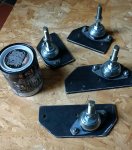
Galvanizing probably a good idea, but I've decided to take the easy option. Friend just painted a steel fuel tank he made with Powerfix paiont (he loves Lidl) which he says is an epoxy coating. He's an engineer and been around big fishing boats, so I reckon it should work. These are the plates - vetus M3.10 to Beta 20:
 

Attachments

  • IMG_20201231_113035664_1.jpg
    IMG_20201231_113035664_1.jpg
    628.3 KB · Views: 19
I've used Zinga, from MG Duff (the anodes people). It's similar to Galvafroid but seems to have advantages in that it continues to protect even when deeply scratched.
The keel plate on my Hunter 490 was done in Zinga at the recommendation of the chap who blasted it. It has lasted and protected very well but seems to chip off very easily. The leading and trailing edges, which run pass rollers - have both lost most of their paint. On that basis I'd recommend Zinga for anything unlikely to be abraded.
 
New engine is slightly narrower than old one so I have made up plates to fit new bearers onto. Advised to use Galvafroid on the bare metal. What for the top coat (red - it's a Beta)? Just exterior gloss?
Hot dip galvanising is by far the better option in the long run, even if you have to recut any threads after galvanising. I have a local metal fabrication business that sends batches for HDG and are happy to add extra items in the batch. I've just had an outboard bracket for an inflatable done which cost me £5.

Www.solocoastalsailing.co.uk
 
Hot dip galvanising is by far the better option in the long run, even if you have to recut any threads after galvanising. I have a local metal fabrication business that sends batches for HDG and are happy to add extra items in the batch. I've just had an outboard bracket for an inflatable done which cost me £5.

Www.solocoastalsailing.co.uk

Yes, I have a couple of boys who would do that for me, too but my poor planning has left me over the holiday period wanting to get the engine in pronto. Lots of other things on 2021 horizon so no waiting around - especially over here where time is not of the essence.
 
The keel plate on my Hunter 490 was done in Zinga at the recommendation of the chap who blasted it. It has lasted and protected very well but seems to chip off very easily. The leading and trailing edges, which run pass rollers - have both lost most of their paint. On that basis I'd recommend Zinga for anything unlikely to be abraded.
I have a feeling we've discussed this before, and I'd agree. It is softish and does need a tough overcoating, the Physics of which it wouldn't cut it in all applications. Perfect for an engine bearer though.

Dunno where @dgadee lives, but I've got a part can he's welcome to if he's near Surrey.
 
The keel plate on my Hunter 490 was done in Zinga at the recommendation of the chap who blasted it. It has lasted and protected very well but seems to chip off very easily. The leading and trailing edges, which run pass rollers - have both lost most of their paint. On that basis I'd recommend Zinga for anything unlikely to be abraded.
Good day to you. I have just come across this debate on the use of Zinga on boats, and I can confirm that Zinga has been used on over 80 steel vessels in the UK, including tug-boats, fishing trawlers, work barges, house-boats, two Mediterranean Cruisers and also on two British nuclear submarines. The usual method is to blast-clean the steelwork, do a 'Bresle' test to ensure there are no embedded chlorides in the steel surface, and apply Zinga by spraying. This should be done within an hour of blasting, as you may experience flash-rusting, especially if the humidity is above RH60%. You only require 60 - 80 microns of Zinga thickness. Wait for two hours and apply an epoxy MIO sealer coat.
On larger vessels, below the waterline the final coat is antifouling, and above the waterline the final coat is a high gloss polyurethane.
Average time to first maintenance is 12 years. Regards coating cars, Zinga was used on Range Rover Vogue chassis as an OEM coating and it has an official Land Rover part number. PS: You can use Zinga inside you potable water tanks too!!
 
Top