Outboard in Well

Aquaboy,

what does it do for a fairing plug ?

Not sure what I think of a midships engine, I use the prop throw in astern gear to advantage - midships is good for weight distribtion though, I guess the keel / plate is just forward of it ?

Edit - Just had a look at the Coast 250, ' interesting '.

No mention of a fairing plug but engines ( under companionway ) 9.9 - 70 hp ! I hope it works better than those beginning with M who shall not be mentioned...:rolleyes:
 
Last edited:
Sorry I have not read entire thread. We have a Jeanneau Tonic with a Yam 9.9 in an offset well.

Never been aware of water sloshing around when sailing. It exists through two stiff rubber sheets. The owner of boatyard I took it to said he had never seen a boat with a f***y before.

No way I could lift the engine out from nigh on foot level without trashing my back. I used to be able to just about lift the mercury 8 it replaced. That had a small exhaust vent at the top of the lig which exiting through the transom. The Yamaha may have as well although I have not used it. The engine does get starved of air if I run out in still conditions whilst moored but is fine with a breeze or underway.
 
The engine does get starved of air if I run out in still conditions whilst moored but is fine with a breeze or underway.

I don't understand. I thought exhaust goes out through the propeller hub? How does the engine in the well above, get smothered?
 
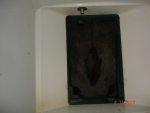
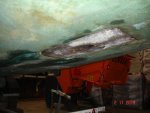
Here is the "plug" fitted in the well of my Etap.
In the first photo you can see the exhaust port s/s tube which exits the transom. a rubber Yamaha exhaust tube fitted to the leg of the engine pushes through this, so when you take the engine out there is nothing to disconnect - just pull the rubber tube out.
There is a small hole in the bung that allows water from the tell tale to escape.
The second photo shows the fit which is completely flush with the hull of the boat. Only a small part of the leg of the engine protrudes + the prop.DSC00029.JPGDSC00028.jpg

No problems with the engine being starved of air - even when the engine well is partly enclosed with soundproofing. The Yamaha 8hp 2 stroke exhausts gases through the prop and half way up the leg, hence the pipe.
 
Last edited:
Ace photos Coveman, exactly the idea I was flattering myself I had invented! Clever old Etap. ;)

I can't remember if in this thread so far, you have described whether (with that excellent plug fitted) you have measured a discernible reduction in speed, attributable to the engine leg and prop sticking out, as opposed to sailing with the engine extracted?
 
Ace photos Coveman, exactly the idea I was flattering myself I had invented! Clever old Etap. ;)

I can't remember if in this thread so far, you have described whether (with that excellent plug fitted) you have measured a discernible reduction in speed, attributable to the engine leg and prop sticking out, as opposed to sailing with the engine extracted?

I haven't noticed a huge difference - obviously there is some friction, but the leg only slightly protrudes, so very little. Obviously for maximum speed for racing a hull with no prop protruding must be best, but as a leisurely cruiser I am willing to forego that for convenience, as any sailor is with a standard inboard. Having the engine in front of the rudder also allows excellent control at close quarters - she reverses exactly where you expect her to. I would emphasise that when Etap produced these bungs they were designed to exactly fit the leg of a Yamaha 8hp 2 stroke (std shaft), so it is a perfect fit for that engine which they fitted to their boats at the time, but anything else would need modifying or as you are suggesting manufactured to fit the specific type of engine used.

I respect those that do not want an engine leg protruding- their choice, but I like my choice!
I have also sailed her with no plug or engine and while there is then a fair amount of turbulence in the well, no water enters the cockpit.
 
Last edited:
I respect those that do not want an engine leg protruding - their choice, but I like my choice!

So do I, too. I'm going to go for all options rather than picking between them...I'll make a wrap-around plug for efficient low-effort cruising, and also keep a fully-faired plug for pure offshore sailing. :encouragement:
 
I don't understand. I thought exhaust goes out through the propeller hub? How does the engine in the well above, get smothered?

Yes most of the exhaust gases do exit through the leg, but my previous Mercury 8 had a breather pipe attached at the top of the leg which exited through the transom.

I am not sure whether my Yamaha has a breather hole. I had assumed when the boats not moving and there is no breeze some of the exhaust gas which had exited through the leg under water leeches back into the engine well. On the other hand it may be that I have a breather hole in the leg that is not connected to anything. I must check.
 
Understood, thank you.

I'm going to try my Mariner in a trough of water some time next week. I expect I'll have learned a lot by the time I get it started!
 
My Yamaha does have a breather hole at the top of the leg. So, I may attach a bit of copper pipe as my old engine had and/or provide some forced ventilation.

Il
Yes most of the exhaust gases do exit through the leg, but my previous Mercury 8 had a breather pipe attached at the top of the leg which exited through the transom.

I am not sure whether my Yamaha has a breather hole. I had assumed when the boats not moving and there is no breeze some of the exhaust gas which had exited through the leg under water leeches back into the engine well. On the other hand it may be that I have a breather hole in the leg that is not connected to anything. I must check.
 
My Yamaha does have a breather hole at the top of the leg. So, I may attach a bit of copper pipe as my old engine had and/or provide some forced ventilation.

Il
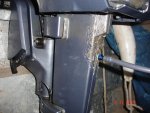
I used to have a copper pipe as a breather but I found it was rather fragile and would break off especially when trying to manoeuvre the engine in and out of the well. My Yamaha dealer replaced it with Yamaha exhaust tube, which looks like any rubber tube but is resistant to heat and exhaust gases. It is fixed over a spigot which was fitted to the engine leg and is very flexible, so not prone to breaking like the copper pipe was - had it on the engine for 3 years now and seems to work very well. Not only does it stop the engine sucking in exhaust fumes, it also prevents any fumes in the cockpit.DSC00033.jpg
 
Last edited:
I would think 2T engines would need a hole because of backpressure on the exhaust. 4Ts less so.
Seagulls were a bit sensitive to being deeply immersed.

(The engines!!)
 
DownWest,

maybe - people who don't know outboard wells sometimes say the engine always chokes on exhaust gas but I think that refers mainly to some very old designs with a lid shutting over the engine - on boats like the Anderson 22 the well is quite low with the engine head mainly protruding above, and on the Achilles 24 it's just a hole in the cockpit sole with the head right above, hard to imagine any choking gasses.

As for Seagull engines, they seemed sensitive to the phase of the moon and what colour pants one wore, any excuse not to provide propulsion :rolleyes:
 
My boat is a Jeanneau Tonic the engine is fairly deep in the rights well with only one side partially open and a lid. Rough running of the engine when not moving or moving slowly is often rectified by lifting the lid.

I never had a problem with the copper pipe breaking. It was not fixed at the transom end just passed through a hole in the transom, very low down incidently.

And was attached by a brass compression gland to a brass spigot attached to the engine. I think it was a retro fit and the engine had been drilled and tapped.

Interested in the Yamaha exhaust tube. You have a part number please?
 
One of the worst, most thoughtlessly designed wells I've seen was on a relatively modern Hunter 245; it's way over to port so as to lift up into the cockpit locker - no fairing plug, and so far to the side it's useless if there's any breeze at all motorsailing on starboard tack...
 
My boat is a Jeanneau Tonic the engine is fairly deep in the rights well with only one side partially open and a lid. Rough running of the engine when not moving or moving slowly is often rectified by lifting the lid.

I never had a problem with the copper pipe breaking. It was not fixed at the transom end just passed through a hole in the transom, very low down incidently.

And was attached by a brass compression gland to a brass spigot attached to the engine. I think it was a retro fit and the engine had been drilled and tapped.

Interested in the Yamaha exhaust tube. You have a part number please?

Sorry I don't have a part number but it was fitted by www.wetbristol.com who should be able to help
 
Top