Osmosis - Not a concern?!?

Dazzajohm

N/A
Joined
30 Jul 2016
Messages
418
Location
Dover
Visit site
Hi all,

The survey on a 1991 Fairline Corniche I am intending to purchase was conducted yesterday and generally my surveyor tells me the boat is in excellent condition for its age and has been well looked after.

He did however find two 10mm osmosis blisters on the hull inspection but he did not seem to be worried about it at all. In fact he said it's a very small number of blisters for a boat of this age and as long as I manage them properly (if they get bigger as wouldn't do anything with them while they're this small) there should be no issue. I even asked if I were to proceed should I renegotiate price and he seemed to think not as only two 10mm blisters would not affect the price (plus I have already knocked off several grand from the asking price)

For me, I was mortified as I thought osmosis was like the black death for boats, so to be told not to worry kind of blew my mind! The boat I have just sold was two years older and had no traces of osmosis at all.

Anyone have any views on this?

Cheers
D
 
I totally agree with the surveyor. They are by nature a cautious bunch, so you should feel as relaxed as he does. The odd blister is nothing to worry about and easily repaired.
 
If there is no delamination it should be a simple and easy fix. If delamination has occurred that's when I'd worry.
 
He did however find two 10mm osmosis blisters on the hull inspection but he did not seem to be worried about it at all.
In fact he said it's a very small number of blisters for a boat of this age
I disagree with the surveyor, sort of. That would be much better described as "nothing at all", rather than a "small number"! :encouragement:

BUT, how could he tell for sure that those are the only points in the whole hull?
Unless the boat was already stripped to bare gelcoat, I suppose he could only scrape the a/f in several places, and even if that's a reasonably accurate way of sampling the hull for osmosis, it can't be enough to rule out completely the presence of some blisters anywhere else...
 
For the age of boat, it's not something I would worry about.
A duff engine or outdrive will cost you far more ££££.
 
I disagree with the surveyor, sort of. That would be much better described as "nothing at all", rather than a "small number"! :encouragement:

BUT, how could he tell for sure that those are the only points in the whole hull?
Unless the boat was already stripped to bare gelcoat, I suppose he could only scrape the a/f in several places, and even if that's a reasonably accurate way of sampling the hull for osmosis, it can't be enough to rule out completely the presence of some blisters anywhere else...

Would it not be fairer to say that the OP simply needs to factor in a hull scrape, minor remedial repair and an epoxy paint layer before reapplication of AF? Hardly a deal breaker and he may follow your lead and do a copper coat. Having done a hull scrape and a preventative epoxy coat on mine I can confirm its hard work but no deal killer and something the OP should consider doing anyway given the age of the boat.
 
In all my years I a e never seen osmosis blisters on a Fairline at that age , the earlier 32 sedan was a major culprit but by the time the corniches had evolved they had it sorted , where were the blisters on the hull?
 
I disagree with the surveyor, sort of. That would be much better described as "nothing at all", rather than a "small number"! :encouragement:

BUT, how could he tell for sure that those are the only points in the whole hull?
Unless the boat was already stripped to bare gelcoat, I suppose he could only scrape the a/f in several places, and even if that's a reasonably accurate way of sampling the hull for osmosis, it can't be enough to rule out completely the presence of some blisters anywhere else...

You raise a good point but he looked like he inspected the hull very thoroughly, hitting every inch with a hammer and he took loads of moisture readings which he told me were well within the correct parameters.

As the survey was only done yesterday, he only gave me a brief verbal run down but will wait until I get the full written report early next week before I decide what to do :)
 
hull.jpg
In all my years I a e never seen osmosis blisters on a Fairline at that age , the earlier 32 sedan was a major culprit but by the time the corniches had evolved they had it sorted , where were the blisters on the hull?

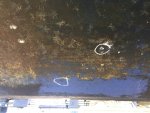
Hopefully there should be a photo attached. They were towards the front of the boat, just after where the hoist strap sits.

Apparently the owner said that there were a couple detected back in 2017 so he had the hull treated with something or other (epoxy??) which was supposed to have stopped further issues and seemed genuinely surprised they had come back
 
View attachment 73137

Hopefully there should be a photo attached. They were towards the front of the boat, just after where the hoist strap sits.

Apparently the owner said that there were a couple detected back in 2017 so he had the hull treated with something or other (epoxy??) which was supposed to have stopped further issues and seemed genuinely surprised they had come back

That hull was treated in 2017? No way! Look at it, if it was then who ever did it was master of the half job. Hopefully you'll do a better job. :encouragement:
 
Agreed.
Besides, neither of the two marked point look anything like "normal" blistering, imho.
Though it's hard to tell from the pic, of course.
 
Agreed.
Besides, neither of the two marked point look anything like "normal" blistering, imho.
Though it's hard to tell from the pic, of course.

I've not seen osmosis blisters before so cant really comment but apparently the tell tale sign is when they're "burst" the smell of vinegar which indeed was present.
 
I've not seen osmosis blisters before so cant really comment but apparently the tell tale sign is when they're "burst" the smell of vinegar which indeed was present.

That's not de facto osmosis. Any blister or cavity that has sea water in it for any length of time will smell of vinegar and does not therefore automatically imply osmosis. Judging from the half job it could well have had an epoxy coat dabbed on while on the hard during winter in low temps and the epoxy itself did not cure properly and then created a blister of it's own.
 
View attachment 73137

Hopefully there should be a photo attached. They were towards the front of the boat, just after where the hoist strap sits.

Apparently the owner said that there were a couple detected back in 2017 so he had the hull treated with something or other (epoxy??) which was supposed to have stopped further issues and seemed genuinely surprised they had come back

To me that would be a concern, whatever he did last year could very well mask additional osmosis.
 
Who was the surveyor? Surely he knows best (having actually viewed the boat - unlike us)?

Surveyor was Nic Fieldhouse (Fieldhouse Surveys). Came highly recommended and I also did some research online and he came highly reviewed also. He certainly seemed very knowledgable and extremely thorough - was on the boat from 0900 - 1800 so I have no reason to doubt him. Just as per my original comment it has always been my understanding that osmosis in any capacity is something to be worried about. Plus although I have a boat for pleasure and not to make money, on the other hand I don’t want to find if I decide to sell in a couple of years that it’s worth half what I paid for it.

I’ve also read other posts about the subject on here which suggests I might have problems insuring it once a surveyor mentions osmosis in the survey report.

As people have said before on here there is so much going around on this subject it’s hard to know what the real considerations should be and what’s just hyped up nonsense. :)
 
Top