Oil questions

Ebay search results in a couple of outlets still willing/able to supply 25L drums, internet search found a company able to sell a 25L drum with the correct spec for around the same money as a 20L drum.
Arrived on the doorstep 24 hours later.
Off to the local motor factor for a couple of good quality oil filters from a known named company, oil and filter change for well under £100.
Done in under an hour with an electric pump and 15 mins of that is getting both engines up to temp to thin the oil.
Then a mere day or two to clear up the mess.
Fortunately have friendly garage nearbye , happy to take the old oil and filters other wise have to book an appointment at local tip.
Garage, which repairs autogearboxes, have a couple of 50 gallon drums to take waste oils/ATF etc.
Not sure if they get paid for or have to pay for the tanker which collects once a fortnight.
When I had a boat with a 2.5 litre BMC engine I bought oil in 25 litre drums from Morris Oils. Delivered to home at competitive prices. Quality certainly good enough for that engine.
 
I have always used fully Synthetic oil for my old and newish engines as they are far superior to mineral oils in every way and at the same price. Make sure you use the correct specification for your engine and always Synthetic.
 
I have always used fully Synthetic oil for my old and newish engines as they are far superior to mineral oils in every way and at the same price. Make sure you use the correct specification for your engine and always Synthetic.
While they may have different properties (because they are designed for use in different types of engines) synthetic oils confer no benefits for small diesel engines designed to use mineral oils. Typically 20% more expensive for no benefits. So not "superior in every way", but only in engines that require those properties.
 
I have always used fully Synthetic oil for my old and newish engines as they are far superior to mineral oils in every way and at the same price. Make sure you use the correct specification for your engine and always Synthetic.
You may benefit from reading Vyv's very knowledgable web page. Link here:
Oil for yacht engines

I found it very informative
 
Ebay search results in a couple of outlets still willing/able to supply 25L drums, internet search found a company able to sell a 25L drum with the correct spec for around the same money as a 20L drum.
Arrived on the doorstep 24 hours later.
Off to the local motor factor for a couple of good quality oil filters from a known named company, oil and filter change for well under £100.
Done in under an hour with an electric pump and 15 mins of that is getting both engines up to temp to thin the oil.
Then a mere day or two to clear up the mess.
Fortunately have friendly garage nearbye , happy to take the old oil and filters other wise have to book an appointment at local tip.
Garage, which repairs autogearboxes, have a couple of 50 gallon drums to take waste oils/ATF etc.
Not sure if they get paid for or have to pay for the tanker which collects once a fortnight.
Fortunately the marina here has an oil disposal tank.

I put down an old bed sheet or a dust sheet in the engine bay to catch the inevitable drips of oil.
For me 20L is enough oil for two engines and leaves a couple of litres spare .
But if say 25L is required I would but 2x20L tubs and keep the leftover oil for the next oil change.

At an engine oil change I like to pump the oil out on a warm engine. I then leave the engine overnight to let oil held in the engine drain down into the sump. The next day its always possible to extract a little more oil.

I did buy a Volvo Penta service kit earlier this year (impeller, oil filter , fuel filter) that was not excessively priced extra over the impeller alone. I have experimented with cheap impellers but the genuine part is defiantly longer lived so better value over time.
 
I have always used fully Synthetic oil for my old and newish engines as they are far superior to mineral oils in every way and at the same price. Make sure you use the correct specification for your engine and always Synthetic.
Where are you buying fully synthetic oil for the same price as mineral? I hope you can share this information with us, although not for my boat engine.

The molecular length of synthetic oils is far more controlled than in minerals. The consequence is that at high temperatures there is far less burning of short molecules, hence deposits and sludging are reduced. For high performance, high temperature engines the benefits are clear but yacht engines can no way be described as high performance.

My air cooled, 2CV engined kit car runs at oil temperatures up to 150C in the hot summers we have enjoyed for the past two years. Hence I use synthetic lubricant in it. Conversely the oil in my Yanmar is unlikely to reach 80C, so synthetic oil would be money down the drain.
 
We had numerous posts on this topic over the years explaining the superior properties of synthetic oils over the old fashioned mineral oils; (do a search).
Engines are not designed for a particular oil type; oils specifications are "designed" for engine types. Actually, mineral oils nowadays are the same price or even more expensive than synthetic oils.
 
We had numerous posts on this topic over the years explaining the superior properties of synthetic oils over the old fashioned mineral oils; (do a search).
Engines are not designed for a particular oil type; oils specifications are "designed" for engine types. Actually, mineral oils nowadays are the same price or even more expensive than synthetic oils.
It would be useful if you could post examples of your "cheap" synthetic oils. I have followed the discussions about different oils and it seems to me that the consensus is that the properties of synthetic oil are of no benefit in small marine diesels, although agree that a small number of people like you have a different view.

Your view is also different from the manufacturers. For example my new Kubota based Beta 30 which is as state of the art as you can get in small diesels specifically requires mineral oil with the proviso that if not available then a semi synthetic with no more than 30% synthetic content may be used. This requirement goes across the range of Beta engines from 10 t0 115hp. What do you know that is different from one of the world's largest manufacturers of small diesel engines?
 
It would be useful if you could post examples of your "cheap" synthetic oils. I have followed the discussions about different oils and it seems to me that the consensus is that the properties of synthetic oil are of no benefit in small marine diesels, although agree that a small number of people like you have a different view.

Your view is also different from the manufacturers. For example my new Kubota based Beta 30 which is as state of the art as you can get in small diesels specifically requires mineral oil with the proviso that if not available then a semi synthetic with no more than 30% synthetic content may be used. This requirement goes across the range of Beta engines from 10 t0 115hp. What do you know that is different from one of the world's largest manufacturers of small diesel engines?
To my knowledge, Kubota USA have no preference for as long as it meets the specifications of whatever oil you use. Ten, twenty, years ago, people were totally against synthetic oils, based on misconception; nowadays, especially the younger, choose to use synthetic oils. in terms of cost, both synthetic and minerals are similar prices
 
Fortunately the marina here has an oil disposal tank.

I put down an old bed sheet or a dust sheet in the engine bay to catch the inevitable drips of oil.
For me 20L is enough oil for two engines and leaves a couple of litres spare .
But if say 25L is required I would but 2x20L tubs and keep the leftover oil for the next oil change.

At an engine oil change I like to pump the oil out on a warm engine. I then leave the engine overnight to let oil held in the engine drain down into the sump. The next day its always possible to extract a little more oil.

I did buy a Volvo Penta service kit earlier this year (impeller, oil filter , fuel filter) that was not excessively priced extra over the impeller alone. I have experimented with cheap impellers but the genuine part is defiantly longer lived so better value over time.
"I put down an old bed sheet or a dust sheet in the engine bay to catch the inevitable drips of oil."
On both Volvo Penta and Yanmar one of the engines will always have the oil filters secreted up under the coaming, an entire arms length away past a seething hot engine block.You need eyes on stalks to even see them.
There is a 99 % chance that a millisecond after the filter departs the thread holding it onto the engine block, boiling hot oil will spill out ,scalding your hand and immediatly turning the filter into a slippery non grippable red hot can about to dump a litre of filthy oil onto what ever is placed in the bilge It will find a way past your drip catcher.
On my ancient Perkins M130 the filters were located on top of the block and upside down so all oil drained out back into the sump ?
Do believe that Volvo Penta D6 has now incorporated this revolutionary design. :)
 
On both Volvo Penta and Yanmar one of the engines will always have the oil filters secreted up under the coaming, an entire arms length away past a seething hot engine block.You need eyes on stalks to even see them.
Not so with my boat. The port engine oil filter is a bit easier to get to than the starboard.
1699641047248.png
There is a 99 % chance that a millisecond after the filter departs the thread holding it onto the engine block, boiling hot oil will spill out ,scalding your hand and immediatly turning the filter into a slippery non grippable red hot can about to dump a litre of filthy oil onto what ever is placed in the bilge It will find a way past your drip catcher.
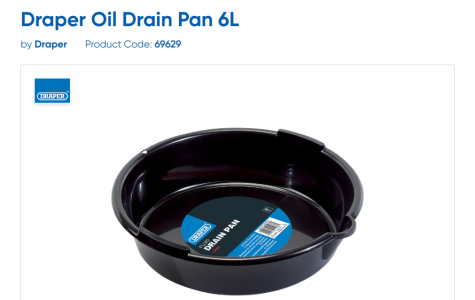
No need to get the engine oil that hot . I use a pan to catch the oil from the filter which minimises spills. Plus there is the dust sheet.
1699640270782.png
 
The following has worked great on my 3YM30 for 13 years. Oil consumption negligible and it looks clean for ages

https://www.tesco.com/groceries/en-GB/products/285281489

A key thing to avoid bore glazing is not to let your engine idle for long. You see people who come down to the marina start the engine and leave it ticking over rather than engaging gear. Not surprisingly most of them blow blue smoke everywhere because they have glazed their bores with this action
 
Top