Not your average Anchor question

The same Panope tests hammer Rocna with ratings less than either Spade and Excel. If the Spade or Excel, in any version is better than, Rocna, a highly popular design then one might say - who cares what the Panope tests indicate. Knox is equally hammered (another popular design by members here) one might question the objectivity of the Panope tests - not question the objectivity of those who bought and used Knox, Rocna and both aluminium and steel Excel and Spade.

Jonathan
I'm not familiar with Panope's work, but anyone doing formal comparative testing has a greater a priori claim to objectivity than a verdict based on punter popularity.

Dashew seems to think Rocna is over-hyped.

I wouldn't know, but I'd like to believe that, since I dont have one.
 
I'm not familiar with Panope's work, but anyone doing formal comparative testing has a greater a priori claim to objectivity than a verdict based on punter popularity.

Dashew seems to think Rocna is over-hyped.

I wouldn't know, but I'd like to believe that, since I dont have one.
Dashew might have said it was hype - but he contributed by using them on his 'expedition' yachts - and I have not heard he has rejected them in favour of a different design - but I don't follow Dashew. His expedition yachts are not cheap and you would expect to see a state of the art anchor on the bow roller - the fact it was there and Dashew (including his reputation as a yachtsman) chose same - endorsed the hype.

Maybe the Panope spread sheets are part of a return to reality and more objective choice.....:)

Rocna is a copy, to allow it to be made cheaply, of a Spade. The plan view of the flukes are very similar, if you take a French curve to the Rocna shank you get the shank of Spade. The toe of the Rocna has a double thickness of steel, replacing the lead ballast of the Spade. Vulcan looks like the anchor Peter Smith wanted to make in the first place (and looks even more like a Spade).

Its much hyped because it was a big step in the right direction (and arguably is the development that should have been conducted by Spade themselves). It spawned the idea that an anchor must have a roll bar (I consider the roll bar as a step backwards). Bruce, Delta, Spade, Vulcan, Excel et al did not need a roll bar In both Rocna and Supreme it led to fluke clogging which was not a topic of debate prior to roll bars. The other factor engendering approval was Peter Smith's use and heavy promotion of a high tensile steel in the shank - which then became their undoing when it was not HT steel.

The Rocna story's underpinned because West Marine sponsored an anchor test to which the sailing media was invited which happened to occur contemporaneously with the release of Rocna -and Rocna was the star performer. Nothing like being in the right place at the right time.

Since then printed media has been hammered, you tube is flavour of the decade(s), just see the Panope vids - and what is left of printed media cannot afford the cost of anchor testing (its both labour intensive and expensive). We are now subject to the integrity of gifted and passionate individuals - who are not subject to peer review.

It was hype and there is no such thing as bad advertising - the heat in the hype has gone but Rocna, for the wrong reasons, was one of the best known brands in the marine industry - and certainly in anchor debate. The results, of the hype, are solid and sit on bow rollers arguably the buying pubic were or are gullible to 'marketing'.

Of course instead of a roll bar most other anchors used ballast - except for Bruce and now Odin.

Most anchors now use ballast or a roll bar - the outliers are Bruce (introduced in the 1980s) and Odin 2025. It will be interesting to see if Odin catches the buying public's imagination - but these 2 designs use no crutches what you buy is either the shank or devoted to hold. Roll bars and ballast offer no increase in hold - they are simply there to allow the anchor to set.

Jonathan
 
Last edited:
Indeed!

Weed, and especially kelp, is very common in higher latitudes, and some of us cannot avoid anchoring in weeds.

I have used Fishermen back in the day for this, which work, I believe, because they are very heavy in relation to their small flukes, so penetrate very well.

Contrary to Jonathan, I don't believe that anchoring in weeds depends on roots. It depends on getting the anchor to penetrate through the weeds to the actual substrate, and then penetrating THAT deeply enough to be well set. I don't think roots have anything to do with it, provided the anchor is properly set.

In my experience, only a Fisherman or a very large Spade or Ultra works well for that. I have heard that very large Bruces (like the 80kg ones Dashew used decades ago) work well in weedy bottoms, but I don't have my own experience.

In certain kinds of kelp, nothing works, and that is a real hazard in high latitudes where it can be hard to find an anchorage without it.

Thread drift, but I have just removed a forward looking sonar and replaced it with a CHIRP fishfinder, specifically for imaging the bottom in weedy places, to try to identify spots without weeds. I have no idea whether this will actually work or not, but I'll post about it when I know.
Well, if you hunted Sea Otters to local extinction, they would not eat the Sea Urchins any more
So the Sea Urchins would eat the kelp
and you would be able to anchor
Huzzah!
But wait...you aren't allowed to hunt Sea Otters any more.
But if you screwed up the oceans with overfishing and such
So some seal populations collapsed
The Orca (bloody troublemakers) would eat the Sea Otters
So the Sea Otters would not eat the Sea Urchins any more
So the Sea Urchins would eat the kelp
and you would be able to anchor (at least in the Aleutians)
Huzzah again
Might be prudent to stop people blowing up Orca's just in case they might nibble their rudders though.


https://www.science.org/doi/10.1126/science.282.5388.473
 
It seems that whatever the question, if anchor is in the title the same set of responses arguing the virtues of different types get trotted out. I wonder if they’re new or just cut and pasted from last week’s anchor thread.

Anyway, since no one’s answered the original question, nuclear submarines do have anchors, stowed under the bow and operated from within the pressure hull. They’re a typical double fluke commercial type but have a fairing plate underneath so that they present a flush surface when stowed. They are usually additionally faired in with filler around any gaps. The chain is stored carefully so that it doesn’t rattle.
They are for emergency use only and very rarely used, obviously when surfaced only. There only regular use is when they’re checked during docking periods
 
Last edited:
Rocna is a copy, to allow it to be made cheaply, of a Spade. The plan view of the flukes are very similar, if you take a French curve to the Rocna shank you get the shank of Spade. The toe of the Rocna has a double thickness of steel, replacing the lead ballast of the Spade.
The Rocna anchor is nothing like the Spade. One primarily uses a rollbar for orientation, the other a large lead-filled ballast chamber.

About the only thing they share in common is that they are both concave anchors, which when these models were introduced was a departure from the common convex fluke design of the CQR and plough anchors.

Interesting, despite the very different fundamental approaches, both the Rocna and Spade are excellent anchors in my view.
 
Last edited:
If you had read the thread you would find that in Post 9 it was suggested use of Google answered some if not all of the questions - and has a different answer to yours.

Jonathan
 
About the only thing they share in common is that they are both concave anchors, which when these models were introduced was a departure from the common convex fluke design of the CQR and plough anchors.

So....Bruce is a convex design! ?? 1980s

And Spade is also convex......! ?? 1990s

Two revolutionary designs, both ignored

Every days is a school day. :)

Jonathan
 
Last edited:
Well, if you hunted Sea Otters to local extinction, they would not eat the Sea Urchins any more
So the Sea Urchins would eat the kelp
and you would be able to anchor
Huzzah!
But wait...you aren't allowed to hunt Sea Otters any more.
But if you screwed up the oceans with overfishing and such
So some seal populations collapsed
The Orca (bloody troublemakers) would eat the Sea Otters
So the Sea Otters would not eat the Sea Urchins any more
So the Sea Urchins would eat the kelp
and you would be able to anchor (at least in the Aleutians)
Huzzah again
Might be prudent to stop people blowing up Orca's just in case they might nibble their rudders though.


https://www.science.org/doi/10.1126/science.282.5388.473
LOL :LOL:

Only problem here is that sea otters are possibly the cutest creations on earth. YouTube would crash if we killed all the otters.
 
I'm not familiar with Panope's work, but anyone doing formal comparative testing has a greater a priori claim to objectivity than a verdict based on punter popularity.

Dashew seems to think Rocna is over-hyped.

I wouldn't know, but I'd like to believe that, since I dont have one.
If you're interested in anchoring, then by all means watch his videos (100's of them on YouTube) and read his stuff. It is a real revelation to actually watch anchors working -- you learn a lot.

Also Noelex77, who has been posting in this thread, has published 100's of underwater photographs of anchors set and which failed to set.

These are fantastic resources for anyone interested in anchoring.

I used Rocnas for some years and they are not bad at all. They are far better than previous generation anchors. Dashew was using one on his FPB and as far as I know is still using one. My own experience lines up very well with Steve of Panope's test results -- Spade noticeably but not revolutionarily better than Rocna. I haven't tried the Viking, but if Steve says they're that good, then they probably are.
 
LOL :LOL:

Only problem here is that sea otters are possibly the cutest creations on earth. YouTube would crash if we killed all the otters.
Well sort of.

Sea Otter cuteness, while hard to resist, apparently is not irresistible, since the above outline seems to be pretty much what has happened in at least parts of its range. (see link).

Its a classic example of a level dependent trophic cascade.

So thats another problem

Maybe a bit OT, but OTOH there seems to be an aversion to the average anchor question.

Personally I dont mind that, since its something Ishall need to learn about
 
Dashew was correct.

It simply underlines - anchors remain a compromise. The Northhill folded and would be a welcome characteristic when storing the device in a flying boat. If you want it to fold you sacrifice some other feature. The Flook is no different - if you want it to 'sail' or 'swim' you sacrifice the chain, though today you could, advantageously, consider Dyneema.

Nothing has changed we don't yet have an anchor that does not compromise some facet.

Roughy 50% of current popular anchors need ballast (to have them set) - the ballast contributes no hold. The roll bar does not increase hold but does influence clogging in the fluke. Stainless can be gorgeous - but is not cheap etc etc.

More optimistically - if you look at anchor design from the time of, CQR, Fishermans, Danforths (and if you like Northhill) - all around the 19030s - we are slowly getting close to the ideal.

Developments have not ceased, there are still very active 'inventors'

Active Anchors Pty Ltd
I have a CQR

AFAIK (didnt fully search the shed) I dont have a second anchor) so I'll be looking for one, perhaps a Danforth, when I get back to the UK.

I doubt I'll be getting any of the more modern models, primarily because of cost, but perhaps the compromises can be reduced by setting more than one, which, if of different types, might complement each other.

From a bit of poking around there are, of course, lots of ways to set 2 anchors. Tandem anchoring, which I find intuitively appealing, is deprecated by Practical Sailor following testing, so maybe not that but OTOH there are lots of ways to do that too and I suspect they didn't test all of them.

Seems to be ALOTof scope (NPI) for messing around in the mud here, but not until the summer.
 
I have a CQR

AFAIK (didnt fully search the shed) I dont have a second anchor) so I'll be looking for one, perhaps a Danforth, when I get back to the UK.

I doubt I'll be getting any of the more modern models, primarily because of cost, but perhaps the compromises can be reduced by setting more than one, which, if of different types, might complement each other.

From a bit of poking around there are, of course, lots of ways to set 2 anchors. Tandem anchoring, which I find intuitively appealing, is deprecated by Practical Sailor following testing, so maybe not that but OTOH there are lots of ways to do that too and I suspect they didn't test all of them.

Seems to be ALOTof scope (NPI) for messing around in the mud here, but not until the summer.
Two bad anchors does not equal one good one.
 
I have a CQR

AFAIK (didnt fully search the shed) I dont have a second anchor) so I'll be looking for one, perhaps a Danforth, when I get back to the UK.

I doubt I'll be getting any of the more modern models, primarily because of cost, but perhaps the compromises can be reduced by setting more than one, which, if of different types, might complement each other.

From a bit of poking around there are, of course, lots of ways to set 2 anchors. Tandem anchoring, which I find intuitively appealing, is deprecated by Practical Sailor following testing, so maybe not that but OTOH there are lots of ways to do that too and I suspect they didn't test all of them.

Seems to be ALOTof scope (NPI) for messing around in the mud here, but not until the summer.

I'd keep you eyes open for second hand deal, eBay, the for sales ads on this forum website. Fortress come up fairly repetitively. Though if you are located in Taiwan delivery a Fortress might be an issue. You 'need' a Fortress because it is light and can be safely deployed, under most circumstances, from a dinghy and it stores flat when assembled.

Thinwater did recent test for PS on tandem anchors and was scathing. He posts here - maybe he will pass a comment.

One simple reason for needing a second anchor, of a different style to what you have already, - you might lose use of the one you have, a spare is invaluable.

But there is no use in a second anchor unless its as good and as reliable as your primary. If it does not set easily and develop good hold (so any of the modern designs will suffice) - its just ballast (and it will disappoint just at the moment you need it.)

Jonathan
 
But two good anchors are better than one good anchor. :)
If you lay them out in a "V" formation, two anchors good or bad are certainly much better at catching any boats that may be dragging :).
 
Last edited:
To : Neeves

Did you answer my post no. 48 that we were discussing or decide not to?

I received no reply; do not know what that means?

Was I being too thick? ( easily done)😀
 
Last edited:
Cerebus - I would never suggest, nor even agree that any member is thick - if you asked a question and it was not answered - no harm in jogging the odd elbow or three.

I thought it was covered in a number of posts - but maybe.....not

The stock of the Northhill and that of the Fisherman serves the same purpose, the stock sits flat on the seabed, forcing the flukes to orientate vertically at right angles (or roughly so) to the seabed. Actually if the stock is flat on the seabed then the flukes, the flat plates, will be at about 30 degrees to the seabed which is roughly the ideal, still used, for the fluke to start to set. If the flukes were at a lower angle there is the danger they simply skate on the surface and if higher the flukes will find difficulty diving into the substrate. Most modern anchors today dive at between 25-35 degrees to the seabed, in sand.

For hard seabeds these angles don't change much, if variation is possible a lower angle is better - but sharpening the fluke, especially the toe is the way to go. Realistically not many of us are going to file the flukes, removing the gal, as the sharp fluke/toe will soon wear. We are more likely to try a different location. If its very soft then a higher angle is better (as Fortress allows for its anchor in soft, squishy mud.

If you look at most modern anchors the toe can be quite sharp and the working part of the fluke the toe section or area, is narrower than the heel. This is because you want the toe to engage as once it engages it dives (at that 30 degree angle) and the heel is dragged into the seabed - creating padding to hold. Once the toe has engaged the anchor 'generally' stops 'ploughing' and incases its rate of burial.

The problem with the Fisherman or Northhill is that once set there is half the fluke structure sticking up in the sea - already to catch the rode and trip the anchor. This was overcome by removing the part of the asnchorthat might protrude - leading to a modified design and a different deployment process - but that's another story (which would upset NormanS. :) )

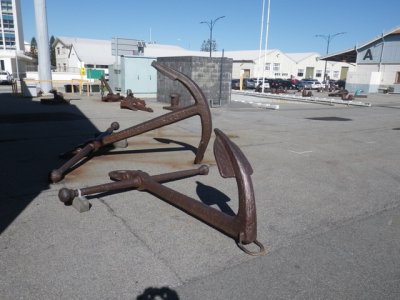
Like the one in the foreground.

IMGP3137.jpeg

These single fluke Fishermans (they might have a more accepted name) were commonly used in fleet moorings and might have been part of the motivation for the CQR design (which is very similar to my picture - but with a hinged fluke). My suggestion is to allow Noelex to disagree with me :). These single flukes anchors came as modified Fishemans or made like this one, to be single fluke by design. Note this one has a shackle at the crown - allowing the anchor to be deployed 'fluke down'

This was an anchor 'display' in Freemantle - the submarine mentioned in this thread is behind from where I took the image sitting on the hard with its anchor, deployed. I don't recall why it, submarine and anchor, did not merit an image.

Jonathan
 
Cerebus - I would never suggest, nor even agree that any member is thick - if you asked a question and it was not answered - no harm in jogging the odd elbow or three.

I thought it was covered in a number of posts - but maybe.....not

The stock of the Northhill and that of the Fisherman serves the same purpose, the stock sits flat on the seabed, forcing the flukes to orientate vertically at right angles (or roughly so) to the seabed. Actually if the stock is flat on the seabed then the flukes, the flat plates, will be at about 30 degrees to the seabed which is roughly the ideal, still used, for the fluke to start to set. If the flukes were at a lower angle there is the danger they simply skate on the surface and if higher the flukes will find difficulty diving into the substrate. Most modern anchors today dive at between 25-35 degrees to the seabed, in sand.

For hard seabeds these angles don't change much, if variation is possible a lower angle is better - but sharpening the fluke, especially the toe is the way to go. Realistically not many of us are going to file the flukes, removing the gal, as the sharp fluke/toe will soon wear. We are more likely to try a different location. If its very soft then a higher angle is better (as Fortress allows for its anchor in soft, squishy mud.

If you look at most modern anchors the toe can be quite sharp and the working part of the fluke the toe section or area, is narrower than the heel. This is because you want the toe to engage as once it engages it dives (at that 30 degree angle) and the heel is dragged into the seabed - creating padding to hold. Once the toe has engaged the anchor 'generally' stops 'ploughing' and incases its rate of burial.

The problem with the Fisherman or Northhill is that once set there is half the fluke structure sticking up in the sea - already to catch the rode and trip the anchor. This was overcome by removing the part of the asnchorthat might protrude - leading to a modified design and a different deployment process - but that's another story (which would upset NormanS. :) )

Like the one in the foreground.

View attachment 200716

These single fluke Fishermans (they might have a more accepted name) were commonly used in fleet moorings and might have been part of the motivation for the CQR design (which is very similar to my picture - but with a hinged fluke). My suggestion is to allow Noelex to disagree with me :). These single flukes anchors came as modified Fishemans or made like this one, to be single fluke by design. Note this one has a shackle at the crown - allowing the anchor to be deployed 'fluke down'

This was an anchor 'display' in Freemantle - the submarine mentioned in this thread is behind from where I took the image sitting on the hard with its anchor, deployed. I don't recall why it, submarine and anchor, did not merit an image.

Jonathan
Thank you. To not call me thick makes you one of the gooduns !

I carry 4 anchors of different designs ) won’t get into that can of worms) .

One is an ‘ordinary’ fisherman’s for rocky areas only and very very rarely sees the light of day ( thank goodness it is galvanised well).

I was confused that my fisherman’s has the crossmember at the end where chain is attached whereas the flying boat had it at the the flukes.

I could not understand if it served the same purpose as the the old style ( my style) fisherman’s anchor. I pondered for ages and gave up when the headache set in.

Thanks for clarifying.

I don’t know why they’ve designed it thus, but that is a whole different story and we all know there are better anchors than fisherman’s anchors … without opening that can of worms.
Thank you
 
But two good anchors are better than one good anchor. :)
Yes, but Ducked doesn't even have one.

You gave him good advice about acquiring a Fortress (or Guardian, the cheaper version) kedge.

He should also upgrade that CQR bower. A used Rocna or Mantus or someone's rusty Spade shouldn't be too expensive.
 
Yes, but Ducked doesn't even have one.

You gave him good advice about acquiring a Fortress (or Guardian, the cheaper version) kedge.

He should also upgrade that CQR bower. A used Rocna or Mantus or someone's rusty Spade shouldn't be too expensive.
If he gets a rusty Spade at a knock down price and is a bit handy

Melt out the lead, save it to add back. Wait till someone here needs a chain regalved, put in a combined lot to be regalved, add back the lead - better than a new Spade.

I get small items here in Oz galvanised for a slab of chilled beer (though some galvanisers will not drrink from cans and the only currency is bottles). It all depends on your powers of persuasion and the daytime e temperature, the hotter it is the smaller the offering of (must be) chilled beer. And you can pick up the item in the afternoon.

Jonathan
 
Top