Not your average Anchor question

The Rocna anchor is nothing like the Spade. One primarily uses a rollbar for orientation, the other a large lead-filled ballast chamber.

About the only thing they share in common is that they are both concave anchors, which when these models were introduced was a departure from the common convex fluke design of the CQR and plough anchors.

I'll let members decide.

Spade was introduce in the 1990s (maybe even 1980s) - though it never took off. Rocna was introduced in around 2005. Correct me if I'm wrong.

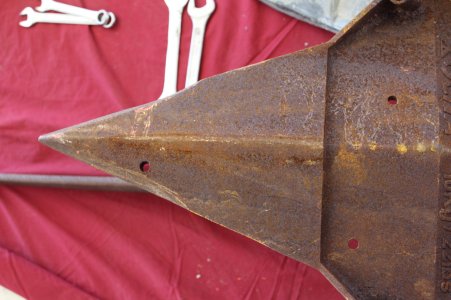
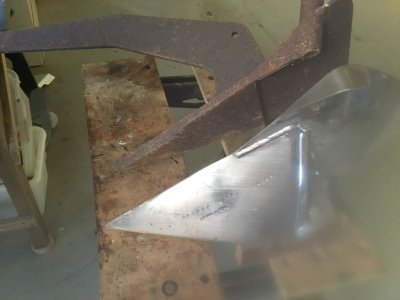
These are pretty rubbish pics but, this is a Rocna (cast fluke and not galvanised) sitting on top of a Spade fluke
IMG_1092.jpeg

Another similar picture, Rocna on top of Spade. You can see the double thickness of steel in the Rocna toe - that's the ballast. Spade has a much better concentration of ballast, its lead, the inability to increased the ballast in the Rocna means for some seabeds it needs a roll barIMG_1091.jpeg
Another view of the fluke with anchors lying on their side. Rocna is a shallow, saucer shaped fluke, guess what the Spade is like. Note any similarity in fluke shape.....? Its a bit difficult to see but check the flaps at the rear of the fluke plate
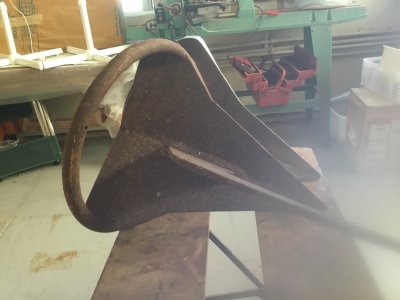
IMG_1090.jpeg

And some would say. 'The Rocna anchor is nothing like the Spade'.

Beleive me - the shanks are similar (look to be copies of a Deta shank, introduced in the 1980s, to counter the inroads Bruce was making.

Jonathan
 
If he gets a rusty Spade at a knock down price and is a bit handy

Melt out the lead, save it to add back. Wait till someone here needs a chain regalved, put in a combined lot to be regalved, add back the lead - better than a new Spade.

I get small items here in Oz galvanised for a slab of chilled beer (though some galvanisers will not drrink from cans and the only currency is bottles). It all depends on your powers of persuasion and the daytime e temperature, the hotter it is the smaller the offering of (must be) chilled beer. And you can pick up the item in the afternoon.

Jonathan
I think that's actually a pretty hot tip for Ducked.

All Spades are rusty if they're not pretty new, and few owners with the patience to melt out the lead and all that in order to get them regalvanised. I bet they are not that hard to find in rubbish tips.

Why haven't they figured that out in 30+ years of production? Lack of patience to melt out the lead etc. was actually why I switched to Ultra; my last rusty 55kg Spade is knocked down in the bilge.
 
But two good anchors are better than one good anchor. :)
I'd think, at least theoretically, that two bad anchors could at least be almost as good as one good one.

Suppose, for example, you are anchoring on a "patchy" bottom so you cant predict exacly what your anchor will be in, say mud and weed, (or, more simply, you dont know the nature of the substrate and dont have time to find out) and you set a fisherman/danforth combo. As I understand it, the danforth is relatively good in mud and the fisherman in weed, so TOGETHER they could give you a better chance of holding, and thus approach the "universal" ideal.

(Application of Sods Law would suggest that the Danforth will set in weed and the fisherman in mud, but maybe dragging will fix that sometimes)
 
I think that's actually a pretty hot tip for Ducked.

All Spades are rusty if they're not pretty new, and few owners with the patience to melt out the lead and all that in order to get them regalvanised. I bet they are not that hard to find in rubbish tips.

Why haven't they figured that out in 30+ years of production? Lack of patience to melt out the lead etc. was actually why I switched to Ultra; my last rusty 55kg Spade is knocked down in the bilge.
Faced with a rusty anchor (my CQR had/has some rust on the pointy bit where the galvanizing has worn off, and will probably be worse now) I would probably try my abrade-with-aluminium-and-a-veg-oil-or-alkyd-resin-binder thing. Wont stand up to abrasion in use but trivial to re-do and should be ok in standby storage, which is where most anchors spend most of the time.

Dont much like the idea of internal voids though. Such rot-traps used to be old car killers and I'd expect they would do the same to old anchors. given time.
 
Faced with a rusty anchor (my CQR had/has some rust on the pointy bit where the galvanizing has worn off, and will probably be worse now) I would probably try my abrade-with-aluminium-and-a-veg-oil-or-alkyd-resin-binder thing. Wont stand up to abrasion in use but trivial to re-do and should be ok in standby storage, which is where most anchors spend most of the time.

Dont much like the idea of internal voids though. Such rot-traps used to be old car killers and I'd expect they would do the same to old anchors. given time.
I admire Dockhead - he seems to see up with people who post and knew you had a CQR! He might know what yacht you have - I confess I don't know your yacht nor how big it is. Nor do I know your chain size

There are many, and a good few here, who will maybe not swear by a CQR but would not condemn it. I would condemn copies and I confess that the small CQR, genuine, we had never failed us - but we never really tested it in the extreme, either extreme weather or extreme seabed.

There are many reliable anchors now, Rocna, Vulcan, Supreme, Kobra (which are relatively cheap), Viking, Odin, buy these 2 direct off the Viking website, Spade (of course, but relatively expensive - though over time the cost is peanuts - the main dealer is in/on the Channel Islands, Ultra (seriously expensive), Excel, SARCA (Jimmy Green), Kobra, as mentioned its a Plastimo product (but available in UK chandlers. Any I don't mention, I've forgotten them or don't recommend.

All of these anchors are reliable in most seabeds and will set with ease. You need to check they fit on your bow roller, don't laugh - its an issue. You then need a decent shackle - read the recent Lidl shackle thread.

and/or ask here on PBO - and sift through the replies.

Jonathan
 
I'd think, at least theoretically, that two bad anchors could at least be almost as good as one good one.

Suppose, for example, you are anchoring on a "patchy" bottom so you cant predict exacly what your anchor will be in, say mud and weed, (or, more simply, you dont know the nature of the substrate and dont have time to find out) and you set a fisherman/danforth combo. As I understand it, the danforth is relatively good in mud and the fisherman in weed, so TOGETHER they could give you a better chance of holding, and thus approach the "universal" ideal.

(Application of Sods Law would suggest that the Danforth will set in weed and the fisherman in mud, but maybe dragging will fix that sometimes)
This was the solution used by all cruising sailors, including myself, until the advent of better and more versatile anchors.

The modern solution is a single large new-generation anchor. Modern anchors work well in a much greater range of substrates, and the larger size rather than two smaller specialist anchors gives this option better performance even if the anchor is in a less than ideal substrate.

The old methods can still work, but there are significant drawbacks, which is why most sailors anchoring frequently have changed.

Using your example of two specialist anchors: Danforth, which is very good in mud substrates, providing the direction of pull does not change, and a Fisherman’s anchor, good in weed and once again vulnerable in a wind change (because of the fluke sticking above the substrate). There are still many substrates (or in this case a wind change) where both anchors are poor, especially as both anchors need to be kept small to make deploying two feasible.

As well as more hassle to deploy and retrieve, the bow weight is higher (because you also need two lengths of chain), and when deploying two anchors, you need to be careful in crowded anchorages where it is likely everyone else will be using a single anchor and therefore will be swinging differently. As mentioned, you also stand far more chance of catching the anchor of any boats that drag. In strong conditions, I am always far more worried about other boats dragging than my own anchor performance, so this is significant extra risk.

The big drawback of the modern approach is that good-quality anchors are expensive. If you are anchoring frequently, the extra cost is easily justified, but if you are anchoring only occasionally and spend most of your time in marinas or on mooring balls, especially when stronger conditions are forecast, the older anchors can now be picked up at very low prices (or even free), and I can understand this is a tempting solution.
 
Last edited:
I'll let members decide.

Spade was introduce in the 1990s (maybe even 1980s) - though it never took off. Rocna was introduced in around 2005. Correct me if I'm wrong.

These are pretty rubbish pics but, this is a Rocna (cast fluke and not galvanised) sitting on top of a Spade.
Your photos clearly show the large lead-filled ballast chamber of the Spade and the lack of a rollbar. These are fundamental differences.

The Rocna and the Spade anchors work in two entirely different ways. The Spade uses ballast, hence the need for the large lead-filled ballast chamber incorporated into the fluke and a lightweight fabricated three-piece shank. These essential features ensure the Spade anchor will adopt the correct setting position and that it is not stable upside down. The Rocna uses a completely different mechanism, the rollbar, for the same purpose.

To state the Rocna is a "cheap copy" of the Spade as was done in post #62 is to misunderstand how these two anchors work.

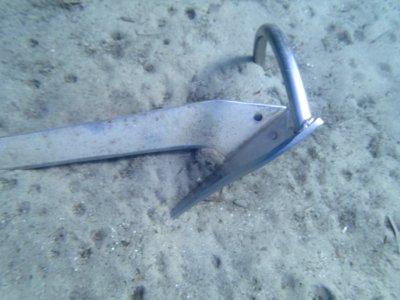
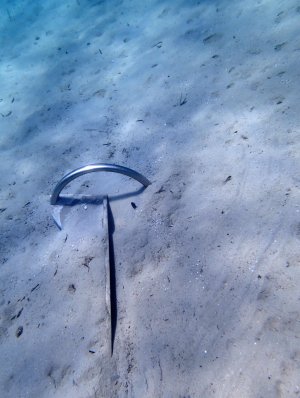
The Rocna was a development of the Bügel anchor, not the Spade.

The Bügel was (arguably) the first commercial rollbar anchor, released well before the Spade went on sale, I believe, around 1986, but Rocna improved significantly on the simple Bügel design and popularised the rollbar concept.

For those not familiar with the Bügel, see my underwater photos below. At first glance, you could be forgiven in thinking these were photos of a Rocna, but the Bügel was designed and first sold long before the Rocna. However, Rocna did make some significant improvements, including adopting a concave fluke, skid plates, increasing the fluke size by adopting a more complex construction and using a Delta shaped shank amongst some of the important changes. Many of these improvements were inspired or even directly copied from other anchor designs. That is how anchor development typically progresses.

Recently, Rocna have released a Mark 2 version with improvements such as a more streamlined rollbar and profiled shank. I have not seen this model underwater to make a proper assessment, but on paper they look to be significant developments. Hopefully this model can outperform my current Mantus M1 that proved to be better, after an extensive trial, than my previous Rocna (Mark 1).

IMG_2200~photo.jpeg
You_Doodle_2025-10-14T12_41_34Z.jpeg
 
Last edited:
I'd think, at least theoretically, that two bad anchors could at least be almost as good as one good one.

Suppose, for example, you are anchoring on a "patchy" bottom so you cant predict exacly what your anchor will be in, say mud and weed, (or, more simply, you dont know the nature of the substrate and dont have time to find out) and you set a fisherman/danforth combo. As I understand it, the danforth is relatively good in mud and the fisherman in weed, so TOGETHER they could give you a better chance of holding, and thus approach the "universal" ideal.

(Application of Sods Law would suggest that the Danforth will set in weed and the fisherman in mud, but maybe dragging will fix that sometimes)
The problem with setting two anchors at once is there is no real way to apply equal force to them. So one of them will generally be doing all the work anyway. And they tend to get tangled with each other. And if the wind shifts or the tide changes -- well, you can just imagine.

Pro tip: Use just one anchor, and make your everday anchor the same anchor as your storm anchor.
 
. . . The big drawback of the modern approach is that good-quality anchors are expensive. If you are anchoring frequently, the extra cost is easily justified, but if you are anchoring only occasionally and spend most of your time in marinas or on mooring balls, especially when stronger conditions are forecast, the older anchors can now be picked up at very low prices (or even free), and I can understand this is a tempting solution.

A discarded rusty Spade is probably not any more expensive than any other anchor.

I would bet most of them get thrown away after some point, as no one will pay for them once the galvanising is gone.

Maybe that would be a business opportunity for someone -- refurbishing and recycling old Spades, improving the galvanising. They are expensive enough when new, that this could be worth doing.

Thread drift, but I always thought the Spade would be better, with a denser and harder tip. Tungsten is hard to work, I realize, but the impure grades are cheap enough. The whole ballast chamber part of the anchor could be exchanged with a solid tungsten part, and while we're messing with exotic materials, maybe the rest of it could be titanium. Then you lose the galvanising problem.

You'd end up with a much heaver anchor of the same fluke size, but on most boats with reasonably powerful windlasses, handling is limited by the bulk and not weight of the anchor. This would greatly increase the pressure on the flukes while setting. Furthermore, the anchor would be (even) better balanced, with more tip weight distribution. I bet an anchor like that would be a demon.
 
I'll let members decide.

Spade was introduce in the 1990s (maybe even 1980s) - though it never took off. Rocna was introduced in around 2005. Correct me if I'm wrong.

These are pretty rubbish pics but, this is a Rocna (cast fluke and not galvanised) sitting on top of a Spade fluke

View attachment 200719
Because the Spade requires a large amount of lead ballast to adopt the correct setting position and not stay inverted, its fluke area is significantly smaller than the same-sized Rocna. The weight has to come from somewhere.

For example, the 15kg Rocna has a fluke area of 1030 cm² vs the 15kg Spade, which has a surface area of 800 cm². This greater surface area is quite noticeable in real life when you see a Rocna next to an identical-weight Spade. Surprisingly despite these differences the performance of these two anchors is similar.

In your photos comparing the fluke of the Spade to the fluke of the Rocna, the fluke area appears almost the same to my eye. In fact, the aim of the photographs seems to be to suggest the top surface of the two flukes is identical which, if you compare anchors of the same weight, is not correct

Was this a quirk of the photograph, or were you comparing different-weight anchors?
 
Last edited:
I recall seeing British and Commonwealth Subs at anchor during the Queen's Coronation Fleet Review in 1953.
The Danforth type anchor, originally developed for holding landing craft steady and kedging off the beach during an assault, was and probably still is part of the subs' outfit.
This has been a fascinating thread but time prevents me from rechecking whether the Danforth has been mentioned yet!
 
The problem with setting two anchors at once is there is no real way to apply equal force to them. So one of them will generally be doing all the work anyway. And they tend to get tangled with each other. And if the wind shifts or the tide changes -- well, you can just imagine.

Pro tip: Use just one anchor, and make your everday anchor the same anchor as your storm anchor.
We have used two anchors extensively. In Greece, where the prevailing wind rarely varies, it is a useful and safe technique.
Fork mooring
 
We too would use 2 anchors in a fork or V. They are particularly useful if the forecast is for wind in a constant direction but oscillating from left to right and back again. There is no issue with the rodes, as one can be all chain and the other a mix, with a minimalist amount of chain, say 6m.

You can easily set to the same tension simply by extending one rode, tension other, slacken first tensioned rode and tension second - simply using engine revs to ensure both are set to the same tension. Retreival is also easy - simply follow the rod and take in and then drop back and take in the second rode.
Your photos clearly show the large lead-filled ballast chamber of the Spade and the lack of a rollbar. These are fundamental differences.

The Rocna and the Spade anchors work in two entirely different ways. The Spade uses ballast, hence the need for the large lead-filled ballast chamber incorporated into the fluke and a lightweight fabricated three-piece shank. These essential features ensure the Spade anchor will adopt the correct setting position and that it is not stable upside down. The Rocna uses a completely different mechanism, the rollbar, for the same purpose.

To state the Rocna is a "cheap copy" of the Spade as was done in post #62 is to misunderstand how these two anchors work.

The Rocna was a development of the Bügel anchor, not the Spade.

The Bügel was (arguably) the first commercial rollbar anchor, released well before the Spade went on sale, I believe, around 1986, but Rocna improved significantly on the simple Bügel design and popularised the rollbar concept.

For those not familiar with the Bügel, see my underwater photos below. At first glance, you could be forgiven in thinking these were photos of a Rocna, but the Bügel was designed and first sold long before the Rocna. However, Rocna did make some significant improvements, including adopting a concave fluke, skid plates, increasing the fluke size by adopting a more complex construction and using a Delta shaped shank amongst some of the important changes. Many of these improvements were inspired or even directly copied from other anchor designs. That is how anchor development typically progresses.

Recently, Rocna have released a Mark 2 version with improvements such as a more streamlined rollbar and profiled shank. I have not seen this model underwater to make a proper assessment, but on paper they look to be significant developments. Hopefully this model can outperform my current Mantus M1 that proved to be better, after an extensive trial, than my previous Rocna (Mark 1).

View attachment 200732
View attachment 200733
The Bugel has no ballast and the crown of the anchor is at the heel. Rocna and Spade are both ballasted and the crown is roughly in the same place as each other - in the middle of the fluke.

All unballasted anchors, Bruce, Fortress, Danforth, Bugel, SARCA, Viking, Odin have their crown at the heel. All Ballasted anchors, of which there are many, Kobra, Ultra, Excel, Delta, Excel, Vulcan, etc etc have the crown in the middle of the fluke.

Moving the crown from the heel to the middle of the fluke in an unballasted anchor reduces the holding capacity - which is why all unballasted anchors have the crown at the heel. If, in fact, you look at a Genuine Bruce the shank attaches - behind the heel.

The only outlier is Mantus, it is unballasted but has the crown in the middle of the fluke. I drilled new attachment holes in my Mantus to move the crown back - and doubled hold.

Size of anchor makes no difference - a bit Rocna is simply a bigger version of a small one, so for design you can look at a small Rocna and a large Spade - its still a fair comparison.

As I said I'll allow members to view the images and decide for themselves. They can view that double thickness of steel in a Rocna and that it would act as ballast, but not as good as lead in Spade. They can mull over the idea that all ballasted anchors have their crown in the middle of the fluke but unballasted anchors have the crown at the heel


Because the ballast of Rocna is not as focussed as the lead in Spade they needed a roll bar.

When we were looking to buy out forever anchor Craig Smith of Rocna actually adviced me that in many seabeds the Rocna did not need a roll bar. It was there, only, for the difficult seabeds.

You can very clearly see the ballast of the Rocna here, its the double thickness of steel at the toe, the Bugel does not have this arrangement as its crown is at the heel. I'm sure someone will argue this is not ballast - but as a huge chunk of extra steel it would be very imaginative to call it decoration. It might be described as strengthening (which I am sure it does, but its primary role is .... ballast

It would merit pondering - why are all unballasted anchor sdesigned with the crown, that junction of shank and fluke, at the heel and why are all ballasted anchors designed with the crown roughly in the centre - and further pondering why is Mantus different - its not different its the only exception.

Jonathan


IMG_9675.jpeg
 
We too would use 2 anchors in a fork or V. They are particularly useful if the forecast is for wind in a constant direction but oscillating from left to right and back again. There is no issue with the rodes, as one can be all chain and the other a mix, with a minimalist amount of chain, say 6m.

You can easily set to the same tension simply by extending one rode, tension other, slacken first tensioned rode and tension second - simply using engine revs to ensure both are set to the same tension. Retreival is also easy - simply follow the rod and take in and then drop back and take in the second rode.
This works, but would not a single larger anchor be a simpler and easier solution? The weight will be less than two smaller anchors and the associated chain. You will swing like most other boats that will be using a single anchor and have significantly less risk of catching dragging boats.

The single larger anchor does not require any late-night excursions when the wind unexpectedly picks up. The larger anchor is always deployed.

Importantly, even in moderate winds, the larger anchor will enable the safe use of more marginal substrates and/or shorter scopes every time the anchor is used. This is a major advantage.

Embrace the modern world. The two-anchor solution was conceived in the days when the best anchors of the day only worked in a very limited range of substrates and when we had no electric windlasses. Even a lightweight anchor was difficult to manage with a small crew. Technology has moved on.
 
Last edited:
Size of anchor makes no difference - a bit Rocna is simply a bigger version of a small one, so for design you can look at a small Rocna and a large Spade - its still a fair comparison.
If you are going to post photographs comparing the Rocna to the Spade fluke, and asking members to decide if there is any difference, the anchor size used absolutely does matter.

Comparing a heavier Spade model with a smaller Rocna model and suggesting they are the same without pointing out the size difference would be misleading. I hope you have not done this.

The point is the Rocna fluke area is considerably larger than the Spade, but this is not apparent from your photos. The post and photos try to convince YBW members the Rocna and Spade flukes are identical which is not true. The surface area is quite different when comparing Rocna and Spade anchors of the same weight.

This should be corrected.
 
Last edited:
I s'pose I'd need to put my hands up to being a YBW anchors nerd, having been slavishly following the 'latest and greatest' in anchor threads ever since back in the day before there was a YBW.

Probably due to the influence of a long-lost Yorkshire girlfriend, from whom I learned a lot, I've managed over the years to acquire at knockdown second-hand prices a pair of Fortress Fx-16s, a Kobra II 16kg, and a Spade 15kg S80 - I sold on the Delta I got some years ago 'vellycheep' from Force 4 at the price I paid for it. That doesn't include the little 4kg. Fortress Fx-7, and the dinghy's little folding grapnel.

All in pristine tip-top nick, and all got for a song/handful of beer tokens when opportunity arose.

All in all, the above SHHP jobs are probably very much better than the two ~35lb genuine-bedouine CQRs collected over the years, plus the 65lb Folding Fisherman prototype I 'bought' at SIBS from Tennamast's boss, who didn't want to cart it all the way back to Ayrshire.

Is there any known cure for this disease....?
 
Is there any known cure for this disease....?
You are doomed.

The next thing, you will be craving is the hard stuff. Mantus, Spade etc.

Before you know it, an Ultra will be on your bow, and you will wish you never opened the YBW dark web.
 
Last edited:
Embrace the modern world. The two-anchor solution was conceived in the days when the best anchors of the day only worked in a very limited range of substrates and when we had no electric windlasses. Even a lightweight anchor was difficult to manage with a small crew. Technology has moved on.
I have heard of this "modern world" of which you speak, but I'm in the days when "we" had no windlass at all, and where "our" hands were becoming a bit arthritic, so some Ye Olde Advantages might still be of use to me.
 
This was the solution used by all cruising sailors, including myself, until the advent of better and more versatile anchors.

The modern solution is a single large new-generation anchor. Modern anchors work well in a much greater range of substrates, and the larger size rather than two smaller specialist anchors gives this option better performance even if the anchor is in a less than ideal substrate.

The old methods can still work, but there are significant drawbacks, which is why most sailors anchoring frequently have changed.

Using your example of two specialist anchors: Danforth, which is very good in mud substrates, providing the direction of pull does not change, and a Fisherman’s anchor, good in weed and once again vulnerable in a wind change (because of the fluke sticking above the substrate). There are still many substrates (or in this case a wind change) where both anchors are poor, especially as both anchors need to be kept small to make deploying two feasible.

As well as more hassle to deploy and retrieve, the bow weight is higher (because you also need two lengths of chain), and when deploying two anchors, you need to be careful in crowded anchorages where it is likely everyone else will be using a single anchor and therefore will be swinging differently. As mentioned, you also stand far more chance of catching the anchor of any boats that drag. In strong conditions, I am always far more worried about other boats dragging than my own anchor performance, so this is significant extra risk.

The big drawback of the modern approach is that good-quality anchors are expensive. If you are anchoring frequently, the extra cost is easily justified, but if you are anchoring only occasionally and spend most of your time in marinas or on mooring balls, especially when stronger conditions are forecast, the older anchors can now be picked up at very low prices (or even free), and I can understand this is a tempting solution.
I had a look on Gumtree at anchors for sale in Scotland.

Prices seem all over the place, with rusty Fishermen examples apparently carrying an optimistic "antique" premium, but there were some apparently modern types below 50 quid, which I might consider.

I was a bit puzzled by this one. It looks basically like a Danforth, but the "hollow fluke" feature, "winglets" and some of the other furniture seem, to my inexpert eye, to be a bit different. I think it (and another smaller one) have been on the site for quite a while so maybe I'm not the only potential punter puzzled.

Any idea what it is?

BOAT ANCHOR fully Galvanised | in Linlithgow, West Lothian | Gumtree
86
 
You are doomed.

The next thing, you will be craving is the hard stuff. Mantus, Spade etc.

Before you know it, an Ultra will be on your bow, and you will wish you never opened the YBW dark web.
I think Dockhead is happy to have an Ultra on his bow roller.

Rocna a copy a Bugel ?- show me a Bugel with ballast or one with its shank/fluke joint in the middle of the fluke. :
 
Top