Not your average Anchor question

The aluminium Spade and Excel anchors consistently perform worse than their steel equivalents in anchor tests, despite their identical fluke areas.


We had a steel and an aluminium Excel No4 and a steel and aluminium Spade, A and S80,m. 38' x 22' catamaran 7t in cruising mode. The Spade '80' and Excel No 4 are roughly the same performance and similar weights. All have ballasted toes, that will obstruct setting as it, the ballast, protrudes under the fluke.

I could not tell the difference between the 4 anchors and the steel versions were relegated to my workshop. I also tested them for hold and their hold was similar.

Of course my assessment is a combination of quantitate testing (hold) and subjective, I only used the steel versions, comparing with the aluminium versions over about 5 years - before I retired the steel versions and used the aluminium versions as sole primary for only 10 years.

If I was buying again - I'd focus on the aluminium versions and recommend same.


If I extend or broaden the 'definition' to include a comparison of the Viking pair of 'ligjtweith anchors I'd focus on Odin, not the original Viking (I think Odin a superior design and engineering).

Jonathan
 
A heavier anchor has more chance of penetrating weed or sea grass than a lighter anchor. And that's without writing a book about it. 😄
Indeed!

Weed, and especially kelp, is very common in higher latitudes, and some of us cannot avoid anchoring in weeds.

I have used Fishermen back in the day for this, which work, I believe, because they are very heavy in relation to their small flukes, so penetrate very well.

Contrary to Jonathan, I don't believe that anchoring in weeds depends on roots. It depends on getting the anchor to penetrate through the weeds to the actual substrate, and then penetrating THAT deeply enough to be well set. I don't think roots have anything to do with it, provided the anchor is properly set.

In my experience, only a Fisherman or a very large Spade or Ultra works well for that. I have heard that very large Bruces (like the 80kg ones Dashew used decades ago) work well in weedy bottoms, but I don't have my own experience.

In certain kinds of kelp, nothing works, and that is a real hazard in high latitudes where it can be hard to find an anchorage without it.

Thread drift, but I have just removed a forward looking sonar and replaced it with a CHIRP fishfinder, specifically for imaging the bottom in weedy places, to try to identify spots without weeds. I have no idea whether this will actually work or not, but I'll post about it when I know.
 
I think everyone agrees that ultimate holding comes from fluke area and geometry, and not weight (or at least, not very much from weight).

And everyone with experience of light-weight Fortresses, which is most of us, since this is the almost universal kedge in our time, knows that even very light anchors can set very well -- at least in certain bottom types -- if they have sharp flukes with the right geometry. The highly regarded Viking apparently works on the same principle.

But that does NOT mean that weight is irrelevant in all cases. More weight, and certainly more weight per unit of fluke area, helps get the anchor set in the first place even if it plays little role in holding AFTER the anchor is set. Especially a conventional anchor with less sharp fluke than Fortress or Viking. What John Harries of Morgan's Cloud says about it:

"Holding Is Not Linear​

"I’m not sure why, but out there in the real world it does seem that the force that an anchor will withstand before dragging does not scale in a linear fashion with size. So the bottom line is that bigger is not just better, it’s a lot better.

"Heavier Anchors Set Better

"Of late there has been a lot of chatter stating that anchor weight does not matter. That’s true, but only once the anchor is set (when fluke area and shape govern ultimate holding). When we are actually trying to get the anchor to set, weight matters big time."
Specifying Primary Anchor Size

This corresponds to my own experience in a lifetime of cruising. I've not used the highly regarded Viking, but I've used Fortresses for decades, and they don't work in all types of seabeds. They will not, for example, penetrate weed. They also don't work very well on very hard bottoms. Back in the last century, I used to use a heavy fisherman for weedy bottoms; nowadays a 100 pound or larger Spade is what I find works best.

Whether saving weight in the anchor is beneficial or not very, depends on your setup. If you don't have a windlass, or have a hand-operated one (as we had on the previous boat in the last century), if you use a rope rode, then weight can be very important. If you have all-chain rode and a powered windlass, weight of the anchor may be almost completely irrelevant, as the entire anchor may be a small fraction of total ground tackle weight, and doubling or halving the anchor size may make no difference at all.

For such cases, an extra-heavy anchor -- say add tungsten to the lead in a Spade -- might be very beneficial to setting behavior, even if it would add little to ultimate holding power.

It's widely observed -- mentioned by Harries ("The 'Hundred Pound Factor'") and Dashew and many others -- that anchors start to set much better once they are over 100 pounds. That is, they don't scale. I've observed this myself; it's a very noticeable thing. My theory is that this is because fluke area does not scale with weight, with conventional anchors. The 121 pound Spade has 2.5x the weight per unit of fluke area, than the smaller ones do, for example. My theory is that higher specific weight on the flukes makes them set better.

Weight is not the only way to get an anchor to set -- as anyone who's used a Fortress knows, as I said. But since on my particular setup with a 2kW windlass and 330kg of chain I don't notice the weight of the anchor AT ALL, the heavier, the better. I notice the SIZE of it, and I wasn't able to use the 75kg Spade because it badly fitted my bow roller, but the weight was not a problem. YMMV if you haul your anchor by hand.

P.S. A small quibble -- the ballast in a Spade is not only to help setting -- increasing weight of the anchor per unit of fluke area -- but also for BALANCE. Balance is why the Spade doesn't need a roll bar. The Rocna has no lead ballast, although it does have a bit of extra plate welded at the tip, which I guess helps balance some. Good balance helps a lot with setting behavior because it keeps the flukes oriented correctly. Also helps retrieving the anchor, as a well-balanced anchor will come up the right way and not need a swivel. The Spade's balance is also enhanced with the fabricated shank, which is much lighter (and much stronger) than a simple plate. Downside is it's much more expensive to make.

Dockhead, we never learn - you and I will both invoke the wrath of NormanS, welcome to the club :).

In the grand scheme of things anchor price should not matter - used over years it cost nothing per night and a good anchor is commonly cheaper than yearly insurance (which hopefully you never use).

I wonder what prompted Ultra to design and market a swivel...... :)

J
 
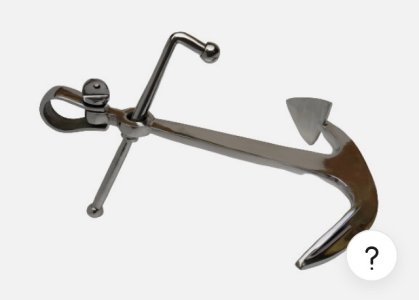
I meant the long crossbar at right angles to the flukes and lying on the seabed. I assume they are hinged, but they are longer than anything on any similar anchor I have seen.

Would they not stop the flukes digging in?
I think you refer to the stock, common on Admiraly pattern Fishermans.

The stock is there so that it lie flat on the seabed, one of the flukes then lies touching the seabed (with the other stick up in the sea. Apply tension and the stock remains on the seabed and the fluke on the seabed buries. The issue with such anchors is that the unburied fluke can foul the rode and the anchor trip.

Jonathan
 
. . . I wonder what prompted Ultra to design and market a swivel...... :)

J
I have asked myself the same question about Ultra. Such a nice anchor and such an obviously awful swivel. And their anchor is so well balanced -- even better than Spade -- that you'd never need a swivel of any kind! Go figure.
 
Not sure of the precise definition of "Yank". In the Yook we tend to use it (probably incorrectly) as a synonym for American, and use the ryming slang analogue "Septic" even if we arent Cockneys. I believe that strictly speaking the term excludes the former Confederate states, so I suppose, to the extent I'd thought about it at all, I'd guessed it to have a Civil War origin.

This ignorance means I'm not sure if the term "Yank" was in use at the time of the Napoleonic wars. IIRC the device shown was originally designed in 1800, and resulted from a "pitch" by Fulton to Napoleon, leading to the construction of a French prototype, by the French, in France, which was destroyed in testing, and at least one later hull, similar to the two images.

The Napoleonic wars were 1803-1815, so both the timing and the constructing and operating nation would make it a Napoleonic War submarine, though it was never used in combat.

Alleged American indifference to the Napoleonic wars has no relevence.

IIRC submarines were used in combat on a very small scale both in the earlier American War of Independance and the later American Civil War, the latter resulting in the sinking of at least one blockading naval vessel
If Fulton pitched that sub to Napoleon, then my comment was incorrect, and yours was right, and I retract mine.

What concerns the demonym "Yank" -- Brits often use this term to refer to U.S. Americans generally.

In the U.S. itself, the term is used by people from the Southern parts to refer to people from the North, or in some contexts, it refers to people from New England.

What concerns subs in the American Civil War -- yes, the first recorded ship sunk in war by a submarine was the Housatonic, sunk by the Confederate Navy submarine Hunley in Charleston Harbour. There's an interesting movie about it.
 
I could not tell the difference between the 4 anchors and the steel versions were relegated to my workshop. I also tested them for hold and their hold was similar.
This does not fit in with the objective test results.

Formal tests confirm the difference. For example, in the large 2008 test involving several sailing magazines, the steel Spade S80 achieved an average holding in hard sand of 1905 kg, and the same dimension aluminium version A80 only managed a little more than half this figure at 1025 kg. The results for the aluminium version were consistently significantly worse in all substrates.

Also consider at the rating Panope gives to both the same surface area steel and aluminium versions of Excel and Spade anchors. The steel Excel was given a rating of 4.0, the same dized aluminium version was given a rating of 3.4. Likewise, the steel S100 was given a rating of 3.8 and the aluminium A100 a rating of 3.5.

Even Spade advises "Aluminium Spade boat anchors are intended for secondary and emergency anchorages". They are not designed by the manufacturer to be a primary anchor.

Aluminium Spade and Excel anchors are a useful option where anchoring weight is critical such as kedge anchor or where no electrical windlass is practical, but we should not fool ourselves that the performance is identical to the steel versions.
 
Last edited:
I think you refer to the stock, common on Admiraly pattern Fishermans.

The stock is there so that it lie flat on the seabed, one of the flukes then lies touching the seabed (with the other stick up in the sea. Apply tension and the stock remains on the seabed and the fluke on the seabed buries. The issue with such anchors is that the unburied fluke can foul the rode and the anchor trip.

Jonathan
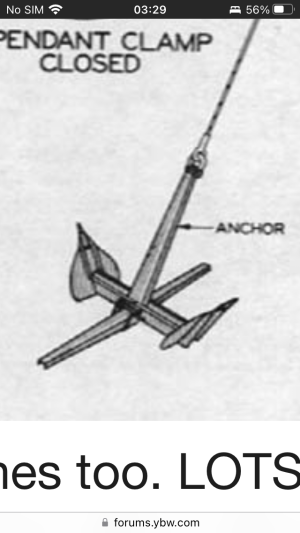
You may be right but I don’t understand.

The stock on fisherman anchors is at other end of the anchor compared to the one here.

Does that make a difference?

5C104CF2-D793-46BD-AD54-2F574BA79315.jpegA9716FF5-2720-4576-B3BB-C2B83519C21F.png
 
Also consider at the rating Panope gives to both the same surface area steel and aluminium versions of Excel and Spade anchors. The steel Excel was given a rating of 4.0, the same dized aluminium version was given a rating of 3.4. Likewise, the steel S100 was given a rating of 3.8 and the aluminium A100 a rating of 3.5.

The same Panope tests hammer Rocna with ratings less than either Spade and Excel. If the Spade or Excel, in any version is better than, Rocna, a highly popular design then one might say - who cares what the Panope tests indicate. Knox is equally hammered (another popular design by members here) one might question the objectivity of the Panope tests - not question the objectivity of those who bought and used Knox, Rocna and both aluminium and steel Excel and Spade.

Jonathan
 
Indeed!

Weed, and especially kelp, is very common in higher latitudes, and some of us cannot avoid anchoring in weeds.

I have used Fishermen back in the day for this, which work, I believe, because they are very heavy in relation to their small flukes, so penetrate very well.

Contrary to Jonathan, I don't believe that anchoring in weeds depends on roots. It depends on getting the anchor to penetrate through the weeds to the actual substrate, and then penetrating THAT deeply enough to be well set. I don't think roots have anything to do with it, provided the anchor is properly set.

In my experience, only a Fisherman or a very large Spade or Ultra works well for that. I have heard that very large Bruces (like the 80kg ones Dashew used decades ago) work well in weedy bottoms, but I don't have my own experience.

In certain kinds of kelp, nothing works, and that is a real hazard in high latitudes where it can be hard to find an anchorage without it.

Thread drift, but I have just removed a forward looking sonar and replaced it with a CHIRP fishfinder, specifically for imaging the bottom in weedy places, to try to identify spots without weeds. I have no idea whether this will actually work or not, but I'll post about it when I know.
One of the options on my MFD plotter is a coloured Fishfinder. I find it invaluable for finding clear patches, if anchoring in places with weed. (I also carry a Fisherman anchor, but I haven't used it for years).
 
Indeed!

Weed, and especially kelp, is very common in higher latitudes, and some of us cannot avoid anchoring in weeds.
Kelp is also very common in Scotland and Tasmania - maybe they are included in high latitudes.

If you try to anchor in weed, that is kelp, then winning the lottery might be a better bet.

Kelp grows on rock, solid stuff, not mud or sand. You need a really special anchor, or a charmed life, to find an anchorage on rock - which is why kelp beds are well defined on local charts and advice is - stay clear......but you
know all this.

Jonathan
 
Kelp is also very common in Scotland and Tasmania - maybe they are included in high latitudes.

If you try to anchor in weed, that is kelp, then winning the lottery might be a better bet.

Kelp grows on rock, solid stuff, not mud or sand. You need a really special anchor, or a charmed life, to find an anchorage on rock - which is why kelp beds are well defined on local charts and advice is - stay clear......but you
know all this.

Jonathan
Unfortunately, kelp also grows on quite modest stones, which can be found scattered on otherwise good clear mud or sand. Stalks of kelp can often be found washed up on beaches, with their roots firmly clasping stones. It's fairly easy to avoid trying to anchor on rock. Odd or occasional stones, not so easy, but the kelp shows well on the fishfinder.
For anchoring purposes, charted kelp beds are seldom detailed enough to be useful.
 
Unfortunately, kelp also grows on quite modest stones, which can be found scattered on otherwise good clear mud or sand. Stalks of kelp can often be found washed up on beaches, with their roots firmly clasping stones. It's fairly easy to avoid trying to anchor on rock. Odd or occasional stones, not so easy, but the kelp shows well on the fishfinder.
For anchoring purposes, charted kelp beds are seldom detailed enough to be useful.

Norman,

You need to come and sail in Tasmania. The kelp beds are well defined, sufficient that a navigator need not impinge on them.

Jonathan.
 
Norman,

You need to come and sail in Tasmania. The kelp beds are well defined, sufficient that a navigator need not impinge on them.

Jonathan.
It must be great to have everything done for you by the cartographer. Unfortunately some of our areas are charted at a scale of 1:200,000, where a pencil line thickness equates to approximately one cable. A lot of our anchorage selection is done by personal observation.
 
I like to see data for myself, not quotes of the data.

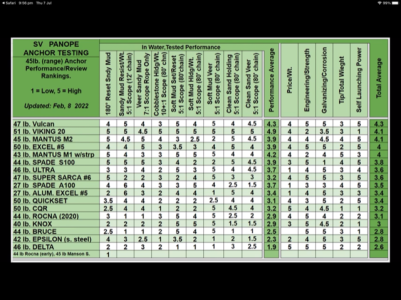
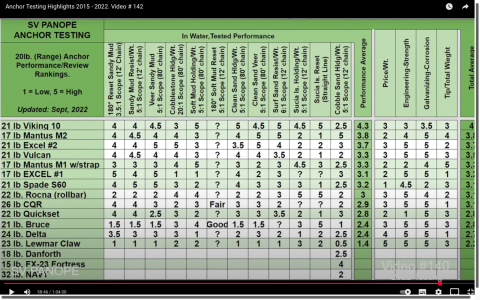
The Panope anchor videos allowed the production of spread sheets comparing anchor performance. The tests were conducted, as far as we know, by one man and no independent observers were ever invited. This is but one of the spread sheets - there maybe are recent version.

Could you tell the difference if you used both the various versions of the steel and aluminium Spade and Excel. Then look at the Rocna - could it really be that bad against the aluminium versions of the Spade and Excel and even worse if you compare the Rocna or Knox wth the steel Excel and Spade

Jonathan

IMG_9522.PNG


To me

The difference between a steel (3.9) and aluminium (3.7) Spade and a steel (3.9) and aluminium Excel (3.4) are differences most if not all owners simply will not detect in use - especially when a Rocna and Knox score (2.9) under the same test regime.

Its not the score that is important but are any of the anchors good all round performers - or is their score 'lifted' or knocked because they excelled or failed above or below the average

Jonathan
 
Last edited:
It must be great to have everything done for you by the cartographer. Unfortunately some of our areas are charted at a scale of 1:200,000, where a pencil line thickness equates to approximately one cable. A lot of our anchorage selection is done by personal observation.

We have cruising guides with good mud maps which would be used in connection with the the marine charts, paper and electronic versions. Some of the guides also include terrestrial maps, similar to your Ordinance Survey, of the anchorages so that you have access to the hinterland as well. Many of the original surveys, think, Cook, Bass and Flinders were conducted in vessels not much difference in size (and draught) to ones we use and older versions of Admiralty Pilots have detail of fresh water access etc. I think the last 'original' Cook cartography in NZ was only updated within the last 2 decades and we both still have large areas through which we sail, coloured white, with a single word across the space 'unsurveyed).

Unsurprisingly most anchorages which would have been used by Bass et al - have not changed over the decades.

That's just another reason its called

The Lucky Country. :).
 
I like to see data for myself, not quotes of the data.

The Panope anchor videos allowed the production of spread sheets comparing anchor performance. The tests were conducted, as far as we know, by one man and no independent observers were ever invited. This is but one of the spread sheets - there maybe are recent version.

Could you tell the difference if you used both the various versions of the steel and aluminium Spade and Excel. Then look at the Rocna - could it really be that bad against the aluminium versions of the Spade and Excel and even worse if you compare the Rocna or Knox wth the steel Excel and Spade

Jonathan

View attachment 200583


To me

The difference between a steel (3.9) and aluminium (3.7) Spade and a steel (3.9) and aluminium Excel (3.4) are differences most if not all owners simply will not detect in use - especially when a Rocna and Knox score (2.9) under the same test regime.

Its not the score that is important but are any of the anchors good all round performers - or is their score 'lifted' or knocked because they excelled or failed above or below the average

I read that the Rocna he used for this test had been bent. He did his best to straighten it but it seems he was not fully successful. In another set of tests, 25 lb I think, the Rocna did well, as might be expected.

I have to say that when I tested a Knox in a very 'difficult' anchorage it was most disappointing. I gave up after many attempts to get it to set and reverted to my Rocna, which set first time.
 
The manufacturers and distributors of, both Spade and Excel, are quite realistic about the limitations of the aluminium versions of their anchors.

Excel:
"I'll be the first to tell you weight does play a role in setting so the aluminum version will take a little longer to set, particularly true in harder bottoms. Also, if your using it full time, anchoring every night, it's not going to have the longevity of a steel anchor."

Spade:
The manufacturer stresses that their aluminium version is designed as a secondary, not a primary anchor.

"Aluminium Spade boat anchors are intended for secondary and emergency anchorages.Aluminium is a much lighter, more flexible material than galvanised or stainless steel, meaning it is also weaker. That is why aluminium anchors are ‘secondary’ ones. They are designed for use in emergency situations on a boat, when you need to cut the primary anchor rode, or when you want to prevent a boat on its primary anchor riding at anchor."

Spade like Excel also note that the aluminium version does not penetrate hard substrates as well as the steel version although this statement seems to have subsequently been removed from their website:

"This is true; the model in steel will dig in slightly more readily than the equivalent aluminium version."

The steel Spade is an excellent-performing and very durable anchor. The fact that the aluminium version does perform quite as well should not mean you should not consider this model, but be aware that some of the brilliance of the steel version has been lost in the switch to the lighter material.
 
Last edited:
You may be right but I don’t understand.

The stock on fisherman anchors is at other end of the anchor compared to the one here.

Does that make a difference?

View attachment 200574View attachment 200575
I THINK (But only intuitively, based on the appearance, no experience and certainly no formal testing) that the Fisherman could still lie with its arms parallel to the seabed and thus not set. That looks very unlikely with the Northhill pattern.

I'd also think one might be able to modify a Fisherman pattern by lashing on a temporary disposable stock at the junction of the arms and the shank, and see how that does.

OTOH on soft substrate it looks like the Northhill stock could dig in, so one ended up anchored by the stock, which wont hold well. I'm guessing the stock might be able to pivot, (the shank is apparently angled in the Catalina pic) and also appears to be a fairly weak/light section, so it could perhaps bend, to prevent the anchor hanging up on it.
 
Last edited:
I read that the Rocna he used for this test had been bent. He did his best to straighten it but it seems he was not fully successful. In another set of tests, 25 lb I think, the Rocna did well, as might be expected.

I have to say that when I tested a Knox in a very 'difficult' anchorage it was most disappointing. I gave up after many attempts to get it to set and reverted to my Rocna, which set first time.

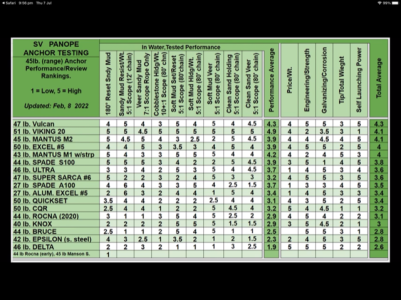
I copy two Panope spread sheets for different anchor weights 45lb and 20lb. One is a copy of the one posted above - but I wanted to make it easier to compare.

The Rocna results for the different weights of anchor are very similar, which suggests either both had bent shanks or that these results are not of bent shanked Rocna. The Rocna's perform very similarly to a CQR......? The fact the two Rocna's scored similarly might suggest that the tests are repeatable

IMG_9522.PNG


Screen Shot 2025-10-12 at 12.45.47 pm 2.png

Note that the Viking does very well. The Viking 10 fluke is a similar size, surface area, to the Excel No4 (the steel No 4 weights around 15kg) - the advantage of using HT steel - and allows a lighter anchor to be recommended for a given yacht size (similar to an advantage of aluminium anchors).

Jonathan
 
Top