No more synchronisation of buoy lights

dgadee

Well-Known Member
Joined
13 Oct 2010
Messages
4,693
Visit site
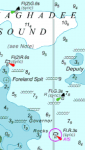
In front of the house, buoys were installed which flashed in time with each other - noted on charts. Not any more. Any idea why Irish lights might have changed the sequence?

 
Lots of things can cause a change in lights flashing
Brexit? :unsure:
Roadworks, traffic lights?:unsure:
House of ill repute?:unsure:
Council forgot to take the Xmas lights down? :unsure:
Mick has had a row wid Murphy & refuses to flash his torch at the same time :unsure:
Just being "bloody minded Irish" :unsure:

Are you sure they flash? because where my mate Paddy lives they are fixed.
But he gets a lot of lorries drive past his front window & he gets confused :confused:


Apart from that I cannot really help :unsure:
Any one else know?
 
Last edited:
I have never seen synchronised lights in action but we were shown a visual display of what they would look like when we visited Trinity House in Harwich some years ago. You would be entering a river and be confronted by lines of red and green lights flashing on and off together and it would be a bit like approaching a runway at night. I don't know if they have been installed anywhere?
 
Some years ago I saw a presentation by a lady from the Irish nav lights organisation. Very professional presentation and advanced thinking about the service. The synchronised light videos looked very helpful.
I seem to remember that Menai Strait north end was planned to have synchronised lights but some time since I was there.
 
Mick has had a row wid Murphy & refuses to flash his torch at the same time :unsure:
Just being "bloody minded Irish" :unsure:

Are you sure they flash? because where my mate Paddy lives they are fixed.
But he gets a lot of lorries drive past his front window & he gets confused :confused:
Paddy? Irish Lights cover all of the island of Ireland. Until you down in the cultural wilds of Essex decide to dump the north of Ireland we are still in Brittie Land.

When they were synchronised one would start and then a few minutes later the other linked buoy would start flashing. I think they were gps controlled. They have been out of synch for a few weks so doubt it is a fault.
 
Last edited:
Some years ago Trinity House experimented with synchronised lights in the East Swale. It was pretty weird to see - it probably works OK if the channel is dead straight but with slight bends you could find yourself wondering which buoy you were actually looking at. Anyway, they reverted to the original light characteristics after a couple of years.
 
I have seen them in action, but I can't remember where. (Not Swale, but I thought it was somewhere East Coast-ish?)

it probably works OK if the channel is dead straight but with slight bends you could find yourself wondering which buoy you were actually looking at.

I think, to the contrary, sequentially synchronised lights are actually most valuable when the channel is not straight, at least from the point of view of a vessel following (or navigating in relation to) the channel. In that case it is more important to know it is within the channel (or outside of the channel in some cases), and where it is turning next, than where along the channel it is.

It is less handy for those trying to establish exactly where they are.

I can remember approaching Plymouth at night years ago (i.e. I had no GPS), exhausted and sleep deprived after an eventful single-handed trip to the Scilly Isles. As I entered the Sound I was confronted with a vast sweep of dozens and dozens of flashing reds, greens and whites, and struggling to work out which were small buoys close or large buoys more distant. to try to discern which was the big ship channel I wanted to avoid and the smaller passage (the Bridge) further in that I needed to find. Synchronised lights on the big channel would have greatly helped me (and the big boys) perceive the general layout.

I can imagine it could be very helpful if the big channels through the sands of the Thames Estuary were sequentially synchronised. Currently (or at least before the wind farms were installed), unless you know exactly where you are, is that nearby buoy the next step along your current channel, or just the other side of a deadly shoal?

It was pretty weird to see

When I encountered some of these sequentially synchronised lights it was decidedly un-wierd. It made the place seem like some sort of suburban road network, rather loosing the mysterious, seemingly random twinkling of a conventional arrangement, where the pattern of the layout can only be divined by those with the requisite arcane knowledge.
 
The most confusing lights I encountered were when approaching Deauville at night. As well as shore lights and some fixed lights there were lights at the base and ends of the moles. Some of these were flashing and some occulting, which was bad enough, but several had different coloured sectors, so that a light that appeared to be flashing red would change to flashing white and effectively disappear, or the reverse. The odd fishing boat coming and going didn't help either. Nowadays I would just follow my track on the plotter, but that wasn't an option then.
 
As well as shore lights and some fixed lights there were lights at the base and ends of the moles. Some of these were flashing and some occulting, which was bad enough, but several had different coloured sectors, so that a light that appeared to be flashing red would change to flashing white and effectively disappear, or the reverse. The odd fishing boat coming and going didn't help either.

I know that type of scenario only too well!

On the entry to Plymouth I mentioned above things were further complicated, I eventually realised, by an unlit small vessel somewhere ahead moving about and sporadically blocking some of the lights.

(I eventually came across them - a small open motor/angling boat with a rather distressed family aboard. It transpired their motor had failed and they had been drifting about in the dark for some considerable time but now, I saw, were just about to be swept by the spring tide across the anti-submarine nasties between Drake Island and the western shore. At significant risk to my own boat I eventually managed to get a line between us and tow them to safety.)
 
Last edited:
I have seen them in action, but I can't remember where. (Not Swale, but I thought it was somewhere East Coast-ish?)

I think, to the contrary, sequentially synchronised lights are actually most valuable when the channel is not straight, at least from the point of view of a vessel following (or navigating in relation to) the channel. In that case it is more important to know it is within the channel (or outside of the channel in some cases), and where it is turning next, than where along the channel it is.

It is less handy for those trying to establish exactly where they are.

I can remember approaching Plymouth at night years ago (i.e. I had no GPS), exhausted and sleep deprived after an eventful single-handed trip to the Scilly Isles. As I entered the Sound I was confronted with a vast sweep of dozens and dozens of flashing reds, greens and whites, and struggling to work out which were small buoys close or large buoys more distant. to try to discern which was the big ship channel I wanted to avoid and the smaller passage (the Bridge) further in that I needed to find. Synchronised lights on the big channel would have greatly helped me (and the big boys) perceive the general layout.

I can imagine it could be very helpful if the big channels through the sands of the Thames Estuary were sequentially synchronised. Currently (or at least before the wind farms were installed), unless you know exactly where you are, is that nearby buoy the next step along your current channel, or just the other side of a deadly shoal?

When I encountered some of these sequentially synchronised lights it was decidedly un-wierd. It made the place seem like some sort of suburban road network, rather loosing the mysterious, seemingly random twinkling of a conventional arrangement, where the pattern of the layout can only be divined by those with the requisite arcane knowledge.
Now you mention it, the experiments in the Swale did include a period where the lights flashed in turn leading along the channel and that did seem to work for me.
I'm sure the system, either one, would be much more effective viewed from a few 10's of feet up, rather than from virtually sea level in a small-boat cockpit.
 
Top