no cooling water coming out of exhaust

mainshiptom

Well-Known Member
Joined
15 Jul 2002
Messages
3,399
Location
Faversham kent uk
Visit site
well , no water coming out so checked impeller and looking good, checked filter and a bit dirty so clean now, still no luck.
Inserted hose into filter casing and water is running fine through engine,

so How do i clear the stopcock?
 
Are you actually drawing seawater in? If so, where is it going???

If not, and assuming the seacock is open (!) it sounds like the raw water inlet is blocked. Difficult to remedy whilst still in the water; might be worth getting a diver down to clear the inlet from below, you might have a poly bag sucked into the inlet, or eg mussel growth. .
 
That’s my thought. Or a poly bag.
With Seacocks closed take pipe off impeller hosing.
Insert marina fresh water hose into pipe using wet rag wrapped around fresh water hose to seal
Open Seacocks and turn fresh water hose on full for 1/2 hour.

Your bilge pump will sort out any leakage.

If it’s a loose bag it should shift it.


Several years ago I had a Seacock handle fail in that the handle opened but didn’t turn the valve, that is my diagnosis as a bag or growth is unlikely to seal 100% and it would stop the Seacocks from closing.
 
I have had some luck clearing a blockage by following the procedure described by Sandy and simonfraser except instead of using a pointy pokey thing I stuff the end of the hose with rags and the high pressure pump I use to inflate my dinghy. I literally stand on the pump.

When you hear the big POP, the blockage is clear.
 
I did an engine course with Sea Start this week. They said this was a common problem.

As Toucan says, to clear the inlet (sea cock to strainer), a standard dinghy foot pump nozzle fits the diameter of the hole in the strainer. Use the pump to blow back any rubbish.

Next is to check the lid, small cracks will allow air in so the impellor can't suck sea water through.
 
Had it happen taking our new to us boat back home, starboard intake got blocked, with all that was going on at the time, locking through a sluis and not being at the helm working the ropes we never noticed the temp going up, it was only when under power going down the next section of canal that I seen the temp rise, by then it was a bit late, impellor shredded and bits of rubber ingested.

Now our boat has filter stacks for the raw water inlet that come about 30cm above the waterline which means we can open the raw water filters and rod down through the seacock, also putting antifreeze in the raw water system is easy, just close the seacock and fill the stack, turn over the engine to suck the antifreeze around, fill and repeat until it comes out the exhaust.
_DSC9366SM.JPG
Intake stacks

IMG_0610SM.jpg
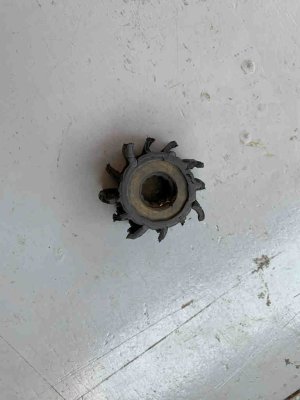
Old impellor

IMG_0615SM.jpg
After rodding through the intake, you can see the canal below

IMG_0619SM.jpg
New impellor fitted

IMG_0631 - Copy.jpg
waiting for an unwary boater...
 
Connect the inlet hose to another seacock. ie I have a short hose that I can use to connect under the sink outlet in emergency. That will test the engine system.
If you were able to use a hose to push water through the engine , why not reverse it & see if you can push water back out the other way. Any seacock blockage may clear under pressure. Water pressure from a tap can be quite high as it builds up & you may be able to join you hoses & clamp with jubilee clips then turn the tap on.
Which is basically a repeat of #10 now that I have read through the thread- sorry.
 
Connect the inlet hose to another seacock. ie I have a short hose that I can use to connect under the sink outlet in emergency. That will test the engine system.
If you were able to use a hose to push water through the engine , why not reverse it & see if you can push water back out the other way. Any seacock blockage may clear under pressure. Water pressure from a tap can be quite high as it builds up & you may be able to join you hoses & clamp with jubilee clips then turn the tap on.
Which is basically a repeat of #10 now that I have read through the thread- sorry.
Top tip. The guys at Sea Start also suggest a T piece at the toilet sea water intake routed around to a tap and T near the impellor input hose so that there was a fast way to regain cooling to the engine.

I bought a small digital thermostat and poked the probe into the edge of the elbow and exhaust hose. It's set to 40C and a diode feeds the engine alarm and a big red LED next to the engine panel at the helm so early warning of a cooling failure.

I'd also read about using a t piece at the impellor inlet with a hose to the bilge as an emergency pump that would be more effective than the electric or mechanical bilge pump. At my Sea Start day, they told me that some boats have this arrangement as standard.

My stat - £5.59 on Ebay STC-1000 12V/24V/110-220V 12-72V Digital Temperature Controller Thermostat NTC | eBay

stat.jpg
 
Last edited:
Top tip. The guys at Sea Start also suggest a T piece at the toilet sea water intake routed around to a tap and T near the impellor input hose so that there was a fast way to regain cooling to the engine.
Good concept but much better to join the intake pipes of the port/starboard engines using a link hose and 2 Tees, and have a valve in that link pipe. That's what I have. Toilet sea water inlets, if you even have them, tend to be small like 3/4 inch.
I'd also read about using a t piece at the impellor inlet with a hose to the bilge as an emergency pump that would be more effective than the electric or mechanical bilge pump. At my Sea Start day, they told me that some boats have this arrangement as standard.
Quite common in Italian boats at least. Actually questionable imho because the flow rate of the engine pump at low rpm generally isn't as much as a decent 400v or 230v emergency bilge pump, and the valve can't easily be operated remotely, and there's then risk of losing cooling flow to the engine plus the last place you might want to be in such an emergency is the engine room (depending on the exact circs of course).
Afaik none of the classification societies insist on this, requiring instead a pair of powerful 400v/230v and 24v pumps operable remotely, which tells you something.
 
Top