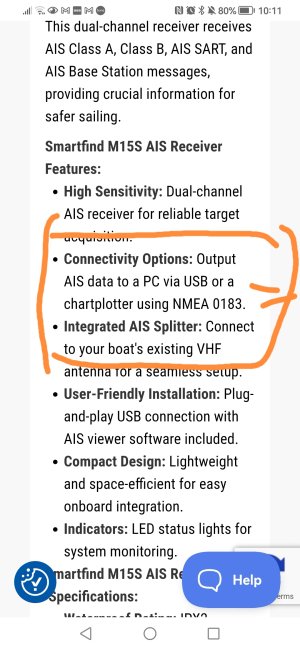
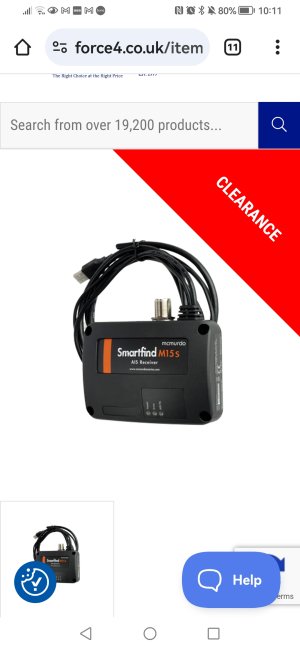
Nmea0183 to 2000

Nasa ais3. No N2K output

The more expensive models do have n2k. So you were right there. But why are we being sold last century's tech?
 
Last edited:
Data speed for wind etc is 4800 bps, N2K is 250kbps not sure how that makes 0183 better.
Problem is not bandwidth, but latency in the N2K network, which can mess up wind triangle calculations. Every 0183 sensor has its own separate cable and port, so there's basically 0 latency.

That's why well-funded racing teams use 0183 or pulse analog sensors connected point to point to their sailing computers, and not N2K.

You generally can't buy high end racing sensors in N2K. They are almost always analogue pulse or 0183.

Also higher end 0183 sensors generally use 38,400bps 0183, not 4800. My B&G wind sensor does, for example.

The Signet Blue Top speed logs used by most racers from America's Cup class on down are analogue pulse.

The NKE speed logs output BOTH analogue pulse and 0183, but not N2K.
 
Last edited:
Problem is not bandwidth, but latency in the N2K network, which can mess up wind triangle calculations. Every 0183 sensor has its own separate cable and port, so there's basically 0 latency.

That's why well-funded racing teams use 0183 or pulse analog sensors connected point to point to their sailing computers, and not N2K.

You generally can't buy high end racing sensors in N2K. They are almost always analogue pulse or 0183.

Also higher end 0183 sensors generally use 38,400bps 0183, not 4800. My B&G wind sensor does, for example.

The Signet Blue Top speed logs used by most racers from America's Cup class on down are analogue pulse.

The NKE speed logs output BOTH analogue pulse and 0183, but not N2K.
Needs to be a big or complicated network for N2K latency to be an issue for the vast majority of users. If it's an issue then Ethernet is a better option than 0183, but that's usually reserved for things like radar, multi MFD networking etc, although it's now starting to spread to more devices with the introduction of NMEA OneNet.
 
Needs to be a big or complicated network for N2K latency to be an issue for the vast majority of users. If it's an issue then Ethernet is a better option than 0183, but that's usually reserved for things like radar, multi MFD networking etc, although it's now starting to spread to more devices with the introduction of NMEA OneNet.
Gigabit Ethernet would have been vastly better than Canbus, but that's not how it developed.

Latency in N2K becomes a problem much faster than one would think. After 30% network load -- easily achieved; I've seen 50% on mine -- you get a vicious circle of latency.
 

Attachments

  • Screenshot_20250418_221117_com.android.chrome_edit_3482719451627421.jpg
    Screenshot_20250418_221117_com.android.chrome_edit_3482719451627421.jpg
    447.3 KB · Views: 5
  • Screenshot_20250418_221104_com.android.chrome.jpg
    Screenshot_20250418_221104_com.android.chrome.jpg
    351.2 KB · Views: 4
Gigabit Ethernet would have been vastly better than Canbus, but that's not how it developed.

Latency in N2K becomes a problem much faster than one would think. After 30% network load -- easily achieved; I've seen 50% on mine -- you get a vicious circle of latency.
Ethernet has been around for marine network for decades, but N2K has proved adequate for most installations. I've been installing Ethernet equipment on boat since its inception, but N2K has worked for the vast majority of people for the vast majority of devices.

Who here races in the Americas Cup ?
 
Nasa ais3. No N2K output

The more expensive models do have n2k. So you were right there. But why are we being sold last century's tech?
All NASA stuff is old hat, which is part of the reason why it is cheap. Adequate for some people because they have old gear. I have NASA gear and a modern Garmin plotter that has an 0183 input. My AIS is an old style Raymarine that has an 0183 output. The NASA AIS engine was introduced primarily for use with PC based systems which were popular 15-20 years ago. I had one on my boat, installed in 2009 using a laptop and Imray charting software. Prior to that on an earlier boat I had an AIS/Radar, installed 10 years earlier. That device has only recently gone out of production

We are not being "sold" old gear - we buy what is suitable for our needs. If you want a N2K network, buy gear that uses it. Things move on and there is always a long tail of gear on the market using older technology for those that need it.
 
I wanted to integrate my tacktick to my N2K system (wind, depth, speed log). I achieved this using one NGW1, and linking it directly to a Tacktick interface T122. It works well, all info now available on chartplotter.
 
It would be helpful if sellers would make clear at the top of their postings that gear was 0183 or N2K or both. Instead of having to read through, sometimes, long winded descritions to find out.

It is a kinda important feature of the product after all.
 
No, most do not.

I had to search a lot to find N2k

Most are 0183
Even expensive well known brands. If buying we all need to check. AIS is an expensive add-on, and be palmed off on last century tech... ... Really? Not acceptable.

What would be useful would be a vhf/DSC with;
*integrated AIS transponder and GPS
*all tx & rx through the mast head antenna.

Does such an item exist?
At what cost?
Yes B and G make a vhf radio with AIS transponder built in, about £1000
 
I agree with you there. VHF, GPS DSC, AIS transponder, all sharing the same antenna. Just one electrickery box with everything in it.

Thats an expensive option at the moment. Hopefully it will come down in price, so in a year or two most new boat fixed vhfs will have all these features as standard, with both nmea 0183 & 2000 (& WiFi, & Bluetooth etc etc)...
 
Top