NMEA 0183 over WiFi

pawelg

Member
Joined
22 Jan 2025
Messages
26
Visit site
Hi,

I want to share over the WiFi the GPS and AIS data for my iPad so I can have all needed information in Navionics.

The boat has quite an old NMEA 0183 network with Raymarine AIS650, AIS splitter 100 and Raymarine E80.

I have also YDNR-02 which I want to use as wifi router.

What I understand I need to connect YDNR-02 as following:
RX1+ / RX1- → GPS
RX2+ / RX2- → AIS
TX+ / TX- → Not connected

Which lines should I connect from the PWR/Data cable which goes to AIS650?

Does it have both GPS and AIS data? I guess I need to first check in proAIS2 is it running on 4800 or 38400. Is it correct?
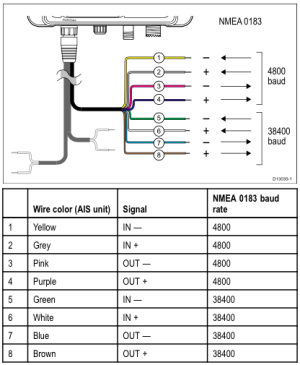
AIS_650_350.png
when talking about the physical connection, I would like to make it clean so I don't necessarily want to cut the cable and some wago's. Is there any cable tee for NMEA 0183 available ?
 
I have a similar system. I’ve got ais & gps heading into a raspberry pi at the chart table running Openplotter (straight download and no programming skills to set up).

This has a monitor which can be in cockpit or chart table plus I can log into and use up to 10 devices using rVPN from the onboard wifi broadcast from open plotter

Primary benefit for me was I can easily switch between ocharts & antares but could also work in your situation too.
 
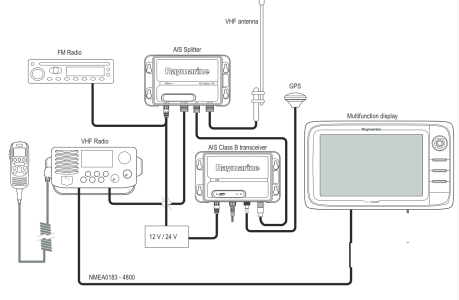
Could you describe how the system is currently wired up now?
AIS650 is connected via Power/Data only and SeaTalkng is unplugged. What I read from the manual "
Do NOT connect a SeaTalkng multifunction display to the AIS unit’s NMEA 0183 and SeaT alkng connections at the same time." using the SeaTalkng is not an option.

The wiring looks more less like that 1747118986269.png

I have a similar system. I’ve got ais & gps heading into a raspberry pi at the chart table running Openplotter (straight download and no programming skills to set up).
From where did you get both AIS and GPS signals? I was also thinking about OpenPlotter, but iPad (especially it's 12.9 inches) and Navionics would do the job, so no need for PI4 .. at this moment :)
 
Last edited:
From memory, Openplotter includes kplex which is an NMEA0183 multiplexer. It can take multiple inputs at different speeds and output a single combined stream over IP. That can then be read by OpenCPN
 
Do you currently see AIS targets on the plotter?
If so, there must be a NMEA 0183 connection between the plotter and the AIS transceiver.

If not using SeatalkNG. Then I don't see any connection showing on your diagram.

Or is the AIS currently working 'stand alone'?

Like I said before, its a pain trying to make all this old stuff work together.

Off the top of my head, I can think of two ways to make it work.

Connect the AIS NMEA output & Plotter NMEA output to the inputs on the YDNR multiplexer.
And one of the outputs from the plotter back to an input on the YDNR.

You will need to somehow power the YDNR as it is powered by an NMEA2K bus that you don't have.

Or.
Setup a NMEA 2K / SeatalkNG bus. Have the Plotter, YDNR-02 & AIS all connect into that bus.
And finally leave the one NMEA0183 output from the plotter to the VHF.

The second setup seems to me to be the easiest and more likely to be plug & play.
 
From memory, Openplotter includes kplex which is an NMEA0183 multiplexer.
It doesn't.

It converts all inputs to a single "database" format that is published via an in built web server.

You can then convert to any output you want. Internally it has no concept of NMEA strings, it just has a long list of keys and values, for example "environment/wind/true speed 21.1".

It's a much more efficient way of doing things and borrows heavily from current IT practice.
 
From memory, Openplotter includes kplex which is an NMEA0183 multiplexer. It can take multiple inputs at different speeds and output a single combined stream over IP. That can then be read by OpenCPN
Way back in the distant past. Any nmea0183 coming in gets sent out again on ipaddress:10110 Also any nmea0183 coming in a serial port can get routed through another so long as the in/out speed is the same, so GPS coming in /dev/ttyGPS at 9600 can get sent out again though a serialUSB `port /dev/ttyWIND at 4800.
Ai with manuals loaded > https://www.perplexity.ai/collections/openmarine-ai-support-SslrWnWdSeuxuzUAkxUVMg
 
Do you currently see AIS targets on the plotter?
If so, there must be a NMEA 0183 connection between the plotter and the AIS transceiver.
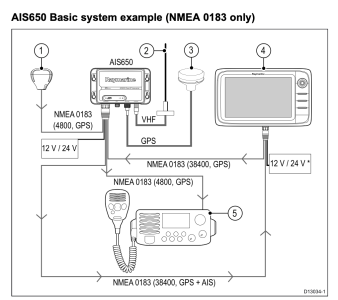
Yes, I have AIS data visible on the E80 plotter. I found another diagram which might explain how those links are done. It doesn't include AIS splitter, but it's relevant for that case.

1747136316742.png
 
The second wiring diagram contradicts the first, but OK, assuming the 2nd.

Leave most of it as it is, take the output from the E80 that is currently going to the AIS 650.
Put that output into the YDNR.
Put the output from the YDNR into the input on the AI650 that you just removed the E80 from.

That should work, you may need to change settings inside the YDNR or it may work out the box. I still think the SeatalkNg network is a more elegant solution, but this you can do without buying any extra bits.

For power you can strip down a NMEA2K drop cable and and feed power into that with the other end plugged into the YDNR. The power is red and black, The other wires are data & shield and you can ignore them.
Make sure to put a fuse on the power wire.

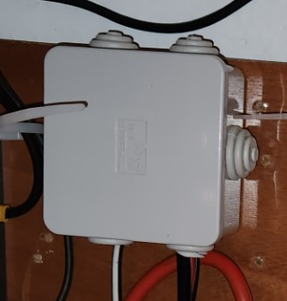
For wiring the normal way I've seen is WAGO connectors or some form of screw connector block. You can mount them in a small plastic junction box to keep it all neat and tidy from the outside.
Something like that:
1747138495427.png
 
Do NOT connect a SeaTalkng multifunction display to the AIS unit’s NMEA 0183 and SeaT alkng connections at the same time." using the SeaTalkng is not an option.
Is there a reason not to feed everything into the YDNR and then have the only link to your MFD a STNG connection?

Something like

GPS==>YDNR (via nmea0183 probably 4800 bps)
AIS==>YDNR (via nmea0183 probably 38400 bps)
YDNR ==> VHF (via nmea0183 probably 4800 bps)
YDNR <—> MFD (via STNG)
YDNR ~~> Navionics app (via WiFi)

You can add many items to the STNG network for future extension.
 
Is there a reason not to feed everything into the YDNR and then have the only link to your MFD a STNG connection?

Something like

GPS==>YDNR (via nmea0183 probably 4800 bps)
AIS==>YDNR (via nmea0183 probably 38400 bps)
YDNR ==> VHF (via nmea0183 probably 4800 bps)
YDNR <—> MFD (via STNG)
YDNR ~~> Navionics app (via WiFi)

You can add many items to the STNG network for future extension.
Good idea, but I'm not sure how the YDNR is stable. By having such a setup it will become a single point of failure.
I wanted to be as less intrusive as possible.

But I guess it's not possible, by reading what you and Ceirwan are proposing it seams YDNR needs to be in between (in-out), not just connecting its RX (in) and leaving TR (out) empty.
 
But I guess it's not possible, by reading what you and @Ceirwan are proposing it seams YDNR needs to be in between (in-out), not just connecting its RX (in) and leaving TR (out) empty.
I seem to remember in the dark old days of nmea0183 you could have two listeners in parallel on a single output BUT it’s like the old days of landline extensions with REN (if you are old enough to know what I’m talking about) so I suspect that causes more problems than it solves. I would expect YD to produce robust kit when it’s being used exactly as intended.
 
It should be doable ...
" The NMEA 0183 standard uses a simple ASCII, serial communications protocol that defines how data are transmitted in a "sentence" from one "talker" to multiple "listeners" at a time. Through the use of intermediate expanders, a talker can have a unidirectional conversation with a nearly unlimited number of listeners, and using multiplexers, multiple sensors can talk to a single computer port. " NMEA 0183 - Wikipedia
 
If you don't want the YDRN to be in the middle, then you could attach the out from the plotter and put it into the In on the YDNR as well as the in of the AIS 650. So wired in parallel as described by ylop above.

I've successfully doubled up NMEA0183 outputs before.
 
Thanks for all of you for very valuable input! I will try it out and let you know.
Maybe in the next year, I will upgrade it to something modern.
 
It's a much more efficient way of doing things
I would argue that “more efficient” is the last phrase I’d use there if the task is simply to move NMEA-0183 data between a serial interface and the network. I had this discussion with the signal K folks a decade ago: “efficiency” isn’t the goal. The signal k implementation facilitates certain use cases its developers are targeting but in pure computing terms, a node program converting strings to a different internal format and back is not more efficient than shuttling a string between file descriptors in C.
 
Last edited:
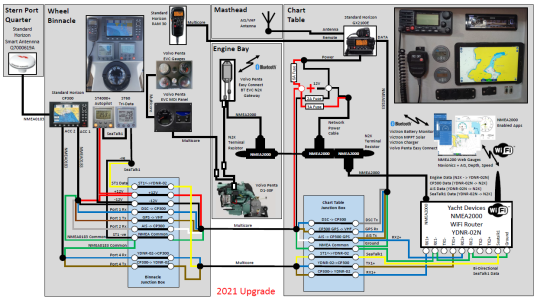
This was my solution to getting AIS and GPS etc. to Navionics over WiFi. It worked with the proviso that in the routing table of the YDNR-02N you don't route AIS data to Seatalk1 - in my case it overloaded the Seatalk1 bus and caused the Autopilot to malfunction and randomly steer in circles. Remove the tick-box in the routing table and all is good. Worked flawlessly.


1747198926372.png
 
Top