Newbie needs answers about batteries ?

Amscerp

New Member
Joined
1 Jan 2020
Messages
16
Location
Bodrum, Turkey
Visit site
I have been reading a post in the East Coast Forum about a member who removed his batteries for the winter.

He has one dedicated car battery for the engine starter motor, and additional leisure batteries.

The sailing boat I have just aquired has two leisure batteries, but I don't see a car battery!

It is a repair job which I have taken on, but now I am wondering if I need a dedicated battery for the starter??
 
Its very possible that you have one battery bank which is used for everything. Having said that I believe that it's common sense to have a seperated battery for the engine so that in the worst case scenario you can at least start the engine and charge the house bank.

One thing worth asking, are the two batteries connected by leads or are they seperate, the previous owner could have conceivably simply used a leisure battery for the engine starter, do you have a 1-2-all switch or similar fitted?
 
I sleep better knowing that however long the lights, heating and devices are left on I will always be able to start the engine. Given the benefits it would not be expensive to fit a 3 way switch and wire in a starter battery. If all my leccie was in one place I would be forever fretting.
 
It would be worth checking if the batteries are both connected together and to everything, or if they are isolated, or if there's a 3-way switch. Also what is size and type of battery

I would definitely want to isolate the starter so you avoid running it down for house purposes.

I would then want a switch so that you have the option of temporarily putting both batteries into the starter. Depending on the setup, note and avoid the risk of leaving both batteries disconnected with engine running, knackering the alternator.

The reason to prefer a car battery for the starter is (1) it is cheap and (2) most importantly it is good at delivering high current in a short burst. Typically you'd prefer a different type of battery for "house" that might be higher capacity and longer-lived, but with lower output capability.

All the above I gleaned from

Practical Boat Owner's Electrics Afloat: A Complete Step by Step Guide for Boat Owners Practical Boat Owner's Electrics Afloat: A Complete Step by Step Guide for Boat Owners: Amazon.co.uk: A.E. Garrod: 9780713661491: Books
 
OK ... prime difference of the batterys ...

A true leisure battery should never be used to start an engine - it just cannot survive the abuse. The plates will quickly buckle and cells short out. This is why a true leisure battery does not state CCA on the label ! If it has CCA on the label - then its a compromise battery and is not really one or other ..

A true starter battery has CCA on it and is not designed for discharge past about 40% used ... that means 60% remaining.

Personally because I have a 43HP diesel engine - I prefer both my batterys to be starters (90 A/hr each) ... and accept that I need to be careful about domestic drain on them. My boat is a motor-sailer - so most times engine is at least running during passage and charging them up.

I did use a leisure battery years ago - I used to have caravans as well ... but soon destroyed them on boats !!

In the UK - you are lucky that there are plenty of car breaker yards selling good 2nd hand batterys ... I used these for years ... one set lasted me over 5 years. Why pay out loads of dosh on new when you can get excellent 2nds for a lot less dosh. Plus if you only get a year or so - still works out cheaper.

I have the 1-Both-2-OFF battery switch in my boat ... never seen any reason to change to auto switching. I start on whichever battery is highest charge ... then once running - switch to both ... and charge up fully.

Alisatir Garrods book may not be latest - but its served many a boater and is well worth having.
 
Another +1 for having separate batteries. If you have space and weight capacity for an extra, I'd add a starter battery.

On my boat, the starter battery is wired directly to terminal 1 of a 0-1-2-both switch. The alternator and starter are wired to the common terminal and the domestic battery to terminal 2. I have a cheap headlamp relay energised by the wire from the alternator to the charge warning light that connects terminals 1&2 when the alternator's charging. If I were doing it now, I'd get a VSR, but VSRs were expensive when I did it and I was broke.

The final thing I'd want to add is as much solar power as I could afford/have space for via a twin battery controller. Mine's set up to charge the starter battery first then, when that one burps, it turns its attention to the domestic. 99% of the time, the starter battery takes very little, but it ensures that is fully charged.
 
Headlamp relays .... brilliant simple bits of kit. I have one wired in that auto powers my Peltier Coolbox. As soon as alternator kicks in - coolbox gets power.

Before fitting the relay - I was having days of discharged battery due to the high current draw. Now I don't have to remember to unplug when engine stops ... it does it for me.

I have a Maplins charge splitter that was designed for caravans. It takes a mains powered charger (you need an old type non auto charger) and detects which battery needs charge ... cheap as chips but works.
Sadly they stopped selling them.

I went through the stage of the diode based splitter for my battery bank - but of course that drops your charge voltage about 0.7V and I didn't have a cheater regulator or fit a diode to alternator to cheat the sensing ... its still on the boat but disconnected now. Still good order but ...
 
OK ... prime difference of the batterys ...

A true leisure battery should never be used to start an engine - it just cannot survive the abuse. The plates will quickly buckle and cells short out. This is why a true leisure battery does not state CCA on the label ! If it has CCA on the label - then its a compromise battery and is not really one or other ..

A true starter battery has CCA on it and is not designed for discharge past about 40% used ... that means 60% remaining.

You refer to "true leisure" batteries, what you should really be saying is "true deep cycle" batteries.

Starter batteries are for starting engines, cycling them will shorten their lives. a handful of 50% cycles will kill a car battery.

Leisure batteries normally quote CCA and AH and are, as you said, a compromise. The work well enough for average domestic needs and will withstand many more 50% cycles, but will last considerably longer of the DOD is reduced. They are also well suited to engine starting.

Deep cycle batteries are not designed for engine starting (these are the batteries you refer to in your first paragraph).
 
Here we go again ...

Leisure batterys in fact if you go back to the early days were TRUE Deep Cycle Batterys ... designed for caravans. Caravans didn't have engines ! The term Leisure Battery has now been taken by as PRB says the RV people for the compromise batterys. Unfortunately I am of old school and forget the youngsters use of the old terms. Note I did say TRUE leisure battery in my post and clearly stated without CCA ... AND made the distinction of compromise battery.

For good order sake and to keep people happy :

Deep Cycle (In the 'old days' were the Leisure Batterys) are designed for low current draw and use of about 60% of capacity ... forget the sales hype of using more - they want to sell you replacements !! Start an engine with one and you soon have a dead battery.

Compromise or as today termed Leisure batterys are as said compromise and designed for 50% use and to start small to moderate sized engines ...

Starter batterys are as said for starting engines and can be discharged 40%, leaving at least 60% ... lower and you start to shorten life each time you do it.

Must mark that on my chart ... don't use the old original terms !!
 
It seems to be all in the name. Now leisure battery is not a description seen much around here. You can get a starter battery with quoted CCA or you can get a deep cycle battery where AH is quoted. What we also see is so called "Marine " batteries. These seem to be designed for start and some discharge and are claimed to be ruggedised for small runabout boats. I think it a bit misleading saying leisure batteries will be killed by starting engine from them. So much depends on the size of the battery and number of batteries in parallel and of course the size of the engine to be started. I think many people use this multipurpose battery type where you have the 1,2,both,off switch and 2 identical batteries.
OP needs to understand (and remember) we use dual batteries so that we can quarantine one battery for engine start. ie keep one good while we discharge the other with mundane things like lights fridges instruments etc. But also because batteries die of old age we need to keep a standby alternative. So while it is simple and easy to turn to "both" for all operation this will share the starting current load and facilitate charging both when engine starts. It is important to regularly start on each battery individually to confirm each will do the job alone. If it will then if you discharge one or one dies you have a backup. Of course he must go to either battery for any prolonged discharge without engine running.
I would prefer a system using a dedicated start battery for reasons given by Refueler rather than have a symmetrical battery arrangement. OP could do this by buying a start (car) battery and adding it to the system. The both leisure batteries can be wired in parallel for domestic discharge. However do bare in mind that these batteries can and will die of old age and need to be treated as individuals. At least for occasional checks.

As to OP question re removal for winter. Sorry I have no experience of cold weather but I imagine keeping out of cold and occasional charging would be best treatment. ol'will
 
Parelleling 'Deep Cycle' batterys will not protect against start damage. I tried it.

The problem is the plate types ... hard .. soft .. thick .. thin .... each has a characteristic to determine amps it can sustain. The Deep Cycle plates are thick and soft ... and cannot tolerate the high loads. Being close together - they end up touching when driven hard. This is the typical failure seen.
Starter batterys have thin but more number of hard plates ... giving greater surface area but less capacity per plate .. the hardness and separation of plates allows the high power demands for starting. But being thin - they have less tolerance for deep discharge. They need to be topped up as soon as possible after use.

The Dual Purpose battery - which many people today call the Leisure battery sits between the two and can start small - moderate engines ... but I have to say that having had a recc'd brand one in my boat for a time in UK ... it dd not like starting my Perkins 4-107 ... it did not last long. I returned to 2nd hand starter batterys for both domestic and engine.

Winter : This is an interesting item ... as many know - I live in cold Baltic's and care of lead acid battery in winter is important. You should make sure the battery stays fully charged ... If you allow the battery to be discharged and the fluid loses acidity / density - then you risk freezing the battery and cracking the case. Its simple Chemistry / Physics. I have an Exide 90 A/Hr sitting outside my garage with a hole in its base and the top pressure plate blown for this reason. Unknown to me - my mains supply to my pontoon was off for significant period ... battery was discharged through various items .. no need to go into details.
 
Parelleling 'Deep Cycle' batterys will not protect against start damage. I tried it.

I don't see that anyone is suggesting it will, it wouldn't make any sense.

The Dual Purpose battery - which many people today call the Leisure battery sits between the two and can start small - moderate engines ... but I have to say that having had a recc'd brand one in my boat for a time in UK ... it dd not like starting my Perkins 4-107 ... it did not last long. I returned to 2nd hand starter batterys for both domestic and engine.

"Many" people = everyone except you. I don't see anyone else calling T105s etc "leisure batteries", "domestic" batteries, "house" batteries etc, sure, but that's a reference to the use the batteries are put to, not the type of battery. They are deep cycle batteries, end of.

Starter batteries are for engine starting. Using them for domestic purposes on most sailing yachts will result in early failure. There will be exceptions, such as those, like you, who motor sail and those with minimal electrical requirements. Same reason for both cases, minimal cycling.

Deep cycle batteries are for domestic/house duty and are best not used for engine starting (as you said), except in an emergency.

"Leisure" batteries are suitable for both engine starting and domestic duty. Sometimes labelled as "marine" batteries, but both a basically slightly beefed up starter batteries, there is no such thing as a "hybrid" battery. To say they can only start small to moderate engines is incorrect. I've just fitted a new battery to my car, a 3.0 litre, V6, 224 BHP diesel, wouldn't really consider that "small to moderate". It's fitted with a 850 CCA battery. The "leisure" batteries on my boat are 900 CCA each, so no problem starting my car with one of those. Certainly no problem starting my boat engine, an 1800cc Mercedes.
 
PBR ... you seem to very selective in your reading ...

William H in fact mentions paralleling ...

I have a 2.5ltr 255HP Volvo ... I'll stick with a dedicated Starter battery thankyou. You think I'm going to trust a Leisure battery to start her in -25C ???

You also seem to think I need to be told what a Deep Cycle and Starter batterys are for ... if you feel good doing that - go for it ..

You introduced word 'hybrid' ... my term was : 'The Dual Purpose battery - which many people today call the Leisure battery '. A term you will find in Garrods Book and many other reference books on the subject.

I have owned trucks where HD Dual Purpose batterys are called for far in excess of anything you or a boater will require ... batterys that have to run hydraulic tail lifts ... cranes ... with and without engine assistance. You soon learn what you can and cannot do with Lead Acid batterys !!

"Using them for domestic purposes on most sailing yachts will result in early failure. " - I call you out on that because most yachties do not drain their batterys that much ... its different for serious cruising folk / liveaboards ... but for the average boater .. a couple of decent starters are enough for domestic and starting ... but of course there are the 'leisure' batterys of today.

""Many" people = everyone except you. I don't see anyone else calling T105s etc "leisure batteries", "domestic" batteries, "house" batteries etc, sure, but that's a reference to the use the batteries are put to, not the type of battery. They are deep cycle batteries, end of. " Gor Blimey mate ... talk about mixing them all up !! I'll just refer you back to Garrods book again ...
 
PBR ... you seem to very selective in your reading ...

William H in fact mentions paralleling ...

Nothing selective about my reading, Will was talking about leisure batteries, that's what the thread is about, the OP has leisure batteries.

I have a 2.5ltr 255HP Volvo ... I'll stick with a dedicated Starter battery thankyou. You think I'm going to trust a Leisure battery to start her in -25C ???

Like i said, my domestic bank consists of 900 CCA leisure batteries, any one of those is cpable of starting an engine that requires, wait for it, up to 900 CCA. I work on high powered motorboats with some very big engines, they have no problem starting from a leisure battery of adequate CCA, because leisure batteries are starter batteries.

You also seem to think I need to be told what a Deep Cycle and Starter batterys are for ... if you feel good doing that - go for it ..

You seem to be struggling.

You introduced word 'hybrid' ... my term was : 'The Dual Purpose battery - which many people today call the Leisure battery '. A term you will find in Garrods Book and many other reference books on the subject.

I have owned trucks where HD Dual Purpose batterys are called for far in excess of anything you or a boater will require ... batterys that have to run hydraulic tail lifts ... cranes ... with and without engine assistance. You soon learn what you can and cannot do with Lead Acid batterys !!

It's practical boat owner, not practical truck owner.

However, i work on anything from a small yacht or motorboat, to large commercial work boats. I'm fully aware of what can be done with batteries. I've just finished an electrical refit on a large North Sea rescue boat that uses more batteries to run the onboard computers than your little boat has in total, not to mention the power systems for the 1000HP engines, electrical systems, generator, inverters and a hospital deck.

"Using them for domestic purposes on most sailing yachts will result in early failure. " - I call you out on that because most yachties do not drain their batterys that much ... its different for serious cruising folk / liveaboards ... but for the average boater .. a couple of decent starters are enough for domestic and starting ... but of course there are the 'leisure' batterys of today.

You're stuck in the dark ages, try reading some of the electrical threads on these forums, then you'll see how much power people are using on boats regularly install multiple battery domestic banks of hundreds of AH and some pretty big solar installations. Your 90ah car battery wouldn't last five minutes on the typical cruiser, a handful of 50% cycles and it'd be a gonna.

""Many" people = everyone except you. I don't see anyone else calling T105s etc "leisure batteries", "domestic" batteries, "house" batteries etc, sure, but that's a reference to the use the batteries are put to, not the type of battery. They are deep cycle batteries, end of. " Gor Blimey mate ... talk about mixing them all up !! I'll just refer you back to Garrods book again ...

Stick to your 100 page book, by all means. I'll stick to doing what i do, working with marine electrical systems on a daily basis. That's todays systems, not stuff from 100 years ago. Some people listen and learn, other think they already know it all, so learn nothing.
 
:sleep:

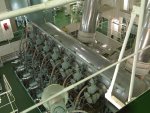
Just trying to find the Leisure battery to start this baby ...

alex great 14jan11-engine01.jpg

I don't only play with small boats.

I am certainly not in the "other think they already know it all, so learn nothing. " class ... far from it ...

And on subject of Garrods book ... recc'd by PBO / YBW - has far more relevance to small boats / yachts than a North Sea Supply / Rescue boat .. which as PRB fails to tell you but knows full well - most use AIR start for engines not 12v !! :p
 
Last edited:
:sleep:

Just trying to find the Leisure battery to start this baby ...

View attachment 83740

I don't only play with small boats.

I am certainly not in the "other think they already know it all, so learn nothing. " class ... far from it ...

And on subject of Garrods book ... recc'd by PBO / YBW - has far more relevance to small boats / yachts than a North Sea Supply / Rescue boat .. which as PRB fails to tell you but knows full well - most use AIR start for engines not 12v !! :p

Yawn.

I see that your few years absence from the forum has not taught you anything.

I really wish the forum mods hadn't told me not to call anyone a "bell end"...................
 
Hello All

First of all, I would REALLY love to thank you for all the replies, now I am REALLY pleased that I joined this Forum, there is lots to be gleaned from experienced Sea Farers !!!

I have got down on Hands and Knewes . . . there is a large Switch, which has One, Two, All, . . . I assume, that this is what you have been asking for . . . it controls the batteries, either One, Lights, or Two, Starter, or BOTH the lights and the engine. (I hope that is the right definition)!!!

I am, however, going to look into the suggestion of having one DEDICATED for the Engine!

And I LOVE this suggestion . . . .Quote . . . Headlamp relays .... brilliant simple bits of kit. . .Unquote

So thanks again for all your replies . .. it helps
 
Hello All

First of all, I would REALLY love to thank you for all the replies, now I am REALLY pleased that I joined this Forum, there is lots to be gleaned from experienced Sea Farers !!!

I have got down on Hands and Knewes . . . there is a large Switch, which has One, Two, All, . . . I assume, that this is what you have been asking for . . . it controls the batteries, either One, Lights, or Two, Starter, or BOTH the lights and the engine. (I hope that is the right definition)!!!

I am, however, going to look into the suggestion of having one DEDICATED for the Engine!

And I LOVE this suggestion . . . .Quote . . . Headlamp relays .... brilliant simple bits of kit. . .Unquote

So thanks again for all your replies . .. it helps

Many boats in the past never divided jobs on the batterys .. the switch as you describe was purely to decide which battery to use or both for all. I am sure that your switch will be that way as there is only one OUT from the switch despite the TWO in ..

Anyway - please remember one thing ... With such switch NEVER switch to OFF when engine is running. You may be lucky and get away with it - but often the result is blown diodes in the alternator / regulator ...

The switch is a MAKE BEFORE BREAK type - meaning that as you go from 1 - Both - 2 ... it makes contact with next before breaking contact with previous. So you can change position while engine running ... but never via OFF.

As to headlamp relays - they really are. Of course today you have digital relays and all - but the humble Headlamp relay still has life for us ... my Coolbox is a good example. Many people use the Peltier box - but its amps load is silly. Firget to unplug once and you'll know all about it. That relay saves me a lot of heartache.
 
When I bought by 27 foot yacht some 20 years ago it had two batteries, both were the marine type which will do both starting an house duties. The batteries circuits are totally separate with individual isolators . An Adverc charger was fitted. I had no problem starting the 20hp buhk engine. I kept it that way for a few years until the engine battery started to fail and I changed it for an engine start one, it did have more grunt for starting with less AH rating. When the domestic battery failed I fitted a deeper cycle battery and that has been more tolerant of deeper discharges. If your batteries are still good i would keep them but definitely separate the circuits and mod the alternator to give a good charging regime.
David MH
 
Top