New Tender for Blue Angel

BartW

Well-Known Member
Joined
9 Oct 2007
Messages
5,236
Location
Belgium
www.amptec.be
We would like to buy a new tender, a little bigger, more comfort, and more power then the one we have now. Our 4m Novamarine + Yamaha F30 will become for sale.
Two Big questions

1) Which model ?
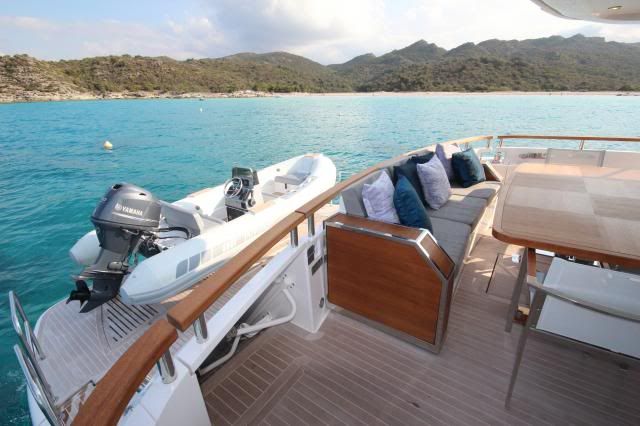
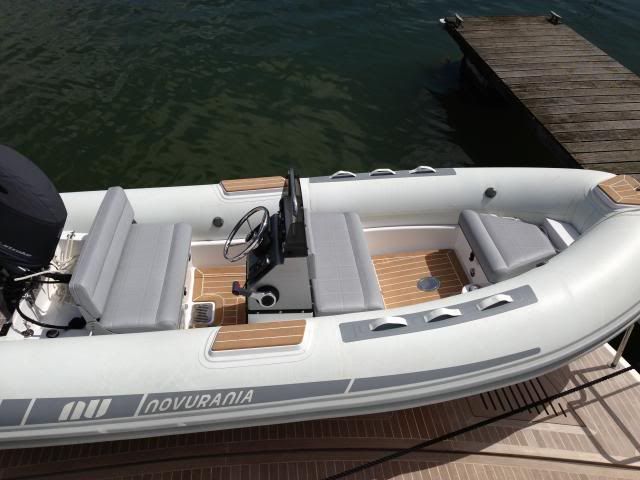
At this moment I have in mind to copy Jfm’s choice, the Novurania DL430 with the Yam F70
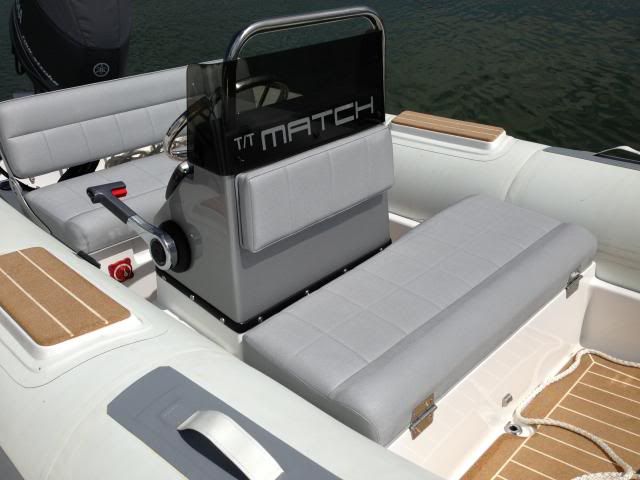
We saw it in the flesh in Antibes, and swmbo liked the extra bench in the middle that our old tender does not have.

nvr_th13064298721.jpg
(without the canopy)

Also the idea to buy direct in Florida is appealing ;-)
I expect a quotation including transport to Antwerp tomorrow.
Have been looking at many brands the last few years, but because the usage for collecting divers from a dive spot, is now almost zero,
our preference goes to more comfort and nice looking.
The Novurania seems a popular choice on superyachts, so they must be OK.
Only small concern, I have read that the F70 on some applications is on the limit, not much more oomph then the F50,
Alternative is a 2 stroke, but I don’t like Evinrude Etec’s.
Any other alternative ?
We are no power nor speed maniacs, we just want to be able to easily tow a wakeboarder , or a tube, with a few guests sitting in the boat.
And get the boat on the plane with 8 folks in it.
Jfm can you share your experience ?
Next week I’ll go to Dusseldorf, but I don’t expect to find anything more appealing between the zillions of Ribs at the show.
(and I find this very boaring)


1) Weight concern,
The new tender will be at least 100Kg more weight then the old.
The crane is not a problem, but I have no idea how much more weight the flybridge overhang can handle.
I have been standing on the overhang around the tender, it has had more then 100kg extra :( but I want to be able to do the same with the new tender,
and also have some reserve for rough weather passages, These dynamic forces can be so much more then the static weight I think.
Even if we do a estimation and calculation on the forces, we will never be sure of the condition of the old plywood (all superstructure is marine ply, very good quality and very good condition, but old)

Here are 3 potential solutions, to play safe
I. 2 poles in the cockpit left and right of this bench would probably be the best solution.
Many bigger boats have this, but still it’s a compromise on esthetics.

Pole1.jpg


II. A round pole and extra horizontal square SS Tube in the corner, on two sides as in this pic, would be less obstructing.
Its not possible to make the horizontal tube invisible, there is no space above the ceiling pannels (there are small wooden beams in the other direction)
but could perhaps be visibly integrated in cockpit ceiling ….

pole2.jpg


III. the strength of the FB overhang is created by the “marine ply tube construction “ left and right on the superstructure.
The Red V indicates where the biggest forces are in this wooden tube,
There is no wooden nor any other beam inside, its plywood only.
So the top plate of this tube has to support the biggest pulling force.
So why not place one or two SS bars on top ? like the blue lines, with many screws clamped to the plywood. (I can get my hand inside from below, to place nuts on the screws.)
Its not possible to place a SS plate inside the tube, there are compartments every 60…80cm.

_MG_5848lores.jpg


Idea’s ?
 
Bart I've no doubt that JFM picked a fine tender but to my mind the modifications you've mentioned seem fairly excessive for the sake of a heavier rib? Surly the solution is something lighter? Ribeye aluminium hulled ribs seem ideal although I'm not familiar with their products..on quick inspection their specs show c.100kg dry/boat only weight saving over the Novurania 430dl for a similar sized Alu hulled boat..it could be worth considering.
 
Bart, is it possible to fasten flat steel plates to the two outer faces of each plywood box girder, without it looking terrible? In construction this is called a flitching plate. Here's a random pic where a flat steel plate is bolted to a weak timber beam to strengthen it:

<snip>

If the flitching plate could bridge the point where the plywood box girder becomes unsupported it would provide a lot of support. The difficulty is fixing this without it looking terrible, I guess.

Edit: I've got rid of that photo because it was a bit massive.

This is roughly what I am on about:

Capture_zps843485d8.jpg
 
Last edited:
Bart, is it possible to fasten flat steel plates to the two outer faces of each plywood box girder, without it looking terrible? We'd call this a flitching plate.

Jimmy this is exactly what I have in mind with my option III,
but instead of placing the flitching plate on the face, I place it on top,
imo this is even stronger then on the side, think about the forces, you will understand ....

compare with a steel I profile, the forces are in the horizontal plates, the vertical is only there to keep them at a distance...

In my case, a extra fitching plate on the side would make it even stronger, but looks indeed terrible.
 
Jimmy this is exactly what I have in mind with my option III,
but instead of placing the flitching plate on the face, I place it on top,
imo this is even stronger then on the side, think about the forces, you will understand ....

compare with a steel I profile, the forces are in the horizontal plates, the vertical is only there to keep them at a distance...

In my case, a extra fitching plate on the side would make it even stronger, but looks indeed terrible.

Yep the looks are the problem, I completely agree. But I suppose intuitively I prefer the plates on the side because the bending load on them is in their strongest dimension. (In my drawing above I show the flitching plate as 150 x 10, 1000 long - and the bending force is on the 150 dimension. If the plate is on the top face of the plywood box girder, isn't the bending force only on the 10 dimension?)

I've actually used flitching plates in a building project to strengthen a timber beam that was 150 wide, 250 high, 5000 long, and they worked very well. Bolted on the side. :D
 
Bart I've no doubt that JFM picked a fine tender but to my mind the modifications you've mentioned seem fairly excessive Ribeye aluminium hulled ribs seem ideal although I'm not familiar with their products..on quick inspection their specs show c.100kg dry/boat only weight saving over the Novurania 430dl for a similar sized Alu hulled boat..it could be worth considering.

in the past I've looked at Alu hulled ribs, but they were either too much utilitarian,
or not powerfull enough,

just tryed to have a look at Ribeye, but the website does not work well on this PC,
 
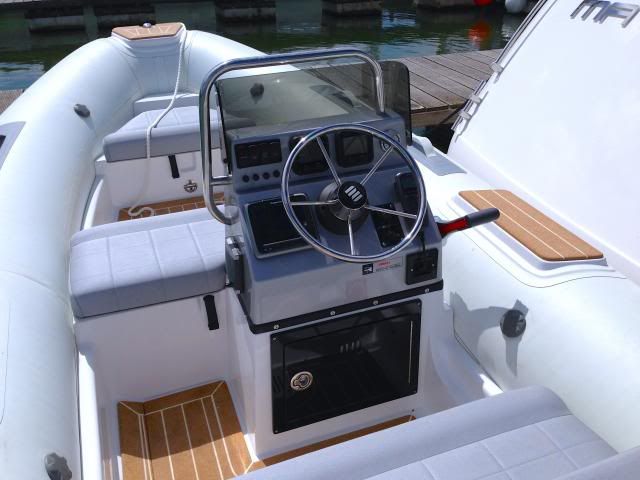
I totally love the Novu 430 and Yam 70 BartW. I would buy it again. The boat has the best deep V in its class, so is very good in waves (as much as 4.3 can be...). Novu will customise the colours. In pics below the upholstery is silver movida done in UK to match the mother ship, and I had the dash re-made to fit all the switches, Yam gauges, Lumishore controller (has RGB), touchscreen Raymarine a67 and proper VHF. Fuel tank about 45 litres under the floor

GRP finish behind the scenes is not good (lots of sharp GRP fibres) so I had to "tidy up" the moulding work (sandpaper). IMHO the hull needs more stern lift and a long term project is to fit extra mould GRP planing surface on the hull (like Avon 400DL, my last tender, which had loads of stern lift and never had bow lift as it shot out of the hole). Also, remember a Yamaha bought in US has no euro warranty or Y-Cop immobiliser, but I don't care about warranty because it won't break and I fitted YCop myself, £200 off eBay and very easy

It came with a ss 16P prop, but there is no torque low down on these engines so I have bought a 14P. I use the 14 for general use - carrying lots of passengers and w/ski, and fit the 16 when it is just 1 person or 2 of us and I want to go fast

I have zillions of pictures but here is a selection. The very last pic isn't mine - I found it on the 'net. It shows the deep V nicely

IMG_5303.jpg

IMG_5052.jpg

photo7.jpg

tenderlumishore.jpg

IMG_0316.jpg

IMG_0315.jpg

P1050576.jpg

IMG_4435LR.jpg

IMG_1220.jpg

P1070091.jpg

IMG_0314.jpg

hurley-marine-cantilever-01.jpg
 
Last edited:
Bart, im sure you have considerd mounting the tender on your bathing platform, rather than the fly as with Match? This way you will not need to modify the fly structure. Of course this means launching the tender when you need to use the bathing platform for diving, but with your hi/lo platform, I guess this is not difficult?
 
im sure you have considerd mounting the tender on your bathing platform, rather than the fly as with Match?

we use both positions frequently, and don't want to sacrifice that feature.
its so handy to have the tender upstairs during dives, in the marina, ... and have all the space of the platform available,
but sometimes when moving from one anchorage to another, or for quicly picking up the tender during a swell, we use the platform.
 
BartW, I will email you my invoice for the Novu 430 so you can compare prices

As rregards strengthening the flybridge overhang, I've been wondering about this. Truth is, the thing can probably handle 900kg static load quitre easily. But if you fear some degradation of the plywood, and of the glued joints in the box, then of course it is time to worry. The consequences of a failure at sea are huge

Engineeringly the best answer is option I - the two vertical poles. If done neatly, in say 60mm tube, these will look good. You need to be sure about strength of the mounting locations but that isn't difficult

I'm a bit worried about option III. You are right that in I section steel the top and bottom strips do a lot of the work but that is a bit of an oversimplification. The top is merley in tension and the vertical web actually takes a lot of compression and shear loads. It' a sort of team effort. So, just adding strength to the top (the light blue strips in your picture) will be of limited use if the glue joints or the vertical plywood are not in good condition

A further thought is the potential mixing of stiffnesses. Imagine the light blue s/s piece were infinitely stiff. Then as soon as the tender is loaded it is doing all the work, and the upward pull on the bolts at its front end could bust the plywood. So it needs to be a flatter section, 60x6 strip or something, that works in tension only

It's very hard to say more than that just from an armchair. If you have significant doubts you need to use option I. But truth is that the construction is probably waaaay over strength and will be perfectly fine. You could measure the downward deflection of the overhand (using digital calipers or a dial test indicator) with the tender loaded/unloaded, and compute the loads on the top plywood using the young's modulus off the 'net, and see what % of the yield strength that is. You could also sketch up the construction by measurement (incl measure the plywood thickness), and compute the theoretical yield point of the plywood box sections, and you'll probably find it will take a 2 tonne tender, in which case you can relax
 
we use both positions frequently, and don't want to sacrifice that feature.
its so handy to have the tender upstairs during dives, in the marina, ... and have all the space of the platform available,
but sometimes when moving from one anchorage to another, or for quicly picking up the tender during a swell, we use the platform.

OK, sounds sensible.
 
BartW, I will email you my invoice for the Novu 430 so you can compare prices
thats very kind of you J many thanks

what are the "Towing eyes P and SB BOW" ?
didn't you consider to have the sunbrella cover delivered from them ? ?
they have the correct pattern, etc.... I have asked for a quote

re strength of the flybridge overhang,
I'm completely with you regarding your remarks, all understood !

The calculation and simulation would be a lot of work, and still not accurate, as we don't know the properties of the old ply and glue, etc...
the only thing I know, they ply is very hard (experienced when I placed the sockets for the flybridge railing)
and there are no crack's nor any indication of degradation,

but on the other hand, I've never seen a C70s with a 4.3m modern tender and 70Hp engine on the Fly :)

in spring the boat might be in Rome for a month, and I could asc my favourite SS company to make the poles from option one,
strength of the mounting position I've checked, can be handled easyly in the Utility room on the ceiling and on transom steps & passerel housing

Perhaps these poles are not really needed, but nevertheless a improvement of the general stiffness of the superstructure and Fly overhang.
 
Last edited:
we use both positions frequently, and don't want to sacrifice that feature.
its so handy to have the tender upstairs during dives, in the marina, ... and have all the space of the platform available,
but sometimes when moving from one anchorage to another, or for quicly picking up the tender during a swell, we use the platform.

I agree
Until you have actually experienced it, you don't realise how useful it is to get the dinghy out of the way.
We, too, have the option for either lifting the dinghy onto the FB or the bathing platform.
For example, if you are just popping round a headland to anchor again, it makes sense to have the dinghy on the bathing platform.
On the other hand, there is a huge amount of time (in port etc) when the dinghy isn't being used so getting it out of the way makes the bathing platform another useful space.

Not sure how we are going to cope with a Jetski as well though and I'm not intending lifting the Jetski onto the FB.
In our home berth though, the Jetski will probably spend most of its time on one of those plastic docks.
 
in spring the boat might be in Rome for a month, and I could asc my favourite SS company to make the poles from option one, strength of the mounting position I've checked, can be handled easyly in the Utility room on the ceiling and on transom steps & passerel housing
Perhaps these poles are not really needed, but nevertheless a improvement of the general stiffness of the superstructure and Fly overhang.
All agreed, I wouldn't bother considering anything else than either doing nothing, or option 1.
Which BTW is not as ugly as someone may think, and in fact it's a solution normally adopted also in many modern boats.
The only cockpits where stern poles are totally out of place are fisherman boats (for obvious reasons) and hardtop boats (where they really would be fugly), imho.
Just avoid making them too thin, because you can't hide them anyway, so it's much better to make them look substantial: I'd rather go for 80 than 60mm, in fact.
And since after all also the deck is wooden built on BA, you might check if it's possible to fit a couple of poles also under the deck, 'kinda extensions of the above poles, going down to the hull and attached to the stringers.
It might be overshooting, but while you are at that, better safe than sorry.
After all, depending on how/where they should be placed under the deck, they might be not much of a problem.
And of course, under the deck, where aesthetic doesn't matter, the poles could be much thinner - 40mm or so, I'd say.
Btw, does "spring in Rome" mean that you made up your mind re. moving to the Adriatic for next summer?
 
thats very kind of you J many thanks

what are the "Towing eyes P and SB BOW" ?
didn't you consider to have the sunbrella cover delivered from them ? ?
they have the correct pattern, etc.... I have asked for a quote

re strength of the flybridge overhang,
I'm completely with you regarding your remarks, all understood !

The calculation and simulation would be a lot of work, and still not accurate, as we don't know the properties of the old ply and glue, etc...
the only thing I know, they ply is very hard (experienced when I placed the sockets for the flybridge railing)
and there are no crack's nor any indication of degradation,

but on the other hand, I've never seen a C7s with a 4.3m modern tender and 70Hp engine on the Fly :)

in spring the boat might be in Rome for a month, and I could asc my favourite SS company to make the poles from option one,
strength of the mounting position I've checked, can be handled easyly in the Utility room on the ceiling and on transom steps & passerel housing

Perhaps these poles are not really needed, but nevertheless a improvement of the general stiffness of the superstructure and Fly overhang.
Bart the towing eyes are the pair of forged eyes shown on the last picture I posted. I recommend these, though you can fit them yourself if you have time. Inside the hull, easily accessible in the anchor locker, there are two pig pads (plywood or aluminium, I cant remember) to spread the load

Yes you could get the cover from Novu but I wanted some special features (all fastenings accessed stbd side, so I can reach them on my swim platform) so I had a custom made cover. No big deal. I also had a small cover made just for the console, to keep the instruments protected when cruising without the big cover in place.

Your comment above gives me a thought: there are several canados 70/23 in Antibes. I will take a look and see what tenders they have. I think Highlander, opposite my boat, has a Novurania 400 with Yam 50, which is 50kg lighter maybe than 430+70. BTW, the Yam 70 is by far the lightest 70 4T ever made; it weighs same as a Yam 50/60 within a few kilos

Option I is pretty good. Sure, we would all choose to have no supports if we had the choice, but when you think about it all sunseekers, Absolutes and many others all have these supports and their owners seem not to complain, so they cannot be too bad
 
Bart,

many valid points from JTB and JFM there.

I'd also go for option I IF NEEDED!!!

I'd definitely avoid strengthening one element of a complex glued/screwed together boxy frame (I have similar pillars supporting a much smaller cantilever at the end of the f/b and even with strengthening the endplate (new ply) and scarfing and joining new ply for the "floor" bit it tends to flex) as it'll unbalance the whole lot and anything can happen/see fail.

IF you got to seriously strengthen the f/b cantilever, and IF you're considering redoing the f/b teak, THEN and only THEN, I'd sand the teak down a bit (I guess it's the ready made teak faced ply like I have (rather had) in the decks) and apply a 200+gr/m2 mat with epoxy and then get some new teak on top. This will help by strengthening the upper skin of this complex construction which as rightly JFM says is under tension.
On the compression edge of the deck there's not much you can do I'm afraid other than adding a few poles :( You'll have to rip the aft deck lining apart and then you'll realize that it's so complicated and narrow framed that there's not an easy/clever solution.

cheers

V.
 
as the strengthening is only needed when the RIB is on board, is there any mileage in having supports which are temporary (i.e. only installed when the RIB is loaded) and when at anchor or in a marina for any length of time they can be taken down and the aesthetics restored.

I am thinking of stainless steel Acrow props (not really :) )
 
Last edited:
Bart, you've shown the option I support in line with the front edge of the cockpit seats, which could make it a bit awkward to shuffle in when the table is there. Could they go at the back of the seat, or is that too far back? I seem to remember the Sunseeker supports are mounted on the GRP moulding behind the seats.
 
Top