New mast skirt materials, fastening?

Gary Fox

N/A
Joined
31 Oct 2020
Messages
2,025
Visit site
I need a new mast skirt, should I use heavy sailcloth, or is there a better product? I will get it made by a local sailmaker or upholsterer (E.Cowes).

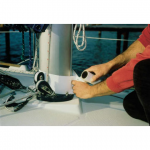
The top end has to grip an octagonal section of the mast; it previously was lashed with cord in a sewn tube, like the mouth of a sailbag, and was never totally leak-free, I was thinking of similar, but using a corrosion-proof version of a ratchet strap, as used for securing loads on trailers. And a supplementary bandage to hide the ratchet mechanism and stop lines catching.
Can you get stainless* or DZR ratchet strap mechanisms? Has anyone tried it? Penny for your thoughts.
*Google says yes, hooray.

She's a traditional wooden gaffer, but I am quite happy to use the latest materials and techniques to keep the oggin out.

The mast skirt is at the foot of the mast, and surrounded by heavy halyards being flung about and banging it, plus reefing tackles etc being flung down there out of the way. I am not sure that any form of canvas or fabric is ideal, but everone seems to use it. But maybe there were no hi-tech solutions using modern materials and fittings when the boat was designed and specced in the 40's.
 
Last edited:
I need a new mast skirt, should I use heavy sailcloth, or is there a better product? I will get it made by a local sailmaker or upholsterer (E.Cowes).

The top end has to grip an octagonal section of the mast; it previously was lashed with cord in a sewn tube, like the mouth of a sailbag, and was never totally leak-free, I was thinking of similar, but using a corrosion-proof version of a ratchet strap, as used for securing loads on trailers. And a supplementary bandage to hide the ratchet mechanism and stop lines catching.
Can you get stainless* or DZR ratchet strap mechanisms? Has anyone tried it? Penny for your thoughts.
*Google says yes, hooray.

She's a traditional wooden gaffer, but I am quite happy to use the latest materials and techniques to keep the oggin out.

The mast skirt is at the foot of the mast, and surrounded by heavy halyards being flung about and banging it, plus reefing tackles etc being flung down there out of the way. I am not sure that any form of canvas or fabric is ideal, but everone seems to use it. But maybe there were no hi-tech solutions using modern materials and fittings when the boat was designed and specced in the 40's.
You could try TopGun fabric ,I will send you a bit if you remind me how big ,even got in grey x
 
Its over half a century since I had to do this, but if I remember correctly the traditional method for canvas was for the mast skirt is put on the mast upside down. The neck is lashed to the mast then the skirt folded over it so that the lashing is inside the skirt. Probably to protect the lashing rather than improve the water proofing.

I had a mast skirt on a later boat that was made of a thick rubber material that was a tight fit to the mast, bedded on silicone sealant and lashed with thin nylon twine with each turn tensioned so the twine stretched. It was on an oval section wood mast and did not leak. Have also seen thin neoprene, similar to a dry suit neck seal used with long jubilee clips securing at mast and deck collar used on an alloy mast.

Come to think of it a dry suit neck seal may do the job if the neck and collar sizes will fit your mast. A dive shop can probably source replacement neck seals in various sizes. A canvas skirt could be put over it to keep the trad appearance and protect the neoprene.
 
Its over half a century since I had to do this, but if I remember correctly the traditional method for canvas was for the mast skirt is put on the mast upside down. The neck is lashed to the mast then the skirt folded over it so that the lashing is inside the skirt. Probably to protect the lashing rather than improve the water proofing.

I had a mast skirt on a later boat that was made of a thick rubber material that was a tight fit to the mast, bedded on silicone sealant and lashed with thin nylon twine with each turn tensioned so the twine stretched. It was on an oval section wood mast and did not leak. Have also seen thin neoprene, similar to a dry suit neck seal used with long jubilee clips securing at mast and deck collar used on an alloy mast.

Come to think of it a dry suit neck seal may do the job if the neck and collar sizes will fit your mast. A dive shop can probably source replacement neck seals in various sizes. A canvas skirt could be put over it to keep the trad appearance and protect the neoprene.
That's a very interesting suggestion thanks
 
Unless the mast is down, you want a material which can be glue to give a waterproof joint.
You can either use a sun-resistant tough material, like rubber dinghy fabric, or use cheaper rubber, inner tube even, with a canvas cover to keep the sun off and protect from abrasion.
To make a section of a cone, with just one joint is quite wasteful of fabric. I decided if one joint/seam was OK more seams were OK.
I had some of the proper 2-part contact adhesive for the PVC boat material I used. Still Ok when I sold the boat 4 years later.
 
When we were in USA there was an ultra wide version of self amalgamating tape made for just this purpose. On my own boats in the past I used 4mm neoprene wetsuit material and the inverted and glued cone fold back over itself hose clamp method mentioned by others
 
Mast is staying up, it's a good point, that I need to think about closing the joint with the skirt in place.
And yes, that's a good idea, cheating by having a modern solution plus canvas over it for more protection and disguise.
 
I need a new mast skirt, should I use heavy sailcloth, or is there a better product? I will get it made by a local sailmaker or upholsterer (E.Cowes).

The top end has to grip an octagonal section of the mast; it previously was lashed with cord in a sewn tube, like the mouth of a sailbag, and was never totally leak-free, I was thinking of similar, but using a corrosion-proof version of a ratchet strap, as used for securing loads on trailers. And a supplementary bandage to hide the ratchet mechanism and stop lines catching.
Can you get stainless* or DZR ratchet strap mechanisms? Has anyone tried it? Penny for your thoughts.
*Google says yes, hooray.

She's a traditional wooden gaffer, but I am quite happy to use the latest materials and techniques to keep the oggin out.

The mast skirt is at the foot of the mast, and surrounded by heavy halyards being flung about and banging it, plus reefing tackles etc being flung down there out of the way. I am not sure that any form of canvas or fabric is ideal, but everone seems to use it. But maybe there were no hi-tech solutions using modern materials and fittings when the boat was designed and specced in the 40's.
Have made two mast coats for our wood mast both from large tire inner tubes for their thickness. They are lasting a very long time.(30 yrs) The boat was built with a bronze mast deck plate that it is secured using contact adhesive as is the single joining seam placed aft. It is cut from s paper pattern as per lampshade formula. Can always make canvas cover for looks but didn't and the rubber has coped with UV.
 
I could would suggest plasticized tarp as used for lorry canopies. We made a bimini top out of it. It lasted for ever, was completely waterproof, is available in a reasonable choice of colours, can be sewn on any household machine, wears like the devil and is remarkably UV and tear resistant, is fairly cheap and looks as close to canvas as to make little difference.
 
I also have an octagonal mast, which is surrounded by a galvanised steel up stand of about a 2 inches and about 20mm from the mast all round.

I used neoprene, initially though of cutting up an old wetsuit, by my wife said no... I bought a sheet and then fitted it around the mast with an "S" type at the join. The collar was lashed to the mast but with the collar projecting upwards from the lashing. I the folded the collar down over the mast lashing and lashed it around the collar. Finally, I sealed the top of the collar to the mast above the lashing with sikaflex. It hasn't leaked!

The problem with the octagonal mast, is you never really get enough pressure on the flat sides to stop the leaks. The neoprene seemed to be soft enough to overcome this, and the sika at the top seemed to finish it all off.
 
Top