New boom for 41' mast furling AWB (on a budget) - do we panic?!

As I think Boathook has suggested, shape a long plate to fit neatly inside that extrusion, knock it up the spar and rivet in place. Easy, neat, stronger than new.
Thanks Doug - I'm not sure whether other posters were suggesting inside or outside (I had assumed outside so my confirmation bias led me in that direction) - but given the shape of the extrusion and the requirements of the repair I now definitely think inside is the way to go. It would only require two bends instead of four (due to the bevel on the outside corners).

Thanks all for the input, more broadly. The new boom costings were more just to focus the mind (still no UK received quotes yet) - in the meantime, I have hopefully rediscovered my inner 'PBO' and now have a repair in mind:

For the vang bracket, I'm thinking a plate inside the boom. The two bends could bring it a considerable way up either side of the extrusion without too much of an external 'Frankenkboom' effect. My one remaining question on this is - would slightly thinner wall (say 1/8" or 3mm) be okay? My logic is that it would bend/conform easier to the shape (even though I'm planning to have it bent professionally). I fear a thicker plate - say 5mm - wouldn't 'pull in' with the rivets, even if it were just a mm or two off.

For the mainsheet bales - I'm also thinking of inserting a (flat) backing plate and riveting through these (after making good the corrosion with some brazing rod). There is sufficient flat area at the bottom of the boom to accommodate a 50mm/2" backing plate. This could be thick material as no bend required. My question here is - should I use aluminium to reduce the risk of further/future corrosion? (Or would stainless with a coat of duralac be better/simpler - e.g. no need to paint or anodise the backing plate?)

The the outhaul car, I have experimented and found that our (32mm x 6mm) genoa track sliders fit perfectly. I know the Barton sliders run on a slightly thinner (5mm) track and the old Barton cars I've got in the spares box are missing their nylon slider liners so I cannot test them for fit. So I think I'll source a new Barton slide and try it for size. My nagging question on this would be - is a simple slider ever 'okay' longer-term for an outhaul car? (Seeing as all the purpose-made products use some sort of roller or ball bearing?) Either way, hopefully it would work for a season to allow some sea trials/shakedowns and decide whether to re-visit the 'old over new' track idea.

I'm also not averse to @doug748 's suggestion to re-work the original. I'm not sure about just repairing the wheels (to still be left with a small 4 wheel car with only 1 eye) - but I know a good machine shop that specialises in non-CNC milling and I'm sure they could make up a new 'body'. I also know a good local engineering plastics place that could probably do the wheels/bearings.
 
Thanks Doug - I'm not sure whether other posters were suggesting inside or outside (I had assumed outside so my confirmation bias led me in that direction) - but given the shape of the extrusion and the requirements of the repair I now definitely think inside is the way to go. It would only require two bends instead of four (due to the bevel on the outside corners).

Thanks all for the input, more broadly. The new boom costings were more just to focus the mind (still no UK received quotes yet) - in the meantime, I have hopefully rediscovered my inner 'PBO' and now have a repair in mind:

For the vang bracket, I'm thinking a plate inside the boom. The two bends could bring it a considerable way up either side of the extrusion without too much of an external 'Frankenkboom' effect. My one remaining question on this is - would slightly thinner wall (say 1/8" or 3mm) be okay? My logic is that it would bend/conform easier to the shape (even though I'm planning to have it bent professionally). I fear a thicker plate - say 5mm - wouldn't 'pull in' with the rivets, even if it were just a mm or two off.

For the mainsheet bales - I'm also thinking of inserting a (flat) backing plate and riveting through these (after making good the corrosion with some brazing rod). There is sufficient flat area at the bottom of the boom to accommodate a 50mm/2" backing plate. This could be thick material as no bend required. My question here is - should I use aluminium to reduce the risk of further/future corrosion? (Or would stainless with a coat of duralac be better/simpler - e.g. no need to paint or anodise the backing plate?)
Definitely use aluminium. 5mm will easily pull in if you use 6mm rivets. if you use the correct grade of aluminium there is no need to anodise on an internal plate.
 
Working inside the boom at more than arms length can be tricky, an air wedge and wooden spacer can help. I would certainly use al alloy and duralac plus sheet metal pins for initial fix. Once you have the first pin in it gets easier:

Sheet Metal Fasteners

What I was suggesting is using a relatively heavy plate, to suit, shaped at the ends to a good fit, as roughly shown below (imagine the ends rounded):


1676369168061.jpeg

Maybe 18in long, fixed with staggered rivets. You may have to grind back the nose of your rivet gun to get better spacing. And/or use one of these dodges:


With the existing car perhaps if the top bolts could be removed cleanly (big if) then it's a simple matter to replace it with additional eyes fixed to a new plate clamped under the original when replaced. A variety of ways come to mind but I was thinking if the thing has done it's job for twenty years the design is a least workable?

If you go for a folded plate inside the boom itself, 1/8th would be fine. It would be an easy matter to bend yourself there are lots of guides ont'net. Cut some 1" strips of metal first and work out where the bend lines should be, before you do the real thing, as the metal stretches. There are compensation charts but it is probably easier to work things out on the bench.

.
 
the old Barton cars I've got in the spares box are missing their nylon slider liners so I cannot test them for fit. So I think I'll source a new Barton slide and try it for size.
I managed to get some spare nylon liners from Jimmy Green. They had to be ordered especially but were very cheap.
 
Update!

Life got in the way of the boat for a while - but also I wanted to see whether I could get the inboard boom end off - which I did finally manage to do yesterday (I wedged a small bench drill onto the side deck and manhandled the boom in/out/around it in order to drill out the seized screws!). I also took some proper measurements. Together - these affirmed that the swapping the boom ends and avoiding the vast majority of the corrosion damage will be possible after all.

My plans is now as follows (although not necessarily in this order!):
- Cut a bit off both ends of the boom - there's more evidence of corrosion there and around the screw holes show the scars of the heat/drilling required for disassembly.
- Source and fit a factory Sparcraft vang bracket appropriate to a pneumatic rodkicker. They do a beefy stainless cast version with 6 rivet holes and a 8mm thick tang. It's a considerable upgrade from what was there before. This would be instead of any need to fabricate a new plate and bracket arrangement:
https://www.riggerne.com/products/8...900-mm/3231-sparcraft-vang-fitting-f3400-ep8/
- Source and fit cast Sparcraft mainsheet bales. These are also beefier and longer - with 4 rivets instead of 2. The logic with these fittings is that they are physically larger (while still fitting the groove) and will spread the loads. They are otherwise 'factory spec' - if towards the overspecced end of their range.
https://www.riggerne.com/products/8...238-sparcraft-bale-for-mainsheet-f1700-f3400/
- I'm planning to braze on a repair patch over the hole to practice with alu repair rods. If that doesn't look too messy, I might try the repair rods on the corrosion under the old mainsheet bale locations. I can avoid those damaged areas - just - when fitting the new ones, by swapping the boom ends.
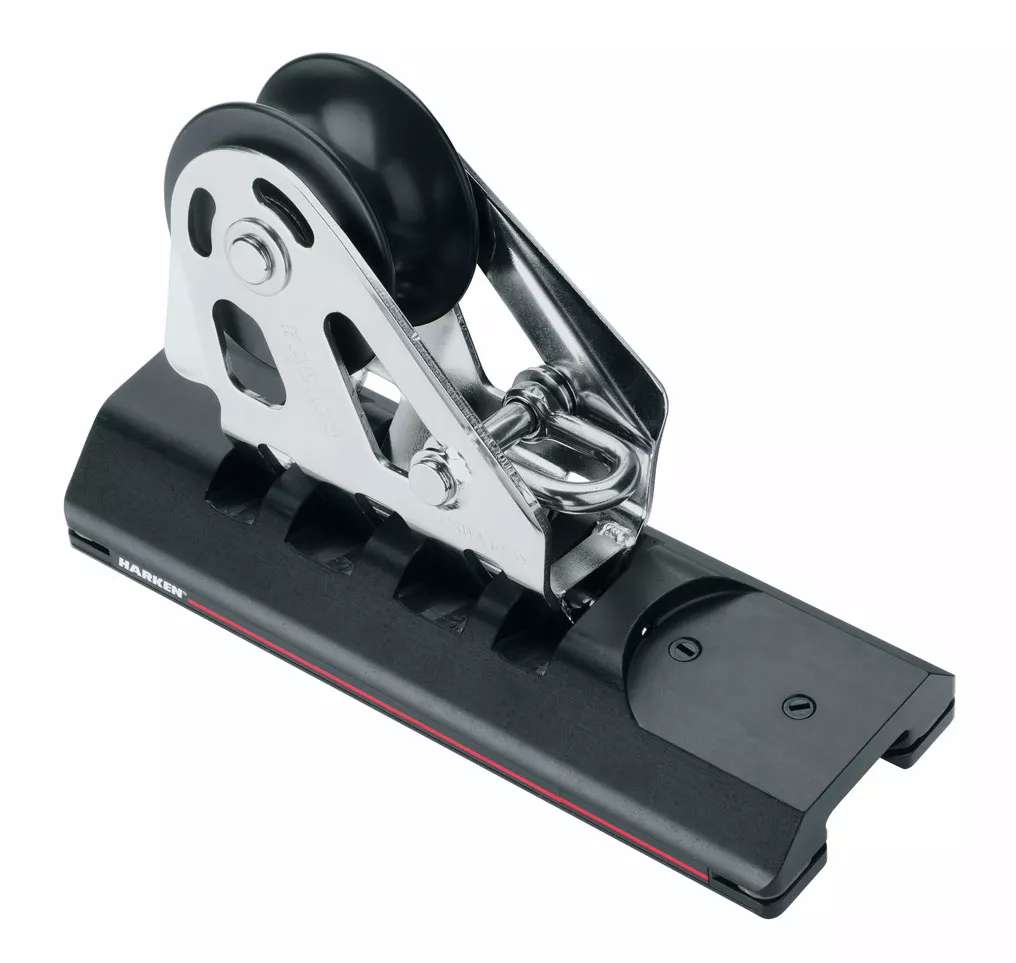
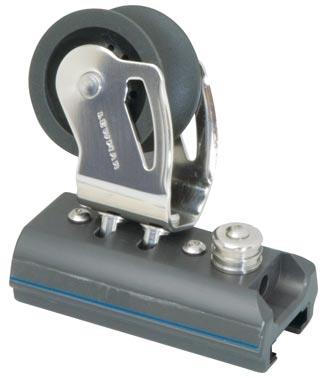
- I'll keep experimenting with the genoa car as outhaul car idea. I think our local boatyard can order Barton spares. I also think a Lewmar 32mm t-track genoa car could be modified to work much the same as the current Harken outhaul cars (although of course these have fancy recirculating ball bearings):
a0ce9fbb-3021-453b-a9c4-ff98542977f6.jpg

(RRP £1000+!)
...could be replicated with this:
ZLEWL29041700.jpg

...modified with a pin/D-shackle arrangement added to the saddle somehow. These also aren't cheap - but sometimes crop up on eBay. I know it would fit as we have identically-sized genoa cars (from Pfeiffer) and they fit the boom track perfectly. But for the cost of new nylon liners (as per @andsarkit ) I can rig and test it properly with a spare Barton car I have.

I know that buying these bits won't be cheap and the new bent vang bracket/backing plates idea was perhaps 'more PBO' - but I can recondition all the other bits (new sheaves etc.) cheaply and importantly do all the work myself and on the boat. Overall, this will save a fortune on a new boom, use factory parts, and also save my finding a welder to do the work.

Thanks all for the input on the other - more invovled - repair solutions, nevertheless.
 
Update!

Life got in the way of the boat for a while - but also I wanted to see whether I could get the inboard boom end off - which I did finally manage to do yesterday (I wedged a small bench drill onto the side deck and manhandled the boom in/out/around it in order to drill out the seized screws!). I also took some proper measurements. Together - these affirmed that the swapping the boom ends and avoiding the vast majority of the corrosion damage will be possible after all.

My plans is now as follows (although not necessarily in this order!):
- Cut a bit off both ends of the boom - there's more evidence of corrosion there and around the screw holes show the scars of the heat/drilling required for disassembly.
- Source and fit a factory Sparcraft vang bracket appropriate to a pneumatic rodkicker. They do a beefy stainless cast version with 6 rivet holes and a 8mm thick tang. It's a considerable upgrade from what was there before. This would be instead of any need to fabricate a new plate and bracket arrangement:
https://www.riggerne.com/products/8...900-mm/3231-sparcraft-vang-fitting-f3400-ep8/
- Source and fit cast Sparcraft mainsheet bales. These are also beefier and longer - with 4 rivets instead of 2. The logic with these fittings is that they are physically larger (while still fitting the groove) and will spread the loads. They are otherwise 'factory spec' - if towards the overspecced end of their range.
https://www.riggerne.com/products/8...238-sparcraft-bale-for-mainsheet-f1700-f3400/
- I'm planning to braze on a repair patch over the hole to practice with alu repair rods. If that doesn't look too messy, I might try the repair rods on the corrosion under the old mainsheet bale locations. I can avoid those damaged areas - just - when fitting the new ones, by swapping the boom ends.
- I'll keep experimenting with the genoa car as outhaul car idea. I think our local boatyard can order Barton spares. I also think a Lewmar 32mm t-track genoa car could be modified to work much the same as the current Harken outhaul cars (although of course these have fancy recirculating ball bearings):
a0ce9fbb-3021-453b-a9c4-ff98542977f6.jpg

(RRP £1000+!)
...could be replicated with this:
ZLEWL29041700.jpg

...modified with a pin/D-shackle arrangement added to the saddle somehow. These also aren't cheap - but sometimes crop up on eBay. I know it would fit as we have identically-sized genoa cars (from Pfeiffer) and they fit the boom track perfectly. But for the cost of new nylon liners (as per @andsarkit ) I can rig and test it properly with a spare Barton car I have.

I know that buying these bits won't be cheap and the new bent vang bracket/backing plates idea was perhaps 'more PBO' - but I can recondition all the other bits (new sheaves etc.) cheaply and importantly do all the work myself and on the boat. Overall, this will save a fortune on a new boom, use factory parts, and also save my finding a welder to do the work.

Thanks all for the input on the other - more invovled - repair solutions, nevertheless.
Im curious about the ref to soldering aluminium, its not possible because of the oxidation rate of alu. There was some zinc based soldering rods around and someone did an article about using them in alu, they worked but the reaction between the metals quickly led to "fizzing"
 
Have you considered a secondhand boom? Some years ago I bought a secondhand boom from Z-Spars. I shortened it to suit(27' boat). I've also bought a secondhand boom on my current 33' boat on ebay.
 
Im curious about the ref to soldering aluminium, its not possible because of the oxidation rate of alu. There was some zinc based soldering rods around and someone did an article about using them in alu, they worked but the reaction between the metals quickly led to "fizzing"
Yup it's new to me too (but so is most metal working beyond the basics/obvious) - but I ordered these 'flux-free aluminium repair rods' recently: Aluminium Repair Rods
(after someone mentioned another brand - Lumiweld - on here). I've been waiting for an excuse to try them (using my MAPP torch).

I thought for what I was aiming for, which is filling in the pits/damage mainly, but perhaps getting a small repair strip of new material to patch the hole - it might be a reasonable DIY solution. I know a proper TIG welder would make short work of a better repair, but that trade is in short supply up here (Merseyside). I'm still keeping an eye/ear open for someone to do it 'properly' in the meantime!
 
Have you considered a secondhand boom? Some years ago I bought a secondhand boom from Z-Spars. I shortened it to suit(27' boat). I've also bought a secondhand boom on my current 33' boat on ebay.
I was hoping that the various spar makers I contacted might have said 'we've got a suitable extrusion lying around, how about £££' but no such luck! It is a big boy - the second largest size available from Sparcraft.

Our boom would have looked like a good buy second hand, until the bales and vang bracket had been removed, revealing all the corrosion! Of course, all SS into alu fasteners also seized. So I'm not sure how much further ahead we'd be with a 'new old' replacement.

Incidentally, it does sound like no change from £5k on a new boom delivered to the boat 'ready to sail'. Making this one right will likely cost more like £500. Can't say the 'pay and go' alternative isn't/wasn't tempting!
 
Im curious about the ref to soldering aluminium, its not possible because of the oxidation rate of alu. There was some zinc based soldering rods around and someone did an article about using them in alu, they worked but the reaction between the metals quickly led to "fizzing"
Impressive - if it's for real!
 
Take care with those rods some are seem impossible to use:

Great review/test - thanks.

It's impressive that some of these repair rod joints will actually hold considerable load. For the boom, I'm really looking for something to work almost entirely as a 'filler' anyway (I could even use epoxy or JB Weld). But if it works on the pitting and I gain enough confidence, I might try to use them to secure a patch over the actual vang hole.

Note that, by swapping the boom ends, all of the main load points (vang and 2 x mainsheet bales) will now be inboard of all but some very minor corrosion pitting.
 
Ca' canny with chopping the ends - make sure there is enough left to fully extend the foot with all its paraphenalia. I say this from experience!
I've got an awful feeling that the main might come up a big 'baggy' with the shortened boom!

We are only talking a few inches of length on the one hand (100mm max), but I cannot remember there being tonnes of space aft of the clew! On the other hand, it's a furling mast and the sails - while in good condition - are (literally) unbranded and definitely not cut for performance.

We also badly neeed the UV corner (and genoa strip) re-done and so I'm hoping - if it comes to it - the sail loft could find a way to shorten the foot for us if it becomes an issue at the same time (over next winter).

I'm not looking forward to making the cuts. The extrusion is too thick for a 4" grinder disc. It's too wide for those portable metal band saws! I'm thinking of going carefully with lots of hacksaw blades and aiming to smooth out the cut with file or die grinder after. It is 'only' alu, after all!
 
Update!

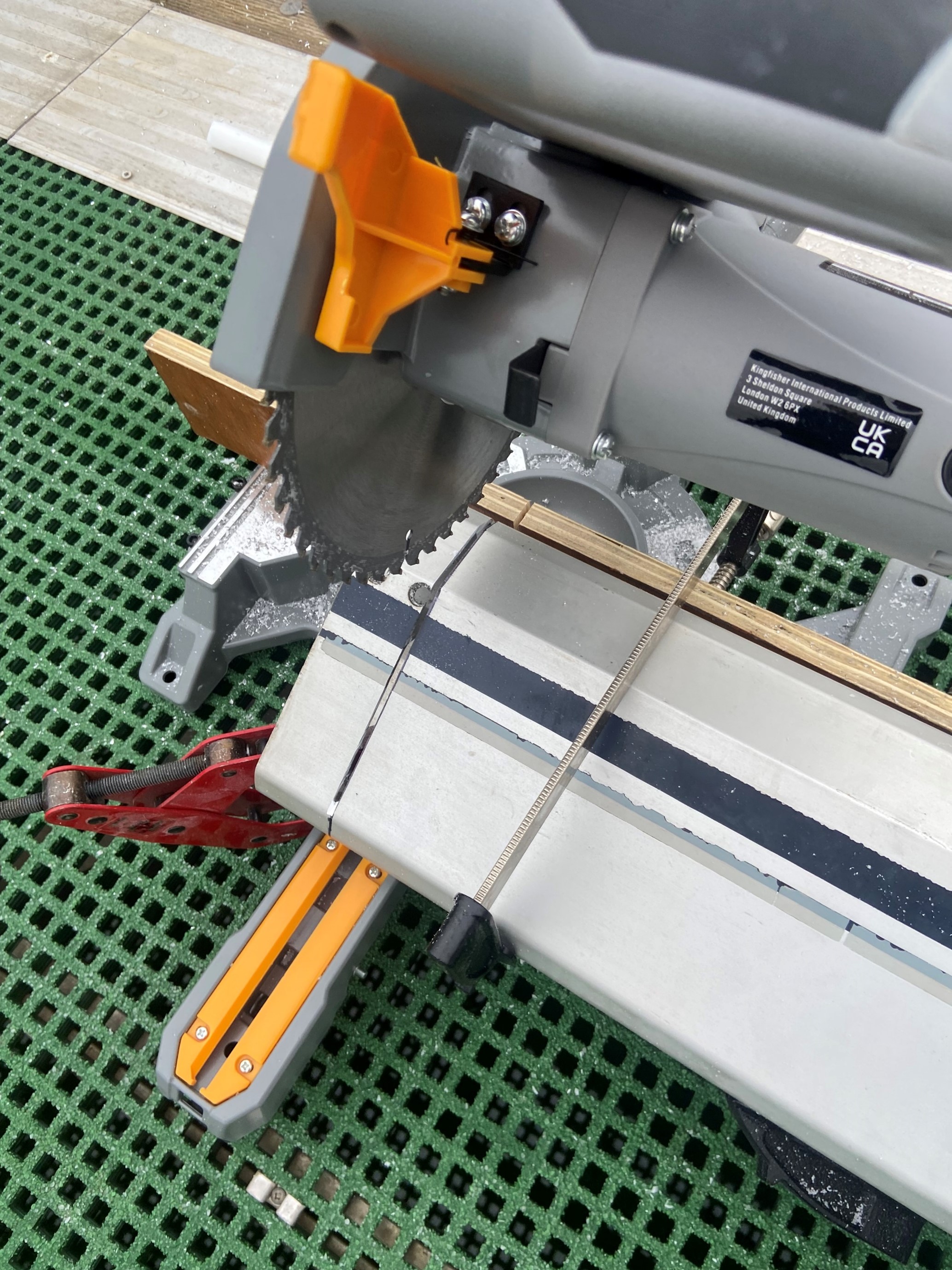
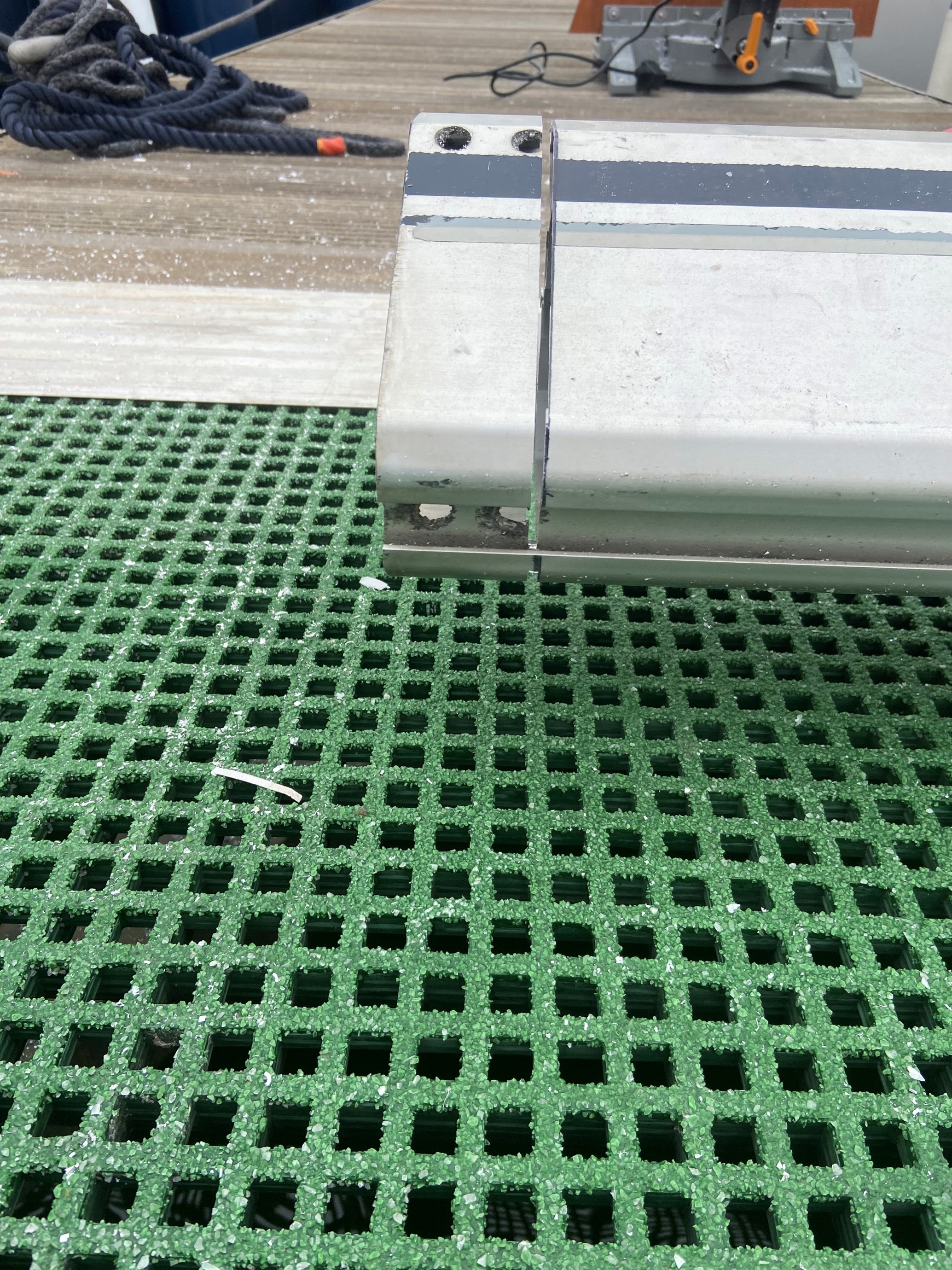
Allow me to introduce the 'Boom Chopper 2000':
IMG-2105.jpg

It's the cheapest Screwfix sliding mitre saw, modified with a larger fence and various bits removed (some dust extraction parts and - obviously - the guard!) such that it just fitted over the widest section of the boom (approx 130x200mm).

There were a few sleepless nights as the prospect of doing accurate/square cuts for this. I did think about 'KISS' and using a combo of 4" grinder, hacksaw and working back to a line by sanding/grinding. In the end, it was a dream to be able to 'machine' it completely square/clean/true!

IMG-2116.jpg

Some obvious safety precautions were required. The F-clamps did the best job possible of holding it without fouling the saw. We religiously kept it unplugged unless we were cutting (the thought of touching the switch inadvertently without a guard doesn't bear thinking about). I donned the cut gloves and operated the saw from the side in case it kicked. First Mate hoovered up (yes, really!) the mess afterwards - going again I might have but a tarp down to catch more of it.

In the end, being aluminium and with a new (48T TCT) blade, it went through like a knife through butter. I followed a trick found while researching online and used candle wax on the blade. Not sure if this did anything (apart from make a mess!).

The sketchiest part of the day was probably the First Mate and I getting the boom off and back on the side deck by 'craning' it on a halyard.

The cuts matched up beautifully and - to my surprise - it was possible to get the (210mm) blade all the way through with literally 1mm to spare (the photo below shows the first cut - but on the second I was more confident and pushed the saw home to complete the cut).

IMG-2115.jpg

Without boasting too much - I think we got it squarer than the original factory cuts (which were both about 1mm out of square, despite obviously being machined - perhaps their saw/fence was off?!).

This isn't the be all and end all of the repair, of course, but it was essential for the swapping the boom ends plan and having succeeded in getting nice square cuts has given confidence that we can get the lot back together without looking too butchered.

Next step will be to re-drill holes for the boom ends, source the aluminium stock required to repair the hole/corroded areas, and wait on the (made to order) replacement bales/vang bracket.
 
Last edited:
Sorry to jump into an older post - but i have the same boat with the same failing outhaul car. Were you ever able to verify if the harken 32mm CB outhaul car would fit on the X-track and function properly?
 
I wonder how the OP got on, and if he ever got his quotes for a new boom.

I was pleasantly surprised when I asked Z Spars to quote me for a new boom on my Moody 39 5yrs ago- they wanted about £1000.
 
Update!


- I'll keep experimenting with the genoa car as outhaul car idea. I think our local boatyard can order Barton spares. I also think a Lewmar 32mm t-track genoa car could be modified to work much the same as the current Harken outhaul cars (although of course these have fancy recirculating ball bearings):
a0ce9fbb-3021-453b-a9c4-ff98542977f6.jpg

(RRP £1000+!)
...could be replicated with this:
ZLEWL29041700.jpg

...modified with a pin/D-shackle arrangement added to the saddle somehow. These also aren't cheap - but sometimes crop up on eBay. I know it would fit as we have identically-sized genoa cars (from Pfeiffer) and they fit the boom track perfectly. But for the cost of new nylon liners (as per @andsarkit ) I can rig and test it properly with a spare Barton car I have.

I know that buying these bits won't be cheap and the new bent vang bracket/backing plates idea was perhaps 'more PBO' - but I can recondition all the other bits (new sheaves etc.) cheaply and importantly do all the work myself and on the boat. Overall, this will save a fortune on a new boom, use factory parts, and also save my finding a welder to do the work.

Thanks all for the input on the other - more invovled - repair solutions, nevertheless.
Sorry to jump into an older post - but i have the same boat with the same failing outhaul car. Were you ever able to verify if the harken 32mm CB outhaul car would fit on the X-track and function properly?
 
Top