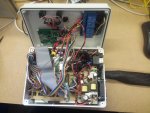
My Raspberry Pi Boat Monitor

What a brilliant idea. I have a Pi that's going spare. You've just given me something to do with it.

As regards selling the device; if you can't be bothered with the effort of manufacturing it, you could just sell the instructions and software (or perhaps even give it away but gain a bit of revenue via advertising on your website). I have no idea what it would be worth but I would be happy to pay for the instructions and software as it would save a huge amount of time in making one of these gadgets.
 
Input: microswitch on your saloon door?
Output: heat or aircon activation? I have web control over the central heating at home and it's v useful when you've been away and you want to warm the place up ready for your return

Ah, I can just see us in the local Bistro thinking it's a bit warm tonight pop the air con on dear...
Roll on summer, mind you I just spent 3 weeks in Cannes Yard painting the hull (in between the rain), not bad for January.
 
Ah, I can just see us in the local Bistro thinking it's a bit warm tonight pop the air con on dear...
Roll on summer, mind you I just spent 3 weeks in Cannes Yard painting the hull (in between the rain), not bad for January.

You and me both, I'll be Antibes in March for a similar reason... :D
 
Is the only extra card you've installed the ADC card, or is that an additional add-on card between the Pi and the ADC? (I'm looking at your photo in your OP)
 
What a brilliant idea. I have a Pi that's going spare. You've just given me something to do with it.

As regards selling the device; if you can't be bothered with the effort of manufacturing it, you could just sell the instructions and software (or perhaps even give it away but gain a bit of revenue via advertising on your website). I have no idea what it would be worth but I would be happy to pay for the instructions and software as it would save a huge amount of time in making one of these gadgets.

Interesting idea, could sell a preloaded SD card. Must say it took a lot of effort to get the Pi stuff right.
 
Interesting idea, could sell a preloaded SD card. Must say it took a lot of effort to get the Pi stuff right.

In fact better still, if you also included a spec sheet with links and part numbers etc for the hardware and some newbie instructions on how to get a up and running with say one volt sensor, one temp sensor, one mains sensor, one switched 12v sensor (in your example, the bilge pump activation) then that is definitely a proposition I'd be interested in. Ideally a 3g card as well for the texting. That would give all the ingredients to create your own test rig, which the buyer could then customise to their own boat / requirements.
 
good idea with the preloaded SD and specs.
However, documenting something you've done as a project for others to use is probably more time consuming than the actual work!
Got to avoid legal issues as well, so a pre-kit form that each one builds and customizes to their needs is a plus

Jimmy, microswitches on the saloon door is a bit of a pain (it's double door so need two switches connected in series) however a 20quid radar from the lower helm pointing towards the saloon door is much better - but I've done it so I'd say so, wouldn't I? I feel in many cases ppl break in from the saloon side windows and not the doors.
OK, just realized you've got a targa, what I'm saying applies to f/b.

@42: lisp coding with a proper (bracket matching!) editor is a breeze :D

cheers

V.
 
good idea with the preloaded SD and specs.
However, documenting something you've done as a project for others to use is probably more time consuming than the actual work!
Got to avoid legal issues as well, so a pre-kit form that each one builds and customizes to their needs is a plus
V.

You are not wrong, documenting & building a web site will be time consuming & is unlikely to happen until after this summer. The legal issues are important. Linux licenses to understand, product liability etc etc. Looks as if a website explaining how to do it for self builders might be the easiest route. If a system i built & sold failed to send an alert & someones boat sank, there could be a bit of an argument! Mind you the Navigation sellers get away with disclaimers.

Its not a bad idea though, maybe make a few pennies, so to speak, which might encourage me.

As you can see from the pic, it is surprisingly busy inside the box & that's without an internal GSM module. However if I got a pcb made up for the interface board that would help. The Pi is hiding under the ribbon cable, 12v > 5v power supply on right, underside of LCD on lid + relay board. There are 25 wires that connect to the boat so that helps with the mess!

The switches on the lid force a instant status message & clean poweroff (have to hold them for 5 secs). Poweroff takes a while & is important with the Pi to avoid SD card corruption. Pulling the power plug is a nono (you can be lucky but there is a 50/50 chance of corruption).

Funny thing, this morning I started getting pump1 run messages. It was only running for 1 sec every few minutes. I looked at the forecast & sure enough there is a big 4m swell from the south. Now i know that makes the boat really move about in La Napoule & as there has been a lot of rain there will be some extra water in the bilge (not enough to trigger my system). Figured the float switch is just jumping enough to do it so sent a run pump message for 30 secs & bingo, no more pump run messages. Feeling smug again now :D. (yeah i know i need some hysteresis on the float switch).


20131122_102651.jpg
 
Finally I added a 3G dongle and the system uploads two files each day (using ftp) to some web space of mine. One is a log file which shows me exactly what my software has been doing and the other is a text file with a line written each minute containing the raw data from my sensors. I currently download these files to my Android phone to examine on a text editor but plan eventually to write an app to show graphs of battery volts, temps etc.

I wouldn't bother with an app. It would be very easy to load the csv files into a mySQL DB then build a PHP web site to generate the charts and graphs (Libchart is free). You could use an expensive CSS framework like https://wrapbootstrap.com/theme/ace-responsive-admin-template-WB0B30DGR to get a professional look and feel. Make it responsive for viewing on a mobile device.
 
Hi Forty_Two,

Great project! Apologies, I don't know your technical background but I have a company full of coders so if you need help 'productionising' the code - purely from an academic perspective I.e. Not getting into the realms of full go to market style proposition (different kettle of fish), then more than happy to point one of the guys in your direction to assist. I've got everything from grads to 30 year veterans. Java, c, python and all loads of others I don't understand...

Happy to lend a hand if needed. The younger guys also spend their spare time with robots, pi etc (as well as Xbox and iPhone app dev)

Cheers

Mat
 
This sounds like the perfect product to be pitched on Dragons Den! Count me in for one if you ever productionise it
 
Looks like a bit of kit I would like to have on board but not at any cost. I could handle the mechanics of building it but the not the software.
The ideal way for me and I guess quite a few others would be a shopping list of components, very basic assembly instructions and a programmed card to make it all work. Would be happy to pay around £50 for this.
 
Thank you one & all for your enthusiasm, offers of help & ideas. I will take it forward, just have to decide the right way.

I am leaning towards a DIY website with info, links to buy parts etc. I could supply the loaded SD card & a populated interface PCB. That together with some site ads should pay for hosting etc & maybe a few litres of expensive EU Diesel!

Fair bit of work to get to that state so unlikely to happen till the winter.

As the man said - I'll be Back!
 
I wouldn't bother with an app. It would be very easy to load the csv files into a mySQL DB then build a PHP web site to generate the charts and graphs (Libchart is free). You could use an expensive CSS framework like https://wrapbootstrap.com/theme/ace-responsive-admin-template-WB0B30DGR to get a professional look and feel. Make it responsive for viewing on a mobile device.

I've been working on an RWD (Responsive Web Design) website for the last 6 months.
I made the RWD bit change the menu system significantly for smaller (mobile) screens.
Anything less than the horizontal resolution of an iPad Mini switches to the mobile menu system.
You can see it working at www.motorsportauctions.com
If you are using a PC, you can see this concept working by gradually reducing the width of the browser's window.
There are, in fact, several steps of font size so that it looks good on all screens.
But the step just under (about) 900 pixels switched the whole menu system.

Once I got all this working, I then set my mind to writing some apps.
Currently, there are two apps - one for Android and one for Apple devices.
Fundamentally, the apps are just browsers - all the hard work was already done on the RWD part of the server.

Lots of technologies in this particular RWD design (Javascript, JQuery, PHP, Smarty, MySQL and Ajax etc - to name a few) but it should be possible to do something simpler for your application and then just implement the "browser" apps.

Our Android and Apple apps are in the relevant stores for free so, if you are interested, you could see from this implementation what can be done.

The great thing with this design is that you only write the apps once - all the clever stuff is done in the RWD web server.
 
Thank you one & all for your enthusiasm, offers of help & ideas. I will take it forward, just have to decide the right way.

I am leaning towards a DIY website with info, links to buy parts etc. I could supply the loaded SD card & a populated interface PCB. That together with some site ads should pay for hosting etc & maybe a few litres of expensive EU Diesel!

Fair bit of work to get to that state so unlikely to happen till the winter.

As the man said - I'll be Back!

Have a look at this site
http://www.openpicus.com/

I used one of these for this project - not finished the it though - I'm afraid.
http://www.ybw.com/forums/showthread.php?353367-DIY-Anchor-Chain-Counter-Project

All the stuff you need seems to be imbedded - it seems to me that the Raspberry doesn't have the same flexibility that this has and there is a GPRS module.
I used the imbedded web server which worked very well.
Programming was fairly easy but with most of applications like this, you need to get your head round where the code you write is actually running.
What I mean is that code can run on the imbedded web server or inside the client's browser.
Ajax is used in these devices to communicate between the client and server.
Once working this concept is remarkably fast - as can be seen in my little project referred to above.

Have fun
 
Have a look at this site
http://www.openpicus.com/

I used one of these for this project - not finished the it though - I'm afraid.
http://www.ybw.com/forums/showthread.php?353367-DIY-Anchor-Chain-Counter-Project

All the stuff you need seems to be imbedded - it seems to me that the Raspberry doesn't have the same flexibility that this has and there is a GPRS module.
I used the imbedded web server which worked very well.
Programming was fairly easy but with most of applications like this, you need to get your head round where the code you write is actually running.
What I mean is that code can run on the imbedded web server or inside the client's browser.
Ajax is used in these devices to communicate between the client and server.
Once working this concept is remarkably fast - as can be seen in my little project referred to above.

Have fun

Thank you for that, looks very interesting, will spend some time looking. I was aware of your project but for some reason missed the hardware you are using.
 
The great thing with this design is that you only write the apps once - all the clever stuff is done in the RWD web server.

Agree with what you're saying in principle (see my post #31) but for the record the responsive part of "Responsive Web Design" is done on the client not the server.

Some examples of Responsive sites that I've built for friends....

http://www.threecountiescatering.co.uk/
http://www.resetgym.co.uk/
http://www.africaecoservices.com/

As Hurricane says, resize the browser screen and you'll see the effect. By far the easier way to get this effect is by using the "Twitter Bootstrap" CSS framework and derivatives (templates) of it.

I think this would be a very nice template for the OP's boat Monitor project....

http://198.74.61.72/themes/preview/ace/
 
Last edited:
Top