Multi-strand (electrical) cable cross-sectional area

mjcoon

Well-Known Member
Joined
18 Jun 2011
Messages
4,925
Location
Berkshire, UK
www.mjcoon.plus.com
This topic is not special to marine applications, but my question arises from an article in Yachting Monthly ("January 2022" page 79).

There it states that multi-strand (electrical) cables increase the available cross-sectional area (CSA) for a given cable diameter. This seems to me to be exactly wrong. The multiple strands will each be circular (not hexagonal) so will have air channels between them. This means that the area of metal will be lower than if the cable was solid.

Can anyone explain why the article should be right and I am wrong?
 
Fred Drift ere ; multi strand electrical cable in Marine use I have found to more prone to salt water corrosion ; water appeared to get a sort of capillary action so working its way up the cable underneath the cable protective sheath ; plus with multi core cable the (each) strand corrodes and fractures more easily .

Seems starnge to me about the increase in cable diameter ! with multi core over single strand
 
I cannot speak for a magazine article but it may be because you have assumed the comparison with a 'single' solid conductor, which should-not be used because it is not designed to be flexed. A single solid conductor should not be used on any moving vehicle (or boat) because its prone to fracture caused by vibration. So the article may be referring to semi-solid stranded copper conductor cables, such-as those used in domestic electrical installations.

Use multi-stranded cables (& tinned copper to reduce corrosion) for marine environments. Hence the finer the strands, the more flexible and stronger the cable against such vibration. So perhaps the article was referring-to more fine strands in-total for a given CSA? ...but that is just one parameter in choosing the correct cable for a given application.
 
This topic is not special to marine applications, but my question arises from an article in Yachting Monthly ("January 2022" page 79).

There it states that multi-strand (electrical) cables increase the available cross-sectional area (CSA) for a given cable diameter. This seems to me to be exactly wrong. The multiple strands will each be circular (not hexagonal) so will have air channels between them. This means that the area of metal will be lower than if the cable was solid.

Can anyone explain why the article should be right and I am wrong?

You're right. ISTR it's called the "fill factor" with wire ropes, which can never be as strong as a solid bar of the same diameter.

Don't be too hard on the journalists. Their job is to fill space, they don't always understand what they're writing about.
 
I cannot speak for a magazine article but it may be because you have assumed the comparison with a 'single' solid conductor, which should-not be used because it is not designed to be flexed. A single solid conductor should not be used on any moving vehicle (or boat) because its prone to fracture caused by vibration. So the article may be referring to semi-solid stranded copper conductor cables, such-as those used in domestic electrical installations.

Use multi-stranded cables (& tinned copper to reduce corrosion) for marine environments. Hence the finer the strands, the more flexible and stronger the cable against such vibration. So perhaps the article was referring-to more fine strands in-total for a given CSA? ...but that is just one parameter in choosing the correct cable for a given application.
My boat was wired with single strand house wire and most of it has survived over 50 years. The main advantage is that it has the minimum surface area of copper that might corrode and also the insulation seals around it and prevents water wicking down the cable. Any corrosion can be scraped off leaving sufficient copper to reconnect. I have not had any fatigue failures possibly because most of this wiring is between the deck and liner and cannot move.
I have followed convention and used stranded and usually tinned cable in conduit for any additional wiring but my experience is that there are several factors that need to be balanced. I will leave the original wiring in place as long as it is reliable as it would have to be replaced in surface conduit which is not visually attractive
I have concluded that the most important thing you can do is keep water away from the electrics especially at the ends of cables. IP66/67 junction boxes, glands and connectors are now very cheap and I use them where possible with adhesive heatshrink on any exposed wire connections.
 
A greater number of finer strands has less attenuation of high frequency signals as the higher frequencies tend to flow across the surface of the conductors rather than through them. This is more relevant to vhf cable and uhf signals such as depth sounders and fish finders than simple dc power cables.
As others have said though, finer strands equals greater surface area equals more opportunity for oxydisation
 
A greater number of finer strands has less attenuation of high frequency signals as the higher frequencies tend to flow across the surface of the conductors rather than through them. This is more relevant to vhf cable and uhf signals such as depth sounders and fish finders than simple dc power cables.
As others have said though, finer strands equals greater surface area equals more opportunity for oxydisation
You are thinking of Litz wire (that took a bit of remembering!): wikipedia.org/wiki/Litz_wire As wikipedia says, the strands are not only not tinned, they are separately insulated, so the whole cable is even fatter!
 
You are thinking of Litz wire (that took a bit of remembering!): wikipedia.org/wiki/Litz_wire As wikipedia says, the strands are not only not tinned, they are separately insulated, so the whole cable is even fatter!
The ratio of the impedance of a cable increasing with frequency is significant at quite modest frequencies, not just uhf, it is easy to hear the difference in hf detail with 79 strand speaker cable compared to using the same csa 20a mains flex
 
For any given cross sectional area, the finer strands will have less air gaps than coarser strands, eg a glass full of pebbles compared to a glass full of sand
Not so. There are more air gaps with finer strands. They are smaller gaps than with coarser strands. The net effect overall (if the strands in each group are all the same diameter) is the same voidagein both cases.
 
Not so. There are more air gaps with finer strands. They are smaller gaps than with coarser strands. The net effect overall (if the strands in each group are all the same diameter) is the same voidagein both cases.
I wondered about that, and how to calculate it. (Given the complexity of packing algorithms.) Do you have a reference, please?
 
Do you have a reference, please?
Chemical Engineering Vol 2, Coulson & Richardson. Section 4.2.2 in my 3rd edition 1978.
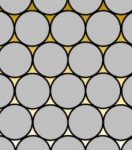
Simpler to consider this diagram:
voidage.jpg
It doesn't matter what diameter the cylinders are, the fraction of space to cylinder is the same. The void fraction is about 0.1.
 
I don't know for sure but I imagine the multistrand bundle could be forced through a die or similar compressive process, in which case the strands would become more hexagonal and therefore pack more tightly.
 
The ratio of the impedance of a cable increasing with frequency is significant at quite modest frequencies, not just uhf, it is easy to hear the difference in hf detail with 79 strand speaker cable compared to using the same csa 20a mains flex

Your ears must be quite special.

Most - See Does speaker wire affect sound quality? No Myths, Just Facts for a very typical article on the subject - don't agree that speaker cable makes the slightest difference to perceived audio quality. It's certainly nothing to do with skin-effect as the the highest demodulated audio frequency which an HF set puts out up is only around 2.7kHz. At that frequency the skin depth in Copper is well over 1 mm so will provide no effective high frequency cut off at all.

Edit: unless you mean For the Antenna rather than for the speaker (despite using 'speaker wire')? But even so, the issue is likely to be a fraction of a dB in receiver sensitivity at 7 or 14MHz I'd have thought. Much more plausible than skin-effect would be a difference in making good terminations, where the softer and more flexible speaker cable could be advantageous.
 
Last edited:
Top