Motorboat Newbie's Change Of Direction

Ref 1, I can give you my first hand experience after 17 years of boating with a D boat equipped with 4 s/steel fuel tanks, exactly 1 cubic meter each (4k liters in total).
When I moved her to CF from the Adriatic in 2006, I filled her to the brim in Lastovo (Croatia), before crossing towards Apulia, going round the heel of Italy, then through Messina Strait, and eventually reaching S Sardinia.
Upon arrival, I had enough of that Croatian fuel left to cruise for the rest of that summer - though we actually cruised just locally, after the 1200Nm trip from N Adriatic...
At the end of 2006 summer, I stored the boat with still 5/600 liters left (which means just 15cm or so at the bottom of 1m high tanks).
In 2017, I began the season with that fuel, which was by then more than one year old, and I only loaded some more after a couple of months.
In all the following years, I never left more than 10 to 15cm of fuel at the bottom of the tanks, during winter.
I never used any fuel treatment, and the only reason why I'm aware of the fuel bug existence is that I read about it here in the asylum.
Maybe I'm just lucky, 'dunno.

Ref 2, my experience with the DP is too short to be meaningful (and my previous P boats where too different to compare), but in principle I think that some relationship between the quantity fuel loaded over any given period of time and its content of water and sediments is bound to be expected...
P, as you are aware, the dreaded diesel bug needs water to create the right environment to grow. You will get water in your fuel tanks either from ingress through the filler cap, or condensation in the tank. With low winter ambient temps, then condensation is a real issue in our northern Eu climate, hence most of us fill up before the cold weather takes hold. You may not get cold enough where you moor for condensation to be an issue. Uncle Google says lowest ave winter temp in Sardinia is 10C in Jan. It probably gets colder for a few days, but probably not cold enough and long enough for condensation to gather and become a real issue. I would suggest prolonged temps below 5C are really needed for significant condensation to accumulate. Happy to be proven wrong by those on here more knowledgeable. :)
 
Fuel polishing has been a key subject of debate for many years, but it seems it's poorly understood. There are the two key elements to polishing. First, to keep the fuel dust free, the second to ensure that anything which has built up at the base of the tanks (typically water, dead bug sludge and debris) has been removed.

The first is best achieved by the overspill of fuel being drawn by the engines and returned to the tanks. This fuel will have been through at least two sets of filters and will continue being cycled for as long as the engines are turning.

The second is only achieved by a properly installed polishing system, comprising a competent filtration system, a really powerful pump, and correct plumbing. The return pipe from the pump should be aimed such that the outflow is directed at the base of the tank to stir up whatever may be lurking there. The draw should be 'somewhere' mid-tank', sucking out the now mucky stirred up fuel before passing it through the filtration system.

You will see a number of polishing systems on the market, but if they are not man enough and plumbed in to achieve the above, they will do no more than your engines do. The key is the powerful pump, with wide bore piping for the outflow installed to stir the base of the tank. If the system is not man enough, it won't work.

My preferred solution to this heavy and little used installation is to use the services of a fuel polishing company such as the one I mentioned before, which, if you look after your boat's fuel properly, you'll only need once in many, many years. http://www.cpfuelpolishing.co.uk/services/

A good article from Passage Maker can be read here: https://www.passagemaker.com/channe...polishing-systems-all-fuel-filtration-is-good
By dust I assume you mean particulates, and yes polishing will remove these, but these are less of an issue in marine tanks. Two stage filtration most of us use gets rid of virtually all harmful particulates.

The big issue for marine users is water. No Water = No Fuel bug so keep it clean and dry then you will have an easy life as far as fuel reliability is concerned.

Now water is heavier than diesel so will sink to the bottom. The thought that blasting the return into one area of a tank's base will then stir up any contaminants neatly into the middle of the tank is just wishful thinking. For me I draw from the low point drain into the polishing rig then back via the spill return. The engine normal pick up will be higher than the base, so any muck lurking on the bottom will not necessarily be collected unless the contamination is quite severe.

You do make fuel polishing sound like a black art, which it isn't. For me the proof of the pudding is in the eating, I have never had a blocked filter since I made my simple Heath Robinson rig 10 years ago.

The simplest number one thing too many boat owners should do is smother the filler cap threads with a waterproof grease. This is the number 1 point of water entry, but seemingly many prefer to ignore this simple seal and prevention technique in favour of elaborate cures and snake oil.
 
By dust I assume you mean particulates, and yes polishing will remove these, but these are less of an issue in marine tanks. Two stage filtration most of us use gets rid of virtually all harmful particulates.

Agreed.

The big issue for marine users is water. No Water = No Fuel bug so keep it clean and dry then you will have an easy life as far as fuel reliability is concerned.

We both agree that water ingress is a major issue. But, as I'm sure you are aware, water is naturally present in diesel. Hence, bug grows even if you've kept condensation at bay and there's no other point of water ingress.

Now water is heavier than diesel so will sink to the bottom. The thought that blasting the return into one area of a tank's base will then stir up any contaminants neatly into the middle of the tank is just wishful thinking.

Sorry, superheat6k, I really cannot agree with this comment. Too much first hand evidence of this as fact. What's required is to plumb and pump such that the tank's contents are stirred up as if being whisked, ready for polishing.

You do make fuel polishing sound like a black art, which it isn't. For me the proof of the pudding is in the eating, I have never had a blocked filter since I made my simple Heath Robinson rig 10 years ago.

Not a black art, just very misunderstood. Something I feel makers of simple polishing systems exploit.

The simplest number one thing too many boat owners should do is smother the filler cap threads with a waterproof grease. This is the number 1 point of water entry, but seemingly many prefer to ignore this simple seal and prevention technique in favour of elaborate cures and snake oil.

As you say, plus condensation.

So, I repeat, if there are no known issues with your fuel tanks, just prevent water ingress from condensation (keep tanks full) and as superheat6k says, from around the fuel caps, and treat the fuel with your chosen additive regularly, and all will be well with one proviso - that the fuel you take on board is clean in the first place.

But if you do unfortunately have a problem, a proper scouring of the tank contents as I detailed above, is the solution. Once completed, you shouldn't need it again. Just let the filters and engines' overspill polish the fuel of particulates.
 
Uncle Google says lowest ave winter temp in Sardinia is 10C in Jan. It probably gets colder for a few days, but probably not cold enough and long enough for condensation to gather and become a real issue. I would suggest prolonged temps below 5C are really needed for significant condensation to accumulate.
Good point, particularly considering that we are talking of southern Sardinia, where even in Jan having more than 10C (at least in daylight) is way more frequent than having anywhere below that.
Otoh, before going there, the boat spent 6 years in the N Adriatic, and also there I never left the tanks full at the end of the summer.
And the weather is VERY different up there: in one occasion, I even found the boat surrounded by ice within the marina, go figure...!
 
Good point, particularly considering that we are talking of southern Sardinia, where even in Jan having more than 10C (at least in daylight) is way more frequent than having anywhere below that.
Otoh, before going there, the boat spent 6 years in the N Adriatic, and also there I never left the tanks full at the end of the summer.
And the weather is VERY different up there: in one occasion, I even found the boat surrounded by ice within the marina, go figure...!
While I was in the Ionians in Sept, one boat had a bug problem. Looked like a winter issue as they can get snow there. Cleaned the fuel pick up and dosed, and fixed for now.
 
While I was in the Ionians in Sept, one boat had a bug problem. Looked like a winter issue as they can get snow there. Cleaned the fuel pick up and dosed, and fixed for now.

There’s a big difference between sea temp ( boat left in as most Med boats ) and air temp ( charter yachts lifted out ) .
When I have previously discussed the “bug “ issue with VP engineers in the SoF , they told me it’s very rare and not to bother with this full tank over the winter thingy .In fact they had not really heard about it .
Of course in northern / cooler climates it’s diferent .
We have tank cocks at the lowest point so along with clearbowl racors any water is easy to drain .
So far in 3 Winters I have never seen any .
Then as Piers has said frequent running ,with the return ,it’s constantly being filtered anyhow .
As a belt n braces I been adding Startron diesel fuel additive most fill ups and make sure it’s done for the winter .
It’s supposed to stabilise any water in the fuel and somehow stop it coming out / separating, thus minimising the effect of the water - diesel interface effect , which is allegedly where any bacteria supposedly breed .

In the winter ( SoF ) I actually run the tanks down so if there’s a leak in the fuel system while the boat is unattended in theory = less mess .
We put oil heaters in the main cabins either side of the ER in Dec - April so the air temp in the boat stays high ish ?
Not sure how cold the water gets 12/ 15 degrees at a guess ?? .
So for most Med boaters this tank condensation thing is not an issue if the boats left in .

As said nice to have drain cocks on the tanks to actually see what’s at the bottom now and again .
 
While I was in the Ionians in Sept, one boat had a bug problem. Looked like a winter issue as they can get snow there. Cleaned the fuel pick up and dosed, and fixed for now.
Snow in the Ionian sea? In September?
There must have been some news headline "Metereological event of the century!" that I missed... :D
Mind', I'm actually further South than most of the Ionian coastline.
 
Snow in the Ionian sea? In September?
There must have been some news headline "Metereological event of the century!" that I missed... :D
Mind', I'm actually further South than most of the Ionian coastline.
Read it again P, I said a winter issue. Unless the It calendar is different, winter in Greece is Dec/Jan. if you recall, Vas posted some pics of MiToS snowbound in Volos last winter. Volos is a similar lattitude to Lefkada. :encouragement:

I guess the confusion was the Sept bit, which was when we enjoyed a wonderful sailing flotilla there.
 
Last edited:
Aha, understood.
Also for clarity, I assumed the IT side of the Ionian sea (but don't ask me why!), hence my comment about CF being further south... :)
 
Got a video to make and show the updates so far, but suffice to say the Fridge Freezer has packed up. I usually (as I recon most do) turn off at the main DC panel - this time I turned off the controller inside the fridge to '0' then turned off power at the DC panel and set about cleaning the thing as it was awful inside.

All done turn back on, nothing..Great. Look up online replacements for an idea - have an 'episode' so sit down in the dark with a beer and pretend I had not seen the cost of large marine fridge freezers. Then while trying various ideas out in my mind I remembered that recently I had turned off the fridge at the DC panel but oddly it sounded for all thew world it had carried on running - almost as if it was 240v. So long story short and not sure now how I stumbled upon trying this out, but if I turned off the 240v supply to the Galley, but then turned on the 12v supply to the fridge it worked! Then the moment I turned on the galley 240v supply there was a click and the fridge stopped.

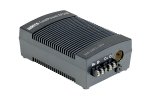
I then had a poke about with a torch and found the fridge has a Waeco Rectifier module (see photo)
waeco-coolpower-eps-100-convertidor-neveras.jpg

attached to the bulkhead behind the fridge. This takes 240v in and outputs 12/24v. This means when on shore power although the fridge is 12v, it is not being run from the ships domestic batteries, but instead by the Rectifier and 240v supply. Turn off the 240v (e.g you leave harbour) and the fridge then runs off the 12v DC battery feed.

Would fellow readers therefore presume as I have that the Rectifier has gone 'pop' and so is no longer able to provide 12v power when I energise the 240v supply, but does still correctly isolate the 12v DC feed from the batteries and that should I replace the Rectifier I likely will solve the issue?
 
Sounds about right .
We had a dodgy waeco cool box in the cock pit on the Sunseeker .
So much so the Sunseeker engineers kept spare rectifiers .
One August I went in to see them and the guy gave me 3 FOC .They can be temperamental

They were pulled off there feet at the time and the guy was pleased I was a diy er , as I had taken the duff rectifier off to show them the part .They had a big box of them . The replacement lasted about 3 y so fitted another ,when I sold the boat I had one left unused .
Btw I dropped a create of beer off at the tech office for the guys .

Another time doing a job I got into a muddle over some sealant of other ,I went into the tech office to ask for advise , they gave me a tube the right stuff , “ this is what we use take it mate ‘ kinda thing .
 
Last edited:
I am used to very basic set-ups on river boats and it is often the case even on new-build models you will have wiring run across a bulkhead with cable clips hammered in place with steels nails in them waiting to rust in due time, so the Trader with her proper wiring trays and looms and neat installs really is nice. So much of her fit-out has been well throught out but what has surprised me most is the fact the boat has such small capacity for her batteries and no Inverter :eek:

On many boats I have hired, gone are the 'marine fridges' and in come larger domestic versions running on 240v supplied by the boats Inverter. No need for these small rectifiers from Weaco to power the fridge when on shore power. (and I bet their not pure sign wave).

She has only two 200Ah domestic batteries and one 200Ah batter to start both engines. On Broad Ambition, the river boat I part own, we have six 110Ah Domestic batteries and a separate cranking battery. The real issue with this small capacity of course is they are just normal Lead Acid based batteries, so to be safe you can only really use 50% of their capacity thus I effectively have 200Ah of usable capacity.

When you consider the boat is also 12v (I'd have preferred 24v to further halve the amperage draw) and she had over fifty 20w Halogen G4 lamps throughout, until I changed them to LED this means if way from shore power using the toilet, using lighting, water pump and so on you've not got much reserve and the most annoying aspect is if you wanted to charge a laptop, watch the Television etc you can only get 240v by starting the Generator! Couple this with the fact you cannot get heat without the air-conditioning system running in reverse cycle (or using electric heaters) you've got a very inefficient boat so far as power, its generation, storage and use goes.

Not something I will do yet, but I will be increasing the battery capacity and installing a Victron combined charger and inverter together with a diesel fired heating system.

In the short term and for the fact the boat will be moved in winter time (when it is usually blooming cold) we have some choices when we are underway so far a heat goes - run the Generator to run the air-con system in reverse cycle, or run the Generator to get power to run fan heaters or not to have any heat. All this is pretty unacceptable to me so I am am going to get some 'free heat' from the engine.

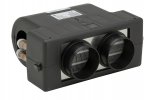
This is an easy thing, taking a feed from the hot water side which heads off to heat the domestic water tank but first run such through a heater matrix - I recon there is space for such to be installed in the front or rear of the base of the helm seat (even if I loose the 'Booze Drawer') supply it a 12v feed to run the circulation fan and while ever the engine is running you've got heat at 'no cost' and even if only the Saloon was warm, the rest of the boat can be heated once we are in Port and connected to shore power.

XEROS.jpg
 
Last edited:
Don’t forget, that “hot water” going to the calorifier is engine coolant.

You want to be sure anything you use is top quality, compatible materials and robust.

Would such a small matrix slow the flow to the calorifier?
 
On Ocean Spirit which is very close to the same age as your boat we also only have 400 ah domestic and 200 ah engine start batteries but they are all AGM Gel rather than standard lead acid. The fridge and freezer are 240v Bosch but is run from an inverter when 240v shore or generator power isn't available.

We have the same issue as you with many halogen bulbs which I am also considering replacing. You may have answered this in a previous post but may I ask which bulbs you used that fit the Cantaloupi fittings?

On the heating front we have reverse cycle aircon and two DL5C Eberspacher heaters. I think the aircon was probably not fitted as original equipment but at a subsequent refit. The Eberspachers are extremely efficient but probably not worth a retrofit if you have ready access to 240v supplies.

In my experience no two Trader boats are identical as, whilst Tarquin weren't a custom builder, they did allow a lot of customisation in their build programmes.

Looking forward to your next instalment!
 
IDAMAY: Well let me tell you the fun I had with the damn Cantaloupi fittings! I presume these are used through out the boat, but the ones that caused the most and which I know are Cantaloupi are the flush mount 'fake' chrome ones - two under the sundeck and two under the brow of the upper deck over the windscreen. These, the 'chrome' effect has worn off, leaving bare white plastic and that plastic has ages, dried and become creaky and bonded to the thread. Getting one off broke the frosted glass and left me in a lot of frustration. The others seem to be a chrome plated brass and I ma not sure if are Cantaloupi made.

Anyway, they all use G4 Halogen bulbs - 20w. I have found it hard to get LED replacements that not only live up to the same lumen output of a Halogen 20w but also replicate exactly the colour temperature. The ones I have originaly used a couple of years back are no longer made, so had to switch to a new supplier - get a packet and see how they work for you I think they are great myself, 4w and perfect light output. https://www.amazon.co.uk/gp/product/B06XHL8CBH/ref=oh_aui_detailpage_o04_s00?ie=UTF8&psc=1

The other good news was finding in a drawer on board four brand new Cantaloupi fitments to replace the broken one and plastic ones which the 'chrome' has worn off from.

I plan on fitting a 'wet' Diesel fired heating system whereby coolant is heated and pumped along pipes to matrix style heaters and uses about 550ml of fuel an hour to run, that is not too bad going and is more efficient than heating air which looses its heat far faster along an air duct that water along a pipe.
 
Last edited:
IDAMAY: Well let me tell you the fun I had with the damn Cantaloupi fittings! I presume these are used through out the boat, but the ones that caused the most and which I know are Cantaloupi are the flush mount 'fake' chrome ones - two under the sundeck and two under the brow of the upper deck over the windscreen. These, the 'chrome' effect has worn off, leaving bare white plastic and that plastic has ages, dried and become creaky and bonded to the thread. Getting one off broke the frosted glass and left me in a lot of frustration. The others seem to be a chrome plated brass and I ma not sure if are Cantaloupi made.

Anyway, they all use G4 Halogen bulbs - 20w. I have found it hard to get LED replacements that not only live up to the same lumen output of a Halogen 20w but also replicate exactly the colour temperature. The ones I have originaly used a couple of years back are no longer made, so had to switch to a new supplier - get a packet and see how they work for you I think they are great myself, 4w and perfect light output. https://www.amazon.co.uk/gp/product/B06XHL8CBH/ref=oh_aui_detailpage_o04_s00?ie=UTF8&psc=1

The other good news was finding in a drawer on board four brand new Cantaloupi fitments to replace the broken one and plastic ones which the 'chrome' has worn off from.

I plan on fitting a 'wet' Diesel fired heating system whereby coolant is heated and pumped along pipes to matrix style heaters and uses about 550ml of fuel an hour to run, that is not too bad going and is more efficient than heating air which looses its heat far faster along an air duct that water along a pipe.

Many thanks. I will certainly try that. I had to replace the fittings under the "eyebrow" and took the opportunity to change them to LED at that point. All the others are halogen so we have a lot to replace.
 
Some good news I spoke to Carl of CP Fuel Polishing today and a very nice man here seems to be.

The reason I am seeking the services of his company is because I do not know how long the boat has been sat and how old the fuel in her tanks is. Does it contain the dreaded ‘diesel fuel bug’ or perhaps there is a lot of muck and debris that have fallen to the base of the tank just waiting to be stirred up once one gets in to a bit of a rolling sea and potentially could clog the fuel filters and be an engine stopper why such are changed.

The main issue he can see is access to the tanks as ideally one would like to take off the inspection hatches and see what is actually in the tanks – then use a type of vacuum cleaner that sucks up any mess that be lurking. Once that is done the entire contents of the tank are pumped through a filtration system in a loop until the fuel is crystal clear.

Of course if he is not able to get into the tank, the fuel cleaning will sort any issues with the current fuel but not remove the any crude at the bottom of the tank. Another option is to drain fuel from the bottom of the tank and hope that what comes out will include any crude or another option would be to purposely stir up the tanks contents using a high pressure fuel pump and then begin to suck and filter the tanks contents capturing as much suspended matter as possible in the process until the fuel is clear and clean.

He has estimated 6 hours of onsite time, but this may vary and is based some 3 hours or so away in Poole so talking to him I was expecting several thousand pounds but initial estimate if all goes to plan is £580.00 odd. I can for see there will be issue and so will budge to double this but even so for peace of mind and knowing that what will be in the tanks is as clean fuel as one can hope for and then treat the fuel with a suitable ‘diesel bug’ treatment like Soltron, will be one big item ticked off the pre-departure list of things that have to be done.

I have also shared a video link and asked his permission if I may film some of the work he does and then be able to share the process with you all. I have emailed the Marina ever so politely seeking their permission for his visit and seeing what the state of play is as to parking. I hope they don’t put a spanner in the works and say no!
 
Some good news I spoke to Carl of CP Fuel Polishing today and a very nice man here seems to be.

The reason I am seeking the services of his company is because I do not know how long the boat has been sat and how old the fuel in her tanks is. Does it contain the dreaded ‘diesel fuel bug’ or perhaps there is a lot of muck and debris that have fallen to the base of the tank just waiting to be stirred up once one gets in to a bit of a rolling sea and potentially could clog the fuel filters and be an engine stopper why such are changed.

The main issue he can see is access to the tanks as ideally one would like to take off the inspection hatches and see what is actually in the tanks – then use a type of vacuum cleaner that sucks up any mess that be lurking. Once that is done the entire contents of the tank are pumped through a filtration system in a loop until the fuel is crystal clear.

Of course if he is not able to get into the tank, the fuel cleaning will sort any issues with the current fuel but not remove the any crude at the bottom of the tank. Another option is to drain fuel from the bottom of the tank and hope that what comes out will include any crude or another option would be to purposely stir up the tanks contents using a high pressure fuel pump and then begin to suck and filter the tanks contents capturing as much suspended matter as possible in the process until the fuel is clear and clean.

He has estimated 6 hours of onsite time, but this may vary and is based some 3 hours or so away in Poole so talking to him I was expecting several thousand pounds but initial estimate if all goes to plan is £580.00 odd. I can for see there will be issue and so will budge to double this but even so for peace of mind and knowing that what will be in the tanks is as clean fuel as one can hope for and then treat the fuel with a suitable ‘diesel bug’ treatment like Soltron, will be one big item ticked off the pre-departure list of things that have to be done.

I have also shared a video link and asked his permission if I may film some of the work he does and then be able to share the process with you all. I have emailed the Marina ever so politely seeking their permission for his visit and seeing what the state of play is as to parking. I hope they don’t put a spanner in the works and say no!


Ain't broke don't fix it ! Filters clean ? Leave well alone.
 
Ain't broke don't fix it ! Filters clean ? Leave well alone.

Hmm I can't really sit happy with that way of thinking. We are talking about fuel that is of unknown quality and age, in tanks which sadly are not transparent so you have no idea what is within them so the first I'm going to know it is broken is when one or both fuel filters clog up. I'd really prefer not to be in that situation, in February somewhere between Dartmouth and Portland in a chop and having to be down in the engine room changing fuel filters and cursing why I had not sorted the issue sooner.

I will be really happy if after the fuel tanks have been inspected and fuel filtered it all goes really smoothly and the chap says '"well look at that you'd been fortunate hardly any crude in your tanks and you had lovely clean fuel to begin." That £580.00 odd spent will be peace of mind to me not a waste.

In other news...

I have been making a list of items to address, some small and cosmetic, others larger and that can be attended to next Spring. One of the annoying issues is in the galley there are two port lights, the one closest to the Hob leaks when it rains, and has been merrily doing so for a good long while as the wood beneath the port light has about as much strength as wet cardboard. This is not the opening part of the port light, but the actual surround that screws into the wood interior. This therefore will need to be removed, investigate why it is leaking and stop it and then try and find some marine ply with a veneer that matches as close as possible to the rest of the grain in the galley area.

Another issue is the Williams RIB. At some point when it has been raised or lowered by the crane the bow has had a nasty whack on something. It has made a 'chip' that is about 2 inches in diameter into the gel coat, and right thru to the underlying laminate. Small repair that can be addressed in situ but one that I will want to do before I do a launch - it is handy I found the remote control for the crane under a pile of paperwork a the back of one of the drawers. I've also found a safe (sadly it was empty) but handy to have one.

I have been in touch with a company to produce the vinyl graphics for the boats name. One of the hardest things about this is the choice of font but I think I have chosen one that reflects an air of modernity yet elegance and a colour that is rather subtle.

Name Plate.jpg

As one thing usually leads to another so it has here - I am now thinking about having some vinyl artwork made to cover the big plain boring white wall in the aft heads to which the electric towel rail is attached to. Being vinyl this should be easy to put on, but will be a big panel to get right. I am also desperately trying to resist the urge (though not all that well to be honest) at having the hull vinyl wrapped in navy with a red topping line. Well, something to mull over at least.

Last weekend I got the fridge freezer out and what a laugh that was - and find the fuse in the Rectifier has blown - my luck continues - I change it, and it works both on 12v and when 240v is applied. put it all back, re-attach wood trim that holds the fridge freezer firmly in place together with the louvered door. A few hours later it no longer works when I have 240v power to the galley on. New Rectifier it is then! If that too fails and proves to be something with the actual fridge freezer, then the damn thing is for the tip. I have a nice domestic one lined up and a company who can make a custom vent panel to disguise the gap that would result at the top of the domestic style fridge freezer and the top of the enclosure it would fit into.

Having got fed up with fridge troubles, I did a temporary install of my new 5.1 surround speaker system. It is a Logitech Z906 and has been rated at 500w of continuous power with a temporary peak output of 1000w with 30cm sub-woofer enclosure - the neighbors will love me.

61hxQM346-L._SL1200_.jpg

The issue is I had not measured the sub before I ordered it, and now find I can't put it where I had planned - it currently sits in the saloon looking very much out of place in the 'traditional surroundings' of the Trader. My plan now is to put the sub in the handy space I found under the helm seat. I will then mount the satellite speakers to the wood trim that hides the blinds, and hide the wiring also behind this trim and run the wires down with those running from above the helm to the space under the seat. I also have 240v nearby to tap into so should work well. As to the sound quality, out the box it was loud but also was very dull and muddy sounding, but after some adjustment it really has come to life. At half volume doors vibrate and windows shudder so this will be something for 'offshore' use hehe.

I am running behind with videos a the moment, but I will do a sort of 'catch up' one soon and show what is what so far.
 
Top