Motorboat Newbie's Change Of Direction

Electronic throttles: are you sure to have the option of controlling manually the engine and gearbox, should the ZF system go nuts? Afaik, the actuator boxes inside the e/r (as opposed to the Kobelt boxes, which are unique in this respect) neither allow the disengagement of mechanical cables, nor have any manual levers to move the cables, once detached from the actuators.

So the electronic throttle basically sends a signal to the controller in the engine room and moves an actuator. This might 'go nuts' but it does mean you can physically disengage the output from actuator to engine be it gearbox or throttle. His was shown to me by the engineer. Indeed from engine to control box it is an old school mechanical set up so you could revert back to manual mechanical throttles.

However is that to say every ZF electronic install is prone to go wrong? I doubt the previous owner went into this lightly having an a great deal of expense to buy the system and then have it fitted. Whatever it would seem what was their originally was not to his liking and decided upon the ZF controls as the best route and hiding from the Director of the company who looked after the boat and who spent two hours going over it with me, the previous owner was the type of chap to have a want and hand over the realisation to the company to fulfill. I suspect they (the company) believed in the ZF system compared to others that could have been procured.

Therefore your comment of "whoever replaced cables-only controls in a boat whose engines and gearboxes are both made an expansive mistake" does not ring true to me until and unless I find evdicen of these ZF control systems failing. If and when I do then I may consider their replacement but I don't see things at the moment as this being needed.

As far as Stablaizers and boats goes I think I am correct in presuming that most boat owners do it and go boating for the enjoyment. They also tend to have others with them - perhaps their family or just their wife, who will become less than happy if things get uncomfortable. I've read posts on this Forum of such and I understand that. It's not like you're paid and so come a rough day you are out there come what may like those working on offshore support boats and the like are.

But from my point of view if the boat rolls hard that is just how she is and there are countless other Trader owners who have enjoyed their boats without stabilisers after all the previous two owners of mine did. So if if it is ok for them I'm sure be okay for me. Of course I will be more conscious of roll as I've got the added weight of a Williams rib up top but he boat also has a third fuel tank mid ships so it's swings and roundabouts really.

I say this much, she sits in the water like a rock compared to the Fairline phantom 50 and Princess V48 either side of my Beth. Had some real big wind gusts today and they were really being pushed about far more than the Trader was despite me having more height to catch the gusts so it's a comfortable boat when you're just spending time onboard in a Marina.
 
Last edited:
Thanks for the message, when was she last used - don't ask me sensible questions like that lol but I would guess August, this was when she was taken from her berth to the marina where she was lifted and had a lot of works undertaken and brought back September. Put it like this, as the Engineer said the previous owner did not go out much on her but would want her ready to just in case, so we needed to look after her as if she was being used regularly. Judging from the amount of glassware on board I would say she spent more time in port as a floating bar for the consumption of fine wines.

If she hasn't had much use then I would be concerned about the state of the fuel. Has the boat got glass bowls on the fuel filters? Do you know if the previous owner did anything to prevent bug?
 
If she hasn't had much use then I would be concerned about the state of the fuel. Has the boat got glass bowls on the fuel filters? Do you know if the previous owner did anything to prevent bug?

Yes she has twin Racor filters. They have no water in them and minor sediment. I'd dealt love to have the fuel tanks inspected but quite how one would get to them (she has three) I know not. They are and have been kept full to help prevent condensation and has been recommended I do a shock dose of a good 'bug killer'. I also may have tthe fuel polished which won't do much for crud in the tank. This is something on the to do list and the guys who will be looking after here needs prior to me leaving to advise and do.
 
your comment of "whoever replaced cables-only controls in a boat whose engines and gearboxes are both mechanical made an expansive mistake" does not ring true to me until and unless I find evdicen of these ZF control systems failing.
...
As far as Stablaizers and boats goes [...] she sits in the water like a rock compared to the Fairline phantom 50 and Princess V48 either side of my Beth. Had some real big wind gusts today and they were really being pushed about far more than the Trader was despite me having more height to catch the gusts so it's a comfortable boat when you're just spending time onboard in a Marina.
LR, I have the feeling that you are reading my comments as meant to dismiss your choice, or Traders in general.
Which couldn't be more far from being true, because while Traders are (imho, as always!) very far from being the best SD boats on the planet in absolute terms, they also are among the very best in terms of VFM - which is the main reason why I almost bought one.

But let's focus on technicalities rather than personal choices/preferences.
It's ALWAYS (not just in your boat!) an expensive mistake to replace mechanical levers with electronic ones in a boat whose engines and gearboxes are mechanically controlled, no matter how good and reliable the electronic system can be. The very simple reason is that by doing so you introduce one additional complexity layer for no reason, and as the old saying goes, the only component that will never break onboard is the one you don't have.
So, if I say that mechanical levers are more reliable when compared to electronic ones plus mechanical actuators, I'm just stating the obvious, rather than expressing a personal opinion.
Otoh, I can only repeat what I already said: if anyone just likes the feeling of electronic single levers, who am I to argue? That's an entirely different reasoning, though.

Ref. the possibility to "physically disengage the output from actuator to engine be it gearbox or throttle" which that engineer showed to you, I am genuinely curious, because the only actuator I've ever seen with built-in manual levers that can be used to push/pull the mechanical cables directly, after disconnecting them from the electronic control, is the Kobelt that I previously mentioned.
Could you possibly name the model of the ZF system you are talking about? I've seen ZF controls on several boats, but in none of them it was possible to bypass the electronic actuators.
Mind, if what the engineer told you is that you could disconnect the mechanical cables from the black box and push/pull them manually, well, of course that is true of any electronic actuator, but do you have an idea of what that implies in practice? I'd rather hope that someone will copy my pan-pan, in such situation... :ambivalence:

Talking of stabilizers instead, well, I simply reported my first hand experience in a less than moderate sea.
You don't need to convince me that Traders are very comfortable for spending time onboard in a marina, because that has been also for myself their single most appealing feature.
If that's all you are interested in, I struggle to think of any better choice that you could have made, at that size! :encouragement:
 
Yep I already have thought of this, going to keep what is on now as only put on in August. Then then she is in the fresh water come her next lift will switch over to Magnesium which is what we have on Broad Ambition, also I am impressed with the Anti-Foul we have on her which works well so will use on Independence in due course and got from a light blue bottom to either a deep navy or red.

We have used aluminium on the southern rivers for a number of years as we do both river and sea. They have been fine on our last two boats (Fairline Targa with outdrives and Broom 41 with shafts).
 
Ref. the possibility to "physically disengage the output from actuator to engine be it gearbox or throttle" which that engineer showed to you, I am genuinely curious,

Firstly no I don't take what you say as begin all negative, but I don't worry about things going wrong as you might. I mean it is like in modern cars when you press the accelerator, it has a physical peddle but has no connection therein to the engine - it is all done electronically.

If the actuator did fail you would soon know, and then need to remove the physical cable linkage from the engine/gearbox and then manually move the arm on the engine. What would you do if you had a mechanical set up from helm to engine and the cable broke, well much the same thing initially even if you happened to have a spare cable onboard they are not easy and quick things to remove a Morse control head for example, detach the cable, fit new, then feed the new cable down to engine and connect. What you have done is made me think I need to brush up on ZF systems and how easy is it to work on - like the Actuators for example, can these be changed easily or is it a rip out and begin over job if one goes.

The thing is, I have personally known someone with a Volvo system which went belly up and made the engines have a 'life of their own' before the system became inoperable and no drive could be selected. It turned out to be a costly fix and down to a controller chip getting a rouge high voltage spike. Fortunately none of this happened when underway at sea. However I also have known people (and indeed happened to us) where a physical throttle cable has broken and the work then needed to change it.

So there is always the risk of something happening and going wrong, for my part since the boat is not going to be heading off to far flung destinations and being used as others may use their boats I am not going to be getting worried about if the throttle will do what I want it to do when I move it.
 
Video Tour Time

Yes it has been requested and those that did not might want to have a nose about anyway, so here is a very raw video I filmed on Sunday. I had a cold that has left me with a horrible cough so forgive how I sound and the shaky video but I hope you will get a feel for things. Also remember at time of the video being taken I had spent perhaps 27 hours tops on the boat so a lot of things I am getting used to and discovering as I go along. Hope you like:

 
Video Tour Time

Yes it has been requested and those that did not might want to have a nose about anyway, so here is a very raw video I filmed on Sunday. I had a cold that has left me with a horrible cough so forgive how I sound and the shaky video but I hope you will get a feel for things. Also remember at time of the video being taken I had spent perhaps 27 hours tops on the boat so a lot of things I am getting used to and discovering as I go along. Hope you like:


Congratulations, she looks magnificent!
 
Thanks for a very interesting video. She looks a very clean boat indeed, both from your video and the sales information. She is from the same build year as our Trader 54 and shares many of her features including the ZF control system. As I think I said in a previous post, we have taken Ocean Spirit to Porto and back in the last two seasons and haven't had any problems with the controls in around 400 engine hours. I think that shouldn't be a major worry for you, particularly considering that most modern engines are fully electronic anyway. From my experience with 450hp CAT's, I would be very surprised if you don't have enough power for the thrusters from your Yanmars.

Anyway, we wish you much enjoyment and safe boating in your new Norfolk home. We look forward to the unfolding story.

Richard.
 
Looks great. I agree, that GPS plotter is in a daft place so I think I'd start from scratch with the dashboard. JFM or one of the others will give you some good advice to maximise space.

That fuel system doesn't look original or right to me. You can see holes in the bulkhead where things (filters?) were originally fitted and having the fuel lines running below the door doesn't look correct.

Regarding the removal of ornaments, if you're lucky they'll be attached with the gelstuff that they use to stick credit cards to paper and won't leave a mark.

Good result inheriting all that fuel and booze!
 
Last edited:
I tend to agree with petem when he says that the filter placement was probably modified for some reason.

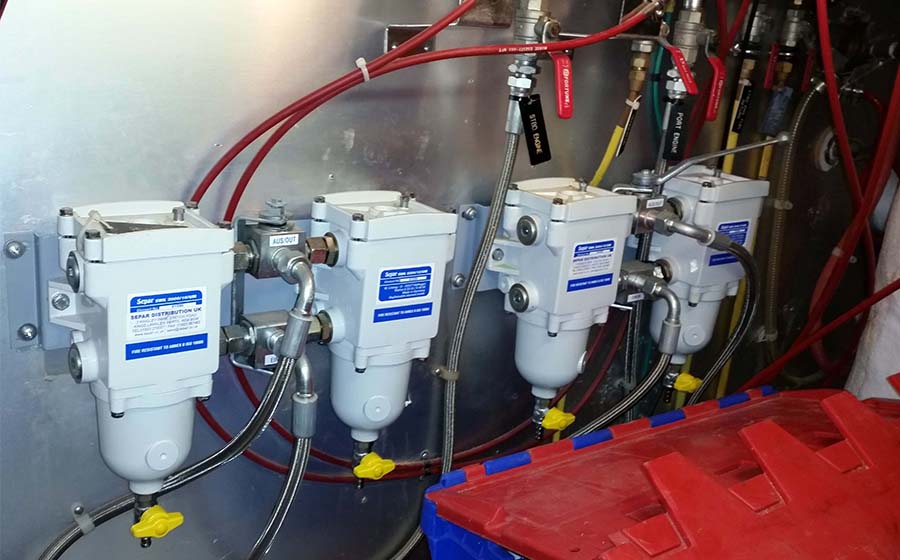
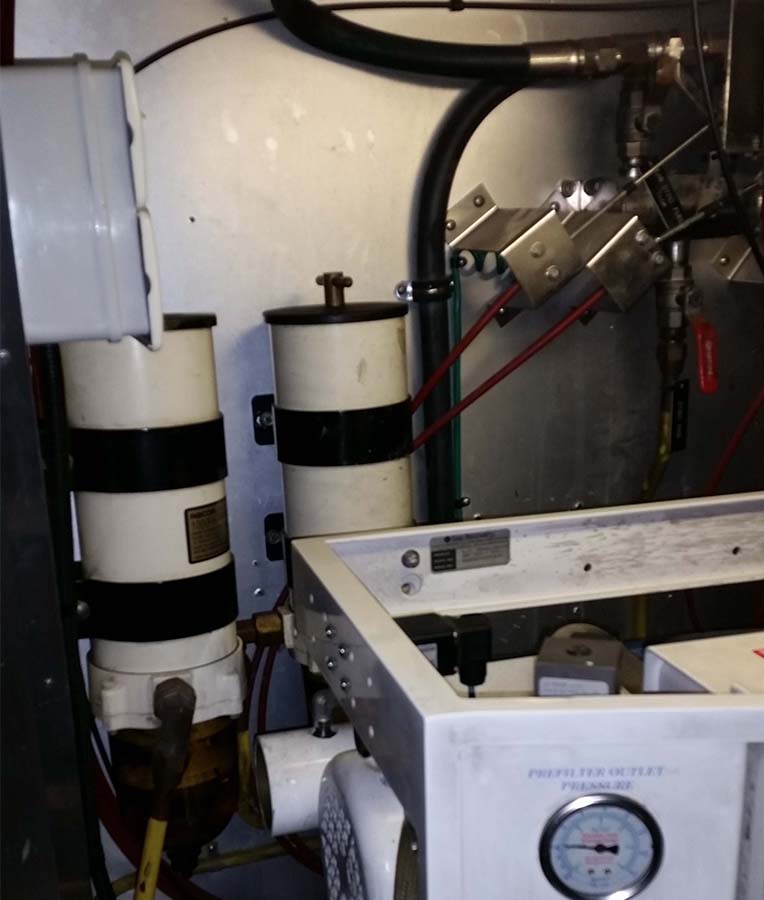
LR, since you asked for suggestions in that respect in your video, below you can see two pics of the very same area (aft e/r bulkhead, port side) that can be seen from 19:15 onward, which were taken in two different T575.
Unfortunately, I can't remember if they had a similar fuel valves arrangement, possibly placed somewhere else.
Anyway, being the nearest to the e/r entrance, imho that area is much better suited for placing the filters rather than the fuel valves, which in practice you are unlikely to ever need.
Otoh, I'm unsure about how complicated it could be to relocate the fuel lines and valves - and where.
But if you would do that, I'd definitely exploit the space to fit twin parallel filters, as in the first of the two boats below, because whenever one gets clogged it's just a matter of moving one lever and use the other one.
Anyway, looking forward to seeing some interesting refitting pics! :encouragement:

qkKBe27P_o.jpg


imLtNBlF_o.jpg
 
That fuel system doesn't look original or right to me. You can see holes in the bulkhead where things (filters) were originally fitted and having the fuel lines running below the door doesn't look correct.

Yes I agree, but the holes in the bulkhead look just perfect for the backing plates that hold the Racor Filter - I have wondered why one would move it further over? I'm sorry in the video I was suffering a nasty cold and was not thinking straight, but looking back now it would make emptying the glass bowl hard to fit anything under to catch the fuel. I've only had a breif look, but it would seem that these two filters are 'live' all the time - one for each engine.

I need to adapt the system anyway to get a BSS certificate, the glass bowls will need to be changed to have a metal shield in order to do this (though different people say different things) but I wondered if a better, easier system would be like this:

filters.jpg

Now I must confess this is all based on reading peoples experiences, but if you use such a set up you would draw fuel through one filter (and alternate periodically between) but not to draw fuel through both filters at once since this does not mean fuel is twice filtered. My question is, would you need this set up duplicated for both engines or would this suffice having both engines feed through one filter?
 
If the actuator did fail you would soon know, and then need to remove the physical cable linkage from the engine/gearbox and then manually move the arm on the engine. What would you do if you had a mechanical set up from helm to engine and the cable broke, well much the same thing
...
Careful there, we are now mixing up two different things:

1) does it make sense in a boat with mechanical engines and gearboxes to replace mechanical throttles with electronics?
My personal answer is no, because by doing that you are NOT replacing one system with another (which might beg the question of which is more reliable). What you are actually doing is ADDING an electronics component to a mechanical one that you still need anyway - hence creating a MIXED setup, which is by definition less reliable, because BOTH can fail.
That was my reason for calling it an "expensive mistake" - nothing else.

2) assuming an electronic fault in such mixed setup, how easy is it to control the boat manually?
In this respect, what I said initially is that (afaik) only Kobelt actuators are 100% fail safe, because you can disengage the electronic actuators and operate the cables manually.
You said that this can be done with ZF actuators, but I believe you didn't get my point because - I guess - you haven't seen the Kobelt actuators I was talking about.
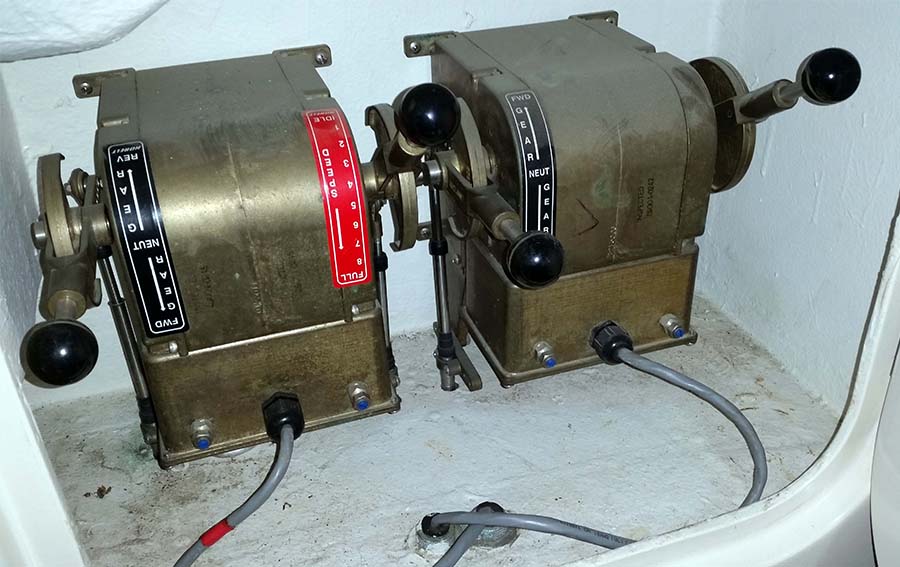
So, here they are. Each of them is connected with the grey electrical cable to the throttles, and the mechanical cables on the sides of the bronze box (which in this installation go down to the e/r through a hole in the grp) are normally pushed/pulled by mean of electronic instructions received from the throttles.
If the electronic side fails, all you must do is use the actuator levers instead (essentially as you would with mechanical throttles).
THIS is the functionality that afaik is peculiar to Kobelt - but glad to stand corrected if anyone knows better.
m2cTBAjF_o.jpg
 
Top