Motorboat Newbie's Change Of Direction

My question is, would you need this set up duplicated for both engines or would this suffice having both engines feed through one filter?
You don't NEED twin filters for each engine, but it's a very nice thing to have because it allows you, in the event that the running filter gets dirty, to switch to the other one with a valve, and take care of cleaning the other one later.
That's the reason why the owner of the first of the two T575 in my previous pics specced such setup.
 
Yes I see the advantage over the use of two filters set up like that - of course the question is how often has such needed to be done 'on the fly' in peoples experiences verses the cost of the install to begin.

I have the feeling of being perched on a fence and could go either way leaving as is or make a change. I like the idea of the filters could be move to make getting to them easier but if you are going to do that, then you might as well go the full hog and put a new assemble in with the twin filters and easy change over valve.

I think, seeing as I have found 4 spare filters on board and currently the biggest voyage I have planned is from Plymouth to Lowestoft with a few stops along the way that the current filter set up will suffice and keep an eye on them before, during and after each leg.

I will leave as is for now – see how things go and make a decision down the line, this sort of thing can be done down the road and while it is not quite the same it effectually is a type of plumbing so far as you are connecting fuel lines into a new filter assembly and out of it to the engine.
 
Yes I see the advantage over the use of two filters set up like that - of course the question is how often has such needed to be done 'on the fly' in peoples experiences verses the cost of the install to begin.

I have the feeling of being perched on a fence and could go either way leaving as is or make a change. I like the idea of the filters could be move to make getting to them easier but if you are going to do that, then you might as well go the full hog and put a new assemble in with the twin filters and easy change over valve.

I think, seeing as I have found 4 spare filters on board and currently the biggest voyage I have planned is from Plymouth to Lowestoft with a few stops along the way that the current filter set up will suffice and keep an eye on them before, during and after each leg.

I will leave as is for now – see how things go and make a decision down the line, this sort of thing can be done down the road and while it is not quite the same it effectually is a type of plumbing so far as you are connecting fuel lines into a new filter assembly and out of it to the engine.

For most people it makes little sense - 2 engine craft which rarely make long trips way from land.

A trader at displacement speed can go a long way and the ability to change filters on the fly ( probably in heavy weather which stirred up the tanks in the first place) would be a benefit.

I would not do it unless there was a specific need or i suppose that you had constant clogged filters ( in which case you solve that problem as opposed to adding more filters ...)
 
For most people it makes little sense - 2 engine craft which rarely make long trips way from land.

A trader at displacement speed can go a long way and the ability to change filters on the fly ( probably in heavy weather which stirred up the tanks in the first place) would be a benefit.

I would not do it unless there was a specific need or i suppose that you had constant clogged filters ( in which case you solve that problem as opposed to adding more filters ...)

I looked at installing twin Racors per engine on Play d'eau a while ago for exactly that reason. However, there's simply not room. Seeing prevention is better than cure, I am fastidious about keeping the bug at bay (currently using Grotomar 82), verifying tank cleanliness every year, and dismantling the Racors completely once a year to ensure they are spotless.
 
Yes I see the advantage over the use of two filters set up like that - of course the question is how often has such needed to be done 'on the fly' in peoples experiences verses the cost of the install to begin.

I have the feeling of being perched on a fence and could go either way leaving as is or make a change. I like the idea of the filters could be move to make getting to them easier but if you are going to do that, then you might as well go the full hog and put a new assemble in with the twin filters and easy change over valve.

I think, seeing as I have found 4 spare filters on board and currently the biggest voyage I have planned is from Plymouth to Lowestoft with a few stops along the way that the current filter set up will suffice and keep an eye on them before, during and after each leg.

I will leave as is for now – see how things go and make a decision down the line, this sort of thing can be done down the road and while it is not quite the same it effectually is a type of plumbing so far as you are connecting fuel lines into a new filter assembly and out of it to the engine.

You ought to practice changing a racor ( u tube it 1 st ) while in a marina .
It’s dead easy .
The only thing I noticed is the height of yours .
To bleed them if they are lower than the fuel level you just open the in cock a bit and watch it fill up when it’s seeping from the lid tighten up secure.
Prob with your set up ( filters approx 1/2 way up the tank , ) I,cant see the “gravity bleeding “ effect working ifthe fuel level is lower than the racors .

So if are gonna move em put them as low as possibe .
Mine are so low there’s only 3 cm from the bottom of the drain cock and hull ,Vertually same height as the base of the tanks .
Without gravity ,then imho it’s a big ask and big risk ,more so in a swell some how using the engines secondary filters prime pumps to drag air out .

Have you found these - the secondary filters and there priming pumps ?

Or course have you got a small 5 L can of fresh ish diesel to top up the racors best you can if the tank level is lower ?

Remember air in the injection pump is a potentially a show stopper or another layer in a panic state to confuse the diagnosis while @ sea with stopped or won,t start engines .Sprinkle in a pair of weak engine batteries and the crank speed slows to add a 3 rd layer to the deteriorating conditions .

Get younVHF course done :)

Having said ^^^^
Like Piers I subscribe to the prophylaxis approach
Add anti bug additive every fill up .
Drain off the tanks if you a sump cock in a timely manor .
And for U.K. keep em topped up in the winter if inactive- reduce condensation suraface area theory.
 
A trader at displacement speed can go a long way and the ability to change filters on the fly (probably in heavy weather which stirred up the tanks in the first place) would be a benefit.
That's a very widespread belief J - and I also used to think along the same lines. Till I went from a D to a P boat, that is.
What got me thinking is the fact that I had twin filters on the old D boat, and even if I never needed to hot swap them while cruising, it was reassuring to have the possibility.
Now, filters are very conveniently placed in the DP, right under the e/r hatch, so they can be opened/cleaned while standing almost en plein air, so to speak. But there's just one per engine.
So, I did some math, out of curiosity.
Let's assume a 200Nm open sea crossing without any port of call in between, as in Menorca to Sardinia, for instance - a rather normal scenario also for P boats.
In my old/new boat, this translates in the following differences:
- 8 vs. 24 kts
- 25 vs. 8:20 hours
- 15 vs. 160 lph
- 375 vs. 1,333 liters total

Bottom line, in which boat do you think it's more likely to be stuck at 100Nm from the nearest port of call, the one whose filters processed half of 375 liters, or half of 1,333 - i.e. 3.5 times as much?
Btw, this reasoning doesn't consider that the real amount of fuel passing through the filters is actually much higher in absolute terms (in both boats of course), so probably the "3.5 times" proportion is even higher.
But that depends also on the type of engines to some extent, so let's leave that complication aside.

All that said, of course I fully agree with Piers approach, but if you ask me whether I would rather fit twin filters on a D or a P boat, my personal answer is first and foremost in the latter.
Unfortunately, I have the same problem as Piers in upgrading to twin filters, i.e. lack of (convenient) space.
Which btw is also the reason why the boat was not built with them, to start with.
All the larger boats of the same yard had twin filters as standard, and very rightly so, imho.
 
Thanks for the help/info :)

You only need to take a look online at how people change their filters - there seems all types of ways, and regardless of which way people will comment it is the bad way lol. But yeah the basic principle of the type fitted on my boat is easy compared to some other types.

The most helpful bit of advice I have seen is not relating to boats at all, but lorries - and how to obtain fresh, filtered fuel in the first place from the engine then how and into what hole (pre-filter side of the filter housing) of the engine filter to fill up to help prime it, so you only ever introduce to the injectors fresh filtered fuel.

I think I will take the longer view on this one. I am however going to add to my list of items for the engineering firm a check of the fuel tanks - I'll even lend them my Borescope inspection camera to get down and see what is what, I'd love to do this myself, but there no way this round fellow can fit in to get to the tanks - it appears one would need to lay over the engines then reach up through the air baffle plates to get to the top of the tanks and inspection hatch.
 
That's a very widespread belief J - and I also used to think along the same lines. Till I went from a D to a P boat, that is.
What got me thinking is the fact that I had twin filters on the old D boat, and even if I never needed to hot swap them while cruising, it was reassuring to have the possibility.
Now, filters are very conveniently placed in the DP, right under the e/r hatch, so they can be opened/cleaned while standing almost en plein air, so to speak. But there's just one per engine.
So, I did some math, out of curiosity.
Let's assume a 200Nm open sea crossing without any port of call in between, as in Menorca to Sardinia, for instance - a rather normal scenario also for P boats.
In my old/new boat, this translates in the following differences:
- 8 vs. 24 kts
- 25 vs. 8:20 hours
- 15 vs. 160 lph
- 375 vs. 1,333 liters total

Bottom line, in which boat do you think it's more likely to be stuck at 100Nm from the nearest port of call, the one whose filters processed half of 375 liters, or half of 1,333 - i.e. 3.5 times as much?
Btw, this reasoning doesn't consider that the real amount of fuel passing through the filters is actually much higher in absolute terms (in both boats of course), so probably the "3.5 times" proportion is even higher.
But that depends also on the type of engines to some extent, so let's leave that complication aside.

All that said, of course I fully agree with Piers approach, but if you ask me whether I would rather fit twin filters on a D or a P boat, my personal answer is first and foremost in the latter.
Unfortunately, I have the same problem as Piers in upgrading to twin filters, i.e. lack of (convenient) space.
Which btw is also the reason why the boat was not built with them, to start with.
All the larger boats of the same yard had twin filters as standard, and very rightly so, imho.

Interesting take but I wonder if the turnover of fuel in a planing boat increases or decreases the chance of fuel being contaminated. From my limited knowledge, there are two type of contamination:

1) Bug - are D boats more susceptible if they have lower turnover of fuel?
2) Sediment / other contaminents - are P boats more susceptible if they have more fill-ups?

I did wonder if there could be a argument for mothballing a tank or two in the case of a multi tank displacement boat where fuel usage is VERY low to stop it from going stale / getting Bug?
 
Interesting take but I wonder if the turnover of fuel in a planing boat increases or decreases the chance of fuel being contaminated. From my limited knowledge, there are two type of contamination:

1) Bug - are D boats more susceptible if they have lower turnover of fuel?
2) Sediment / other contaminents - are P boats more susceptible if they have more fill-ups?

I did wonder if there could be a argument for mothballing a tank or two in the case of a multi tank displacement boat where fuel usage is VERY low to stop it from going stale / getting Bug?

Play d'eau is 14 years old, has over 1700 hours on the clock, and been cruised at D speed. Looking after the fuel as I've said above, has resulted in clean tanks, and clean filters. A point I didn't mention is that I check the O rings around the filler caps are good for another season. Nuff said?
 
Play d'eau is 14 years old, has over 1700 hours on the clock, and been cruised at D speed. Looking after the fuel as I've said above, has resulted in clean tanks, and clean filters. A point I didn't mention is that I check the O rings around the filler caps are good for another season. Nuff said?

Piers, I have absolutely no doubt that your fuel tank regime will ensure totally clean fuel!

My question was more of a theoretical one assuming that the boat owner made no effort to prevent bug or polish / inspect fuel.

Or let me ask my question another way. It's generally considered to be good practice to keep tanks full. If the OP has 3000 litres on board and assuming he is burning 15lph (guess?) then it will take 200 hours to burn that fuel. The average boater does perhaps 50 hour per year (guess?) and therefore the fuel could be a few years old. Surely that can't be healthy?
 
Last edited:
Piers, I have absolutely no doubt that your fuel tank regime will ensure totally clean fuel!

My question was more of a theoretical one assuming that the boat owner made no effort to prevent bug or polish / inspect fuel.

Ah ha! If I was taking over a pre-used boat, I'd employ the services of a company such as http://www.cpfuelpolishing.co.uk/services/ Companies like this use high powered systems which will relive a tank of anything non-diesel. Then it would a question of cleaning the filter system and reverting to the above process.

But having the tanks cleaned with a high powered pump system is paramount.
 
That's a very widespread belief J - and I also used to think along the same lines. Till I went from a D to a P boat, that is.
What got me thinking is the fact that I had twin filters on the old D boat, and even if I never needed to hot swap them while cruising, it was reassuring to have the possibility.
Now, filters are very conveniently placed in the DP, right under the e/r hatch, so they can be opened/cleaned while standing almost en plein air, so to speak. But there's just one per engine.
So, I did some math, out of curiosity.
Let's assume a 200Nm open sea crossing without any port of call in between, as in Menorca to Sardinia, for instance - a rather normal scenario also for P boats.
In my old/new boat, this translates in the following differences:
- 8 vs. 24 kts
- 25 vs. 8:20 hours
- 15 vs. 160 lph
- 375 vs. 1,333 liters total

Bottom line, in which boat do you think it's more likely to be stuck at 100Nm from the nearest port of call, the one whose filters processed half of 375 liters, or half of 1,333 - i.e. 3.5 times as much?
Btw, this reasoning doesn't consider that the real amount of fuel passing through the filters is actually much higher in absolute terms (in both boats of course), so probably the "3.5 times" proportion is even higher.
But that depends also on the type of engines to some extent, so let's leave that complication aside.

All that said, of course I fully agree with Piers approach, but if you ask me whether I would rather fit twin filters on a D or a P boat, my personal answer is first and foremost in the latter.
Unfortunately, I have the same problem as Piers in upgrading to twin filters, i.e. lack of (convenient) space.
Which btw is also the reason why the boat was not built with them, to start with.
All the larger boats of the same yard had twin filters as standard, and very rightly so, imho.

I agree completely ... but i did say most boats .....

I go from Sardina to Mallorca as you know but i don't think in the scene of things many people do trips that long!

The other half of that equation of course is that boats that do that distance or other long trips have a huge fuel turnover which should help keep most stuff at bay!
 
You don't NEED twin filters for each engine, but it's a very nice thing to have because it allows you, in the event that the running filter gets dirty, to switch to the other one with a valve, and take care of cleaning the other one later.
That's the reason why the owner of the first of the two T575 in my previous pics specced such setup.
This is not a subject that I’m familiar with so I will ask a basic question. Instead of exchanging the single Racor filter with a double why can you not just plumb in another single in a convenient location?
 
qkKBe27P_o.jpg
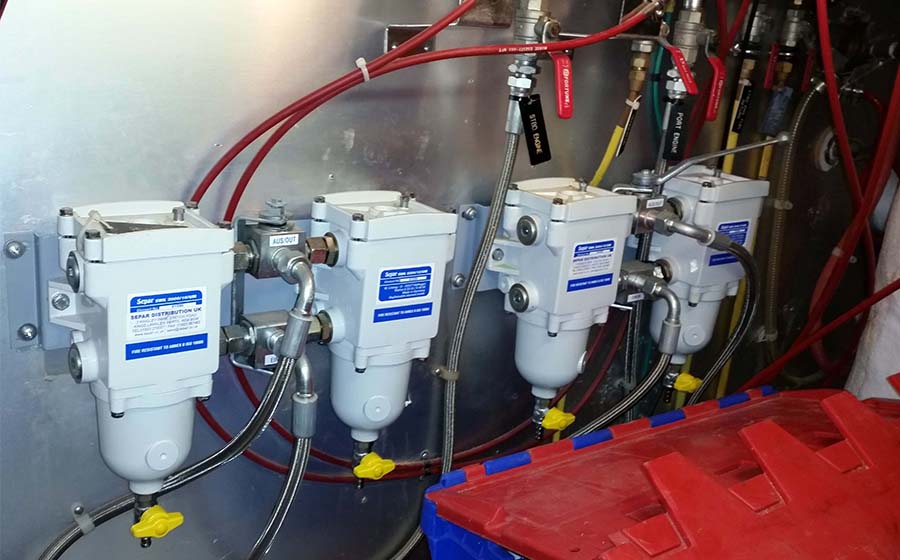
Mapism, just a small point, but I don't love how the inlet and outlet valves are linked by a strip of metal in that Separ set up. It looks ugly, heath Robinson, and ergonomics are not great or intuitive. The Racor product that many of us on here use, and pictured by LR in post 259, where the two valves are combined in a single valve block and share a common shaft, rotated by the single yellow lever, is much more elegant
 
Interesting video, although I did fast forward a few times :cool:
This definitely passes the “custard test”, although your other youtube videos make it pretty obvious that it was going to happen. People on here are a little suspicious at first because there have been a few wind-up artists that then disappeared in a puff of smoke.

The main advice I would give is ... start with the boring basic stuff first.

Check that stuff works, clean hull, clean teak decks, service engines, declutter.
Take out the boat a few times, see what works for you ergonomically / practically and what does not work so well.
This might alter your “priority list”.
Then and only then, start thinking about upgrades and rearranging things. Maybe use boat shows to look at newer models for ideas as well (e.g. dashboard layouts).
 
Interesting take but I wonder if the turnover of fuel in a planing boat increases or decreases the chance of fuel being contaminated. From my limited knowledge, there are two type of contamination:
1) Bug - are D boats more susceptible if they have lower turnover of fuel?
2) Sediment / other contaminents - are P boats more susceptible if they have more fill-ups?
Ref 1, I can give you my first hand experience after 17 years of boating with a D boat equipped with 4 s/steel fuel tanks, exactly 1 cubic meter each (4k liters in total).
When I moved her to CF from the Adriatic in 2006, I filled her to the brim in Lastovo (Croatia), before crossing towards Apulia, going round the heel of Italy, then through Messina Strait, and eventually reaching S Sardinia.
Upon arrival, I had enough of that Croatian fuel left to cruise for the rest of that summer - though we actually cruised just locally, after the 1200Nm trip from N Adriatic...
At the end of 2006 summer, I stored the boat with still 5/600 liters left (which means just 15cm or so at the bottom of 1m high tanks).
In 2017, I began the season with that fuel, which was by then more than one year old, and I only loaded some more after a couple of months.
In all the following years, I never left more than 10 to 15cm of fuel at the bottom of the tanks, during winter.
I never used any fuel treatment, and the only reason why I'm aware of the fuel bug existence is that I read about it here in the asylum.
Maybe I'm just lucky, 'dunno.

Ref 2, my experience with the DP is too short to be meaningful (and my previous P boats where too different to compare), but in principle I think that some relationship between the quantity fuel loaded over any given period of time and its content of water and sediments is bound to be expected...
 
Mapism, just a small point, but I don't love how the inlet and outlet valves are linked by a strip of metal in that Separ set up. It looks ugly, heath Robinson, and ergonomics are not great or intuitive. The Racor product that many of us on here use, and pictured by LR in post 259, where the two valves are combined in a single valve block and share a common shaft, rotated by the single yellow lever, is much more elegant

LOL, "Heath Robinson", I had to google for that!
I see your point, but actually the setup in that pic is OEM Separ - aside from the fact that the top lever is missing from the pair of filters on the left (don't ask me why).
And in practice, it does exactly the same as with the single valve block. Also in terms of ergonomics, if you look at the pair of filters on the right, you just select the filter to be used by moving the top lever towards it.
If there's an ergonomic difference vs. the twin Racor setup, I must be missing it.

Btw, talking of Racor vs. Separ in general, I used to be much more familiar with Racor, and when I found the Separ on the DP, my first thought was to put them in the list of things to be replaced - their square lid with 4 screws being obviously Heath Robinson :), in comparison to Racor.
Then again, I tried to better understand the differences, and you know what? I'm beginning to like the Separ.
Sure, opening them is more tricky. But according to some operators of commercial boats I spoke with, who have used them for decades, both the water separation and the filtration quality are excellent.
And whenever they catch some sediment, the need to open them and replace the filter is extremely rare, and in most cases you can get away with that by simply backflushing them (something which Racor don't allow - unless I missed such feature in some new models).
Besides, I discovered that the clear bowl version that I've got is approved by USCG for installation on their boats - and if it's good enough for them, It is for me too.
Last but not least, even if in principle I don't like the single filter setup (but as I said it would be problematic to fit twins with an equally convenient placement), the model of Separ that I've got is way oversized, being rated for a 1080 LPH flow rate (each filter, i.e. for each engine!).
Bottom line, I'm surely not going to replace them for the moment - time will tell how good or bad they are...
 
Hi LondonRascal - saw your youtube vid last night. What a beautiful boat - you must be very proud :) You seemed a little concerned about the GRP on the flybridge (IIRC)? To me it looked like the same material as an anti-skid deck - a bit of Starbrite Anti Skid Deck Cleaner will have that looking like new in 10 mins. And for your teak decks Boracol will keep them in good nick. Good luck with your new baby!
 
I've been on the boat since Friday and now have my girlfriend with me, and I am under strict orders to stop keep tinkering and just enjoy some time and sight seeing, however after a 4 hour journey from London and a meal tonight she has gone to bed early and I have been productive :encouragement: in terms of the boat people...

One thing that was annoying me was one of the fins on the air intake grill under the starboard side seat was missing. I wondered how on earth it could have got broken, and had looked up the vent online and was pondering if my OCD was great enough to warrant buying another. I was therefore very happy to find the fin under the seat base and it is now back in place.

In so doing, I could follow AV leads from the TV and found they lead to an old school Pace SKY box, this then connects to the KVH satellite TV dome system. There is a system where the output goes into a switch which then connects to the forward cabin's old CRT television and the not much newer 4:3 aspect ratio old LCD on the bulkhead in the aft master cabin.

I've not had Sky TV sine the late 1990's - my opinion is it expensive for what you get and Netflix and Amazon Prime etc give me more, but then I am not a big sports fan which is what Sky does excel at. That said it is nice to have TV and a decent television so I want to update the Pace box to a Freesat receiver which, so far as I can discover online, will work with the KVH dome system in so far as selecting the right satellite. I like the idea of the system, but would never spend out for a new one should this fail it can just stay up on the Radar arch and look 'cool'. I can also live without the TVs in the cabins sharing the Satellite feed and these days you'd do things differently with a multi-room set up than long AV cables with their loss along the them, fine for SD stuff but not able to handle HD.

I am not sure about the TV set up generally, there is a big 'entertainment' centre in the saloon which is a lot of wood for very little other than the 'party piece' of the rise and fall TV. This could be a lot better and deeper if the unit did not have to have all the gear to lower the TV and also I am limited to 32" max set size. This is all leading me to conclude that down the road this unit can be lost and something more suited to my needs put in. I can then also have a larger TV even if it does not lower away. out of sight when not in use. Anyway this is all cosmetic and not important in general scheme of things.

I have now changed all bulbs to 4w LED versions. My current draw has been cut so dramatically, no more neat hand yet the light output is the same - am chuffed but my, it took an age with stubborn light fittings not wanting to unscrew.

Other things I have found out if I ever want to replace the washer dryer this will mean removing the outer covers, taking out the concrete weights and then lifting the unit out of the boat via the side entrance door - for it will give just about 1cm clearance each side. The weight would need removing to be possible to lift is out. I have not thought about the fridge freezer yet but these things do have a habit of breaking down, and it was the only thing I disliked about the Trader was the narrow access for these larger items. I also found I need 22cm wipers and am going to get some nice 'frameless' sort which have less metal thus less chance for rust to set in on the wiper blade assembly.

I now have narrowed down my mechanical list but am disappointed that my email to the fuel polishing company recommended some posts back has gone unanswered. I will give them a second chance but if they are not willing to get in touch then I will just take my business elsewhere. One thing I did mean to mention before was the engine oil - we all know this quickly goes black in a Diesel engine, my oil is still golden having just been moved from the yard where there engineering was done to her berth in August I just thought worth saying as proves it is fresh and not just a case of being told it has been changed recently. Anyway I digress.

I now have a list of things mechanically to have done, and am almost done for the electrical/navigation update - but the fuel tanks and fuel need to be looked at, I am not going to go duel filter setup though - I may but I think let me see how it goes, after all the boat has done ok all these years with the system it has. I will have the Generator serviced, because it has not been done for a few years so the impeller belts, coolant, oil etc all will have just been sat there and we need this as once we leave port and shore power the boat has no Inverter and we have no power and without the generator we also have no ability to make heat while underway even if just a fan heater, and if we move the boat in February this will be a big thing.

The engines are in good order, but I want the belts changed on both - they are not too loose, and do not appear damaged or cracked but I can tell too they are not fresh rubber and again it is a case of me not wanting a belt to let go when it is suddenly being asked to work for hours on end after a period of interactivity such as this boat seems to a have had. I need to also discover where the raw water pump is for impeller changes - and stock up on these as a spare. I also am getting thoroughly frustrated with eh domestic water system.

Having drained the tank which took forever as nearly 1000l in there, I then worked out how much Puriclean would be needed half filled tank and run through to all outlets and left over night. It has resulted in visible cleaner clear water pipes and that 'smell' has gone from the water too. I then took apart the water pump and cleaned the filter - it was a bit mucky. But this did not improve pressure especially to galley sink. Not only that, but I have found I have some very odd things so far as the accumulator. I have two of them for a start, a red one on the main cold water feed - labeled 'set to 28Psi' but then under a pipe labeled 'do not adjust set to 14Psi' - after the pump is the hot water tank, and a blue accumulator, it has a sticker saying 'set to 20Psi'.

But what happens is you turn on a tap and the pump kicks in - either right away, or a couple of moments after. This makes me think there is not much pressure in the system, but with two accumulators and three different Psi amounts who knows what I should be doing - the water Pump is big enough it can shift 20L per minute but what you get out the taps is not this great. My feeling is to replace with a variable speed pump and do away with the accumulators. I know they are meant to extend pump life and stop pulsing, but on Broad Ambition we have had two in 7 years due to failed bladders and one new water pump too.

In my set up too, it seems the accumulator is before the pump, then the second accumulator is after the pump looking at the typical install guide for the pump I have, it suggests pump then accumulator before heading off to split between hot water tank and cold water side. I was told the pump is new and it looks it, but I am not sure if all is right, and having drained the tank it seems louder..I would go as far to say it sounds a bit rough now. But I can see no other way of draining the fresh water tank. It also took so long because the flow is not that great - I think a video is on the cards to explain better than I can in words.

Anyway sorry as ever to rabbit on far too much and ramble - I better call it a night now.
 
Last edited:
I now have narrowed down my mechanical list but am disappointed that my email to the fuel polishing company recommended some posts back has gone unanswered. I will give them a second chance but if they are not willing to get in touch then I will just take my business elsewhere.

Fuel polishing has been a key subject of debate for many years, but it seems it's poorly understood. There are the two key elements to polishing. First, to keep the fuel dust free, the second to ensure that anything which has built up at the base of the tanks (typically water, dead bug sludge and debris) has been removed.

The first is best achieved by the overspill of fuel being drawn by the engines and returned to the tanks. This fuel will have been through at least two sets of filters and will continue being cycled for as long as the engines are turning.

The second is only achieved by a properly installed polishing system, comprising a competent filtration system, a really powerful pump, and correct plumbing. The return pipe from the pump should be aimed such that the outflow is directed at the base of the tank to stir up whatever may be lurking there. The draw should be 'somewhere' mid-tank', sucking out the now mucky stirred up fuel before passing it through the filtration system.

You will see a number of polishing systems on the market, but if they are not man enough and plumbed in to achieve the above, they will do no more than your engines do. The key is the powerful pump, with wide bore piping for the outflow installed to stir the base of the tank. If the system is not man enough, it won't work.

My preferred solution to this heavy and little used installation is to use the services of a fuel polishing company such as the one I mentioned before, which, if you look after your boat's fuel properly, you'll only need once in many, many years. http://www.cpfuelpolishing.co.uk/services/

A good article from Passage Maker can be read here: https://www.passagemaker.com/channe...polishing-systems-all-fuel-filtration-is-good
 
Last edited:
Top