Morgan's Cloud on a Spade anchor failure and Lithium BMS

Anybody going let on what the failure was? Being a Spade user for the last 20 years, I have an interest
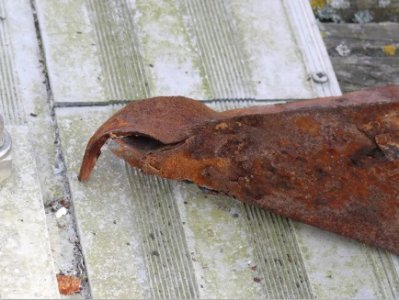
If interested in Spade failures, this is a Spade tip, the shaft was straight and not deformed.
Personal photo, not related to that site.

Personally, I have difficulties in seeing the interest in discussions about broken anchors (apart from intellectual curiosity), everything mechanical can be deformed or broken by a sufficiently high load, that includes every anchor.
Should I buy a boat with a Spade already onboard I would definitely keep it, pictures or not pictures.
spade.jpg
 
I did some rode tension work in a developing Seabreeze in Sydney. Usually its glorious - blue skies but becoming choppy if not sheltered.

I had chosen a location where our cat was only subject to wind, not chop. I did a series of tests at different scopes.

One of the series I recorded a tension of 650kg developed from a 35 knot gust. It was frightening and I chickened out. I was afraid something would fail (it did - my courage). I likened it to driving your yacht into a brick wall.

Add lateral loads, a good, well set anchor, no snubber and you could bend a shank.

It was all part of my work on snubbers.

I've seen bent anchors - but unless I know the background I tend to treat them as a one off. If I were to see a series - I'd want to report them. Today most bent anchors are exceptional. We are lucky - makers of anchors have learnt lessons, from each other - and we can thank Peter Smith for much of the education.

I forgot

I did another series of tests where I set 15kg anchors to a tension of 500kg, straight line pull. I then took a 4x4 and snatch loaded the anchors. I bent the shank of Spade, SARCA, Fortress (FX23) and totally destroyed an aluminium Excel. The exception was a steel Excel Bis800 shank, as good as new. Fortress sent me a new shank, Anchor Right completely re-designed their aluminium Excel and gave me a new one - which we then used for over 10 years.

Jonathan
Did you really feel frightened by a 35 knot gust?
 
That's just one example. He's American. They can't see any middle ground, this or that, all or nothing. Cultural thing

A genuine question by a non-anglosaxon.
I am sure their site is interesting, but reading sentences expressed therein in a very pompous way like "We have withdrawn our recommendation for" this or that, or all this self-incensing relevance attributed to every phrase they write... In cultural places not having this American approach it simply makes everyone laugh out loud.
Have Americans discovered doubt yet?
Do they know there are hundreds of people sailing their own way, with their own anchors or whatever equipment "not being recommended" (or not waiting for any recommendation) and having a perfectly fine time? (I include hundred of sailors in the Arctic, Antarctic, possibly Venusarctic Marsarctic et al).
Anyway, the success of their site means there is a market for everything :)
 
Last edited:
Did you really feel frightened by a 35 knot gust?
No, I feel frightened with a 650kg snatch load.

It was 8mm chain, no snubber but a Dyneema bridle. 3:1 scope, I was intentionally looking for worst case scenario - and found it.

In real life you would not anchor with a 3:1 scope under the conditions. But people do anchor for benign conditions, others come and anchor nearby until you become boxed in (and/or are not on the boat) - a thunderstorm comes through and you cannot lengthen the rode, there is nowhere to run to.

This is what happened to a couple in a cat in the Caribbean, (sailed from France and later I had contact with them when they arrived NZ) - they were on the beach, a thunderstorm came through, their anchor shank bent (it was one of the infamous bendy shank batch - which is why I know about it). It takes a decent snatch load to bend even one of the bendy shank anchors.

You can anchor in places in the Scottish islands in perfect safety until the winds pick up and suddenly williwaws developed as the wind is funnelled and focussed down valleys - commonly described as 'bullets' - first one valley then another - your yacht yaws with each bullet. You soon learn it was the wrong safe haven - but that does not help you 'at the time'.

In the article to which I often provide links of a sudden storm in the Med their Witchard hook for their snubber bent - its a yacht, bad things, unexpectedly, happen

In real life I would never anchor without a snubber/bridle - but I see plenty who do anchor without a snubber or totally inadequate bridle. Our 'hook' a bridle plate is either made from Bis80 or Duplex stainless (we have both). The Witchard hook, I suspect, is 304 or 316 stainless and normally fails because the retaining pin bends and you cannot realise the chain.

If someone anchors 'too' close behind us - we don't winge - we move, its easier. We prefer to be anchored in as close to perfect isolation as possible. If people do not realise they are anchor too close - then you are not going to convince them of their error and they simply get bad tempered. We once had someone close and he asked 'was he too close' my answer was simple 'if you are close enough we can have a conversation without shouting - you are too close'. We still moved - its easier for us than for someone that insufficiently knowledgeable.


The load cell had been tested for accuracy by Robertsons - who are a NATA approved testing facility. Robertsons did most of my chain and shackle testing and I simply included the load cell as part of the financial deal that I arranged with them. I confess it has not been tested recently - but then I have not used it recently.

Jonathan
 
Anybody going let on what the failure was? Being a Spade user for the last 20 years, I have an interest
You have bent over backwards to answer my questions with fulsome answers and extraordinary detail.

This has nothing to with MC or the investigation he and others made. I'll summarise my understanding of the issues discussed by MC, aka John Harries, in another post. So I'm not answering your post yet, I'll do so later.

I post this as it can be a comment made of Spade. I have never actually read of an example of this failure - its, maybe, all in the mind. I would not be happy to be corrected, I think Spade a great design (and it must be great - copied for the design of Rocna, Vulcan and Ultra).

An issue with Spade anchors, especially their shanks, is the internal condition of the hollow shank. The shank will have been submerged in the Zinc bath during the galvanising process and has not been subject to any abrasion. It may have been subject to use in anaerobic muds, muds that smell, and the organisms living in these muds exude sulphur compounds which are acidic. This a is a real problem in galvanised fittings in old dockyards and some water treatment plants - its real as the acidic compounds dissolve the gal. The only answer is use a hose pipe to regularly clean the inside of the shank. Spade anchors do not have a great reputation for the quality of the galvanising added to which you might add: galvanising is not always perfect.

You could stick a probe - straightened wire coat hanger and stuff it into the shank to ream the inside and then see what sort of detritus you pull out.

If there is severe internal corrosion you would have seen it eating through the shank and discolouring the exterior gal. You would have mentioned this, you seem to have an attention for detail,

My guess is that as you have never mentioned anything untoward for your anchor, in terms of galvanising (though might have had it treated once in the 20 years of use) - your anchor is fine. I will not say you are lucky - you have a decent anchor, which is what you paid for.

I have heard of rusty Spade anchors, there are regular comments here on YBW and I actually had one re-galvanised on behalf of a couple making a slow circumnavigation. Interestingly - despite the above, no-one has specifically condemned their shank.


Despite the bendy shank saga the numbers of anchors that were reported as bent was but a fraction of the hundreds made. Though the shanks were compromised few people actually bent the shanks and some of the bends were not catastrophic, a few degrees out of line. You need exceptional circumstances to bend even an anchor not made to specification - you would be one of the unlucky few. To bend a reputable anchor would need even more exceptional circumstances and the reality is we read of few bent anchors.

Spade anchors were introduced in the early 1990s. They have proven popular with French sailors. Galvanising has been an issue but can be resolved - if you set you mind to saving the anchor. Leave it, of course, and it corrodes beyond redemption. The anchor has survived, other than galvanising, has proved to be outstandingly successful. If there were major issues they would have been addressed or the design would have died.

Jonathan
 
The load cell had been tested for accuracy by Robertsons - who are a NATA approved testing facility.
Load cells are never accurate enough for commercial use. That's why calibration is important. They should have supplied you with a calibration sheet similar in concept to a deviation sheet for a compass. The cell might over read on some loads but under read on others, company I used had accurate test weights to provide the load.
Normally it's a laminated spreadsheet tucked in behind the foam in the bottom of the plastic case. Usually loads in the UK & middle east are in Kgf cos that's what people use day to day on site or Kn as well, no experience elsewhere so might be different. 6 monthly calibration is required for ISO9002 companies, might drift a little bit but usually recalibration data doesn't drift too much from previous calibrations. Used to be part of the day job.
Should be a menu option for peak dynamic load reading, from memory most sample around 10Hz though the display will be slower. Wifi is the norm now and has been for some time. Sounds strange that a specialist testing testing company would tell you "yeah, that's fine" though maybe for amateur non critical use they would let one slip under the radar.
If you were using an ancient dial cell then might well have been pretty accurate or might have been well out - you don't know, never used one but hard to see how it could be temperature compensated. Robertsons should have mentioned this as well. Commercial units do this automatically.

Every day a school day... 😉😉🙂
 
No, I feel frightened with a 650kg snatch load.

It was 8mm chain, no snubber but a Dyneema bridle. 3:1 scope, I was intentionally looking for worst case scenario - and found it.

In real life you would not anchor with a 3:1 scope under the conditions. But people do anchor for benign conditions, others come and anchor nearby until you become boxed in (and/or are not on the boat) - a thunderstorm comes through and you cannot lengthen the rode, there is nowhere to run to.

This is what happened to a couple in a cat in the Caribbean, (sailed from France and later I had contact with them when they arrived NZ) - they were on the beach, a thunderstorm came through, their anchor shank bent (it was one of the infamous bendy shank batch - which is why I know about it). It takes a decent snatch load to bend even one of the bendy shank anchors.

You can anchor in places in the Scottish islands in perfect safety until the winds pick up and suddenly williwaws developed as the wind is funnelled and focussed down valleys - commonly described as 'bullets' - first one valley then another - your yacht yaws with each bullet. You soon learn it was the wrong safe haven - but that does not help you 'at the time'.

In the article to which I often provide links of a sudden storm in the Med their Witchard hook for their snubber bent - its a yacht, bad things, unexpectedly, happen

In real life I would never anchor without a snubber/bridle - but I see plenty who do anchor without a snubber or totally inadequate bridle. Our 'hook' a bridle plate is either made from Bis80 or Duplex stainless (we have both). The Witchard hook, I suspect, is 304 or 316 stainless and normally fails because the retaining pin bends and you cannot realise the chain.

If someone anchors 'too' close behind us - we don't winge - we move, its easier. We prefer to be anchored in as close to perfect isolation as possible. If people do not realise they are anchor too close - then you are not going to convince them of their error and they simply get bad tempered. We once had someone close and he asked 'was he too close' my answer was simple 'if you are close enough we can have a conversation without shouting - you are too close'. We still moved - its easier for us than for someone that insufficiently knowledgeable.


The load cell had been tested for accuracy by Robertsons - who are a NATA approved testing facility. Robertsons did most of my chain and shackle testing and I simply included the load cell as part of the financial deal that I arranged with them. I confess it has not been tested recently - but then I have not used it recently.

Jonathan
I have no idea what maximum load I have had on my anchor/boat. With a relatively heavy ketch, and relatively heavy anchor chain, we simply do not do "snatch loads".
I can well imagine that a lightweight, shallow draft, high windage boat will skitter about in every squall, and therefore has to be treated and equipped differently.
 
A genuine question by a non-anglosaxon.
I am sure their site is interesting, but reading sentences expressed therein in a very pompous way like "We have withdrawn our recommendation for" this or that, or all this self-incensing relevance attributed to every phrase they write... In cultural places not having this American approach it simply makes everyone laugh out loud.
Have Americans discovered doubt yet?
Do they know there are hundreds of people sailing their own way, with their own anchors or whatever equipment "not being recommended" (or not waiting for any recommendation) and having a perfectly fine time? (I include hundred of sailors in the Arctic, Antarctic, possibly Venusarctic Marsarctic et al).
Anyway, the success of their site means there is a market for everything :)
I'm Anglosaxon and find quite a few Americans (USA type) black and white with views. They either really like something or don't. There doesn't seem to be a 'grey' area view. I could say that my anchor, Rocna, is the best and you shouldn't use any other, but for years I anchored quite happily with a Danforth 'copy' and I know that others use a variety of anchors with no problems. Luckily where I sail and anchor there are normally plenty of safe places to go if the weather turns bad. Shallow draft also greatly helps.
The one thing I do know is that the Rocna is the best anchor that I have had and has done me well for the last 5 or 6 years.
 
I have no idea what maximum load I have had on my anchor/boat. With a relatively heavy ketch, and relatively heavy anchor chain, we simply do not do "snatch loads".
I can well imagine that a lightweight, shallow draft, high windage boat will skitter about in every squall, and therefore has to be treated and equipped differently.
We have had severe snatch loads on our 18/19t ketch at anchor that have been dealt with by the snubber, usually.
These happen in shallow water where we have, say a metre of water under the keel. I suspect you never experience this, simply because you anchor in tidal,waters, therefore you need to allow way more water under the keel than us.
A few years ago, whilst anchored in Jolly harbour, Antigua, with 0,5m under the keel ( most of the anchorage is very shallow unless you anchor way out), we experienced severe snatching. Enough to snap our aged snubber. Strong gusts and minimal vertical chain will cause snatching even on heavy boats.
We normally anchor in say 5 to 7m of water with a snubber. Snatching is not an issue then in most circumstances
 
Anybody going let on what the failure was? Being a Spade user for the last 20 years, I have an interest

It turns out it is, or was, an isolated incident.

The article and debate it engendered was on a Spade 'failure'. The yacht was a cat and failure occurred under veering and 30 knot winds, 30 knot winds could mean gust of 45 knots. There was no suggestion the anchor was caught under a rock, it seemed to be a sand seabed. As I mention, previous posts, if you get snatch loads then the anchor simply has insufficient time to swivel to the new direction. If the wind veers through 90 degrees over a long period of time an anchor does have time to slowly move as the wind direction changes - but a veering yacht, the changes are too quick. In this specific case there was veering - so the cat would have cycled from one side to the other - constantly stressing the shank. Spade has a well designed fluke - tension the fluke - it simply dives more deeply. Tension the fluke in a snatch load, the fluke will remain immobile - and something has to give.

The shank was torn apart, a weld down one seam was opened up. No indication the shank was compromised by corrosion.

I'm not a welder but was under the belief welds should be stronger than the base metal - seems like a poor weld. Spade's manufacturing base is N Africa - I suspect they don't have sophisticated weld testing equipment and random testing to destruction would be expensive - and miss the faults.

My comment: To enjoy snatch loads - the bridle being used was inadequate. With our bridle even with an inadequate scope you can 'feel' the bridle managing the snatches - its like reversing into balloon or giant sponge. There is no shock load. Remove the bridle its like reversing into a brick wall. There is nothing clever about snubbers - they simply need to stretch. Most cats I see have overly beefy bridles, 20mm is not unusual - based on a fibre with inadequate elasticity and commonly too short. Bridles seem to be supplied to reduce yawing - not to absorb snatch loads. Most mono hulls simply use a short inelastic strop. Both 'options' take the load off the windlass - so its not all bad news. If you have a 10m snubber (or pair of snubbers) you should be looking at a minimum of 1m stretch at around 35/40 knots.

Geem - in terms of Spade - after 20 years you have tested your ground tackle - I don't think there is anything for you to worry about...... Except - the life of snubbers is a function of the number of stretch cycles and their severity. Snubbers have a finite life - have spares handy - and set up so that it is easy to replace a failed snubber ( we have broken 2). If you have not broken a snubber you are either living a charmed life (which is what I hope for you, both) or your snubber is too beefy. On Josepheline we could extend our 10m snubbers, 2 to make a bridle, to almost 30m and under normal condition, as 10m of our snubber was down the deck, your chain hook, bridle plate, was almost within arms reach from the bow - so easy to replace.

Jonathan

Geem, our posts crossed - I see you have had a snubber failure, you still lead a charmed life - just accepting the failure of snubbers as part of the lifestyle.
 
AIUI he's Canadian brought up in Bermuda
Close enough 😂
Or maybe we're being unfair & he is extremely clever in formatting the content to be popular in the large black and white USA market 🤔😁

There's a favourite quote by Bertrand Russell about people who are cock sure about everything and those that are full of doubt..
 
On AAC aka Morgans Cloud, aka John Harries

Close enough 😂
Or maybe we're being unfair & he is extremely clever in formatting the content to be popular in the large black and white USA market 🤔😁

There's a favourite quote by Bertrand Russell about people who are cock sure about everything and those that are full of doubt..

The more I know the more I realise I have more to learn.


Morgan's Cloud has a decent subscriber base and they try to encourage others to subscribe. There is a danger in the Modus Operandi which is evident in other similar income streams.

You build a reputation, you (rightly) decide to monetise the skills and knowledge you have developed.

You now have a customer base paying a subscription who expect a constant stream of new insights.

You can see the danger - seen in sailing magazines. Every X years they have an article on using springs to moor, or on how to trim a headsail - there are a limited number of innovations to offer a fresh look at age old problems. Bendy shanks offered a whole unexpected and sensational series of revelations. Video opened a whole new way to look at a variety of problems. Dyneema offered soft shackles. Lithium and other new batteries are a god send - suddenly a completely new river of knowledge to tap into. Video is now the new normal, Lithium and maybe a string of other battery technologies is refreshingly, almost, unknown and offers those with a subscription service a new lease on life.

I'm not knocking it. It works.

I admit I don't have the imagination to conjure up new ways to package old problems.

Jonathan
 
Something like the more you know, the less you are certain
not quite, he was a little more forceful 😂

Though very relevant to social media, those that shout loudest & longest with black & white generalisations really aren't the ones you should pay much attention to..
But what do I know. -😁

quote-the-trouble-with-the-world-is-that-the-stupid-are-cocksure-and-the-intelligent-are-full-bertrand-russell-25-48-98.jpg
 
Something like the more you know, the less you are certain
Dunning-Kruger syndrome in reverse. I don't know of a Bertrand Russell quote, but WB Yeats gave us:

"The best lack all conviction, while the worst
Are full of hideous certainty
".

An earlier English philosopher, John Locke's "Essay Concerning Human Understanding", published in 1689 includes this gem for all online forums:

"It is worth while to search out the bounds between opinion and knowledge, and examine by what measures, in things whereof of we have no certain knowledge, we ought to regulate our assent and moderate our persuasion".

Very wise words indeed. Published in 1689 after the Glorious Revolution but probably written when he was a political refugee in Holland.
 
You now have a customer base paying a subscription who expect a constant stream of new insights.
There's a big problem with online content proclaiming to be "the way it is". You are now under a lot of pressure to kick out new content each and every week instead of really digging deep & looking into patterns in the universe at your own pace. Which again on morganscloud was why the comments could be very interesting, tap into a massive pool of experience & opinions to agree with or not. Every day's a school day.
2 mantras we should should repeat constantly IMHO. Memento Mori ('remember you must die') & "Yeah, but I might be wrong, happens a lot" 😎
Might be wrong though....
 
Top
