
Maximum load on mooring tackle

eddystone

Well-Known Member
Joined
18 Aug 2013
Messages
1,936
Location
North West Devon
Visit site
Because I need to replace a shackle (corroded split pin can’t be removed) I was wondering about the difference between load rating and “breaking strain” (probably wrong term). Some information on another website refers to American Boat and Yacht Council tables which for my boat (9.6m long, 3.27m beam) would be about 3600lb in 60knot wind plus maybe 10% if assisted by 5 knots tide ( which would be a bit much even on the Tamar). Converted to metric equals about 1.8 tons.
Therefore I deduce a 3 ton load rated shackle would have an easy life?
 
MBL is usually 6x WLL so your 3 ton shackle would break at 18 tons. I suspect your cleat would pull out long before that.
What type of mooring is it? A concrete block will have no give if the chain comes up tight whereas a ground chain will lift off the seabed and reduce the shock loading.
The shackle needs to be a bit stronger than the rest of the mooring system. There is not much point in going larger if there is a weak link elsewhere in the system.
A 3 ton 19mm tested shackle sounds about right compared to other similar moorings.
 
With mooring tackle just fit the biggest you can fit into chain etc. Actual strength becomes unimportant compared to thickness of metal to wear away with time. 19mm sounds good and shoul;d last for a few years. 25mm would be even better even if it is a non tested cheap shackle. ol'will
 
Shackles have a designated min breaking load. Shackle makers have varying safety factors from 4:1 to 6:1 so a shackle with a WLL of 1t might have a minimum breaking load of between 4t and 6t. If you look at shackle makers websites they define their safety factors. They do not tell you how they arrive at their safety factors. Most reputable shackle makers, Van Beest, Peerless, Crosby, Campbell test their shackles and when tested independently their shackles meet the minimum strength defined. Some shackles have no makers name and simply say, for example China, and some of these shackles are excellent, some are not - you do not know which you have. Many imported of shackles, say from China, have their shackles 'own branded' - one hopes they have them tested. In my experience - hope springs eternal.

However if your shackle is side loaded, quite possible, then a side loading of 90 degrees will reduce the strength and WLL by 50%. Suddenly that WLL 1t becomes 500kg. Most reputable shackle makers will have this information on their website. I have tested shackles side loaded - the 50% strength reduction is correct. Shackles are normally tests in a straight line and the clevis pin shears at the thread. If you side load - the thread is still the weak link and the clevis pin can simply pull out.

Looking at 3/8th" shackles most have a WLL of 1t and a MBS of 5t or 6t. These are designated as Grade A shackles, under a US testing regime. Some shackle makers make a Grade B shackle and for a 3/8th" shackle the WLL is 2 with a MBS of 10t to 12t.

Van Beest, Crosby, Peerless and Campbell all make both Grade A and B shackles though Van Beests Grade B range is only for larger shackles. Peerless make the best range from small to large in Grade B quality - but Peerless and Campbell shackles are only available, easily, in the US.

Much mooring tackle fails not so much because it was insufficiently strong but because it abrades or corrodes and abrades. There is no information that strength correlates with abrasion resistance though a stronger steel is harder and more abrasion resistant. Abrasion resistance is rather function of the amount of steel.

For an anchor shackle there will be minimum abrasion - go for strength. For a mooring, do not ignore strength, but go for size - it will be more abrasion resistant. Mooring shackles need not be galvanised - the galvanising will abrade quickly (no quicker than the underlying steel but a galvanised coating is only 70 microns thick - so its not thick, but thin.

So....

Look at the potential loads, based on the size of your yacht. Choose a supplier whose shackles meet that load - and then buy the biggest one that fits the rest of the mooring tackle, preferably much bigger than the load figures determine. The sweep chain will probably determine what size shackle you will use - and the sweep chain will abrade with the same rapidity as the shackle attached to it.

Our sweep chains and shackles might last 3 years - but are serviced annually.

In Europe I'd recommend you look at Van Beests Green Pin shackles and in America, Crosby, Peerless and/or Campbell. I'd ignore any other source - unless you cannot access any of these - and if this latter is the case, post - and I'll make suggestions, with caveats.

Sorry to be so long winded - but I thought you merited the background.

I'm a bit time short -I'll try to post some images later.

Jonathan
 
Because I need to replace a shackle (corroded split pin can’t be removed) I was wondering about the difference between load rating and “breaking strain” (probably wrong term). Some information on another website refers to American Boat and Yacht Council tables which for my boat (9.6m long, 3.27m beam) would be about 3600lb in 60knot wind plus maybe 10% if assisted by 5 knots tide ( which would be a bit much even on the Tamar). Converted to metric equals about 1.8 tons.
Therefore I deduce a 3 ton load rated shackle would have an easy life?

The ABYC tables are NOT actual loads, they are the recommended WLL for the circumstances. The safety factors are in there.

And as others have stated, they don't fail because they are weak, they fail for other reasons. Regular inspection and meticulous installation are required.
 
And as others have stated, they don't fail because they are weak, they fail for other reasons. Regular inspection and meticulous installation are required.

As thinwater says moorings fail for other reasons than being understrength.

This is, or was, a mooring in our mooring field. The hose pipe is part of a splice of 25mm rope, the riser. The riser is attached by a shackle to the sweep chain. The shackles and sweep chain are grossly oversized in terms of strength.

The owner had not serviced the mooring and the mooring failed as a result of abrasion, and probably some corrosion (but the corrosion is minor and constantly abraded away).

In this case its the sweep chain that has failed - but if the shackle had been a bit smaller the shackle would have failed, you can see the effect of the abrasion.

IMGP1634.jpeg

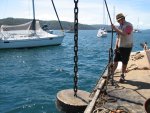
Our moorings seem different to those in the UK. We have a big heavy chain attached to the concrete block and then a smaller sweep chain and it is the sweep chain that has failed in the picture above. The riser is rope, being held by the man in the lower picture. Daydream Believer might give chapter and verse on what he does. (I've never understood why, when our moorings came from the same historic background, in the UK, why they are now so different). Our seabeds, in Sydney, are on a silica sand seabed (those hills in the background are all sandstone). Silica sand is very abrasive.

40wandeen yachts mooring screen 027.JPG

The big beefy chain is obviously heavy and one might think expensive. It is redundant chain from the mining industry (we have plenty of mining) and is simply being recycled. In our mooring, which is now over 20 years old, the heavy chain has never been replaced. Similarly the rings in the concrete block they enjoy no corrosion (so corrosion is a minor failure mechanism) and the ring in the concrete (the block and the rope riser), seem to last, almost, for ever.

For us the failure mechanism is abrasion not strength. For other moorings failure might be corrosion, especially if its a drying mooring. But both corrosion and abrasion need volume of metal - not strength.

There is a direct correlation between metal hardness and abrasion. There is also a direct correlation between hardness and strength for a given alloy. Harder steels tend to be stronger. 316 Stainless is not very hard so though it will not corrode it might abrade, quickly and certainly more quickly than Duplex. I'm not aware of chain nor shackles that have a focus on abrasion though there is a focus on strength (which will be more abrasion resistant - but this is coincidental).

Jonathan
 
Short answer :

MBS : Minimum Breaking Strain ... as it says - point at which shackle fails.
SWL : Safe Working Load .... as it says - the recc'd max load manufacturer states as Safe to use the item. Sometimes quoted as NWL or WLL. Usually as 1/5th of MBS.

Safe Working Load Limits- Terminology
SWL, NWL, MBS — all of the acronyms can get very confusing. Don’t fret – we’re here to clear things up when it comes to safe working load limits and the terms associated with it.

Safe Working Load (SWL) sometimes stated as the Normal Working Load (NWL) is the mass or force that a piece of lifting equipment, lifting device or accessory can safely utilize to lift, suspend, or lower a mass without fear of breaking. Usually marked on the equipment by the manufacturer and is often 1/5 of the Minimum Breaking Strength (MBS) although other fractions may be used such as 1/4, 1/6 and 1/10.[1][2][3]

Other Terms Used in the Industry
Other synonyms include Working Load Limit (WLL), which is the maximum working load designed by the manufacturer. This load represents a force that is much less than that required to make the lifting equipment fail or yield, also known as the Minimum Breaking Load (MBL). SWL or WLL are calculated by dividing MBL by a safety factor (SF). An example of this would be a chain that has a MBL of 2000 lbf (8.89 kN) would have a SWL or WLL of 400 lbf (1.78 kN) if a safety factor of 5 (5:1, 5 to 1, or 1/5) is used.
As such:WLL = MBL / SF

Simple really ....

OK - let me throw this little gem in the mix :

2 ton boat on swinging mooring. 1/2 ton concrete block buried as sinker and then recc'd ground to riser chain. Ground chain secured by BOW shackle to U on sinker. Bow shackle is sized for the chain..... and not obtained at local B&Q !!
All gear regularly checked when dried out at low tide.
Gale conditions passed through while boat on mooring .... next day go to shoreline to check on boat ... she's not on mooring. She's now hard up on Farlington Marsh - having broke free.
At low tide - I walk out to survey the damage .... boat and mooring post are fine ... all mooring chain is laid out in a line from the bow showing boat has dragged it along.
At sinker - the remains of the Bow shackle. Judging by the position and break - the shackle must have rotated so that all the force was applied to the side instead of at apex of the Bow. The pin had sheered, the shackle actually bent wider open.

I kept that shackle in my Land Rover for years - to show people just what could happen out there. No-one believed until placing it in their hands. I will NEVER use a Bow Shackle again on any mooring duty.

Just thought I'd mention ...
 
There's a strange anomaly in that picture of Neeves's mooring. The shackle between the mooring block and the chain, is smaller than the chain. Is that deliberately "the weakest link"?
Short answer to the OP, avoiding all unnecessary words, just go big and brutal.
 
The required size of the shackle will largely depend on the chain/other “jewellery” it’s connected to. Side loading of shackles is, as others have stated a threat but that is a function of poor system design rather than poor shackles.
 
There's a strange anomaly in that picture of Neeves's mooring. The shackle between the mooring block and the chain, is smaller than the chain. Is that deliberately "the weakest link"?
Short answer to the OP, avoiding all unnecessary words, just go big and brutal.
It looks like that shackle is the largest that would go through the hoop on the concrete sinker.
 
Its the chain that failed, not the shackle.

The chain provides snubbing, so needs to have weight. The shackles simply needs to last approximately as long as the chain.

The moorings are meant to be serviced every 12 months. The moorings are leased from New South Wales government. After a few years of failures the edict was issued, no mooring service invoice - termination of lease. All moorings are now serviced every 12 months. As long as the kit lasts 12 months plus a suitable safety margin - maybe another year or so - go big and brutal.
Short answer :

MBS : Minimum Breaking Strain ... as it says - point at which shackle fails.
SWL : Safe Working Load .... as it says - the recc'd max load manufacturer states as Safe to use the item. Sometimes quoted as NWL or WLL. Usually as 1/5th of MBS.


Simple really ....

OK - let me throw this little gem in the mix :

2 ton boat on swinging mooring. 1/2 ton concrete block buried as sinker and then recc'd ground to riser chain. Ground chain secured by BOW shackle to U on sinker. Bow shackle is sized for the chain..... and not obtained at local B&Q !!
All gear regularly checked when dried out at low tide.
Gale conditions passed through while boat on mooring .... next day go to shoreline to check on boat ... she's not on mooring. She's now hard up on Farlington Marsh - having broke free.
At low tide - I walk out to survey the damage .... boat and mooring post are fine ... all mooring chain is laid out in a line from the bow showing boat has dragged it along.
At sinker - the remains of the Bow shackle. Judging by the position and break - the shackle must have rotated so that all the force was applied to the side instead of at apex of the Bow. The pin had sheered, the shackle actually bent wider open.

I kept that shackle in my Land Rover for years - to show people just what could happen out there. No-one believed until placing it in their hands. I will NEVER use a Bow Shackle again on any mooring duty.

Just thought I'd mention ...


As I mentioned, side loading of shackles, whether 'D' or bow reduces their strength, all shackle makers of any reputation mention this in their small print. Ignore at your
peril. If you don't read the small print and ignore......

As I said that WLL of 1t reduces to 500kg if side loaded - 'D' shackle or Bow. I've tested it - its about right.

Whether it will happen on your mooring - it depends how the mooring is designed. I don't know how your mooring is designed - I simply point out - if the shackle can be side loaded its WLL will be reduced by 50%.

Side loading is common on, bow, shackles in an anchor shank


On rated shackles the WLL and size is embossed onto the body of the shackle - the safety factor varies from 4:1 to 6:1 - check the manufacturer (also embossed on the shackle) web site for the safety factor. Other marks on the shackle body might be batch numbers. American shackles are also embossed 'made in USA' or just 'USA .

If the shackle has no manufacturer's name - don't use it for your vessel. It is to secure your dog, not your vessel. If it is embossed 'China' it might be excellent it might not even be good enough to secure your dog. I have found 2 good Chinese manufacturers - but they don't emboss the makers name. There is a good, excellent, Taiwanese manufacturer - Yoke - but like the Americans I don't know if they distribute in Europe. I have tested their shackles and other lifting components - excellent product.

Jonathan
 
Last edited:
Short answer :

MBS : Minimum Breaking Strain ... as it says - point at which shackle fails.
SWL : Safe Working Load .... as it says - the recc'd max load manufacturer states as Safe to use the item. Sometimes quoted as NWL or WLL. Usually as 1/5th of MBS.

Thanks thats probably what I was looking for
 
Because I need to replace a shackle (corroded split pin can’t be removed) I was wondering about the difference between load rating and “breaking strain” (probably wrong term). Some information on another website refers to American Boat and Yacht Council tables which for my boat (9.6m long, 3.27m beam) would be about 3600lb in 60knot wind plus maybe 10% if assisted by 5 knots tide ( which would be a bit much even on the Tamar). Converted to metric equals about 1.8 tons.
Therefore I deduce a 3 ton load rated shackle would have an easy life?
There is often some confusion with shackle markings.
A lifting shackle should be marked with "Working Load Limit" (WLL). This is the maximum designed load as stated by the manufacturer, assuming an in-line , or balanced pull. WLL may never be exceeded.
Safe Working Load (SWL) is slightly different. Perhaps easiest to explain with an example. If you had a winch marked with a 3 t WLL but the wire rope attached to it only had a WLL of 2 t then the SWL of the assembled equipment would be 2 t and should be clearly marked as such. In effect the installer decides on the SWL. In a nuclear plant they might decide everything must have a 10:1 safety factor and de-rate everything then display it clearly as their SWL. Often the SWL and the WLL are the same. The SWL can never exceed the WLL, but may often be less.
Safety Factors on steel lifting shackles should exceed 5:1. Crosby and Van Beest are 6:1. Hence a 3 t WLL Crosby or Van Beest shackle would indeed break at 18 t.

You describe your shackle as needing to be replaced due to a corroded split pit. Some shackles have their clevis pins solely secured by a split pin. These shackles must never be subjected to a side load and therefore are not really suited for mooring purposes. The best shackles are the "Bolt Type" with a nut and a split pin. These shackles will accept some side loading (at a reduced load) but the general rule is to ensure everything is a straight line pull (or in the case of a bow shackle, a balanced pull)

BTW Regards your metric conversion, it should really be 1.8 tonne (lower case t). 1.8 ton (Upper case T) is a slightly different imperial weight. Luckily the difference isn't great or things would be dropping off cranes like confetti. Sorry to be so pedantic!

And to answer your question, I would personally buy a 4.75 t Crosby G2150 "D" Shackle or Van Beest equivalent. For the few extra pounds it should last a fair bit longer. As Neeves says best to size things up on mooring gear.
 
Thanks thats probably what I was looking for

Please remember that all figures are based on the item being used in its correct orientation and purpose. A good example of where it occurred differently - was in the Bow Shackle incident my earlier boat suffered.

Generally D shackles are best for single point fixing as they will tend to turn and orientate correctly. Bow shackles are generally intended for lifting jobs where multiple chains to hooks are needed to connect - ie cranes.
 
There's a strange anomaly in that picture of Neeves's mooring. The shackle between the mooring block and the chain, is smaller than the chain. Is that deliberately "the weakest link"?
Short answer to the OP, avoiding all unnecessary words, just go big and brutal.
I suspect the chain in that picture is oversize in order to allow for mechanical wear and so prolong its life and reduce maintenance costs.
 
Because I need to replace a shackle (corroded split pin can’t be removed) I was wondering about the difference between load rating and “breaking strain” (probably wrong term). Some information on another website refers to American Boat and Yacht Council tables which for my boat (9.6m long, 3.27m beam) would be about 3600lb in 60knot wind plus maybe 10% if assisted by 5 knots tide ( which would be a bit much even on the Tamar). Converted to metric equals about 1.8 tons.
Therefore I deduce a 3 ton load rated shackle would have an easy life?
I think your question has been answered. To complicate things further but not without reason, you have to be careful when choosing shackles. Without seeing a picture of what you are using the shackle for, it’s difficult to know what advice to give. But WLL is not the only consideration. The size and shape matters when it comes to what you are connecting to and what the potential load paths are.
As others have suggested, getting it wrong can lead to failure at loads much less that WLL.
 
My experience in Poole Harbour maintaing moorings at our club for the last 20 something years is that shacke pins are what fail. The tread on the pin just disappears and the pin drop out. We wire all our shacke pins with seizing wire.
If anything is going to fail it will be the shacke one side or the other of the swivel at the top of the riser.
 
Neeves refers to abrasion as wear function on shackles chains etc. I woul;d suggest that it is a function of rust with wear. The rust usually provides a protection for more rust but ifit is ground off with wear this allows more rust. wonder then about rust resistance of high tensile steel compared to black iron.
My mooring is all stainless steel. Has shown incredible long life compared to previous black iron chain and shackles. Government mooring authorities dictated and supplied a buoy with stainless steel swivel in the through rod. This caused all sorts of trouble the dissimilar metals with black iron chain/shackles causing rapid wear/rust. I was fortunate enough to get hold of some heavy stainless steel chain I think from a tumble lime kiln. This coupled together with cheap Chinese 316 ss 10mm shackles has done well. No sign of wear. (21ft boat) The mass on the bottom is an old railway wagon wheel and the ss chain loops through it. So hopefully plenty of life/ metal where dissimilar metals contact. Yes I look at it often but it is proffessionally inspected by government decree every 2 years. ol'will
 
Top