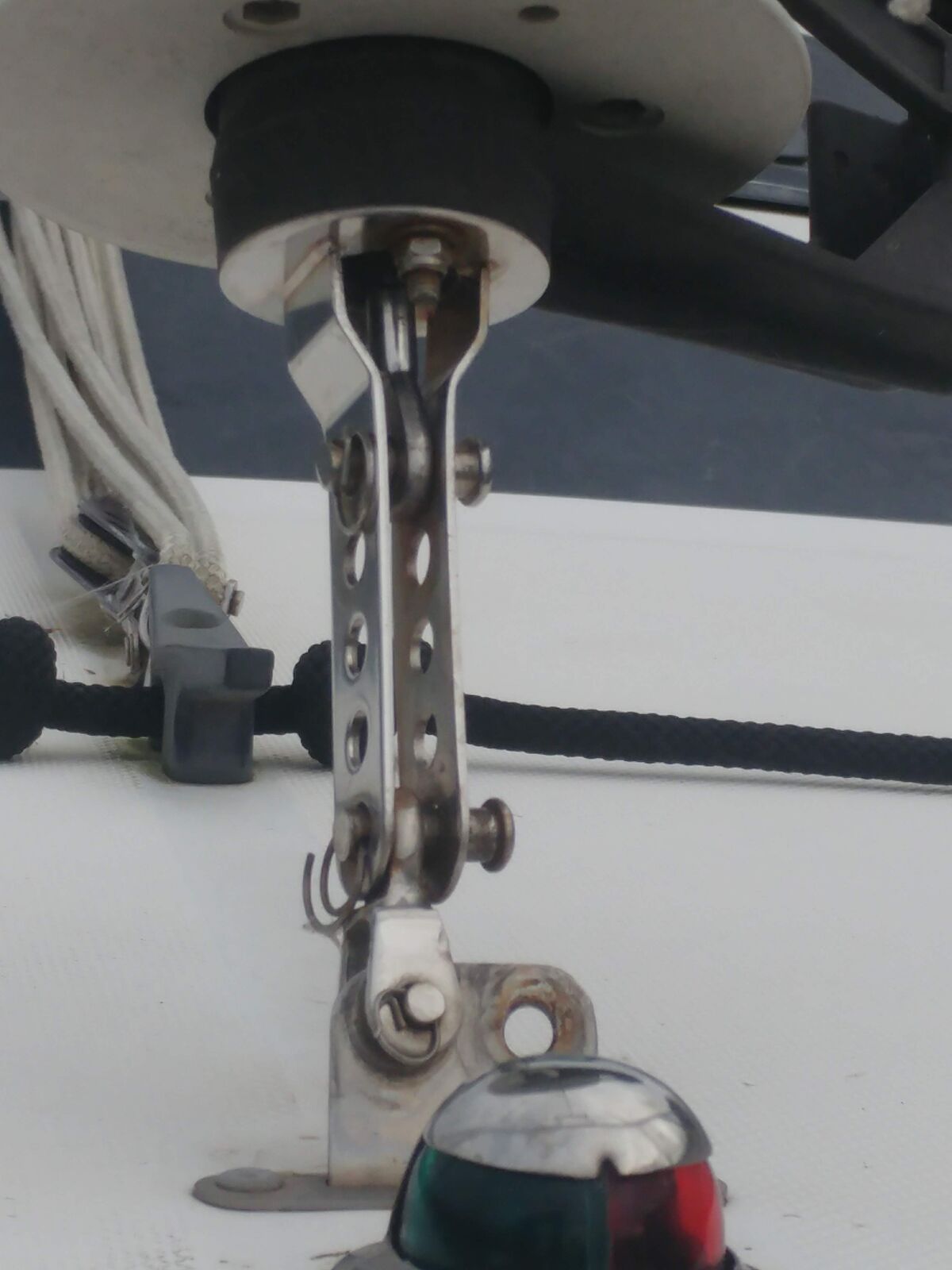
Mast Problem another candidate for the Darwin award

The saddler 25 has I believe a mast head rig. The middle of the mast is I imagine located by intermediate shrouds whose chain plates are aft of abeam the mast so in tensioning they pull the middle aft. This pull aft is usually countered by either one intermediate or baby forestay to an attachment middle of foredeck, or 2 intermediate side/forestays going to chain plates forward of abeam the mast. Now regardless of setting intermediate shroud tension to a percentage of breaking strain it is the relative tensions of the stays pulling the middle forward or back that determine the bend of the mast. So bend aft at spreaders means intermediate stays are too tight or the forward pulling stays are too loose. (it is not just the tension of the stays that determine the pull on the middle of the mast but the distance fore and aft of abeam the mast of the attachments)
So forget the tension gauge and just adjust the intermediate stays to get the mast straight or slightly middle forward bend.
In some rigs (often fractional) probably not yours, they use aft swept spreaders as a means to push middle of mast forward. This relies on the angle of the spreaders aft and the tension of the cap shrouds o provide push forward. In practice then the only way to get the mast bend forward middle is to ease the tension of the intermediate side stays (which pull it back). ol'will
 
Well ... interesting ....

My open drum older 609 Plastimo ... does not rely on the metal strips for forestay .... my forestay has a bottlescrew down to stemhead fitting and the Plastimo strips then sit either side ... a single stud passes through both bottlescrew U end and the strips. A nut either side to finish off. I prefer stud + nut each end ... as my furler and drum / strips when nuts removed - can be slid up the forestay as one when needing to adjust forestay.

Bj6sMlE.jpg


Yes - I know I need to straighten one strip - but as it carries no load .. I am in no rush .. All load is on the forestay and its bottle screw.
The only limitation I have with this - is to not have bottle screw / stay adjustment longer than side plates allow. But this partly reason that Plastimo provide different lengths side plates to suit fixed length and adjustable stays.

As to the metal strips ... they are definitely NOT weak or be described as 'meccano strips' ..... mine are standard Plastimo strips and I would say that visually - if they were put to test - would be stronger than the stay.

Someone suggested adding doubling to strengthen ... look closely and you see end is formed to specific shape to accommodate ... it would be difficult to add doubling as suggested. Its not needed anyway as those strips are more than strong enough.

My Plastimo installation manual covering : 406 .. 609 .. 709 .. 910 .. 1011 .. 1113 ... have both the 'fixed stay length' pinned to the metal plates and the bottlescrew method used on my boat. I accept that my furler is an older version - but it has the same plates and stay fittings.
 
My open drum older 609 Plastimo ... does not rely on the metal strips for forestay...

Because yours is the 11 hole version designed for use with a bottle screw and assembled as you have it.

Yes - I know I need to straighten one strip

They are both bent. You've posted a perfect example confirming what I said earlier about how these items are often old and battered. As these items get a bashing and often end up bent, and aren't replaced when rigging is replaced, and in the short version take the full load of the forestay - all go towards why I don't like the short Meccano strip arrangement. In your assembly they are only holding the furler in place, so you're fine, but I wouldn't be happy if those 40 year old multiply bent/straightened scrofulous bits of strip are all that is holding my mast up.
 
Last edited:
Because yours is the 11 hole version designed for use with a bottle screw.

Thank you for your confirmation ... which I was already aware off.

Confirms what I said earlier about how these items are often old and battered. As these items get a bashing and often end up bent, and aren't replaced when rigging is replaced, and in the short version take the full load of the forestay - all go towards why I don't like the short Meccano strip arrangement.

Please show where it takes full load of forestay ... in fact it has NO load from forestay as the forestay in OP's version as well as mine - is directly connected to stemhead fitting . The side plates only take 'weight' of furler .. nothing else.
 
In the pictures the bottom of the forestay is not assembled as to Plastimo's manual. The diagram from the manual shown in post #14 shows how it should be done. There should be 2 pins/bolts, not 1 (although the Plastimo manual diagram above does not show the lower pin/bolt). Also the toggle at the bottom of the forestay is not required according to Plastimo, but it won't do any harm. The forestay length is not changed - it can't, it has no bottlescrew. However, its effective length is changed by moving its lower point of attachment up or down the Meccano strip thus affecting mast rake. Assembled like this the full load of the forestay goes through the Meccano strips - they don't just support the furling gear. I think you are commenting on how it is assembled in the photos, not how it should be assembled.

This is how it should be assembled...

20201013_114804.jpg


As you can see here the full load of the forestay is going through the Meccano strips, and the forestay can be effectively lengthened or shortened by choosing a different hole for the upper pin.

I had this furling gear on my first boat many years ago and remember thinking it was odd at the time, but the rigger confirmed that it was correct.

Plastimo in fact have two installation methods ... 1. stay attached to stemhead either fixed or via bottlescrew ... 2. pinned to the side chainplates as you show.

One of the reasons for this is to allow existing hanked forestay users to continue using the bottlescrew to adjust forestay .. just needs usually a longer chainplate each side - which Plastimo will be happy to sell ..
 
Looking again and considering that OP's forestay and chainplate arrangement is 'fixed' .... his forestay is toggled to stemhead and not to furlers chainplate.... and that Sadler 25 is deck stepped mast on a blade system that alloows mast foot to be bolted at various positions ...

Maybe mast has been stepped too far BACK .. causing masthead to be aft of design ... so when forestay is pinned - mast head gets pulled fwd ? The baby stays will try to centre the mast mid section ... resulting in the curve.
 
Please show where it takes full load of forestay ... in fact it has NO load from forestay as the forestay in OP's version as well as mine - is directly connected to stemhead fitting . The side plates only take 'weight' of furler .. nothing else.

Yours doesn't because it's the 11 hole version and is not intended to. The OP's doesn't as shown, but you can see clearly from the markings in the OP's 2nd picture that a pin has been used in a higher hole. Plastimo intends that those strips take forestay load in the 5 hole version.
 
Yours doesn't because it's the 11 hole version and is not intended to. The OP's doesn't as shown, but you can see clearly from the markings in the OP's 2nd picture that a pin has been used in a higher hole. Plastimo intend that those strips take forestay load in the short strip version.

Fine ... why keep banging the drum ? Have I not agreed that Plastimo do use a pin to chainplate method as ONE option.

But take note - I can find no reference stating need to change chainplate depending on method used. But I can find based on length of stay ........... might sound like splitting hairs - but that's it.
 
Fine ... why keep banging the drum ? Have I not agreed that Plastimo do use a pin to chainplate method as ONE option.

But take note - I can find no reference stating need to change chainplate depending on method used. But I can find based on length of stay ........... might sound like splitting hairs - but that's it.
The instructions in these things usually assume a much greater knowledge of rigging practice than a DIYer. My profurl is very similar, in the instruction department and the plates. They weren’t required at all on my boat, thankfully. Just a very very expensive lockable pin that was mentioned in a footnote on the last page.
 
The instructions in these things usually assume a much greater knowledge of rigging practice than a DIYer. My profurl is very similar, in the instruction department and the plates. They weren’t required at all on my boat, thankfully. Just a very very expensive lockable pin that was mentioned in a footnote on the last page.

I would put it a little more than that ...

As we see at times on forums ... odd posts take what manuals say and add their interpretation or extrapolation. This can at times send others down a wrong path.
 
I would put it a little more than that ...

As we see at times on forums ... odd posts take what manuals say and add their interpretation or extrapolation. This can at times send others down a wrong path.
Well, yes. Those plates are sort of multi purpose in our installation manual. But it's far from clear. You either know, or you ask someone that does, and probably not us random strangers on the net!
 
I'm more than a lttle troubled by the omission of a toggle between the Plastimo ( and any other ) furling/forestay rigging screw and the corresponding deck fitting.

Every rigger I've listened to agrees one should be fitted/incorporated there.....
 
Little bit of side tracking ... with my furlers chainplates being close in length to what I need and not giving much allowance for greater length bottlescrew adjustment .. I do wonder at times whether I would get longer ones .. being a motor sailer - I'm not worried about setting furler slightly higher ..
 
I'm more than a lttle troubled by the omission of a toggle between the Plastimo ( and any other ) furling/forestay rigging screw and the corresponding deck fitting.

Every rigger I've listened to agrees one should be fitted/incorporated there.....
This infers that there are riggers you haven’t listened to? Our forestay has a toggle, and fwiw I agree with you, you should have one.
 
I'm more than a lttle troubled by the omission of a toggle between the Plastimo ( and any other ) furling/forestay rigging screw and the corresponding deck fitting.

Every rigger I've listened to agrees one should be fitted/incorporated there.....

I like the stay to stemhead as then any maintenance can be carried out easily as stay is not pinned to the chainplates.

I regularly lower my mast and having the bottlescrew method really is an advantage as I can lengthen the overall length of forestay when stepping mast again .. instead of fighting a fixed length. It reduces amount of backstay slack I need to make etc. All I need to do is leave locknuts at correct setting for re-adjusting bottlescrews.
 
Hi everyone, hadn’t intended to raise such a hornets nest of differing views, but thanks for all your suggestions.
I am planning to go down the route suggested by Vyv_Cox Angus Mcdoon and Zoidberg as these suggestions seem to match the rather inadequate diagrams and explanations in the Plastimo 608-1 user manual.
One little thing, sorry refuelled but the Sadler 25 (at least mine) has an unusual mast step which only allows the mast to be placed in one position, no profanity of moving fwd/ast. I have attached a very poor drawing of the mast step taken from Sadlers build instructions, there is just enough detail I think to see it.
I do agree that the Plastimo chainplates look a bit underwhelming but in fact they are only fractionally thinner steel than the toggle, as the mast is going to be lowered this winter I will look further into ‘beefing’ these chainplates up a bit.
Once agin thanks for your replies.
 

Attachments

I do agree that the Plastimo chainplates look a bit underwhelming but in fact they are only fractionally thinner steel than the toggle, as the mast is going to be lowered this winter I will look further into ‘beefing’ these chainplates up a bit.

It's not their size that worries me the most, it's that combined with their never being replaced, could be 40 years old, and may have suffered multiple bendings and re-straightenings in their long life that I don't like when they are installed such that they are taking the forestay load. I agree that they are about the same thickness and size as the toggle - but that will be replaced periodically, and is unlikely to get damaged during its life. If you walk around the small boat end of a marina you'll probably see a few scrofulous examples in various states of despair.
 
Last edited:
One little thing, sorry refuelled but the Sadler 25 (at least mine) has an unusual mast step which only allows the mast to be placed in one position, no profanity of moving fwd/ast. I have attached a very poor drawing of the mast step taken from Sadlers build instructions, there is just enough detail I think to see it.

Opened but print is too feint to read ...

No worries ... was just a thought as you have a fixed length stay etc....

Hope you get it all sorted ..

Don't worry about the 'hornets nest' - large membership forums - its par for the course.
 
In the pictures the bottom of the forestay is not assembled as to Plastimo's manual. The diagram from the manual shown in post #14 shows how it should be done. There should be 2 pins/bolts, not 1 (although the Plastimo manual diagram above does not show the lower pin/bolt). Also the toggle at the bottom of the forestay is not required according to Plastimo, but it won't do any harm. The forestay length is not changed - it can't, it has no bottlescrew. However, its effective length is changed by moving its lower point of attachment up or down the Meccano strip thus affecting mast rake. Assembled like this the full load of the forestay goes through the Meccano strips - they don't just support the furling gear. I think you are commenting on how it is assembled in the photos, not how it should be assembled.

This is how it should be assembled...

20201013_114804.jpg


As you can see here the full load of the forestay is going through the Meccano strips, and the forestay can be effectively lengthened or shortened by choosing a different hole for the upper pin.

I had this furling gear on my first boat many years ago and remember thinking it was odd at the time, but the rigger confirmed that it was correct.
Exactly. I was commenting on how it was assembled as shown by the original photos. Assembling it as shown in your photo makes sense. Each hole in the two straps makes about twice as much difference in forestay length as you would get by swapping it between the two holes in the chain plate at the bottom, which effectively provides the fine adjustment.
 
Top