Mast Ascending options : recommendation needed

+1 for the Kinleven ladder. I have an early version with aluminium treads and it feels very secure when attached to the mast track and tensioned to the deck. With the top of the mast at chest level and then with a harness around the mast it leaves both hands free to work comfortably.
 
Problem is that afloat it womble around all over the place even if you tension the foot.
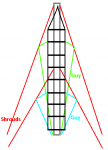
I have always used a bosun's chair and been winched up (a turn around a mast winch and two turns on the electric anchor windlass) but I have lately been thinking about making a ladder. Apart from tensioning the foot, I thought that adding a couple of pairs of guy ropes would keep the ladder stable, the top pair, attached to the ladder about 3/4 of the way up and going out around the upper Shrouds and lower pair, attached to the ladder about 1/2 of the way up and around the aft lower Shrouds, then all tensioned at the base of the mast.
Guy.png
 
I have always used a bosun's chair and been winched up (a turn around a mast winch and two turns on the electric anchor windlass) but I have lately been thinking about making a ladder. Apart from tensioning the foot, I thought that adding a couple of pairs of guy ropes would keep the ladder stable, the top pair, attached to the ladder about 3/4 of the way up and going out around the upper Shrouds and lower pair, attached to the ladder about 1/2 of the way up and around the aft lower Shrouds, then all tensioned at the base of the mast.
View attachment 88964
Would help a bit but takes more setting up. One issue I had is that poly prop sides of ladder stretched a lot so adjustment of stays and foot needed after one starts to ascend. Needs that second man or woman and the more they need to adjust the more time it takes.

However I now think mast slides might be a good idea if amended from my original thoughts. You wouldnt need many. You could can avoid my objection to their restriction by putting slide on a bridle linked to the ends of the rung rather than attaching directly to middle.

All still rather alarming if boat is afloat and heels, as climbing a diagonal rope ladder a challenge even if steady. I just wish Navigator or electric anchor winch were stronger, then I would stick to bosuns chair and backup safety :cautious: .

All useful thoughts folks. If I ever get to our boat I will experiment
 
Dear all, it has not been long until I realized it's about a time to go up the mast
:)
I looked at a few Mast Ascending options and can't decide what to get.

I have looked at

Force 4 Mast Ascending Grip Handles (Pair) | Force 4 Chandlery TOPCLIMBER® buy now | SVB
Force 4 Fibrelight Ladder | Force 4 Chandlery
Yacht Mast Ladder | Kinleven Marine

Still have not decided, can you please share your experience? something reliable but not very expansive. I liked Mast ladder MastL for climbing on a sailing yacht mast | eBay but not sure how safe it is.


thanks, Alex
All ladders are inherently unstable and poor platforms off which to work.

Being hauled up by a friend remains best, followed by ascenders on a length of climbing rope.

Pg
 
I have a 'Defee?? Mast ladder - I think that's what it is - it looks very similar to the Kinleven ladder. It's good, I share it with a friend, with my sail slides on on side and his on the other side - which reminds me, when we can visit our boat I have to replace the vhf antenna which got lost on our trip back from Holland last year.
 
I use a climbing rope, middle of which is tied separetly to two halyards and hoisted to the top of the mast.

Tension one part of the rope and use two asenders and a climbing harness, one fixed to the harness and the other to the to a foot loop.

I use a figure of 8 on the other rope. After each few feet take up the slack on the loose rope passing through the figure of 8.

When I am finished on top I transfer weight to the figure of 8. Take off one asender. And absail down, bringing the second assendor down in my other hand ready to stop a run- away.

I have done this a few times including changing the forestay... Easier if you have a helper but once you know how to absail and to use jumars it is very straight forward
 
I use a climbing rope, middle of which is tied separetly to two halyards and hoisted to the top of the mast.

Tension one part of the rope and use two asenders and a climbing harness, one fixed to the harness and the other to the to a foot loop.

I use a figure of 8 on the other rope. After each few feet take up the slack on the loose rope passing through the figure of 8.

When I am finished on top I transfer weight to the figure of 8. Take off one asender. And absail down, bringing the second assendor down in my other hand ready to stop a run- away.

I have done this a few times including changing the forestay... Easier if you have a helper but once you know how to absail and to use jumars it is very straight forward

yes but you clearly are a climber and have all the kit. It would be fairly expensive to but that lot just for mast climbing and I for one get knacked prussicing up ropes
 
A bosun’s chair to an electric winch with a helper is the most efficient. When I go up this way I rig a second safety rope and fall arrest equipment attached to a harness, so there is redundancy for every piece of equipment.

In the rare event that I go up alone I have two mountaineering semi dynamic ropes hoisted. One to climb and the other as a safety with a fall arrest device on it. For descending I use a descender and switch ropes at the top, putting the fall arrester on the climb rope. I use a Petzl rope climber with foot straps and a chest grip. I also have a spare abseil device just in case.

You need to practice and do it right every time as this is one of those things where you don’t learn from mistakes.
 
On board ship - we were not allowed to use powered winch or similar to go up a mast etc. It had to be handed by a responsible AB ./ OS.
It was only when using the 'Basket' for getting on / off the ship via derrick / crane was powered system allowed.
Things may have changed since then.
 
A bosun’s chair to an electric winch with a helper is the most efficient. When I go up this way I rig a second safety rope and fall arrest equipment attached to a harness, so there is redundancy for every piece of equipment.

In the rare event that I go up alone I have two mountaineering semi dynamic ropes hoisted. One to climb and the other as a safety with a fall arrest device on it. For descending I use a descender and switch ropes at the top, putting the fall arrester on the climb rope. I use a Petzl rope climber with foot straps and a chest grip. I also have a spare abseil device just in case.

You need to practice and do it right every time as this is one of those things where you don’t learn from mistakes.

Never, NEVER use an electric winch. The topic has been well aired here and the dire stories are abundant. Research the reasons.
 
Never, NEVER use an electric winch. The topic has been well aired here and the dire stories are abundant. Research the reasons.
I understand there is a very small risk. Probably not as great as the risk of operator error though and I have a back up. I will do it again. I think the risk is acceptable.
 
I understand there is a very small risk. Probably not as great as the risk of operator error though and I have a back up. I will do it again. I think the risk is acceptable.

I will also continue to do it that way. Most accidents I've read about are with crew getting their hand or fingers trapped in the windlass, not to the one in the chair. I control my own ascent & descent with wireless remote, wife just tails in the normal way.
 
I will also continue to do it that way. Most accidents I've read about are with crew getting their hand or fingers trapped in the windlass, not to the one in the chair. I control my own ascent & descent with wireless remote, wife just tails in the normal way.
A reversible winch. Tres poshe.
 
I understand there is a very small risk. Probably not as great as the risk of operator error though and I have a back up. I will do it again. I think the risk is acceptable.
In exhibitions we hear the gruesome tales and occasionally are presented with evidence - missing fingers.
Worst case was both wrists and helpers fingers.
It's not just the operator. Recently there have been cases of winch solenoids welding up.
 
In exhibitions we hear the gruesome tales and occasionally are presented with evidence - missing fingers.
Worst case was both wrists and helpers fingers.
It's not just the operator. Recently there have been cases of winch solenoids welding up.
I agree that it’s not just the operator. Actually I discount the risk of operator error completely as a valid reason for not using the electric winch for hoisting. We use electric winches for sailing. It’s an acceptable risk to the operator then, why not also for hoisting? Cooking is dangerous too and we do it.

With the risk of a contactor welding itself on you have usually have protection with a CB, so when the knot jams in the block at the top it should blow. If that doesn’t happen and the block shatters the knot will pull into the mast exit hole and the motor will trip it’s thermal overload switch or it will burn out. Panic over. Maybe if your rope is weak the rope will snap. You will then rely on your back up equipment. A very low risk of getting to need it or of that failing too.
 
Top