Mangusta 70 - 80ft (1996 - 2004) Advice

R U for real?
Now deep vee boats, on top of not rolling at anchor, are also fuel efficient?
Poweryachtblog, would you mind telling us something about that?
It gets up and lifts out at about 18/20 knots .Does not feel right but works between 20-25 Its planning like any other .
How ever shove the sticks up further and it lifts like a second time stiffens really up and has like a second burst of acceleration.

Whats happening from what I have deduced yard walking looking at others is the chine flats at the rear are excessively wide and the lifting strips or you may call them spray rails Fwds but they morph extra wide as they tail rewards the stern so in effect add further lift .
The rudders in this 2 nd phase become pretty useless because they lift too far up leaving just the tiny in effective tips in .
Deep V all 23 degrees of deadrise has been lifted .
Any theoretical drag ( you are correct ) has reduced = hence you don’t loose out mpg wise ……you do at 25 knot under , and you can steer it better.

To stop it bow steering the V is actually attenuated by a round rather flat ish bell shaped keel , they call it a lifting pad .
So in my case the 23 degree dead rise is mixed with extra wide chine flats , extra wide spray rails going to the transom morphing in to lifting strips and where the two side meet at the keel a round bell shaped pretty flat ,Union not sharp knife edge .
This add to the ride comfort mostly , arrow like directional stability and reduces drag the extra lift .
That drag reduction can be harvested in two ways .

1- reduced rpm and fuel consumption……PYB s point .
2- higher top speed leave it .

The drag reduction must have been on Amarti mind designing this rudder system .Show me this by another manufacturer Mapish .
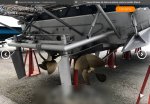
125A0111-3EFA-4CDA-A94F-DDCF7C9BEE3E.jpeg
Note that extra wide strip twixt flap bathing platforms support Rhs of the hull .
 
Reminds me of a trip with MYAG on his Sunseeker.
MapisM was there at the time - maybe he will also remember.
He showed us the boat turning with the aid if his fin stabilisers and with them switched off.
Impressive how the boat stayed flat during a turn with the fins on and banked with them switched off.
Sorry another spanner left in my bag eager to throw ……. :)
I will try and keep it simple in I wish @ # post 30 it just said “ and it last longer the “ event “

Here goes ,..,….

Why would you want it “ stay flat during a turn “ ?


clue ?banking ……..?flat .
 
Yup No Itama owners in the queue at the stabiliser shop(s) .

That would be enlightening work .Ask sea-keeper who there customers are .
Get that list to peruse.
Both factory fit and the retro mkt . Year on year ,

@ DAW nice post btw .
I once met a guy Monaco flagged Riva 76 in the yard at the side of our boat .He was have fins retro fitted .Story was it his last chance saloon in terms of Wife sea sickness .So bad he was forced to stabilise up or she would refuse to boat .They we’re curved btw .Any how I later bumped into him and asked about the wife ( the fin project ) “ Did it do the trick “ etc .He told me yes but it knocked 5 knots off the speed .A fast boat anyhow say 38 / 40 flat out so 32/24 cruise at a engine life happy 1900 rpm .
But now he uses more rpm around 2100 .

Ferretti group as you know do a preview show invitation only @ Monaco YC just before Cannes .It’s a wet show you go out and helm them ,Fortunately we get annual invites .

We found ourselves ( via the dog ) attached to the FG dealer in California, who kindly invited us on a Pershing 115 tripple .
The story went from the mouth of the full time skipper the owner was a serial Sunseeker sports cruiser guy .Porto 53 to Pred 72 to pred 82 to Pred 95 .That’s where it all stalled .This captain had followed the journey ..On the Pred 95 the wife just couldn’t get on with the motion and kept getting sick .Both running with fins and even @ anchor
.So much so once on a trip to Corsica she opted to fly over .

It was finned by S Skr at build .I am not sure if the others were btw ,

The point is even @ anchor with the fins she couldn’t get on with it .Some funny movement the Capt did report .

Perhaps JFM can come in on this ? Instal issues , un calibrated ? Or just while roll is reduced as per the science …up pops my “ subjectivity “ point .You can’t say to her you SHOULD feel better because according to the science …..etc .

The upshot is the new Pred 95 was sold and they moved ( with the same crew ) to this P115 .
Expensive business keeping the wives on board the hobby chaps ;) .Tell me about it !

This had gyros in stead I think more than 1 .They were directed to Pershing by the Capt who had mentioned his predicament to other captains ,for fear if the owners sells up packs it in , he would be risking unemployment .

Its motion under way and @ anchor the P115 was completely different to the S/Skr gyros on or off .

It was basically the base hull form of the Pred 95 despite fin s or turned around the basic motion of the P 115 that made the difference gyros on or off ,
She stopped flying to Corsica, now a days rides with family in the P115 .Capt reported its quicker too over the Pred .Buts that not the reason the Pred was ditched .

Now that’s a big ask to ditch Sunseeker by this serial owner after a decade of happy boating .Just shows hull form does play a significant role in boat movement.
Happy to chime in as requested but we gotta call a spade/spare here and recognise that there is plenty of BS talk from owners/captains in boatyards or whatever. On the 5 knot speed loss thing something was wrong and it wasn't the stabilisers. There is tons of evidence of that. My squadron 78s both did ballpark 31 kts with fins, so a speed loss of 1 knot, which could have been due to weight of my options list! On the pred/pershing captain's story, well clearly the poor woman in question had a significant seasickness tendency. You can get some "funny movement" with fins and gyros, if you don't set them up well. ABT as fitted to those sunseekers is old design old technology too. You wouldn't get this on well set up new hardware. Obviously the bigger pershing gave a better motion under way and at anchor, because 115 vs 92 feet, but tbh I can't see the point of your anecdote here. And btw I take what plenty of captains say with pinch of salt - plenty can drive a boat well (an easy task) but aren't the smartest pupils in the class. I'd say that 115 feet vs 92 is what was playing the significant role in boat movement, not hull form. Anyways this discussion is going nowhere imho.
 
It gets up and lifts out at about 18/20 knots .Does not feel right but works between 20-25 Its planning like any other .
How ever shove the sticks up further and it lifts like a second time stiffens really up and has like a second burst of acceleration.

Whats happening from what I have deduced yard walking looking at others is the chine flats at the rear are excessively wide and the lifting strips or you may call them spray rails Fwds but they morph extra wide as they tail rewards the stern so in effect add further lift .
The rudders in this 2 nd phase become pretty useless because they lift too far up leaving just the tiny in effective tips in .
Deep V all 23 degrees of deadrise has been lifted .
Any theoretical drag ( you are correct ) has reduced = hence you don’t loose out mpg wise ……you do at 25 knot under , and you can steer it better.

To stop it bow steering the V is actually attenuated by a round rather flat ish bell shaped keel , they call it a lifting pad .
So in my case the 23 degree dead rise is mixed with extra wide chine flats , extra wide spray rails going to the transom morphing in to lifting strips and where the two side meet at the keel a round bell shaped pretty flat ,Union not sharp knife edge .
This add to the ride comfort mostly , arrow like directional stability and reduces drag the extra lift .
That drag reduction can be harvested in two ways .

1- reduced rpm and fuel consumption……PYB s point .
2- higher top speed leave it .

The drag reduction must have been on Amarti mind designing this rudder system .Show me this by another manufacturer Mapish .

View attachment 149193
Note that extra wide strip twixt flap bathing platforms support Rhs of the hull .
That's a beautiful concept on that Itama in your picture Portofino. I would say it's ugly, speaking as an engineer who thinks that beauty counts for plenty so why not make a beautiful thing that works instead of an ugly thing that works, but that aside, the concept of lifting the rudders up in a fast boat is a great thing.

The flat strip of hull has a clear naval architectural purpose, and makes a lot of sense so all good there, but let's be clear about the physics: it contributes nothing to lift. I know you repeatedly argue the opposite in the past, but you misunderstand the fluid dynamics and you're just incorrect on that. The strip does plenty, but it doesn't increase lift.
 
Sorry another spanner left in my bag eager to throw ……. :)
I will try and keep it simple in I wish @ # post 30 it just said “ and it last longer the “ event “

Here goes ,..,….

Why would you want it “ stay flat during a turn “ ?


clue ?banking ……..?flat .
You definitely don't want it to stay flat. You want to control/choose the bank angle, not let mother nature it for you.
 
Regarding your point above, there is a setting deep in the Sleipner menu where you can choose the bank angle profile in turns. Rather clever, because you want some bank angle, but this lets you choose exactly what you like best. It's deep in the menu and you need the technician PIN number not just the 1-2-3-4. I have the number but not to hand - I can dig it if you need (though, be careful in there:))

Yes, I was aware that its possible to customise the bank angle profile. About 12 months after delivery, Sleipner came on board to do a major software upgrade and during the subsequent sea trial we experimented with various settings until they achieved a balanced configuration with some flattening in the turns, but not too much. Not sure I could trust myself not to experiment with other settings if I had the technician PIN, so probably best to be without it :)
 
  • Like
Reactions: jfm
Correctly installed fins should cost you no more than 1-1.5 knots, and perhaps even less with the latest generation Sleipner Vector fins which are a curved design shaped to reduce drag and provide some lift. Anything more and there is a problem with the installation or the configuration. Sunseeker quote a top speed of 32 knots for the P57 at half load, with no fins and no tender. I just went back in the water this week after some winter works (so clean bottom, props, etc.) and on a calm day achieved 31 knots with completely full tanks, Williams tender, water maker and all the other junk that accumulates onboard.
 
Correctly installed fins should cost you no more than 1-1.5 knots, and perhaps even less with the latest generation Sleipner Vector fins which are a curved design shaped to reduce drag and provide some lift. Anything more and there is a problem with the installation or the configuration. Sunseeker quote a top speed of 32 knots for the P57 at half load, with no fins and no tender. I just went back in the water this week after some winter works (so clean bottom, props, etc.) and on a calm day achieved 31 knots with completely full tanks, Williams tender, water maker and all the other junk that accumulates onboard.
100% correct (y)
 
That's a beautiful concept on that Itama in your picture Portofino. I would say it's ugly, speaking as an engineer who thinks that beauty counts for plenty so why not make a beautiful thing that works instead of an ugly thing that works, but that aside, the concept of lifting the rudders up in a fast boat is a great thing.

The flat strip of hull has a clear naval architectural purpose, and makes a lot of sense so all good there, but let's be clear about the physics: it contributes nothing to lift. I know you repeatedly argue the opposite in the past, but you misunderstand the fluid dynamics and you're just incorrect on that. The strip does plenty, but it doesn't increase lift.
It’s universally accepted flat surface create lift inc lifting strips .Widths vary , as does every other dim .
Nothing unusual of a spray rail at the bow designed to deflect spray running back and morphing as it runs aft under the hull into a additional lift gen tool .

Theres tons of stuff on this no obvious contradictions . The best imho forum friendly” is this .

Spray Rails and Chines | BoatTEST

We will just have to agree to disagree on the lift generated by lifting strips .Go our separate ways on this .

Apart from the obvious deadrise Itama s do have disproportionate wider strips and some what wider chines are the rear end .Compared to like for like in the yard .Indeed a slight 2-3 degree reverse chine .From exhaust hole back it points down not horizontal to the ground in the yard .

This is consistent with the behaviour of the thing running and the OP s post #37 .
” Wow Thosa Itama ride smooth.”

Re the Pred 95 it was probably a poor clumsy instal . Atypical. But possible , thats why I would emphasise again test drive the thing in the conditions you anticipate using it .The woman was fine with the un stabilised preceding 82/ 72 etc so no re disposition to sea sickness .
 
It’s universally accepted flat surface create lift inc lifting strips .
It absolutely isn't, No proper engineer/fluids person would agree such nonsense.

Theres tons of stuff on this no obvious contradictions . The best imho forum friendly” is this .

Spray Rails and Chines | BoatTEST

That's written by the late Dag Pike. In his main para on spray rails he agrees 100% with me and 0% with you. Then in his penultimate para he slips, disagreeing with himself saying spray rails create lift. He is just not correct on this one point. I realise that we was an incredibly accomplished seaman/navigator (understatement) but he was not a fluid dynamics guy and had no engineering or similar degree and just made a slip in that paragraph, while the other 95% was correct.

We will just have to agree to disagree on the lift generated by lifting strips .Go our separate ways on this .
Sure that's fine. But this is science not opinion. So if we are yes+ no in our answers to "Do spray rails create meaningful lift?" than only one of is is correct.

Apart from the obvious deadrise Itama s do have disproportionate wider strips and some what wider chines are the rear end .Compared to like for like in the yard .Indeed a slight 2-3 degree reverse chine .From exhaust hole back it points down not horizontal to the ground in the yard .
Yup. Reverse chine is different analysis from non-reverse spray rails. Reverse chines do indeed make lift, and no doubt Mr Amati designed your hull deliberately to get this and other effects. But the lift is being paid for by diesel, because you're pumping the water down hill. Conceptually, it's like you have a helicopter with you, with a rope pulling your foredeck upwards - you get lift, but you have to put fuel in the heli. No criticism from me on this - Mr Amati totally knew his onions and did this deliberately, but let's be clear about what he did.

This is consistent with the behaviour of the thing running and the OP s post #37 .
” Wow Thosa Itama ride smooth.”
Yawn - that vid was in calm seas. Any other 40/55 footer would have been perfectly fine.

Re the Pred 95 it was probably a poor clumsy instal . Atypical. But possible , thats why I would emphasise again test drive the thing in the conditions you anticipate using it .The woman was fine with the un stabilised preceding 82/ 72 etc so no re disposition to sea sickness .
So you go on a ferretti group sales trip, and the employed/commissioned captain gives you a rambling yarn saying sunseekers are crummy and pershings are great, and you lapped it all up. :):)
 
Last edited:
The drag reduction must have been on Amarti mind designing this rudder system.
Show me this by another manufacturer Mapish.
Of course I can't.
But why on earth the fact that no other builders ever adopted such Heath Robinson-esque system should be something to be proud of?!? :unsure:
Christ, even Amati himself only built a handful of those things.
In fact (with all due respect for him - RIP), my guess is that more than drag reduction, it's a remarkable quantity of Frascati wine that he had in mind, when he designed it.
 
  • Haha
Reactions: jfm
I can only go on personal experience………my heavy hard top sports boat, has no rudder or drives in the water to create drag whilst rolling…..has a deep V (I think) and rolls like Oliver Reed on a stag do.
 
What are captains's experience with Arno Leopard 24m. how does this vessel compare to AB 78 abliet smaller engines and heavier.?
 
It absolutely isn't, No proper engineer/fluids person would agree such nonsense.


That's written by the late Dag Pike. In his main para on spray rails he agrees 100% with me and 0% with you. Then in his penultimate para he slips, disagreeing with himself saying spray rails create lift. He is just not correct on this one point. I realise that we was an incredibly accomplished seaman/navigator (understatement) but he was not a fluid dynamics guy and had no engineering or similar degree and just made a slip in that paragraph, while the other 95% was correct.


Sure that's fine. But this is science not opinion. So if we are yes+ no in our answers to "Do spray rails create meaningful lift?" than only one of is is correct.


Yup. Reverse chine is different analysis from non-reverse spray rails. Reverse chines do indeed make lift, and no doubt Mr Amati designed your hull deliberately to get this and other effects. But the lift is being paid for by diesel, because you're pumping the water down hill. Conceptually, it's like you have a helicopter with you, with a rope pulling your foredeck upwards - you get lift, but you have to put fuel in the heli. No criticism from me on this - Mr Amati totally knew his onions and did this deliberately, but let's be clear about what he did.


Yawn - that vid was in calm seas. Any other 40/55 footer would have been perfectly fine.


So you go on a ferretti group sales trip, and the employed/commissioned captain gives you a rambling yarn saying sunseekers are crummy and pershings are great, and you lapped it all up. :):)
Spray rails taken fully aft and widened out , carefully located do create meaningful lift at the stern .At certain speeds .
As I said mine are extra wide and do indeed run all the way back ( except the lower pair which stop where the shaft s pop out )
So they morph into lifting strips .Sure start as spray rails forwards in the bow area in-front of the disruption layer .

Maybe this is where we are locking horns .You are only in front of the disruption layer and I am thinking in both areas the rear as well ?

A lot of boats you see them disappear around 70 % of the way back from the bow .Not every designer utilises them , the potential lift function or needs to .There’s huge variability, you see it in the yards ( it’s better than trains spotting guys ) :)

Depending on the shape and profile and indeed width there position and how far back they are taken …..what starts off as a bow spray deflector can end up as it s taken to the stern doing less spray deflection and more lift ing .
They don’t always have to be run all the way to the transom or change width .They have pluses and minuses .

SCIENCE

Go to the literature review .

For those reading unfamiliar with papers and how SCIENCE works in the wider world ( apologies for those au fair granny suck eggs etc ) - , authors often write a “ literature review “with references to set out the current knowledge/ position .They add references see below .

Ignore the subject matter , it’s the REVIEW , the interesting bit the reason why I link it .You might find it interesting thought but that’s not why I am using it .Iam high jacking the REVIEW.

Using this guys LR it’s got a good para on spray rails the current understanding.For ease I have copied the relevant pages and highlighted in blue + red by own emphasis.

https://www.diva-portal.org/smash/get/diva2:1440146/FULLTEXT01.pdf

Look up papers [55 ] [ 56 ] [ [57 ] in particular ,

Further more these papers are pier reviewed by others before the author publishers and a second verification is done by editorial boards before publication.So it’s not some one’s opinion .It’s real SCIENCE.

For example if JMF was right the author would be asked to remove , re write the part I underlined in red / blue prior to publication .


68C30CCF-D376-4435-B806-A4485DC61F80.jpeg
A13C11CA-1712-4276-A259-C07B18915DA7.jpeg
Foe those without a scientific background another well known boaty guy, if Dag Pike isn’t familiar.
Ray hunt design .
Its so universally accepted , this lift thing that it’s just mentioned in passing here .
The Hunt Deep-V | Ray Hunt Design | Naval Architecture

No one’s written in , arguing with them ( Ray hunt design ) hinting his web page is full of crap or has a tiny miss truth in it .
Other naval architects , there friends and colleagues arn’t begging them to re write any of this page .

4338779A-CE78-484B-961D-E806BC90ADCC.jpeg
 
The speed loss of fins stabilizers is estimated at just under one knot at 25 knots cruise.
A captain friend is fitting CmC fins at the moment and this was the theoretical loss with fins closed for 2004 Canados 80 at fast cruise.
The top speed loss should be more or less the same. I will have some real numbers in the end of Spring.
 
Some thoughts on the above based on real world experiences ... apologies in advance for the length of the post.

On fins v gyro ...

I have a 2019 Sunseeker Predator 57 with Sleipner vector fins, and a friend with a 2021 Predator 60 fitted with a Seakeeper gyro. The P57 and P60 are basically the same boat with cosmetic changes to the interior, so its possible to make a direct comparison between the performance of the two systems.

At anchor, fins and gyro are about the same ... both work well and provide almost total roll reduction. Underway is a different experience altogether. Above 10 knots the gyro seems to have limited impact on reducing roll and improving stability, whereas the fins continue to work regardless of the speed. This can make a big difference in heavy weather depending on the direction of approach to the waves/swell.

With fins you lose perhaps 1 knot of top speed and increase fuel consumption slightly due to the additional drag, but the difference is really marginal when when compared with the impact of mid-season fouling. Fins impact significantly on cornering characteristics, making the boat run much flatter through turns, which can be positive or negative depending on your point of view (you can always switch them off if you want the boat to heel over). They also seem to help with maintaining running angle and keeping the boat generally more level, with less use of trim tabs needed.

Both fins and gyro require the generator to be running at anchor ... but we normally turn on the generator as soon as we disconnect shore power to run refrigeration, ice-maker, a/c, etc. so I don't see this as a consideration. Given all the other things you have to do to make a 50-60 foot boat ready to go to sea, I also don't see the 30-45 minutes required to spool up a gyro as a major downside. The gyro seems to be slightly noisier in operation, but you don't really hear this over the noise of the generator. So, even in this respect.

I guess one consideration which may affect wear and tear and long-term working life is that fins only work when needed and can be switched on and off instantly, whereas a gyro is working all the time and has an extended start-up/shut-down time. Fin systems have many different components (actuators, hydraulics, multiple PTOs, etc.) located in different areas of the boat, but in practice seem to be relatively trouble free and other than periodic servicing are maintenance free. Gyros should be more robust as they are delivered as a "sealed unit", but I've heard many more reports of replacement or repair being needed (particularly due to bearing failure). So, inconclusive on this one.

In my experience, the major downside of fins is the paddling effect in crowded anchorages when there is significant swell or chop. It's not an issue in normal conditions and you can always reduce the gain/speed to minimise the effect, but you still have to be aware that you could swing differently to other boats. It's not unusual for us to find ourselves pointing in a totally different direction to everyone else as the fins fight against the waves and counteract the impact of wind/tide. There is always a risk of swimming forward over the anchor, so we generally turn off the fins at night. There is some additional maintenance (particularly of the hydraulics), you (and your neighbours) have to be more careful with lazy lines, etc. in marinas and you need to make sure guests are aware of the movement of the fins and stay away from them when swimming.

Overall, I think the gyro is perhaps a better solution for anchoring, but fins are more versatile with a bigger range of operation. With or without stabilisation switched on, we don't seem to have a lot of problems with guests becoming sea-sick at anchor, but 1-2 hours cruising at 20-22 knots in a rolling sea can be a problem for many. For me the high-speed performance of fins is worth the downside of paddling at anchor and the other minor inconveniences.

On heavy flybridge v light weight sports cruiser ...

I agree entirely with the comments about the physics behind the propensity to roll, roll frequency, etc. for different boats. However, I wonder if in the real world this debate comes down to differences in hull design, overall weight, "inertia", centre of gravity/roll and where you are sitting on the boat, rather than whether the design is a flybridge or a sports cruiser.

I've only ever owned sports cruiser style boats and like some others here, before wide-spread adoption of stabilisation I've sat in anchorages watching people on the top deck of mid-size flybridges rolling uncomfortably and felt smug about being on a sports cruiser so low to the water. However, it doesn't mean we are rolling less or more slowly, it just feels/looks less uncomfortable because we are sitting lower and closer to the centre of rotation.

My current Sunseeker P57 is a heavy boat for its size, weighing in at 32-33T fully laden, and is quite beamy. It weighs considerably more than my previous Portofino 53 which was only a few feet shorter, slightly narrower, had a deeper V hull and weighed only 21-22T. For boats of relatively similar size and style, the difference in comfort at anchor is remarkable. Although not uncomfortable, the P53 felt as though it was always moving, whereas the P57 is much more stable, even without stabilisation.

So my conclusion is that in the real world a beamy, heavy boat with a flatter bottom will usually be more resistant to roll than one which is narrow, light weight and with a deep-vee hull. When it does start to roll, it will do so more slowly and once the moving force has been removed, it will come to rest more quickly. All consistent with basic principals of physics and fluid dynamics.

On the Mangusta 80, etc. ...

I've been fortunate enough to spend a fair amount of time on Mangusta's (mostly the 92) and think they are amazing boats for the purpose for which they have been designed with great build quality. However, I would never consider owning one for the reasons set out below.

For me, Mangusta's are principally intended to be big day-boats and to serve as party platforms. They are great for high speed blasts along the coast, days spent in calm anchorages and nights spent tied up in marinas, all in perfect weather. All of this they do superbly well, but at an eye-watering cost. At this size, they have the accommodation for longer stays and are great for a few days, or a week or two, but this is not their intended purpose. For long-term cruising or a as a full-time, live-aboard boat, the upper deck layout and absence of a flybridge mean they are seriously compromised.

The maintenance expenses on a boat this size can be eye-watering particularly as the boat ages. If you stick with the manufacturers recommended servicing schedule and authorised service agents then its easy to spend EUR 30-40K per year on routine servicing in the mechanical areas alone, and 5/10 year major maintenance/overhauls can cost EUR +150K assuming nothing is broken. Anything which does break is usually expensive ... I know of a 2008 Mangusta 92 where replacement of failed AC components last year cost over EUR 80K, and that was in addition to an overdue QL3 service on the MTU 16V2000 engines which cost EUR 150K (including EUR 70K for replacement of the 32 injectors).

Another consideration is whether you need experienced crew with good mechanical knowledge ... looking after and running a boat with shaft-drives and engines from a manufacturer such as Volvo Penta, MAN or Caterpillar is within the capabilities of many experienced owner/operators, but once you move into the world of MTU, Kamewa drives, etc. its a whole different proposition. These boats were designed to be operated and maintained by experienced professional crew and not by DIY owners.

I've spent time on Mangusta 92s and on Sunseeker Predator 84/92s and I would say that the Mangusta has a tendency to roll more in anchorages and also in a beam sea. This is not uncomfortable ... as others have said, they are big heavy boats and can cut through most sea conditions ... but definitely not as stable as some of their direct equivalents or competitors. Also, most Mangustas don't seem to be fitted with any kind of stabilisation, whereas Sunseekers et al. of this generation usually have TRAC fins, and those that don't have often been retrofitted with gyros.

So, for all of the above reasons, only consider buying a Mangusta of this age if you really want a big sports cruiser, intend to use it mostly for day use or trips of short duration, and have very, very deep pockets. Most are now 10-20 years old and approaching the age where major systems start to fail or require major overhaul or rebuild. They can be relatively cheap to buy on the brokerage market, but will always be expensive to run and usually take a long time to sell.

Once again ... apologies for the thread drift and the long post :)
What would you suggest as a suitable and enjoyable live aboard cruiser similar to man gusts 80 styling.
 
Some thoughts on the above based on real world experiences ... apologies in advance for the length of the post.

On fins v gyro ...

I have a 2019 Sunseeker Predator 57 with Sleipner vector fins, and a friend with a 2021 Predator 60 fitted with a Seakeeper gyro. The P57 and P60 are basically the same boat with cosmetic changes to the interior, so its possible to make a direct comparison between the performance of the two systems.

At anchor, fins and gyro are about the same ... both work well and provide almost total roll reduction. Underway is a different experience altogether. Above 10 knots the gyro seems to have limited impact on reducing roll and improving stability, whereas the fins continue to work regardless of the speed. This can make a big difference in heavy weather depending on the direction of approach to the waves/swell.

With fins you lose perhaps 1 knot of top speed and increase fuel consumption slightly due to the additional drag, but the difference is really marginal when when compared with the impact of mid-season fouling. Fins impact significantly on cornering characteristics, making the boat run much flatter through turns, which can be positive or negative depending on your point of view (you can always switch them off if you want the boat to heel over). They also seem to help with maintaining running angle and keeping the boat generally more level, with less use of trim tabs needed.

Both fins and gyro require the generator to be running at anchor ... but we normally turn on the generator as soon as we disconnect shore power to run refrigeration, ice-maker, a/c, etc. so I don't see this as a consideration. Given all the other things you have to do to make a 50-60 foot boat ready to go to sea, I also don't see the 30-45 minutes required to spool up a gyro as a major downside. The gyro seems to be slightly noisier in operation, but you don't really hear this over the noise of the generator. So, even in this respect.

I guess one consideration which may affect wear and tear and long-term working life is that fins only work when needed and can be switched on and off instantly, whereas a gyro is working all the time and has an extended start-up/shut-down time. Fin systems have many different components (actuators, hydraulics, multiple PTOs, etc.) located in different areas of the boat, but in practice seem to be relatively trouble free and other than periodic servicing are maintenance free. Gyros should be more robust as they are delivered as a "sealed unit", but I've heard many more reports of replacement or repair being needed (particularly due to bearing failure). So, inconclusive on this one.

In my experience, the major downside of fins is the paddling effect in crowded anchorages when there is significant swell or chop. It's not an issue in normal conditions and you can always reduce the gain/speed to minimise the effect, but you still have to be aware that you could swing differently to other boats. It's not unusual for us to find ourselves pointing in a totally different direction to everyone else as the fins fight against the waves and counteract the impact of wind/tide. There is always a risk of swimming forward over the anchor, so we generally turn off the fins at night. There is some additional maintenance (particularly of the hydraulics), you (and your neighbours) have to be more careful with lazy lines, etc. in marinas and you need to make sure guests are aware of the movement of the fins and stay away from them when swimming.

Overall, I think the gyro is perhaps a better solution for anchoring, but fins are more versatile with a bigger range of operation. With or without stabilisation switched on, we don't seem to have a lot of problems with guests becoming sea-sick at anchor, but 1-2 hours cruising at 20-22 knots in a rolling sea can be a problem for many. For me the high-speed performance of fins is worth the downside of paddling at anchor and the other minor inconveniences.

On heavy flybridge v light weight sports cruiser ...

I agree entirely with the comments about the physics behind the propensity to roll, roll frequency, etc. for different boats. However, I wonder if in the real world this debate comes down to differences in hull design, overall weight, "inertia", centre of gravity/roll and where you are sitting on the boat, rather than whether the design is a flybridge or a sports cruiser.

I've only ever owned sports cruiser style boats and like some others here, before wide-spread adoption of stabilisation I've sat in anchorages watching people on the top deck of mid-size flybridges rolling uncomfortably and felt smug about being on a sports cruiser so low to the water. However, it doesn't mean we are rolling less or more slowly, it just feels/looks less uncomfortable because we are sitting lower and closer to the centre of rotation.

My current Sunseeker P57 is a heavy boat for its size, weighing in at 32-33T fully laden, and is quite beamy. It weighs considerably more than my previous Portofino 53 which was only a few feet shorter, slightly narrower, had a deeper V hull and weighed only 21-22T. For boats of relatively similar size and style, the difference in comfort at anchor is remarkable. Although not uncomfortable, the P53 felt as though it was always moving, whereas the P57 is much more stable, even without stabilisation.

So my conclusion is that in the real world a beamy, heavy boat with a flatter bottom will usually be more resistant to roll than one which is narrow, light weight and with a deep-vee hull. When it does start to roll, it will do so more slowly and once the moving force has been removed, it will come to rest more quickly. All consistent with basic principals of physics and fluid dynamics.

On the Mangusta 80, etc. ...

I've been fortunate enough to spend a fair amount of time on Mangusta's (mostly the 92) and think they are amazing boats for the purpose for which they have been designed with great build quality. However, I would never consider owning one for the reasons set out below.

For me, Mangusta's are principally intended to be big day-boats and to serve as party platforms. They are great for high speed blasts along the coast, days spent in calm anchorages and nights spent tied up in marinas, all in perfect weather. All of this they do superbly well, but at an eye-watering cost. At this size, they have the accommodation for longer stays and are great for a few days, or a week or two, but this is not their intended purpose. For long-term cruising or a as a full-time, live-aboard boat, the upper deck layout and absence of a flybridge mean they are seriously compromised.

The maintenance expenses on a boat this size can be eye-watering particularly as the boat ages. If you stick with the manufacturers recommended servicing schedule and authorised service agents then its easy to spend EUR 30-40K per year on routine servicing in the mechanical areas alone, and 5/10 year major maintenance/overhauls can cost EUR +150K assuming nothing is broken. Anything which does break is usually expensive ... I know of a 2008 Mangusta 92 where replacement of failed AC components last year cost over EUR 80K, and that was in addition to an overdue QL3 service on the MTU 16V2000 engines which cost EUR 150K (including EUR 70K for replacement of the 32 injectors).

Another consideration is whether you need experienced crew with good mechanical knowledge ... looking after and running a boat with shaft-drives and engines from a manufacturer such as Volvo Penta, MAN or Caterpillar is within the capabilities of many experienced owner/operators, but once you move into the world of MTU, Kamewa drives, etc. its a whole different proposition. These boats were designed to be operated and maintained by experienced professional crew and not by DIY owners.

I've spent time on Mangusta 92s and on Sunseeker Predator 84/92s and I would say that the Mangusta has a tendency to roll more in anchorages and also in a beam sea. This is not uncomfortable ... as others have said, they are big heavy boats and can cut through most sea conditions ... but definitely not as stable as some of their direct equivalents or competitors. Also, most Mangustas don't seem to be fitted with any kind of stabilisation, whereas Sunseekers et al. of this generation usually have TRAC fins, and those that don't have often been retrofitted with gyros.

So, for all of the above reasons, only consider buying a Mangusta of this age if you really want a big sports cruiser, intend to use it mostly for day use or trips of short duration, and have very, very deep pockets. Most are now 10-20 years old and approaching the age where major systems start to fail or require major overhaul or rebuild. They can be relatively cheap to buy on the brokerage market, but will always be expensive to run and usually take a long time to sell.

Once again ... apologies for the thread drift and the long post :)
Really appreaciate your input. Why did you buy the P57
 
Top