Man overboard devices

Me too, vastly better than reaching up for stanchion bases with no way to use the leg-muscles usefully.

But I don't know the Mastep name, nor can I find any associated image on Google.

Is it the same style as this Plastimo? If every yacht carried such a thing primarily for its own crew's benefit, the tragic stories of marina drownings might be consigned to history. Not that I'm suggesting we need any more laws. :rolleyes:

48453866481_197b9effae.jpg

I fitted a tube into the bottom of my transum and fitted a rope ladder that can be pulled out to help climb up.

The problem like any rope ladder is that it tends to swing under the boat making it difficult to pull yourself up onto the stern.

The stern can also move up and down also making it not easy to board from the stern
 
I fitted one of these safety ladders and when the crew decided to take an early bath at the marina we discovered that they tend to be too high and as said the bottom step swings around too much so while it was useful to hang on to and with no obvious ladders on pontoons had to deploy the swimming ladder which made af stainless steel worked fine but was thinking that using the main halliard might be the only way to winch the casualty back on board . Luckily it was fairly warm but in absence of any other crew or help experience shows even recovery from what are relatively benign conditions in daylight in a marina does take it out of both of you.
 
Like a couple of posters have mentioned its most likely to be a fall when setting up for coming into the marina or such like and we have a motor boat(not that the wind wont push it either) so sails aren't a concern for me. and before i get lambasted yes I do always knock it into neutral if i am setting up but theres always that one time when you "just" go to rearrange something and the worst happens...

I've done several offshore survival courses so, unfortunately, know very well what swimming with a PFD is like. I still believe that a wireless kill cord would greatly increase the chances of managing to re-board the boat should I fall in or worst case scenario greatly reduced the damage should it happen

The other MOB devices I mentioned are more of a belts and braces thing for ensuring everyone is accounted for when out on the water but also a fit and forget item rather than ensuring everyone is clipped on at all times(I doubt very much that anyone can hand on heart say they know where their 4 year old is at all times...)

Edit: We also have a swim platform and ladder so re-boarding is not an issue for our boat although I fully appreciate its a major concern for other boat types. I saw a brilliant idea where the ladder is rolled up and put inside the hull with a screw cap that when required can be easily accessed from the water.
 
Last edited:
My MOB tag system has a relay contact that I used to connect to my plotter to show where the MOB was when the signal was lost.

This contact could also be used to operate a engine stop device on a motor boat.

So any MOB tag system that has a relay contact could be used. I don't know if the NASA systen has a relay contact output as it was a long time ago I looked at it. An E-Mail to NASA would confirm.
 
Rogershaw's quote:

48455624211_4f3a47179f_c.jpg


To which I can only reply that:

I guess the intention with this model, is for the ladder to have its uppermost rung secured near the top of the taffrail or gunwale...

...thus secured, the person pulling down on the ladder is likely to find the lowest of the rungs riding away under the yacht...

...but the rungs should create a usable ladder either up the transom above the waterline, or wherever along the topsides it is secured.
 
Last edited:
Dancrane,

no the Mastep ( which may well be unavailable now ) is rigid thick plastic / nylon with folding sections, goes from about 1' folded to 6' unfolded, has large hooks on the upper end to go over a gunwhale or coaming.
 
On practice MOB drill with real person my wife could not get a man on board with either the 4:1 main sheet block or the spinaker halliard winch and I could barely manage. The "victim" advised that he owned and had ready a 6:1 handy billy and showed how to set it high up mast using halliard. We bought one.

My wife has gone overboard due to slipping on a wet whaleback deck in harbour and I was very very grateful that a work party was at hand to help pull her aboard.

57% of people falling into water drown according to statistics. Have ladder, wear LJ, have hoists to hand but better still net your guard rail, use jackstays and harness, have engine stop or alarm device, stay soberish while boarding but try and stay on board as if your very life depended on it - because it does
 
In the 1970's it was standard for racing boats with separate headsails to have either netting or diagonal lacing at least from the pulpit to the forward stanchions, this keeps crew and valuable sails onboard - I don't mind looking retro, quite like it so have this and it certainly works even when harnessed on - if I had children or pets aboard I'd have netting all round.
 
I also often sail singlehanded and, as I'm replying, you'll gather that I haven't fallen off yet. But the original question is still relevant. I believe that MOB warning devices are shutting the stable door after the horse has bolted. The only sensible solution is a system which stops people falling off, and harnesses and lifelines seem to meet that need in the majority of cases.


MOB devices are more about finding the horse after you left the stable door open and getting in it back in there...
 
In the 1970's it was standard for racing boats with separate headsails to have either netting or diagonal lacing at least from the pulpit to the forward stanchions, this keeps crew and valuable sails onboard - I don't mind looking retro, quite like it so have this and it certainly works even when harnessed on - if I had children or pets aboard I'd have netting all round.

I couldn't agree with you more:
  1. Netting is very cheap.
  2. But I suggest there's not much point if your stanchions are only 600mm high.
 
Hook the ‘spare’ hook onto the attachment point on the harness when not in use.. Thought everyone did this?

Don't do that. People have died that way, under an overturned boat.

When you clip the spare back to the harness you completely defeat the quick release function. This is often overlooked. Clip the spare to the eye of the quick release or another parking loop.
 
Coopec,

I looked up Force 4's catalogue and can see no sign of the Mastep ladder there either.

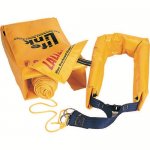
The lifesling illustrated looks useful - my only slight worry is there's only a finite amount of line, so while having it tethered to the boat is a good thing, it would be awkward if it ran out of length before one could turn the boat back to the casualty.

For this reason I'd also have a traditional horseshoe lifebuoy with drogue and light, and a danbuoy with flag and light.
 
Hanging on tight usually prevents the need for an MOB device.

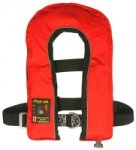
But if a man has gone in and he is wearing a lifejacket and you've got the boat back to him and stopped alongside then having an MOB Lifesaver in his lifejacket that you can grab and attach him to the boat while you set up your retreival system is a good idea.
 
Seajet

Thanks for that. I'll certainly have two horseshoe lifebuoys with drogues and lights (and whistle?)

Advice I have been given (by a person who has cruised for 8 years) is that automatic inflating L/J give problems because they rely on something that dissolves in sea water so they must never get wet.

I'm thinking of a few of something like these L/J for myself and guests
http://www.harboursidechandlery.com.au/catalog/axis-offshore-150n-manual-harness-p-22067.html

I would appreciate advice

203ce771cde5e397f6dc16b3df7823a6db4007bb.jpg
 
There was a problem - especially for foredeck crew on racing boats - with auto lifejackets going off when thecrew were hit by lots of green water.

This is why the Hamma ( sp ? ) trigger system was developed, it's commonly available just a little more expensive than the old salt tablet type.

I've been sailing for 49 years and would always go for an auto lifejacket; years ago we and about 30 other boats responded to a call from Solent Coastguard, a woman had been hit by the boom and was unconscious as she went over the side.

Sadly she was also wearing trendy white waterproofs ( which I think should be illegal ) and it was a breezy day with lots of white horses on the waves - we all tried for hours but could not find her.

The only time it seems a good idea to avoid auto and have a manual lifejacket is in aircraft to avoid being trapped inside after ditching .

It has often struck me a great many people don't know how to deflate a lifejacket which could be critical if trapped under a boat or anything, auto or manual; on the oral inflation tube end cap there is a protrusion - stick this in the end of the oral tube to deflate.
 
Top