Main sail Outhaul adjustment?

xeitosaphil

Well-Known Member
Joined
12 Aug 2004
Messages
1,261
Location
paignton south devon uk
Visit site
Hi all

I have a question about my outhaul for the main sail which someone maybe able to have some input about?

I have a fully battened main which is loose footed.

What would be considered to be the normal amout of length of outhaul adjustment available to control the draft of the sail?

I don't have a slug in the boom, only a tether around the outside of the boom, but it is limited in adjustment length by the 1st reef bale on the outside of the boom.

Im not sure if the small amount of adjustment I have is enough and could be improved if I could find a slug to fit the boom channel. That would mean taking the boom end cap off which would not be easy unless the amount of gain was worth it? Hence my question.


The main sail foot length is 9 feet - 2740 mm


Thanks as always for any input


Philip
 
Hi all

I have a question about my outhaul for the main sail which someone maybe able to have some input about?

I have a fully battened main which is loose footed.

What would be considered to be the normal amout of length of outhaul adjustment available to control the draft of the sail?

I don't have a slug in the boom, only a tether around the outside of the boom, but it is limited in adjustment length by the 1st reef bale on the outside of the boom.

Im not sure if the small amount of adjustment I have is enough and could be improved if I could find a slug to fit the boom channel. That would mean taking the boom end cap off which would not be easy unless the amount of gain was worth it? Hence my question.


The main sail foot length is 9 feet - 2740 mm


Thanks as always for any input


Philip
Maybe 3-4 inches from max on to max off. Probably not even that much.
 
It's not a slug as in mainsail slugs that you need it is a car and the manufacturer of the boom will advise / supply or perhaps a sailmaker.
 
It's not a slug as in mainsail slugs that you need it is a car and the manufacturer of the boom will advise / supply or perhaps a sailmaker.
A velcro clew strap around the boom, and a block on the clew for the outhaul does it for us. We have a 4:1 cascade arrangement to adjust it, using a second 2:1, and cleat, on the side of the boom.
 
Thanks everyone for their input. I didn't realise everyone's adjustable length was so small? I thought it might be 8" or 9 ".
I must have 3"- 4" so probably not worth worrying about.
My boat H30/90 is 51 years old now and doesn't have the original round roller reefing boom. It's has an elongated hexagon shape, so it has flats top and bottom. It did come with velcro strap to boom but I found under tension it wouldn't move on the boom flats so used a piece of 6mm braid, clew to boom which does work better, but is limited by the reef bale.
Perhaps I could increase the length of the braid from boom to clew but that might put slack in the leech.
How close is the foot clew to boom normally on a loose footed main in a stack pack?
All this probably sounds a bit trivial but I do like to sail as best as I can in available conditions.

Incidentally the boat called Magatha, was featured in a six page special in Yachting Monthly in 2016 . It might be worth a read.😊
 
The main on my Southerly is 46m^2 (about 500 sq ft)
I use a velcro strap to hold the sail down and the outhaul is led to an internal 4:1 purchase inside the boom, the tail of the purchase then led to a winch in the cockpit.
Even with all that mechanical advantage, I can't adjust the outhaul under load, the mainsheet and the kicking strap both have to be eased.
The maximum play is about 300mm, and that takes a fully battened, loose foot main from flat to baggy.
So, no need for car on the boom (but there's no problem using one if it works with your boat), but if you want to adjust it whilst sailing, you'll probably need some form of mechanical advantage, with the tail led to a safe place to be able to adjust it.
PS on the Southerly the clew of the main is about 25mm above the boom. The Velcro strap does slide, but as above, not when it's fully loaded.
 
The main on my Southerly is 46m^2 (about 500 sq ft)
I use a velcro strap to hold the sail down and the outhaul is led to an internal 4:1 purchase inside the boom, the tail of the purchase then led to a winch in the cockpit.
Even with all that mechanical advantage, I can't adjust the outhaul under load, the mainsheet and the kicking strap both have to be eased.
The maximum play is about 300mm, and that takes a fully battened, loose foot main from flat to baggy.
So, no need for car on the boom (but there's no problem using one if it works with your boat), but if you want to adjust it whilst sailing, you'll probably need some form of mechanical advantage, with the tail led to a safe place to be able to adjust it.
We have a cascade system in the boom that is, I think, about 32:1. Led to a cam cleat on the underside of the boom close to the kicker attachment. Can be adjusted under load.
 
Within reason, the only reason to have the clew close to the boom is to give more headroom. V important in a Laser dinghy possibly not so important in the average cruiser. A bit of slack will make it easier to adjust
 
Beware of fitting a slider into the boom slot. I converted from fixed to loose footed sail and the clew outhaul is on a slider which is now subject to a pull that is off centre and increased friction. Using tape around the boom and through the clew, and securing the clew outhaul directly to the clew it has reduced the friction and makes adjustment easier.

I would not recommend fitting a slug, slider, whatever, based on my experience of changing from fixed to loose footed.
 
Beware of fitting a slider into the boom slot. I converted from fixed to loose footed sail and the clew outhaul is on a slider which is now subject to a pull that is off centre and increased friction. Using tape around the boom and through the clew, and securing the clew outhaul directly to the clew it has reduced the friction and makes adjustment easier.

I would not recommend fitting a slug, slider, whatever, based on my experience of changing from fixed to loose footed.
That sounds a great idea and possible solution. Thanks for the suggestion.
 
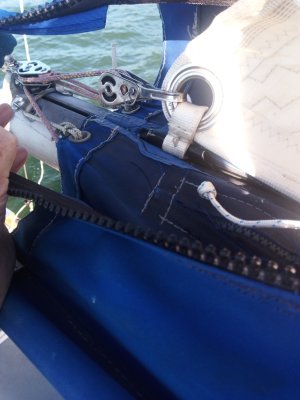
This is mine at about its tightest, I don't mess with it very much, but do let it off when it's not very blowy. The slug came with the sail from Sanders. I had to cut a slot in the sail cover bolt rope to allow the slug room to slide. Not sure how you'd use a strap with a sail bag on lazyjacks.
 

Attachments

  • IMG_20250709_175700_572.jpg
    IMG_20250709_175700_572.jpg
    1.3 MB · Views: 38
….

I don't have a slug in the boom, only a tether around the outside of the boom, but it is limited in adjustment length by the 1st reef bale on the outside of the boom.
….
With a loose footed sail you don’t need anything on the outside of the boom for you reef lines - just go round boom and bowline onto itself. So could remove the side fitting.
 
Op question is really about how far to allow clew forward to increase draft when wind is light. He suspects that the reefing sheave is limiting the amount he can move the clew forward. Unless he is a determined racer it probably is not so critical to get a huge camber (draft) in the main sail. However if he does want more range of movement for ward of clew, as said a car in a track would mean he does not need the tie around the boom.
I have had a car and track in the past of my similar sized main (clew) and have gone to tie clew eyelet around the boom. As close as possible. This to raise the boom as far above head height as possible.
In my case I embedded a sheave box in the top of the boom for first reef. This means the tie around the boom can slide well forward although I don't think I have ever gone that far. I have used 2 sided velcro but also just 2 turns of 6mm rope. Yes it does not slide easily but for the amount of movement and frequency of changing not a problem.
So I would recommend Op fit a sheave box in top of boom for the reef with internal reefing line so need for another sheave box at front under boom for reefing line. Has a major advantage that it removes a potentially dangerous protrusing from the side of the boom if you are going to hit the boom with your head. (as I seem to do occasionally) ol'will
 
My case is a bit different. Solid wooden boom, currently the main sail foot is in an external track. I’m thinking of a new, loose footed sail and it’s been suggested that Velcro would be a good way to attach the clew.
My question is more about the change in distribution of forces. Am I going to bust my boom if the sail is attached only at the corners rather than all along the foot? The rig was not designed for a loose footed sail. It’s 75 years old.
The sail is about 16 sq.m./170 sq.ft. Boom length approx 3.7m/12 feet
 
My case is a bit different. Solid wooden boom, currently the main sail foot is in an external track. I’m thinking of a new, loose footed sail and it’s been suggested that Velcro would be a good way to attach the clew.
My question is more about the change in distribution of forces. Am I going to bust my boom if the sail is attached only at the corners rather than all along the foot? The rig was not designed for a loose footed sail. It’s 75 years old.
The sail is about 16 sq.m./170 sq.ft. Boom length approx 3.7m/12 feet
I suspect the full assessment needs to know the location on the boom of the mainsheet and kicker attachment points.
If you currently have slab reefing then you probably would not have a problem because, when reefed, the main is effectively loose footed.
 
Hmm. No kicker, and the current reefing arrangement is to roll it round the boom. If (and it is still an ‘if’) I get a new sail I’ll use slab reefing.

The boom kind of looks quite stout, and I’m not going to be pushing things. I reckon it will be fine! But I’m curious about how the loads would be differently distributed
 
If the mainsheet is attached at the same place as the clew is the the only force on the boom is a horizontal one pushing the sail away from the mast, the further apart the 2 are the greater the vertical and sideways forces are. There is very little , if any, difference in the forces between loose footed and tracked
 
Top