Low Friction Rings

LW395 - the 1.6 was a joke, I, now, know, but I did not laugh.

Much of what you had said previously in this and other threads has a degree, had a high degree ,of credibility

Anyone who sails a LW395 , in my book, commands respect - its a twitchy, high performance yacht that is exhilarating if sailed well

Suddenly, in my book, you have undermined your own position.

Well done.

Unfortunately your figure of 1.6 did appear to fit with a figure quoted by another member here of 1.5, or 50% larger. Now we understand your idea was a simple fiction.

Thanks for having the honesty and integrity to own up.

People read these threads and accept them as near gospel, maybe (if it is possible) you can amend your original post. sadly people do not red all of a thread and your post and your, fictional, 1.6, are the gospel and until you modify the comment, it is cemented - with your name - in the ether.

Other people make unsubstantiated comments - and don't have your integrity - I can commend you, but I can also understand how 'internet truths' develop, that are not truths.

I'll get off my high horse now.


In the, my, application for the LFRs the high friction under high load is actually advantageous. I want to understand, or learn, about usage (as I have no, zilch, experience of using LFRs, which is why I asked).

Jonathan
The size of the hole is, IMHO, of very little consequence, clearly it needs to be bigger than the rope, if it's similar to the rope diameter, maybe the rope distorts less as it passes through, lowering friction. But 'rope' varies a lot. Why would the optimum for one rope be the same as for another? We all know that different rope handles differently. What matters is the radius the rope rolls around. AIUI, the compromise is wanting the lightest weight and lowest friction, and the fact that the bigger sizes are more expensive, people end to use a fairly small ring. You can't choose hole diameter and ring thickness independently, they just come in a range of sizes more or less scaled proportionally.

Your posts make no sense.
How can you turn a rope through 300degrees with a LFR?
You tell us nothing about your application.
How can anyone tell you what's optimal if you give no clue about what you want?
You later tell us it's not Lowest Friction you're looking for.
You tells us you get these things made yet later you say you have no experience of using them?
As I said in post 2 'what is the question exactly?'
 
I m looking at a novel use for LFRs. I don't know what I want - if I knew - I would not ask.

What I have found is that LFRs are not 'low friction' under tension (in my application) - and this has offered an unseen advantage (as the low friction characteristics can still be used when tension is released). So without trying to influence ideas - I thought to ask an open question and this might lead to open replies.

I lacked the foresight to realise that this approach might be objectionable.

I don't want to lose focus, in why my application might not work (that's my problem) and I might share any problems down the track, but am interested in forum member's experiences in their usage of LFRs. If you don't want to share your experiences, I am more than happy. I hope opportunity to share your ideas and uses of LFRs might be of value to others.

I have this naive ideas that if we share our experiences in an unstructured way some of us, me in this case, can develop novel ideas and applications.

Maybe YBW is the wrong venue.

Jonathan
 
We use these so-called ceramic rings a lot in the paragliding world, in about 8mm id sizes with 1.5mm to 3mm diameter dyneema or kevlar cored lines, usually sheathed. We use them under really quite low loading, say deflecting a line carrying <10kg fluctuating load with a less then 2kg perpendicular load:

  • They can fail in less than 10 hours use; Some will last a few hundred hours.
  • They do not run as smoothly as good pulleys and tend to slip-stick a little.
  • Once the anodising wears through the aluminium then wears quickly, leaving sharp edges which damage the line, our operating in dusty environments exacerbates this, but I would still expect to see it in the marine environment, just maybe a little slower.
  • Once wear is apparent they can be rotated to extend their life a little.
  • I am certain that the line material affects wear rates.
 
We use these so-called ceramic rings a lot in the paragliding world, in about 8mm id sizes with 1.5mm to 3mm diameter dyneema or kevlar cored lines, usually sheathed. We use them under really quite low loading, say deflecting a line carrying <10kg fluctuating load with a less then 2kg perpendicular load:

  • They can fail in less than 10 hours use; Some will last a few hundred hours.
  • They do not run as smoothly as good pulleys and tend to slip-stick a little.
  • Once the anodising wears through the aluminium then wears quickly, leaving sharp edges which damage the line, our operating in dusty environments exacerbates this, but I would still expect to see it in the marine environment, just maybe a little slower.
  • Once wear is apparent they can be rotated to extend their life a little.
  • I am certain that the line material affects wear rates.

Thanks,
You are the first to mention that the aluminium itself can suffer wear. Mention has been made that the anodising wears and as the anodising is meant to be harder than the underlying alloy then logic suggests that with some deeper thought the idea that the aluminium wears is logical (and obvious). I confess not to have thought it through. The 7075 aluminium alloy is harder (and stronger) than most of the common alloys - but I am not sure that anyone makes rings from that specific alloy. The company, in China, that make the Ronstan rings do work with 7075 - they made a different component for me - its not unreasonable to think 7075 rings could be made - and hard anodised. Horror stories abound over the lack of corrosion resistance of 7075 in the marine environment. It does corrode - but insignificantly and if anodised (and the anodising does not wear off) seems sufficiently robust. Be warned - Chinese manufacturers work with huge outputs (ayou need to be very persuasive to have a small trial or small production run).

Aluminium LFRs are made in the UK - it might merit considering other alloys.

Aluminium Thimble

Allen make from aluminium alloy, not sure which, and stainless conventional rings and 2 part threaded rings, that can be fitted through bulkheads etc. They are not cheap :(

I had been thinking of making with 316 stainless - weight is not an issue - maybe I need to think of 2205 Duplex stainless, which is much harder.

I have not detected any performance difference between 316 (also made in China different manufacturer - identical design) and the aluminium LFRs, but I have not been using them both for long enough to define.

My working surface, of the rope, is braided nylon (and abrasion might be a concern). I could incorporate dyneema sleeves in judicious positions.

Jonathan
 
I think I know where this is going but as you say probably best to let the ideas flow without hindrance at this stage. I'll look forward to reading further posts.

Don't be coy,

If there is something that has sparked an idea - then articulate the idea - that's part of the reasoning behind some of my obscure threads (and comments). Thinking outside the box, lateral thinking - call it what you like.

But if there might be novel uses for LFRs, or anything (soft shackles is another) - then surely this forum is where you can explore those ideas (or bounce them around a bit) amongst people who might have the experience but lack your skills in lateral thinking. Wrap the idea up - to ensure you don't constrain the flow of ideas.

But you have me intrigued! :)

Jonathan
 
The size of the hole is, IMHO, of very little consequence, clearly it needs to be bigger than the rope, if it's similar to the rope diameter, maybe the rope distorts less as it passes through, lowering friction. But 'rope' varies a lot. Why would the optimum for one rope be the same as for another?
In theory the relative diameter of the hole and the rope will impact the way in which the rope runs through the hole. When they are closer in size the friction will be distributed across more of the surface of the rope that will probably reduce both friction and the wear on the rope. Whether that makes a significant difference in practice is a another matter.
 
In theory the relative diameter of the hole and the rope will impact the way in which the rope runs through the hole. When they are closer in size the friction will be distributed across more of the surface of the rope that will probably reduce both friction and the wear on the rope. Whether that makes a significant difference in practice is a another matter.
Yes, but depending on the type of rope, the rope will flatten more or less, some ropes stay very round in cross-section, some braids flatten a lot.
For some rope, I suggest the optimum tatio is 1.6. No idea what rope, but I doubt anyone will try them all to prove it wrong :-)
No doubt adding some water or salt crystals will move the goal posts too...
I've changed to a different brand or type of rope a couple of times because perfectly nice rope didn't run through the fittings well enough.
 
I have several I use in relatively static applications, like a bobstay. The line is Dyneema, there is considerable friction under load, but they aren't adjusted under load. Still, the ratio is about 2:1, and even more when the line flattens out under load. I like LFRs for this because failure is not an option (expensive stuff breaks). Also minimium drag through the water.
46.%2Bwichard%2Band%2Bantal%2Blow%2Bfriction%2Brings%2Bin%2Bbobstay%2Bcascade%2Btackle.%2BNote%2Bclimbing%2Bsling..jpg


I've also used them for barberhaulers, outhauls, and reefing lines. these applications used polyester line, and they would NOT have worked well on a large boat. Too much friction. They work on this boat because the winches are well-sized for the loads, and because multihulls barber haul out to the beam, only when reaching (not peak load). I would use blocks on a larger boat, and blocks would not be a mistake on this one. I like the LFRs because there is less hardware banging around.
barberhauler%2B2.jpg


So in my opinion, LFRs work best when:
  • Dyneema line.
  • Limited angle, or...
  • Not adjusted under load.
  • Not adjusted continuously.
  • Space is at a premium.
 
A potentially stupid question from someone who hasn't bought into the LFR trend.

Given that friction is more or less independent of area, wouldn't it be better to put the moving rope around the larger diameter - in other words treating the LFR as a 'shiny but jammed' sheave? Looking at the ratio I'd expect that the internal friction in the rope would be more than halved. I appreciate the the ring now may turn in the loop that holds it, but I can't see an obvious reason why that should actually matter.

Before clicking 'Post Reply' I had look for images, and have found these two where people use them 'my way'.

gallery_30864_676_19829.jpg

post-129708-0-37748700-1488819550.jpg

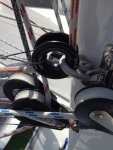
This isn't proof of concept, but here's a 'shiny but jammed' sheave that worked pretty well with a 6mm Dyneema spi halyard until the two new 'corners' bent the halyard more than the whining crew could bear.

WhatsApp Image 2019-06-08 at 18.20.17 (1).jpeg
 
an occasional yachtsman - I did not like to repost your contribution it has has too much in it!

The application you described and illustrate moves, or shares, the friction. To me it appears to solve some of the problems that, for example, Thinwater describes - where the LFRs don't work, or not as intended, under load. Even if the rope does not 'slide' over the sheave, possibly the sheave can turn.

I am sure out there - their must be people who have experience of the what you describe. Hopefully they can contribute.

It seems like one of those applications where you can combine two trendy items together - soft shackles and LFRs.

Jonathan
 
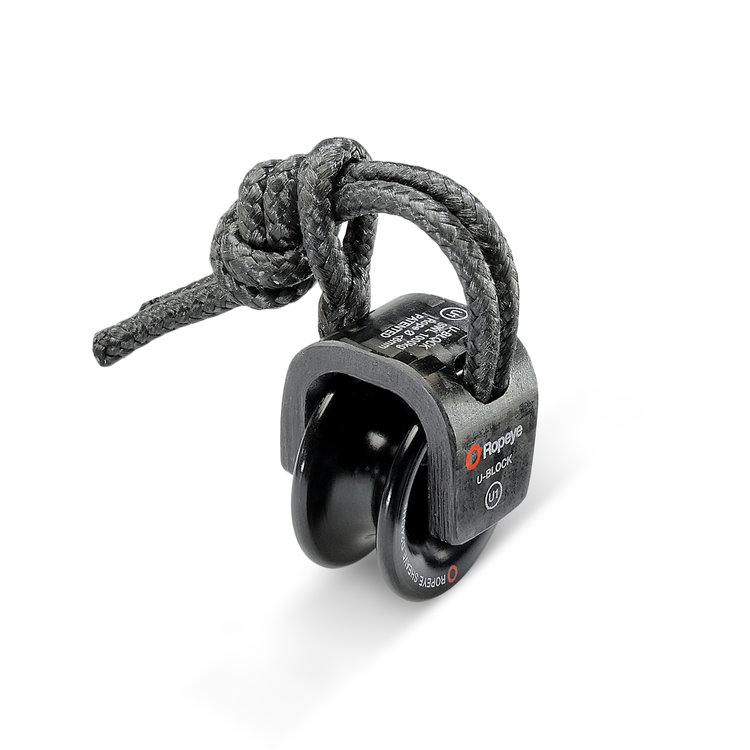
Ropeye U1 block. I have not used them, but I have played with the concept with parts. It works and allows you to used LFRs with polyester rope. But you are now starting to approach the complexity of a block. The price is also a little sick.

Note that the spacer is vital to proper operation. Otherwise the sling cinches down on the LFR and locks it.
I would not use them for halyard blocks; there is always too much friction to start with!

But I'm always glad to see people pushing the envelope.

Ropeye_U1_1.jpg
 
I'm only an interested bystander really, having bb blocks on everything anyway Thinwater - but have you seen or performed any comparative tests between 'reasonably priced' (over here I'd say Barton's ball bearing range) against high end rotating blocks and LFRs? Any thoughts on the merits of not bending loaded rope so severely?
 
I'm only an interested bystander really, having bb blocks on everything anyway Thinwater - but have you seen or performed any comparative tests between 'reasonably priced' (over here I'd say Barton's ball bearing range) against high end rotating blocks and LFRs? Any thoughts on the merits of not bending loaded rope so severely?

A number of these studies have been published in Practical Sailor Magazine.
  • Ball bearing blocks are typically about 95% efficient at 180 degrees.
  • LFRs are typically about 60-70% eff with nylon or polyester and about 80-85% efficient with Dyneema at 180 degrees (smaller lines are more efficient). BUT when placed in a tackle the losses really pile up. This is reason LFR tackles are nearly always cascade (many times fewer blocks) and always use Dyneema.
  • Efficiencies are lower with old, fuzzy line. Sometimes MUCH lower.
As for lesser angles, Google "capstan formula." Yes, it is non-linear.
 
When I was a lad, the route to low friction in dinghy mainsheets was outsize sheaves. Mainsheet blocks had plain bearings but often 5inch sheaves. these gave low friction with nice fat comfy rope.
These days people use smaller ball bearing blocks but have to use thinner rope to make it work nicely.
Unless there's some big benefit such as light weight, or avoiding a block rattling against your varnish or being uncomfortable to sit on, I don't get the enthusiasm for un-inventing the wheel.
While back, I made some blocks which needed to be a certain diameter. I machined delrin 'rims' to mount on off-the-shelf stainless ball races. Seemed to work out OK, although I sold the boat before it really stood the test of time.
Back in the days of outsize sheet blocks, dinghies used levers for the kicker, nice and low friction, sometimes even a cunning rising-rate action. Rare nowadays, most use a cascade of ball-blocks. Cheap to diy too.
 
I agree about re-inventing the wheel.

I feel this about soft shackles - very useful in their place - but people seem to look for uses that to me seem totally inappropriate when something cheaper and easier would work. It was suggested soft shackles would be useful to keep a power cable out of the way when working on deck.... it all sometimes seems a bit contrived.

One reason though we use smaller rope now, instead of then (and then depends on your age) is because we can - Kevlar and Dyneema are fairly recent in the history of many of us - prior to Kevlar we had no choice - we used larger rope because we needed the strength. When these new fibres were introduced their benefit was high strength, vs cross sectional area. I am sure many use dyneema for this reason - but also because it is low friction (but I actually don't recall low friction being high on the benefit list originally).

When Dyneema was introduced it was only used with a cover - because the fear was that it suffered from UV. Rothmans used dyneema for their reefing lines, but left the cover on where it was exposed to the sun - how times change as our ideas develop and more and more people play around - maybe re-inventing the wheel on the way.

I'm hoping the same might be true of LFRs - new uses as they become a bit more common. Even better - low prices as they become a bit more common :)

Jonathan
 
Yeah, uses can be contrived. I like some and avoid others.

The wheel was invented. Before that it was skids. I bet some ludite argued that the wheel would break and that skids were better on snow and soft ground. He was right, of course. Which didn't make the wheel wrong, just wrong for some things.

I see soft shackles as a new spin on knotted strops, and LFRs as a new spin on deadeyes and plain blocks. It's up to the craftsman to determine the best tool for the job. I have a lot of tools.

I like the bobstay application primarily because it is so strong and compact. The other applications... I can take them or leave them.
 
Top