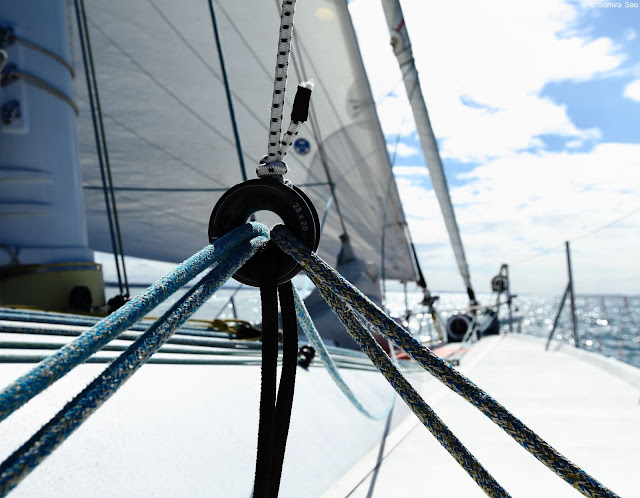
Low friction rings for foresail sheets - any tips?

  • Thread starter Thread starter GHA
  • Start date Start date
This is an interesting thread, use of the latest must haves (without mentioning the other one - soft shackles). Both very fashionable, they have their place.

Looking at the thread GHA appear to have ripped out the sheet tracks - without have\ing tried the options before hand.

Surely the best way to make this sort of modification is to ask for background first - before ripping out the tracks.

At the end of the day I'm really not sure what benefit is going to develop.

But the options could all have been tried - before - the tracks were removed.

Flaming, Tern VI, Lady in Bed, Roberto, Thinwater, (sorry if I missed you) have all made pertinent observations suggesting the original concept is a non starter.

And the concept is meant to make sail handling more simple.

Nothing to do with me, not my yacht, maybe I misunderstand the motivation - just an observation.

I'm not sure how the concept is going to be better than a standard headsail handling system.

It will be interesting how GHA develops his concept

Jonathan
 
Flaming, Tern VI, Lady in Bed, Roberto, Thinwater, (sorry if I missed you) have all made pertinent observations suggesting the original concept is a non starter.

And the concept is meant to make sail handling more simple.

Nothing to do with me, not my yacht, maybe I misunderstand the motivation - just an observation.

I'm not sure how the concept is going to be better than a standard headsail handling system.

It will be interesting how GHA develops his concept

Jonathan

I suggest you have misread my contribution if you think I'm suggesting the concept is a non starter. It's very much a starter, and basically replicates how new race boats are coming from the factory. My only comment was that putting two purchases through the ring is not sensible, and if you want that extra purchase to use a cascade in the tail instead.

Here's the rolls-royce of jib systems. Can be moved up and down as well as inhauled and outhauled.

IMG_5559.jpg
 
I suggest you have misread my contribution if you think I'm suggesting the concept is a non starter. It's very much a starter, and basically replicates how new race boats are coming from the factory. My only comment was that putting two purchases through the ring is not sensible, and if you want that extra purchase to use a cascade in the tail instead.

Here's the rolls-royce of jib systems. Can be moved up and down as well as inhauled and outhauled.

IMG_5559.jpg
Flaming

I can see the need for infinitely variable controls on a racing yacht - GHA has steel yacht where weight is not an issue and getting the last 0.05 knots out of the yacht is not critical - over engineering comes to mind. But as someone who is squeezing every last gram out of his ground tackle - I'm hardly one to talk :)

But

In the photograph is that bungee, the black and white, vertical rope to keep the LFR off the deck?

Just how large are LFRs made?

Jonathan
 
I suggest you have misread my contribution if you think I'm suggesting the concept is a non starter. It's very much a starter, and basically replicates how new race boats are coming from the factory. My only comment was that putting two purchases through the ring is not sensible, and if you want that extra purchase to use a cascade in the tail instead.

Here's the rolls-royce of jib systems. Can be moved up and down as well as inhauled and outhauled.

IMG_5559.jpg
Nice! Shan't be having one of those :) Always worth an ask on here, lots negative comments from armchairs never having tried anything different but usually at least 10% are gold dust. I've just been digging back through old youtubes to see where the car lives most of the time. Cutter rigged so the car never moved much, 1st attempt might be make a bridle onto the ring with a fixed front leg then pull the rear leg up and down, so take much of the load off the leg doing the adjustment. Tracks still exist so if it does all prove to be a silly idea they can be screwed back on to the toe rail but very much doubt it -, never liked those screws though, on long passages it's nice to look at everywhere a force terminates thinking, "Oh now That's Strong!!!" Like dyneema and metal.
Another good habit on a cruising boat is to put a probability of anything in the future panning out they way you thought it would at about 50/75% :) That way you can throw out the passage plan/sheet reeving much easier if it doesn't work as well as you'd like :cool: All I can really do right now is weld lots stainless chain half links around the deck.

And think adjustment, maybe the old track up the side of the toerail with some movable terminations might work......... hmm :)
 
Flaming

I can see the need for infinitely variable controls on a racing yacht - GHA has steel yacht where weight is not an issue and getting the last 0.05 knots out of the yacht is not critical - over engineering comes to mind. But as someone who is squeezing every last gram out of his ground tackle - I'm hardly one to talk :)

But

In the photograph is that bungee, the black and white, vertical rope to keep the LFR off the deck?

Just how large are LFRs made?

Jonathan
It's not just weight, it's also simplicity. A LFR is a lot easier to carry spares and replace in out of the way places than a jib car. I'm definitely not suggesting that he uses a 3D floating system as above, that was just to counter your point that the concept is a non starter, it is a very well proven concept.

Yes Bungee is to keep LFR off the deck and away from portholes. I know of a boat who's porthole was shattered by a LFR powered by a flogging jib sheet. Which to my mind is about the only downside, especially when dealing with high cut sails that will result in the LFR being some way off the deck.
 
It's not just weight, it's also simplicity. A LFR is a lot easier to carry spares and replace in out of the way places than a jib car. I'm definitely not suggesting that he uses a 3D floating system as above, that was just to counter your point that the concept is a non starter, it is a very well proven concept.

Yes Bungee is to keep LFR off the deck and away from portholes. I know of a boat who's porthole was shattered by a LFR powered by a flogging jib sheet. Which to my mind is about the only downside, especially when dealing with high cut sails that will result in the LFR being some way off the deck.
Simplicity, stronger & easier to fix anywhere are definitely main drivers for the change. Plus not having to leave the cockpit to do any tweaking will be nice solo offshore. Flogging wasn't something I'd really taken onboard so ta for that, though it's outboard of the guard rails but even so, some of that ebay UV resistant bungee will find a home.
 
Simplicity, stronger & easier to fix anywhere are definitely main drivers for the change. Plus not having to leave the cockpit to do any tweaking will be nice solo offshore. Flogging wasn't something I'd really taken onboard so ta for that, though it's outboard of the guard rails but even so, some of that ebay UV resistant bungee will find a home.
this guy around 26minutes has a nifty system...very small boat and it would be a mess to try to walk pass whilst underway but may be of some assistance in setting up a system...
 
this guy around 26minutes has a nifty system...very small boat and it would be a mess to try to walk pass whilst underway but may be of some assistance in setting up a system...
What an interesting vid, thanks!! The rings themselves are pretty straight forward but the chinese fingers constrictor clutches are a great idea! Of course! Dyneema is slippy stuff, creeps through knots and clutches so hadn't really thought of a way to terminate without having to splice on some thicker line, so you've almost certainly solved that issue, ta. More dyneema - naturally. :) And another piece with an eye around the ring control line so it will be easy to get a winch on it , then snug up the constrictor clutch which will likely be soft shackled to yet another half chain link welded to the deck. Might need some more chain to chop up at this rate :) Usually there are preventers for the main permanently rigged down the side of the toe rail as well which are abseil climbing dyneema at the moment so they can go down to 5mm d12 as well into a constrictor clutch. And some little bags to stash the spare in.
Coming together, should be pretty tidy and uncluttered. :cool:
 
the chinese fingers constrictor clutches are a great idea! Of course! Dyneema is slippy stuff, c
This was the first commercial such product, I just checked it was shown at Paris Boat Show in 2011
CONSTRICTOR - Cousin Trestec
A number of Mini650 sailors make them themselves, as you have access to metal working it should not be difficult. It's a lot better to use technora braid cover, it really has a lot more grip than braids or covers made with other materials; cost is about the same as dyneema.
 
  • Like
Reactions: GHA
This was the first commercial such product, I just checked it was shown at Paris Boat Show in 2011
CONSTRICTOR - Cousin Trestec
A number of Mini650 sailors make them themselves, as you have access to metal working it should not be difficult. It's a lot better to use technora braid cover, it really has a lot more grip than braids or covers made with other materials; cost is about the same as dyneema.
Saw the prices!! Making some this morning, scrap stainless lying around and I've some technora in a locker somewhere as well so free, been working with high tech fibres for a lot of years on site on high speed winches for live events so lots onboard having been used once :) (One long gig threw most of the ripped jeans and teeshirts in the bin then filled the suitcase with 5mm d12 max :cool: )
Tech12 was used a lot before dyneema took over.
 
PS post a picture of your home made "constrictor" when you have made it
r.
Rough and ready but pretty sure the idea will work. I've 8mm tech12 (technora) and 5mm d12 max to hand, d12 inside tech12 just slipped but tech12 inside d12 works OK. The bungie will be vital, of there's no tension on the 'loose' end of the outside material it won't bite much and slips but ok with just a bit of tension on the tail. No tube rounf about that size so think it will end up with side entry into the splice, which is fine - done that plent times and the actual loads will be so low compared to the strength of the material no issue with reduce capacity. Only have a 500Kg lever hoist to test but even half a tonne is ping ping tight :) Load testing is great fun :cool:
On these images the 'clutch' will be the section at the top, fluffy tail on the right is just the excess of the bottom splice which will be buried End of the 'clutch' will be the tail with the black tape round it which will be stretched with some bungee. But it works!! Left it cranked up to see if it creeps.
W0Y2At7.jpg
 
Pulling a line through a sleeve is one thing, but making the end fitting with the collet to grip the constrictor is another. The materials for the fitting & the constrictor are important. Also it needs anchor points & a cleat for the release rope. So I really would be interested to see how you solve these issues please. I have equipment to make such things. I do have a couple of ideas; but would like to see how other go about it. Something to do in lockdown :rolleyes:
 
Pulling a line through a sleeve is one thing, but making the end fitting with the collet to grip the constrictor is another. The materials for the fitting & the constrictor are important. Also it needs anchor points & a cleat for the release rope. So I really would be interested to see how you solve these issues please. I have equipment to make such things. I do have a couple of ideas; but would like to see how other go about it. Something to do in lockdown :rolleyes:
Issues don't exist. End fitting is a spliced eye into half chain link welded to the deck. Working part enters and exists through the side of the sleeve, done that loads of times - works fine. Can be released under half a tonnne load with 2 fingers, just milk back the outer piece. All that's needed to do the job is in the pics, 2 pieces of dyneema, just needs tweaking now.
 
I had a look at this set-up on a French boat a couple of seasons ago. Completely adjustable from the cockpit, but a PITA when moving forwards ...
 

Attachments

  • Pic 1.jpg
    Pic 1.jpg
    998.1 KB · Views: 34
  • Pic 2.jpg
    Pic 2.jpg
    858.9 KB · Views: 37
I had a look at this set-up on a French boat a couple of seasons ago. Completely adjustable from the cockpit, but a PITA when moving forwards ...
Neat. I like it. Notice that instead of multipart tackles inside a single LFR, he used cascades to build purchase.

Both of my multies have outhaulers based in LWRs, no problems. I had originally considered installing a traditional tackle on my F-24 to slide the genoa cars forward, but I will more likely do something like this instead.

The problem I have is that the outhauler on a multihull can go WAY out. Integrating the inhauler and downhauler would mean a lot of extra line flapping around and long tails in the cockpit. The down hauler wouldn't work anyway, since the control line with be right on the cabin top, as you can see. Of course, I don't need the downhauler when the jib is way out; the outhauler (barberhauler) position takes care of that.

One solution would be to us a separate, dedicated ring for the downhauler. It would be one more thing flopping around, but not much and the line control line would be short. I have a second car to attach it to. I don't need an inhauler, since the track is far enough in for all conditions; I only outhaul. In fact, I have the rings, spare line, and an unused cam cleat on the cabin roof in the right location. I can probably rig up a test in 10 minutes tops.

barberhauler%2B2.jpg
 
Well that works, pretty much, Quick very rough sketch below - blue is the control line. So to release pull the constrictor sleeve at point A to the right, control line slides through, very easy to control huge loads. To get tension at the moment you need to pull the tail to the right & hold point B so it doesn't get pulled to the right as well, not that big a deal but something will get sorted so that isn't necessary. Big fat bungee on todays test which meant it was stiff to pull in, more tweaking needed there and would be great to have a little open table diverter block at point C so the tail could get onto a winch. Which would help lots. But all in all a good fun afternoon fiddling for the price of a few low friction rings and some stainless welding rods, there will be similar for a preventer on the main each side and looks like it should be tidy and small and really strong! , all 5mm D12 max dyneema and tails should stash nicely under a ledge where the winches mount. :cool:

kuByu4q.png
 
Looks good - do you have photos of point b? How have you made the constrictor off to the eye on deck?
yes but it's an embarrassing rusty mess right now.... ;)
Constrictor has an eye spliced in it which just loops round a half chain link welded to the deck. Just nipping out to hardware shop which thankfully is still open to see what bits could make it better :cool:
 
Top